Most marketers think of AI as a faster way to write emails or score leads. And they're not wrong. But stopping there undersells what's possible by a wide margin.
Most marketing platforms offer an AI assistant add-on with basic content generation or minor AI augmentations. But ActiveCampaign is AI-native. Active Intelligence is a system-wide intelligence engine powered by billions of data points and dozens of specialized AI agents working together. It works across the entire autonomous marketing framework (Imagine, Activate, Validate) to guide decisions, surface insights, and optimize campaigns in real time.
Active Intelligence can:
- Imagine high-value audiences through intelligent segmentation.
- Activate campaigns by generating and orchestrating personalized journeys across channels.
- Validate performance by surfacing insights and recommending next-best actions—all within the same workflow.
We’ve put together a list of eight practical marketing automation workflows you can build today. Each one targets a specific bottleneck that AI can take over, resolve, and accelerate significantly.
1. AI-suggested audience segmentation
Manual segmentation involves building lists based on surface-level filters like "opened last email" or "purchased in the last 30 days." Marketers guess at patterns and test segments one by one, hoping that the right audience has been identified before hitting send.
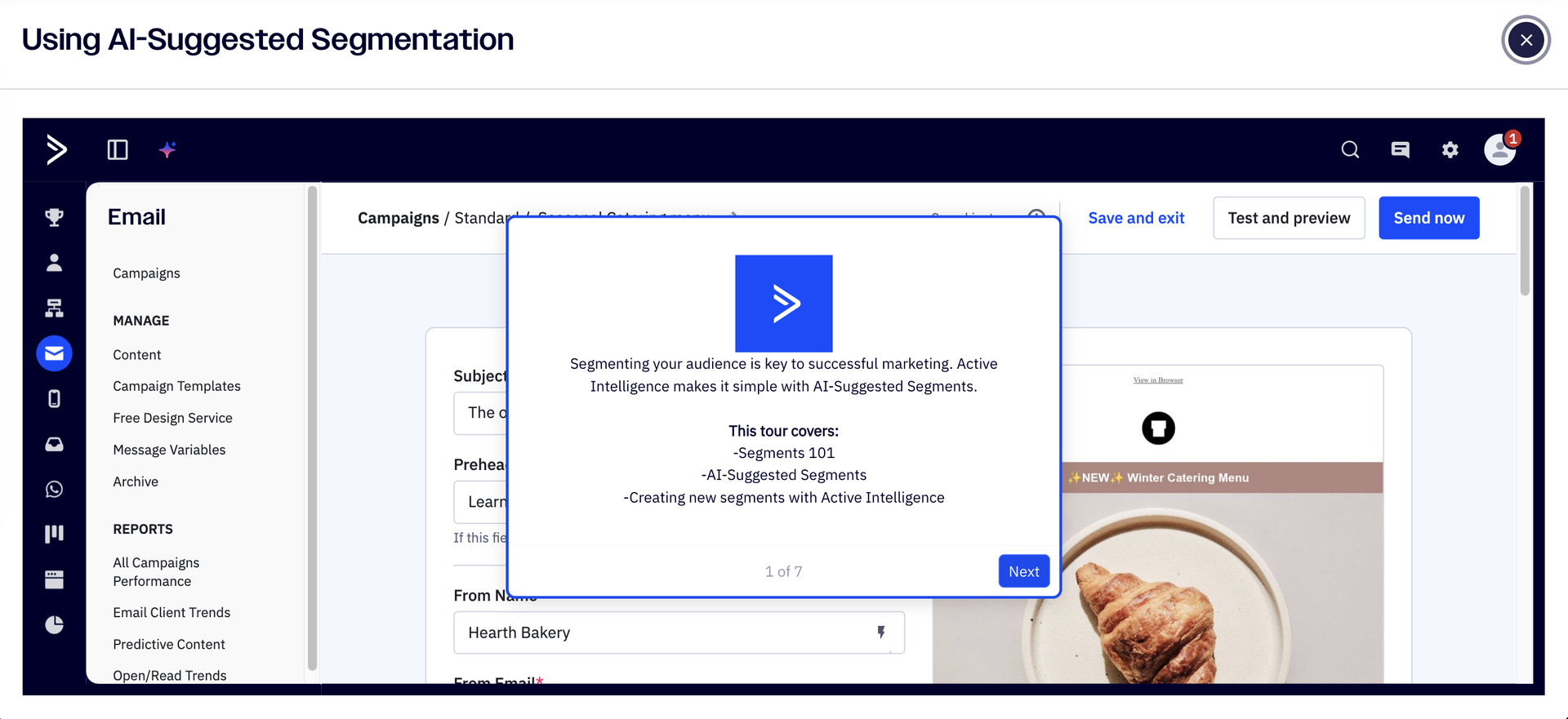
ActiveCampaign’s AI marketing analytics tools can analyze multiple data sources simultaneously to surface high-value segments you wouldn't have identified manually. Active Intelligence examines your entire contact database and presents AI-Suggested Segments: audiences based on behavioral patterns that actually predict conversion.
It might highlight a cluster of contacts who opened your last three emails but never clicked through, identifying a re-engagement segment. It would signal that this audience might need different content or a stronger CTA, not another variation of the same message.
Or it could surface contacts who browse your pricing page repeatedly but haven't started a trial: a high-intent segment ready for a demo offer instead of educational content.
Experiment with AI Suggested Segmentation by clicking on the image below to take an interactive tour:
This eliminates the trial-and-error cycle of manual list building. You're not testing random segments to see what sticks, but acting on behavioral patterns the AI has already validated across your data. You can launch targeted campaigns with confidence instead of crossing your fingers and hoping the segment converts.
2. Prompt-to-campaign email creation
Building an email campaign from scratch typically involves writing copy, designing layouts, and assembling everything into a coherent message. That process can eat hours, especially when you're staring at a blank screen trying to find the right angle.
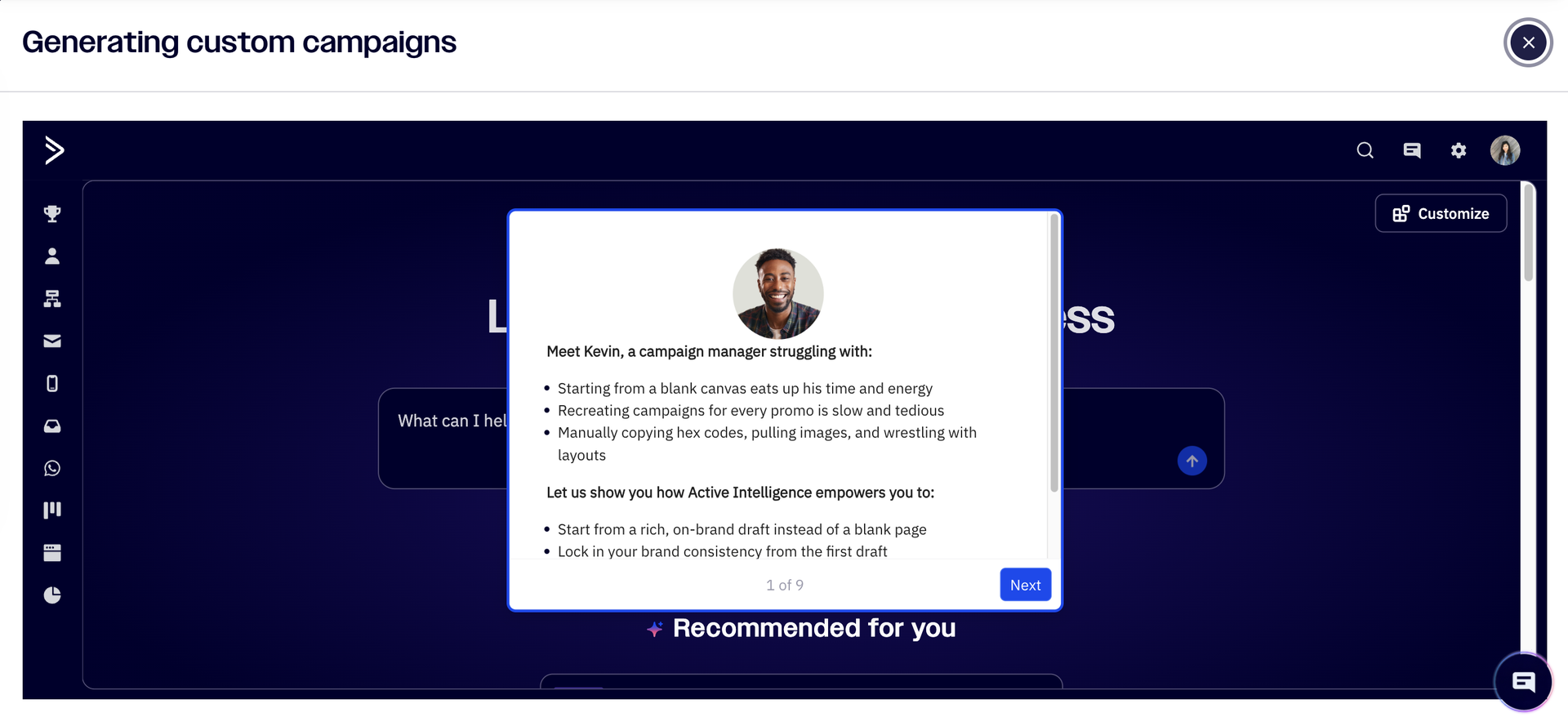
The AI Campaign Builder collapses the timeline into minutes. Instead of opening a blank template and stitching together copy and design, you can describe your goal in plain language and produce a complete campaign, including copy, subject lines, body text, CTAs, and even the automation sequence behind distribution. The AI Brand Kit lets you import brand style directly from your business URL, so layout, fonts, colors and images match your brand specifications with zero design lift.
Try out the AI Campaign Builder by clicking the image below to take an interactive tour:
A marketer could ask Active Intelligence to "Launch a re-engagement campaign for customers who haven't purchased in 60 days." Within seconds, they’d receive a strategic campaign. For example, a fully structured email with personalized copy that acknowledges the customer’s absence, references their last purchase, and includes a compelling discount offer to bring them back.
Once a campaign has been created, you can ask Active Intelligence to adjust tone, swap out CTAs, or test different subject line angles so that it matches your exact intent.
3. Predictive lead scoring and prioritization
The manual lead qualification process requires teams to assign scores and build static rules based on actions like form submissions or email opens. You’d usually assign points for each behavior, review leads individually in the CRM, and hope your scoring model actually correlates with conversion.
Active Intelligence evaluates dozens of behavioral signals simultaneously and assigns dynamic lead scores that update in real time as contact behavior changes. The system analyzes patterns across your entire database to identify which signals actually predict conversion, then applies those learnings automatically.
Scores adjust the moment new information arrives. A contact visits your pricing page, and their score jumps immediately. Someone from their team attends your webinar, and the score updates within seconds. Real-time responsiveness means you catch leads at their moment of highest interest instead of discovering it days later in a weekly report.
The ActiveCampaign CRM is fully integrated with AI marketing automations as well, so predictive lead scoring can auto-route leads above a certain threshold directly to sales via CRM task assignment. The system will create a task and assign it to the right rep, including context about which behaviors triggered the high score.
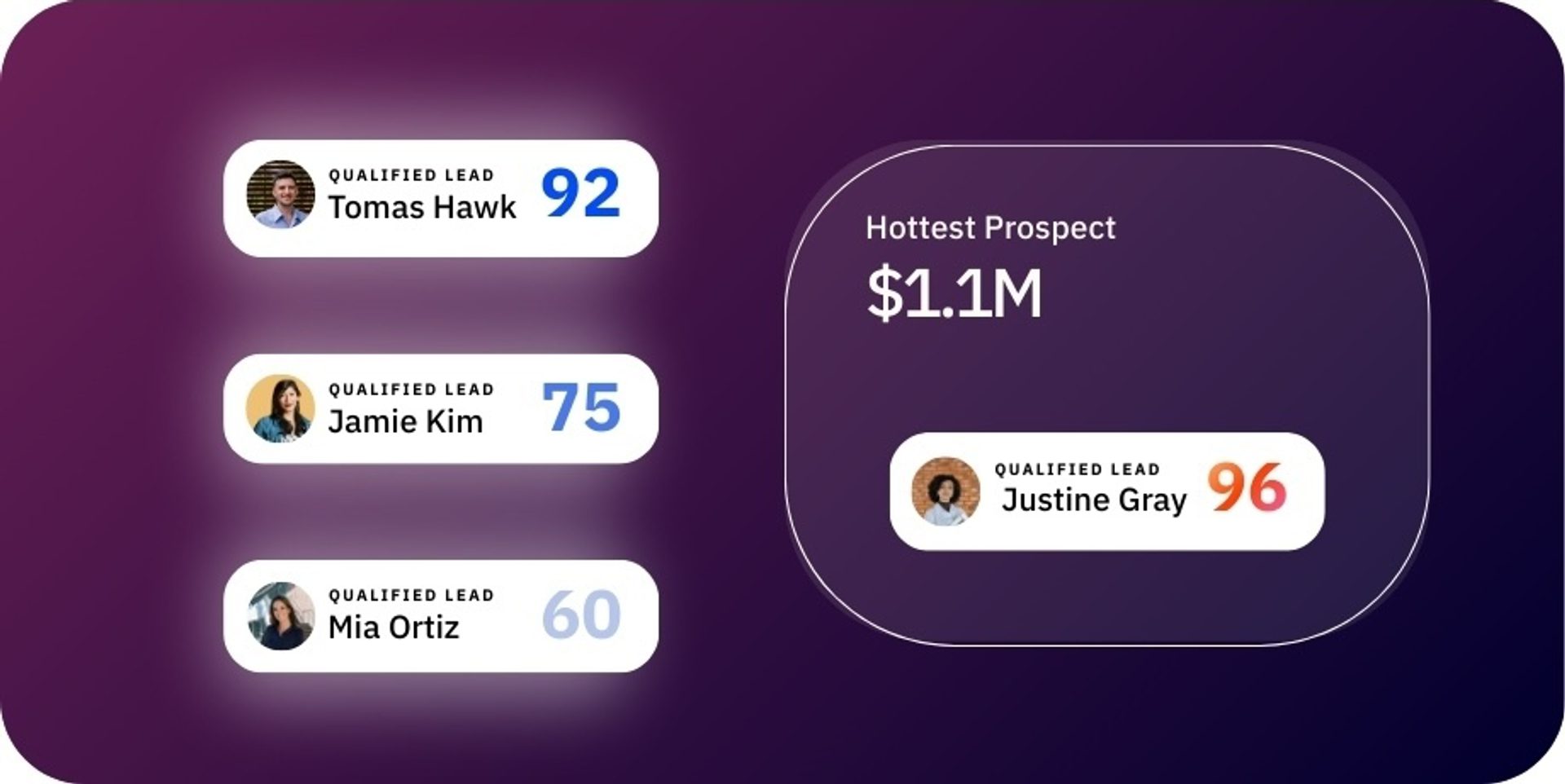
The lag of manual review cycles disappears completely, with the AI workflow creating a clean handoff between marketing and sales. AI looks at behavioral trends, not just surface-level data, giving you a much clearer picture of who's sales-ready, so reps engage the right leads at the right time and everyone works from the same source of truth about lead quality.
4. Adaptive lead nurturing sequences
Static drip campaigns send the same content in the same order regardless of how a contact engages. Email one goes out on day one, email two on day three, email three on day seven. The sequence marches forward whether the contact clicked every link or ignored every message.
AI marketing automations can write logic that adapts intelligently to individual behavior, and serve highly personalized sequences at scale. AI-powered nurturing adjusts based on what each contact has (or hasn't) engaged with. The sequence becomes a responsive journey that adapts to individual buying signals instead of following a predetermined script.
- A lead who clicks a pricing page might skip the educational sequence and move to a bottom-of-funnel demo offer automatically.
- A lead who ignores the first two emails could receive a different subject line angle at an adjusted send time.
- A lead who downloads three case studies in one sitting could be routed to a comparison guide instead of the standard product overview.
These responsive journeys adapt to individual buying signals. Active Intelligence can take care of the hard work to tailor responses, generating a complete automation with triggers, actions, and suggested messaging. And you can review and edit everything before activation, to ensure accuracy and relevance.
Create a nurture flow by clicking the image below to take an interactive tour:
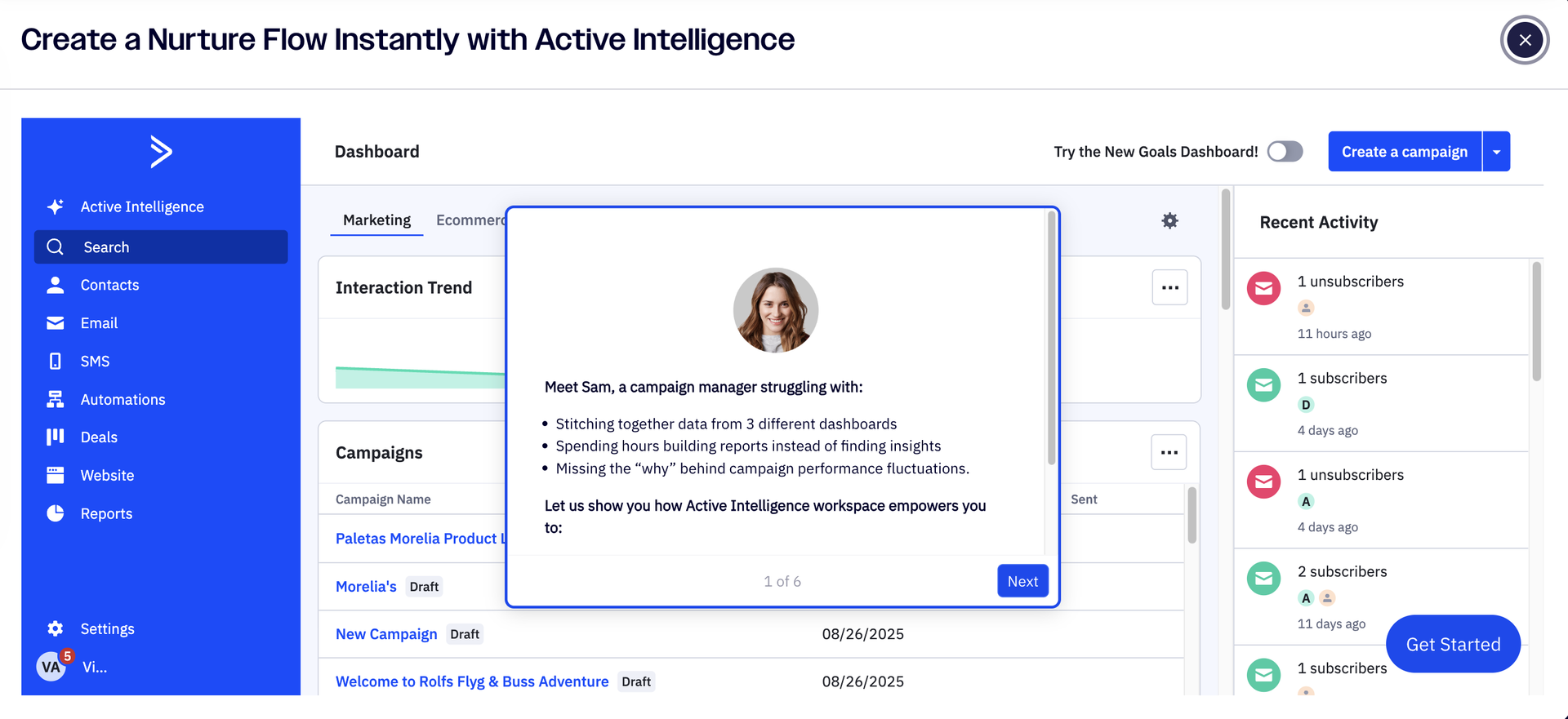
This workflow compounds with predictive scoring. As the nurture adapts, the lead's score adjusts in parallel. When behavioral signals indicate readiness, the system can escalate a contact from nurture to sales without waiting for a human to check in.
5. Predictive send-time optimization
Guessing the best send time often means defaulting to industry benchmarks like "Tuesday at 10 AM" or running rigorous A/B tests to find a list-level average. Many teams are forced to optimize for the majority.
ActiveCampaign’s Predictive Sending is able to identify engagement windows on an individual basis. AI analyzes each contact's historical open patterns to deliver emails at their most likely engagement window, improving click-through rates by up to 17%. Unlike most platforms that offer list-level optimization, ActiveCampaign personalizes delivery timing down to the contact.
One contact might consistently open emails at 7:15 AM before work. Another may engage at 9 PM after the kids are in bed. A third could be checking email during lunch at 12:30 PM. Active Intelligence is able to capture that data, and automatically send each customer emails at their optimal time, so every contact receives the message when they're most likely to see it.
Experiment with Predictive Sending by clicking the image below to take an interactive tour:
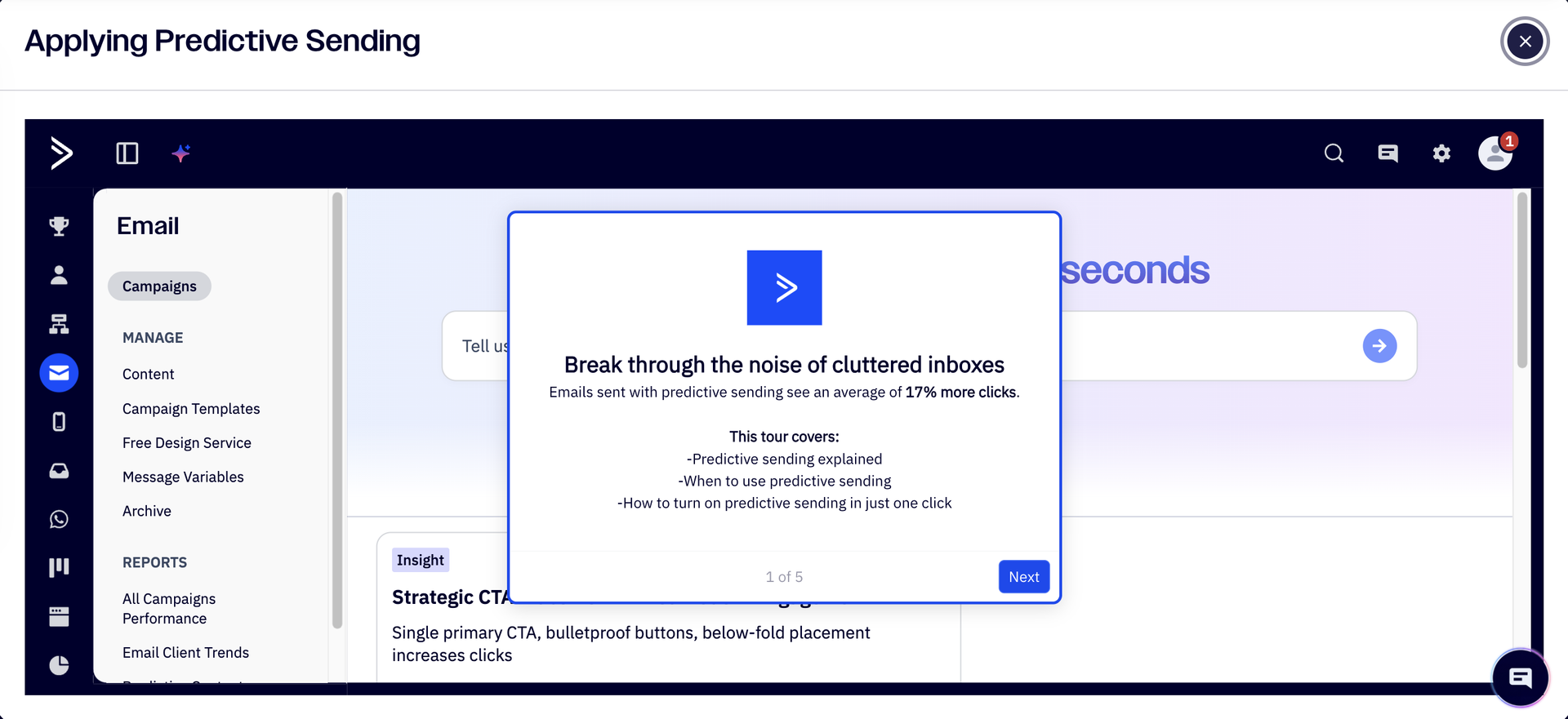
This applies to both automated workflow emails and one-off broadcast campaigns. You don't need to segment your list by timezone or manually schedule sends for different groups. Enable it once, and every send benefits from contact-level timing intelligence that improves with regular use.
6. AI-powered content personalization and translation
Personalization is the secret to campaigns that actually convert. It grabs attention much more effectively than generic emails. But truly tailoring campaigns to individual behaviors and preferences is painstaking work. Every new segment means creating another version, managing more templates, and constantly checking you haven’t left anyone out. At scale, the possibilities can quickly become overwhelming, even for the most organized marketing team.
Active Intelligence works much harder than a first name merge tag. The personalization engine automatically tailors content—headlines, product recommendations, CTAs, and whole content blocks—to individual contacts based on very granular behavior and profile data. Build one campaign, and the engine can personalize it for each recipient automatically.
AI can adjust product recommendations based on complex preferences and behaviors, including browsing history, where the contact is in the buyer journey, and industry, role, or other demographics.
A first-time visitor might see an introductory offer. A repeat buyer receives a loyalty reward. A browsing-but-not-buying contact is offered social proof and reviews. All within the same campaign structure.
See how deep personalization can get by clicking the image below to take an interactive tour:
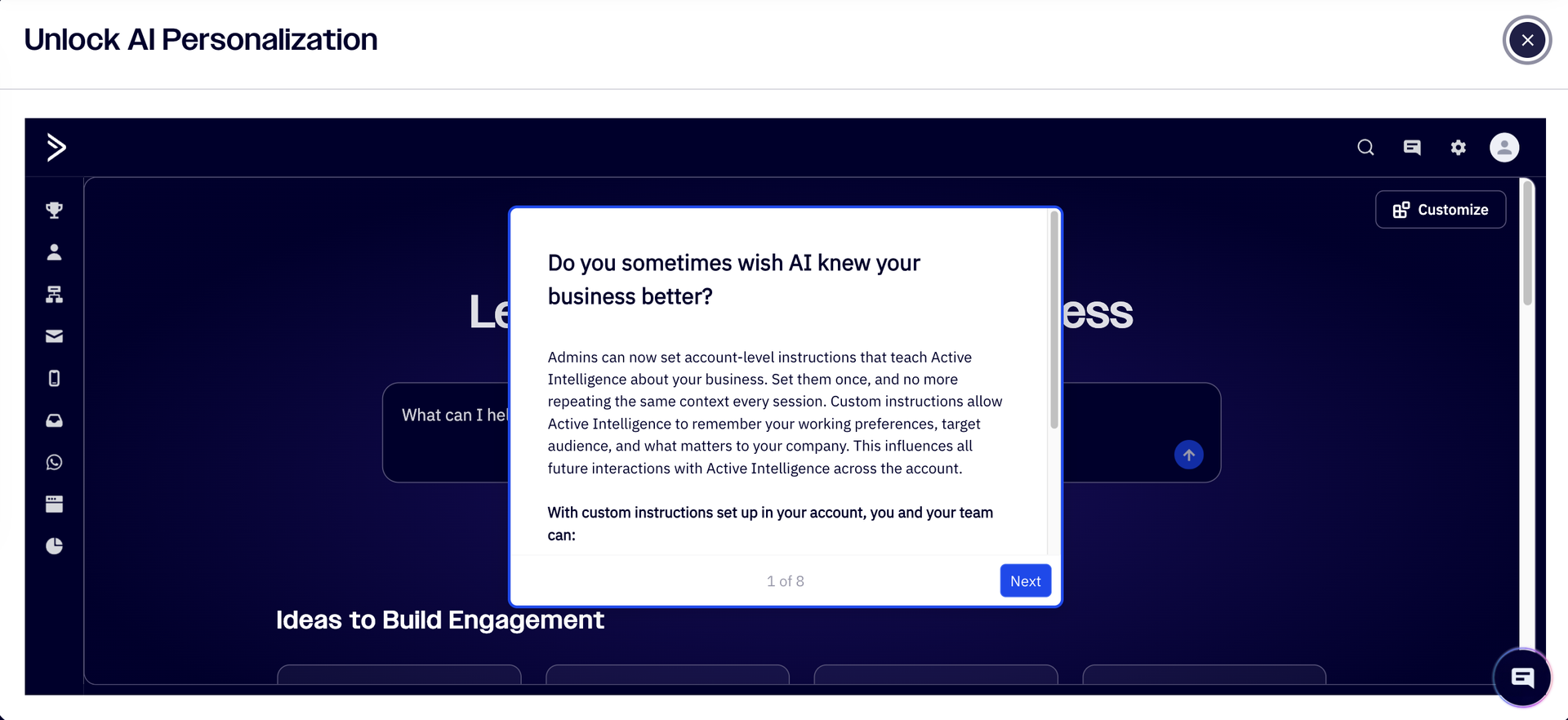
For global or multilingual audiences, campaigns can be localized too. Messaging is quickly adapted for different markets, and AI Translations detect each contact's preferred language field to automatically translate email content into 75+ languages. Separate campaign builds are not required and brand voice is preserved throughout the process.
Global brands can send just one campaign that automatically renders in different languages, with region-specific product recommendations and localized CTAs. Instead of building and translating 12 separate emails, the team launches once. AI handles the rest.
7. Cross-channel workflow orchestration
When email, SMS, and CRM live in separate silos, each channel operates blind to what the others are doing. Contacts might receive redundant messages or fall through the cracks when they don't respond on one channel.
Active Intelligence builds coordinated automation workflows across messaging channels. It chooses the right channel for each goal based on how contacts engage, orchestrating multiple touchpoints as part of one cohesive strategy. For example:
- A contact who consistently ignores emails but opens SMS receives the next nurture touch via text.
- An email-engaged contact stays in the inbox channel.
- A high-value lead who books a demo triggers a CRM task for the sales rep and pauses marketing automation to prevent overwhelm when they are already invested.
All scenarios run within one automation, not separate workflows. The AI recognizes behavioral patterns and adapts the next touch to offer the best opportunity for engagement and conversion.
AI marketing automations help channels work together instead of competing for attention, with messaging, timing, and targeting automatically adjusted across email, SMS, and WhatsApp. 1000+ integrations also allow AI to pull context from ecommerce, support, and ad platforms to inform channel and timing decisions. The system knows if a contact just made a purchase, opened a support ticket, or clicked an ad before deciding which message to send next.
8. Automated performance insights and next-best-action recommendations
Many marketers now use automation for data analysis and reporting. Yet most of that "automation" is just data collection. Someone still has to interpret the numbers and decide what to change.
Active Intelligence’s Autonomous Insights proactively surface findings, such as which campaigns underperform, which segments are most engaged, where leads drop off in a sequence. It also goes beyond “what happened?” to answer “what next?” The system doesn't wait for you to pull a report, but identifies patterns and pushes optimization recommendations to you.
Experiment with Autonomous Insights by clicking the image below to take an interactive tour:
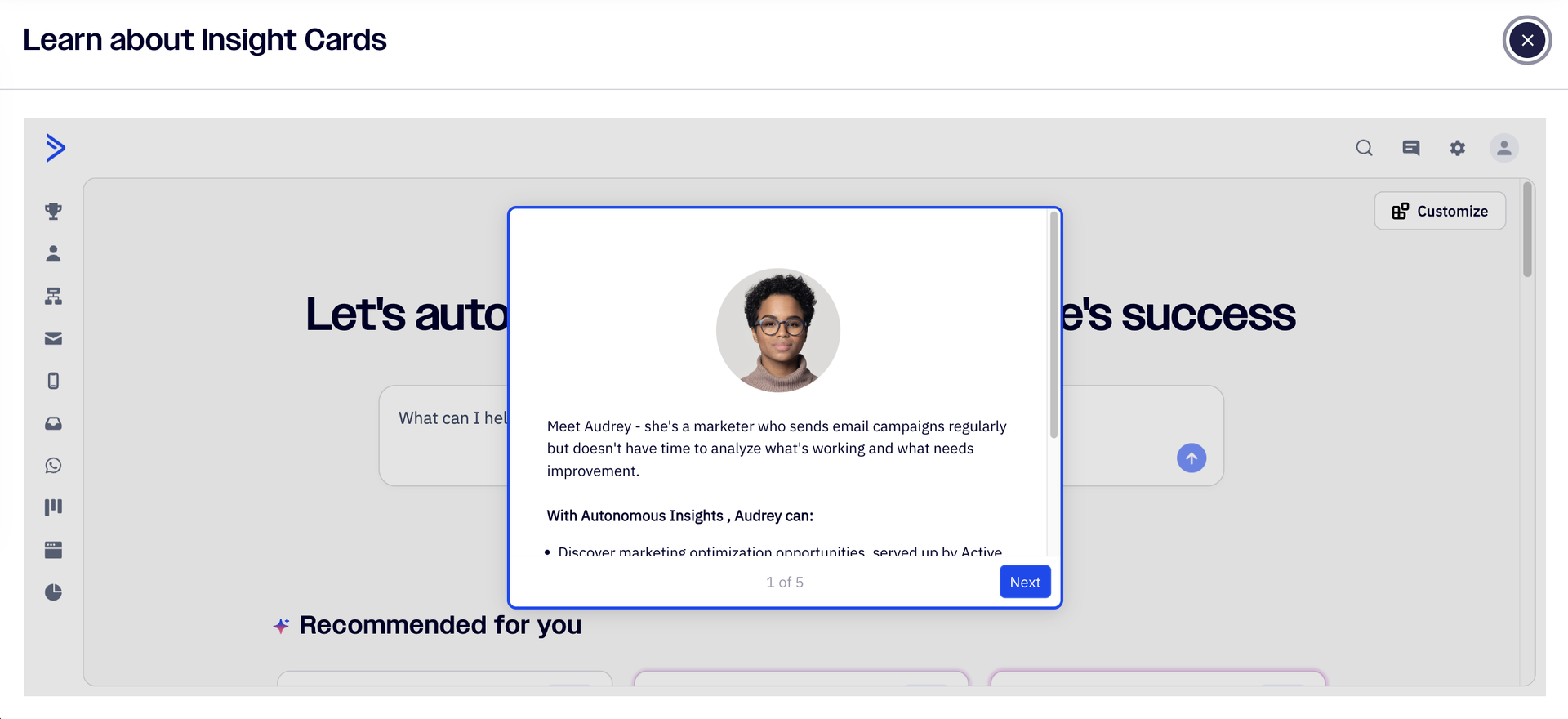
You can ask questions in natural language. Type "Which email had the highest click rate this month?" into the console and receive an instant summary with visualizations and recommendations. No need to create exports, pivot tables, or formulas.
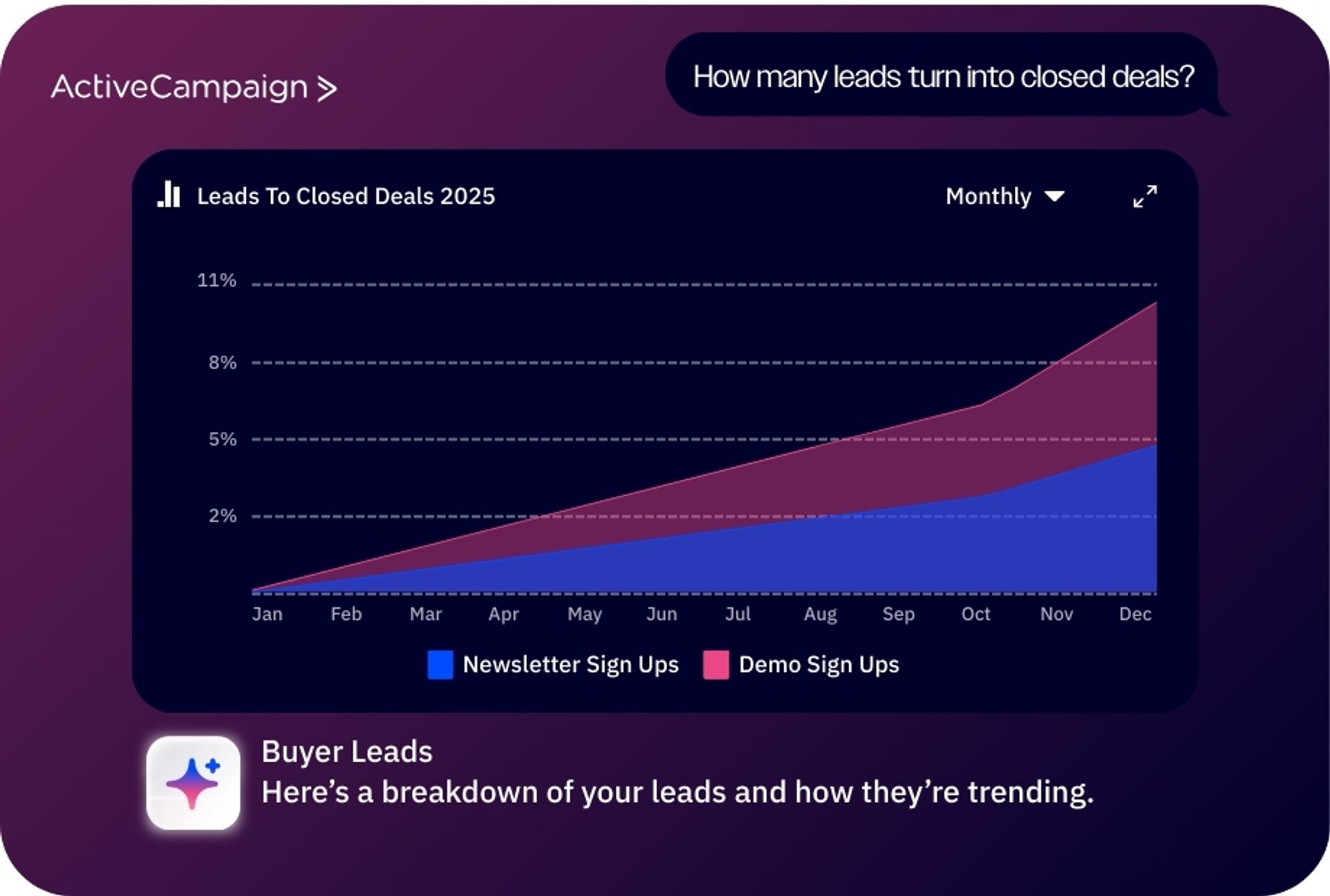
For example, after a product launch sequence, Autonomous Insights might highlight that the second email had a 40% engagement drop-off compared to the first. It would instantly recommend changes like testing a different subject line or adjusting send timing based on similar sequences that performed better. Once you accept the suggestion, it is rolled out to the workflow automatically.
AI Agents are aware of intentions for a campaign too. Define specific Business Goals and they will be factored into cross-channel execution decisions. The system connects performance data to your stated objectives, so recommendations align with what you're actually trying to achieve instead of generic best practices.
How to set your AI marketing automations up for success
ActiveCampaign makes fully native AI marketing automation accessible today. These workflows are buildable now, not aspirational concepts you'll implement someday. We’ve broken these eight examples into individual ideas for simplicity—but in practice, Active Intelligence connects them into a single system that learns and adapts in sync.
Effective AI automations depend on two foundations: clean customer data for the AI to learn from and clear guardrails to keep campaigns relevant and human. ActiveCampaign processes billions of customer interactions every week to give Active Intelligence insight into what actually works.
Here’s a data-readiness checklist that will help you set your foundational inputs up for AI success:
| Data area | To do | How ActiveCampaign helps |
|---|---|---|
| Core contact fields | Ensure every contact record includes name, email, location, language preference, and company (for B2B). Standardize formats across all records. | Custom fields and contact records make it easy to capture, store, and standardize this data for personalization and segmentation. |
| Tagging strategy | Create a consistent tagging system for interests, product categories, behaviors, and lifecycle stages. Apply tags systematically across campaigns and automations. | Tags can be automatically applied via automations, forms, and integrations, enabling AI to identify patterns and suggest segments. |
| Event tracking | Track key actions like purchases, page visits, form submissions, email clicks, and cart abandonment. Prioritize high-intent behaviors. | Site tracking, event tracking, and deep data integrations capture real-time behavioral signals directly inside the platform. |
| Integration data flow | Connect ecommerce, CRM, support, and ad platforms so behavioral data flows into one place. Avoid siloed data sources. | 1,000+ integrations unify customer data, giving AI full context across channels for better predictions and recommendations. |
| Data hygiene | Regularly deduplicate contacts, remove inactive users, and standardize field values. Schedule ongoing data clean-up processes. | Pre-built automation recipes can tag inactive contacts, trigger list cleanups, and maintain consistent data quality over time. |
| Consent and compliance | Confirm GDPR, CAN-SPAM, and CCPA compliance. Store consent records and ensure opt-ins are properly captured before sending campaigns. | Consent fields, subscription management, and verification tools ensure outreach stays compliant. |
Even with clean data and powerful automations, some moments still call for a human touch—and ActiveCampaign makes it easy for your team to step in exactly where it matters:
- Final messaging approval: Review and refine AI-generated campaigns before they go live.
- Brand voice checks: Make sure every message sounds like you, not just “AI.”
- Offer guardrails: Set the right discounts and promotions with real business context.
- Compliance sign-off: Stay confident your campaigns meet regulatory requirements.
Active Intelligence does the heavy lifting, with your team steering when it counts.
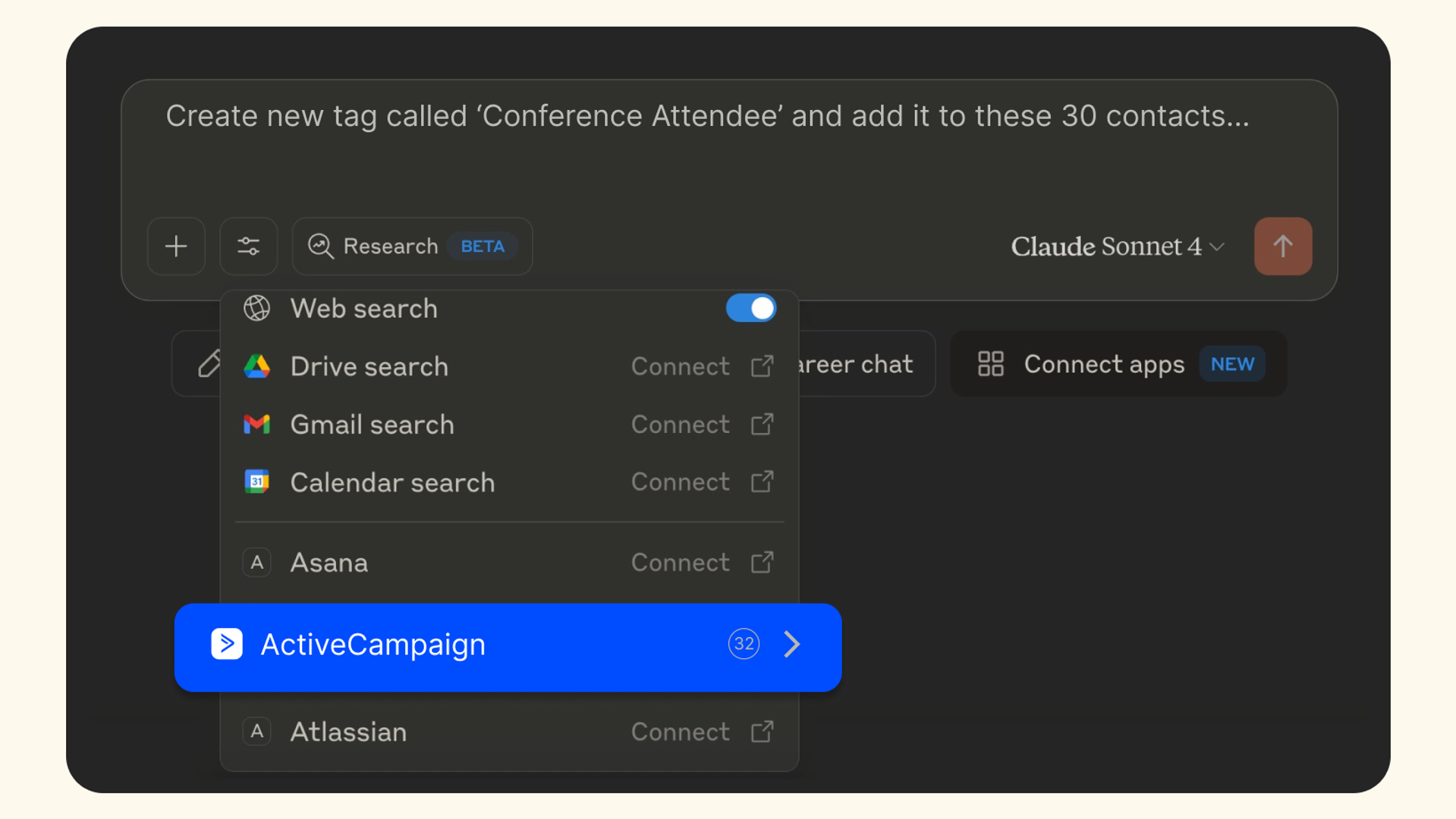
If your team is working closely with another AI tool like Claude or ChatGPT, you can even use the AI connector to chat with your favorite chatbot directly about your marketing campaigns. Different teams can check campaign stats, update contacts, and trigger automations without switching onto the marketing platform.
ActiveCampaign’s AI-native platform is constantly learning. Every campaign, click, and customer interaction feeds back into the system, sharpening its recommendations and improving results over time. That means:
- Less manual work: Teams save an average of 10 hours per week on campaign creation, segmentation, and reporting.
- Personalization at scale: AI handles per-contact content, timing, and language—no extra headcount required.
- Continuous optimization: Every send gets smarter, so performance keeps improving.
Your team moves from managing tasks to directing outcomes, and with the hours freed from manual campaign building, there is more time for experimentation and optimizing for campaigns that truly resonate.
Sign up for a free 14-day trial and start building AI marketing automations that think ahead.
FAQs
How does AI marketing automation differ from traditional marketing automation?
Traditional marketing automation executes pre-built workflows based on static triggers you configure manually. AI marketing automation analyzes behavioral patterns and adjusts campaigns in real time. It optimizes decisions based on what’s actually working across your database. The difference is between a system that follows instructions and one that learns and improves autonomously.
What’s the difference between AI-assisted, AI-augmented, and AI-native marketing?
AI-assisted marketing uses generative AI for individual tasks like writing copy or suggesting send times. You’re faster, but you still build and manage campaigns manually.
AI-augmented marketing means AI actively participates in decisions, like lead scoring or predictive send time optimization. This can yield measurably better campaign performance, but the campaign architecture is still largely human-designed and human-maintained.
AI-native marketing embeds AI into the core platform architecture. The marketer describes an outcome and the AI builds the full path to get there, while course-correcting along the way. It handles strategy, execution, and optimization as a continuous cycle with minimal human intervention.
Can I use ActiveCampaign’s AI features on my current plan?
Active Intelligence is available to ActiveCampaign customers across all plan tiers, with some usage limits on lower-level plans. The most advanced features, like contact-level Predictive Sending are limited to higher tiers, while the AI Brand Kit, Suggested Segments, and Suggested Actions are available to all. Check your specific plan details or contact ActiveCampaign to confirm which AI features are included in your subscription.
How do I ensure my AI marketing automations remain compliant with data privacy regulations?
To ensure your AI marketing automations remain compliant, confirm that you have documented consent for all contacts before activating automated outreach. Use ActiveCampaign’s built-in compliance tools to manage GDPR, CAN-SPAM, and CCPA requirements and regularly audit your data sources to ensure third-party data meets privacy standards.
Review AI-generated content for compliant language before sending, especially in regulated industries, and maintain clear records of how you’re using AI to process customer information.
Does AI marketing automation work for small teams or solo marketers?
Yes. AI marketing automation is especially valuable for small teams because it eliminates repetitive tasks that would otherwise require additional headcount. ActiveCampaign’s AI features are available across subscription plans, unlike many tools with gated AI features, and designed to be accessible without requiring technical expertise. You can implement sophisticated automations without a dedicated marketing ops team, and even use AI marketing automation as a team of one.
Does HubSpot offer predictive lead scoring?
HubSpot has predictive scoring capabilities, but they’re gated behind Enterprise-level pricing. For most businesses evaluating lead scoring tools, that puts it out of reach. The broader platform’s complexity can also make setup more involved than it needs to be.
ActiveCampaign’s scoring works across contacts and deals, updating in real time based on email engagement, site behavior, and custom events. Scores feed directly into automations that route leads to sales, trigger nurture sequences, or flag at-risk accounts.