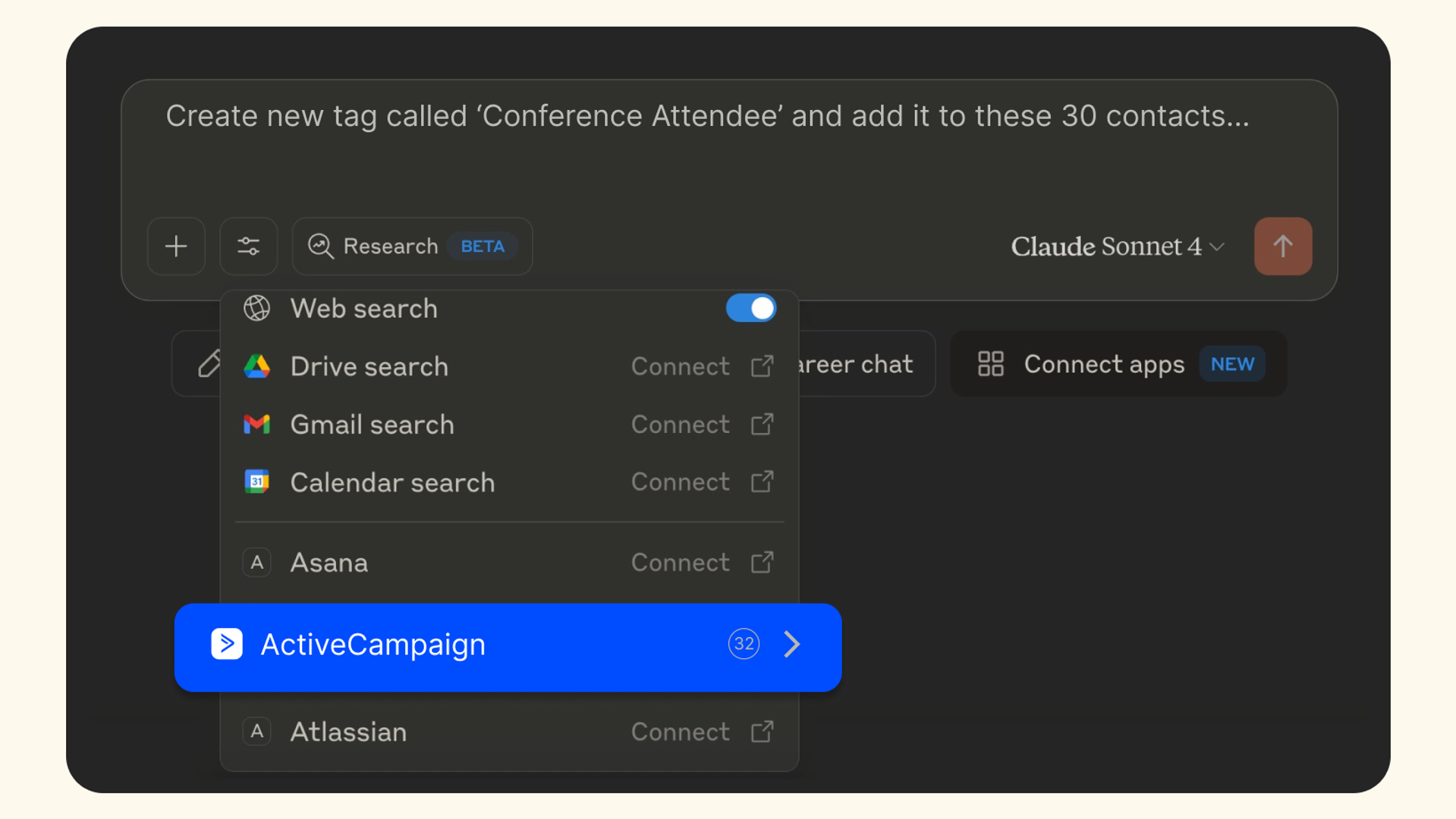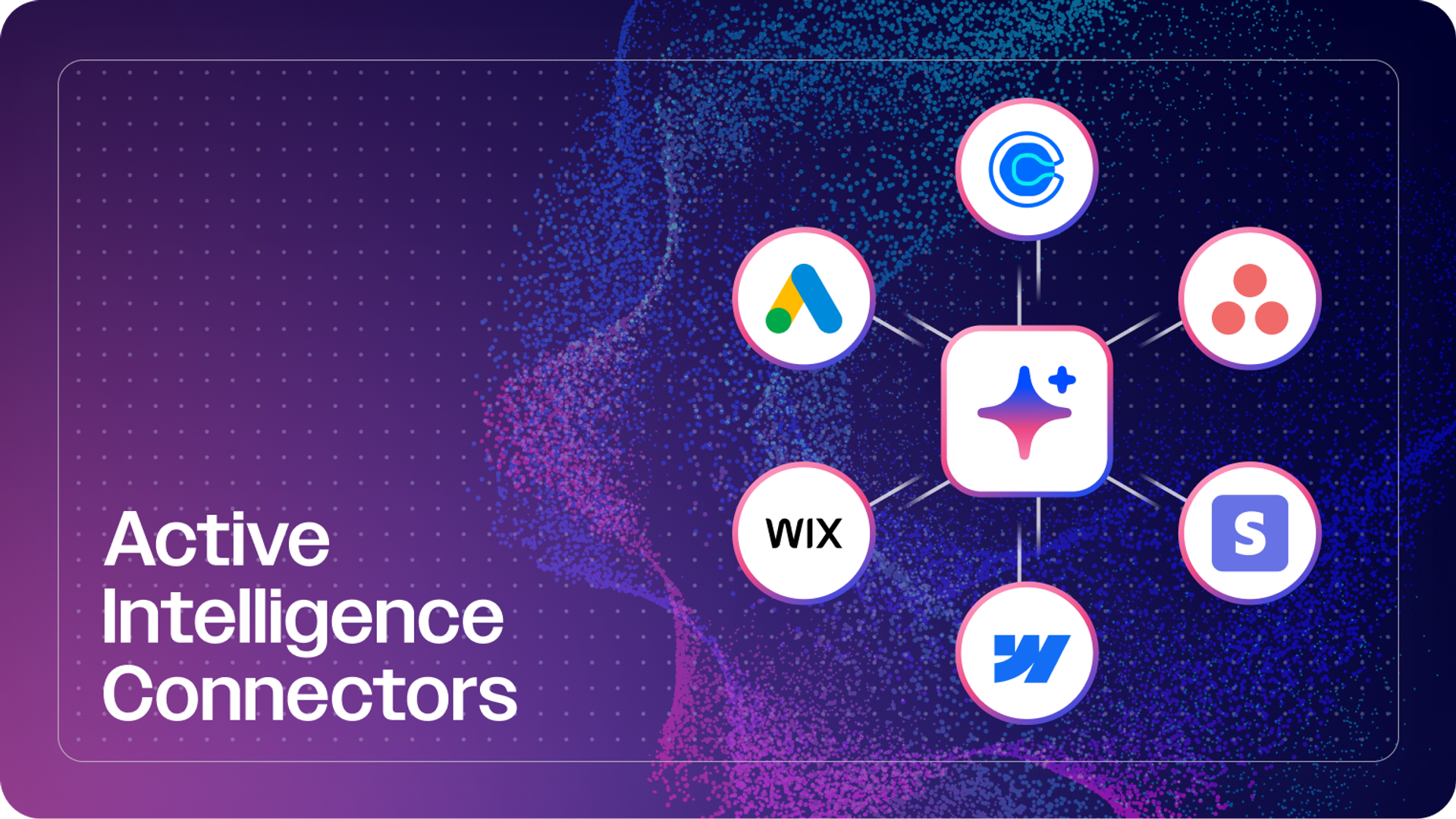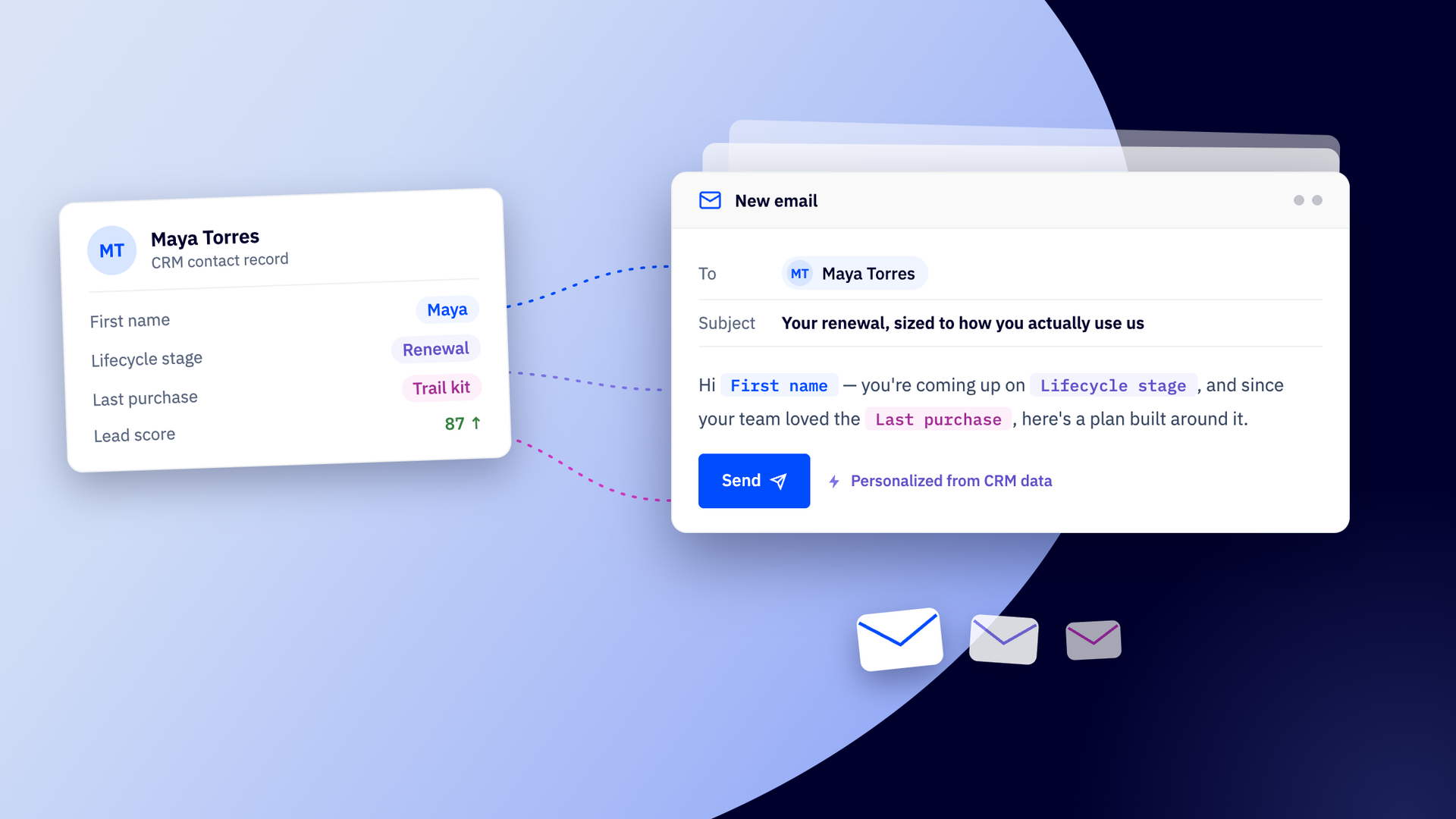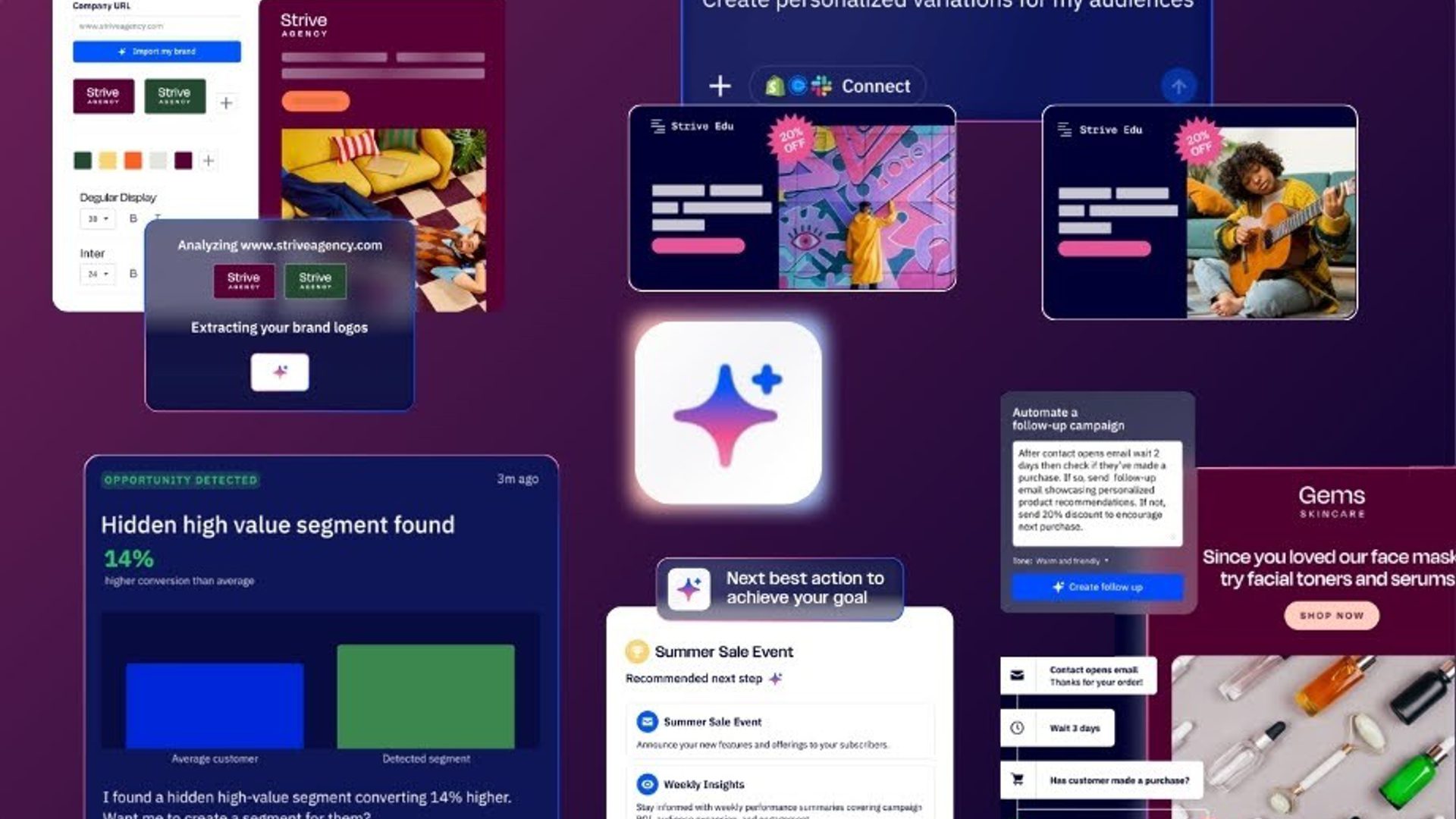
Generative AI promised to make marketing teams faster. More efficient. And for many, it delivered—at the task level. A subject line here, a generated image there. But the campaign is still built by hand, and the speed gains never make it past the individual assignment.
Local speed, it turns out, doesn't always show up in business results. If AI never touches the strategy, the audience logic, or the optimization cycle, there's nothing to connect back to pipeline or revenue. So while AI adoption is high (upwards of 80%), ROI remains, unsurprisingly, murky.
AI-native marketing owns the full cycle. In this model, agentic technology shapes strategy, executes across channels, and improves based on results, so you can improve outcomes without scaling headcount.
This article breaks down what AI-native marketing means, where the AI-assisted approach stops working, and how ActiveCampaign has rebuilt its platform to help you go from faster tasks to fully autonomous campaigns.
What is AI-native marketing?
AI-native marketing is a model where artificial intelligence is built into the core of your marketing operations. "Native" is the operative word here, and what separates this way of doing marketing from everything that came before.
AI-native marketing draws on two types of AI working together. Generative AI creates—writing copy, building emails, and suggesting segments. Agentic AI acts. It makes decisions, triggers workflows, and optimizes campaigns without waiting for a human to step in. AI-native marketing needs both to cover the full cycle, from strategy, creation, delivery, analytics, and optimization.
In this model, you describe a goal to an AI agent (or a series of agents), and it builds the campaign around that goal; including the automations, audience segments, and send timing. The same AI monitors what's working, surfaces optimization opportunities, and feeds those results back into the next campaign.
The best way to see this distinction is by comparing AI-native marketing against the two models it's replacing.
AI-native vs. AI-assisted vs. traditional marketing automation
The differences between the most rudimentary automation and full-fledged AI-native marketing show up in how daily work gets done. Compare and contrast:
- In traditional automation, you build everything by hand. Every trigger, email, and segment starts as a blank canvas. The platform executes what you configure, which means the quality and speed of your marketing is directly capped by the hours you can put in.
- With AI-assisted marketing, generative AI enters the picture, but only at the edges. It helps you write copy faster, maybe scores a lead. The underlying structure of the campaign, though, is still yours to figure out and build. You're faster, but the architecture hasn't changed. Agentic AI, the kind that acts and decides on its own, isn't part of the picture yet.
- When you’re AI-native, you define the goal and set the guardrails. AI takes it from there, building the campaign, selecting the audience, running and monitoring execution, and feeding results back into the next round of decisions. Your job is to strategise, direct, and approve rather than assemble.
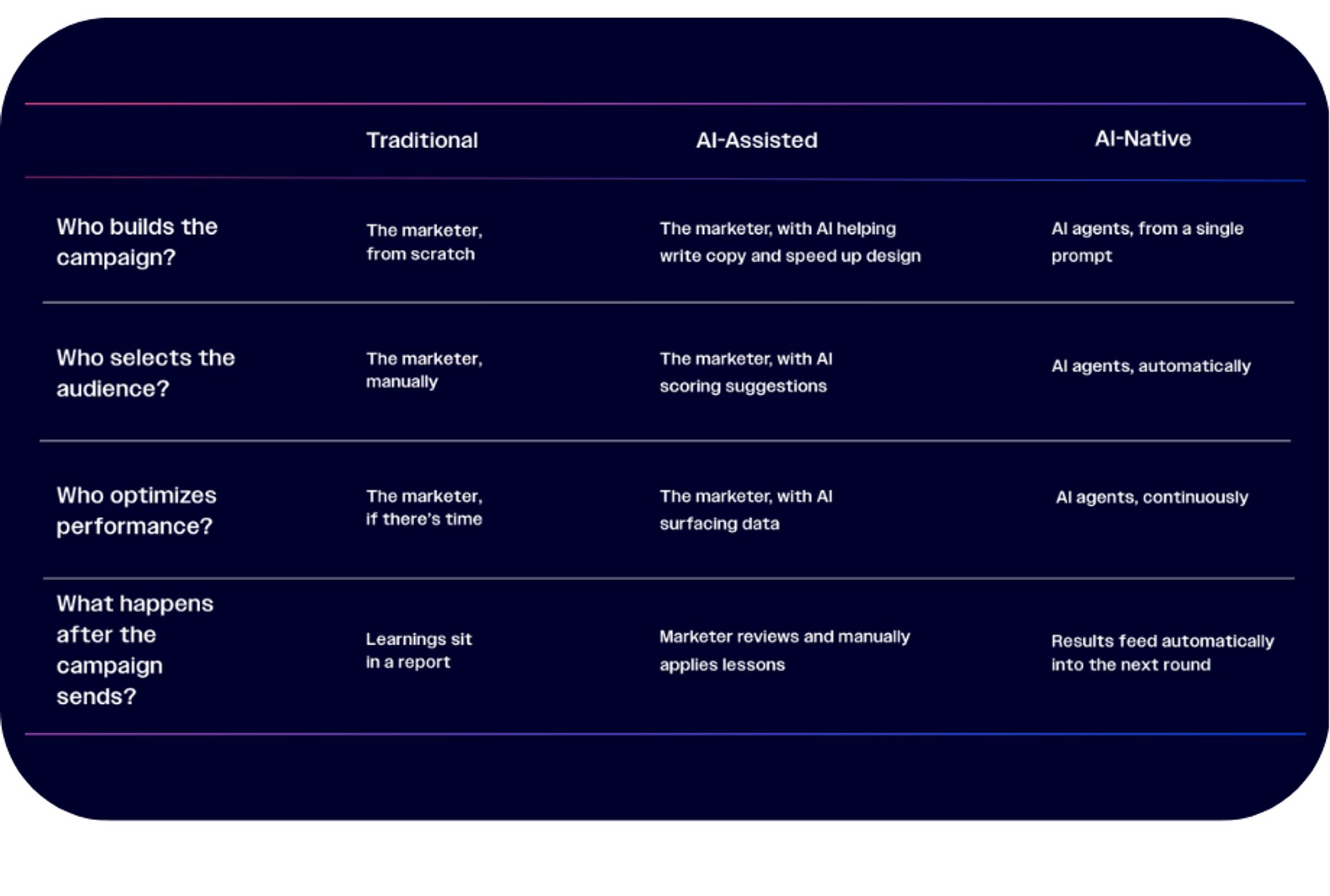
A comparison table showing Traditional, AI-Assisted, and AI-Native marketing across four dimensions: who builds the campaign, who selects the audience, who optimizes performance, and what happens after the campaign sends.
At ActiveCampaign, we map the autonomous marketing progression across five levels of AI marketing maturity:
- Level 1— The AI Beginner: AI-powered assistance speeds up individual tasks like copywriting and content generation. You're faster, but the architecture of your campaigns hasn't changed.
- Level 2— The Developing User: AI takes on more of the build work, delivering dramatic time to value and freeing your team from repetitive setup. Still AI-assisted, but the downstream impact is more significant.
- Level 3—The Intermediate: AI adds marketer-grade recommendations such as lead scoring and send-time optimization that you can act on with confidence. This is where the shift toward AI-native begins.
- Level 4—The Advanced User: AI runs full campaign cycles end-to-end, continuously optimizing based on performance data. You're operating AI-natively — setting direction while AI handles execution.
- Level 5—The Expert: A 24/7 team of AI agents works on your behalf around the clock — strategizing, executing, and optimizing without waiting for a human prompt. Fully autonomous marketing.
Still not sure where you fall on the spectrum?
Why AI-assisted marketing hits a ceiling
There's a lot to like about AI-assisted marketing. It’s dramatically decreased the amount of time spent staring at blank pages, for one. But gains of that nature have a ceiling. Everything that sits above the task level still falls to the marketer—who gets what message, when, through which channel, what the workflow looks like, and what to do when the results come in.
That works fine when the scope is small. But as your list and strategy grow, the manual work compounds in ways that AI-assisted marketing can't offset:
- Every new channel adds a new workload. SMS, WhatsApp, social. Each channel means another workflow to build and maintain, and another place for things to fall out of sync.
- Personalization hits a wall. Tailoring timing and messaging for each contact is work that scales with your list size. A team managing five audience segments won't suddenly manage fifty just because the copy comes faster.
- Optimization is always the first casualty. Running tests, reading results, and applying the learnings to the next campaign is the most important work, but it’s the first to be dropped when things get busy.
AI-assisted marketing might speed up the pieces, but the structure those pieces fit into is still yours to build every time. And that architecture just doesn’t scale.
What changes with AI-native marketing–and how ActiveCampaign is leading the charge
Going AI-native means adopting a different operating model altogether. One based on three pillars:
- AI is built in rather than bolted on.
- Data is unified across every channel.
- Humans set the direction while AI handles execution and optimization.
At ActiveCampaign, we took the pieces of our platform apart and fully rebuilt it for the AI era with these pillars as our guiding principles. Let’s break down where the results show up.
You become a director rather than a builder
If traditional and AI-assisted setups cast marketers in the role of assembler, AI-native promotes them upwards. In this new scenario, you set the goal and the guardrails—the AI handles the build.
That shift makes the work humans do more consequential, not less. AI agents execute brilliantly, but they execute toward whatever goal they're given. The strategy, the audience logic, the creative positioning: those decisions still require human judgment, and they're the ones that determine whether a well-built campaign drives ROI.
Law firm Parrish Law had no shortage of people to market to. What they lacked was fast enough feedback to know what was working, which kept their Marketing Director, Luis Fer, stuck in executor mode—pulling data manually instead of acting on it.
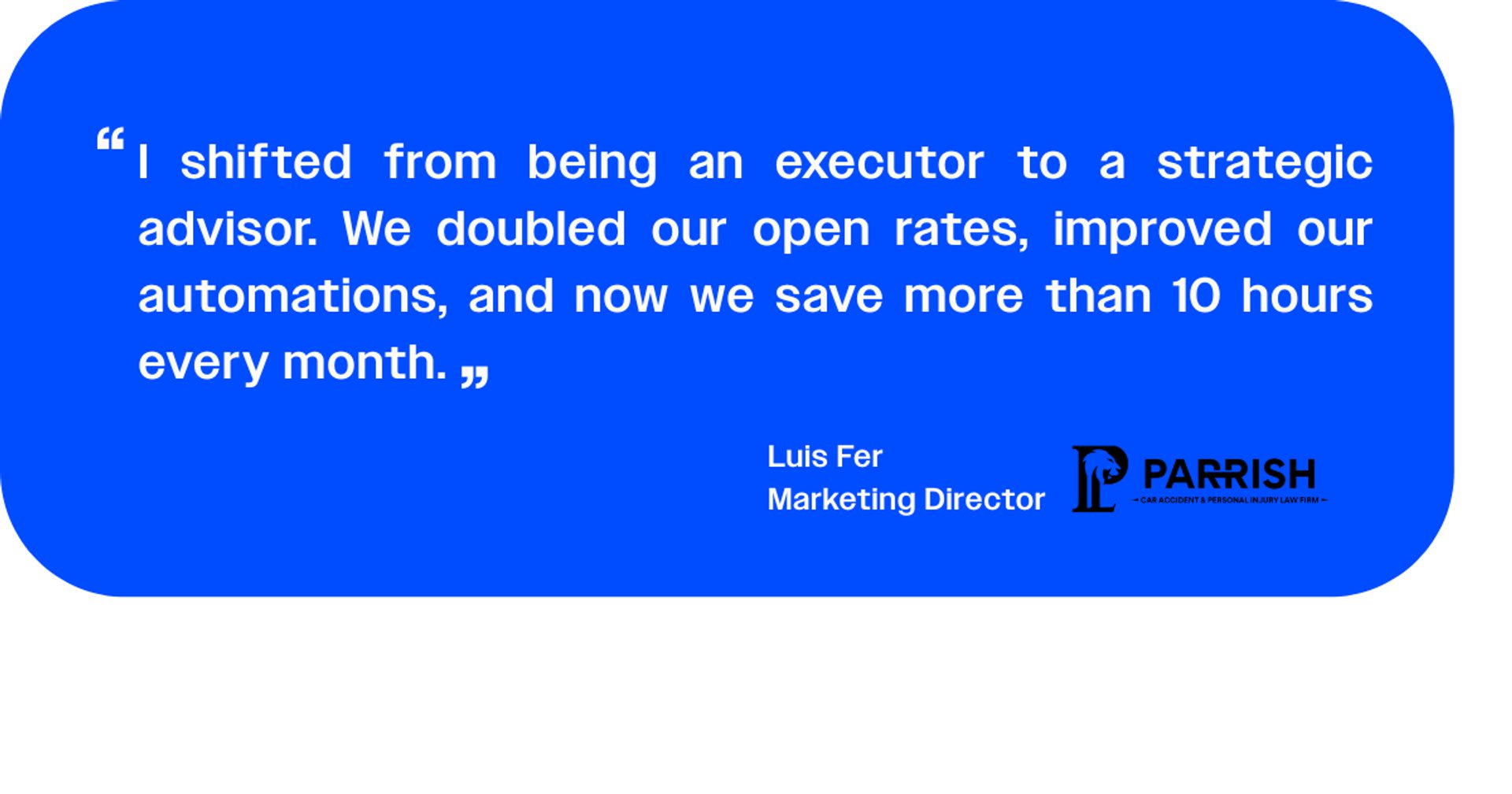
Quote from Luis Fer, Marketing Director at Parrish Law: “I shifted from being an executor to a strategic advisor. We doubled our open rates, improved our automations, and now we save more than 10 hours every month.”
After implementing ActiveCampaign, Fer could ask the platform which subject lines performed best, which campaigns drove engagement, and where audiences were responding in seconds instead of hours.
ActiveCampaign is designed so any team can work this way:
- Active Intelligence is the end-to-end operator. It brings together billions of data points and purpose-built AI agents to turn your goal into a fully realized marketing strategy.
- AI Campaign Builder can build any campaign you need, including subject lines, copy, layout, images, and CTAs. There are 14 “AI made for you” templates available in Active Intelligence, and it can pull directly from your Content Manager when building them.
- AI Brand Kit allows you to pull in your logos, fonts, and colors from a URL once and call it a day. Every AI-generated campaign stays on-brand automatically.
- Custom Instructions enable you to set your brand tone, audience, and content guardrails. The platform knows who you are from there, so you don't have to re-explain it in every prompt.
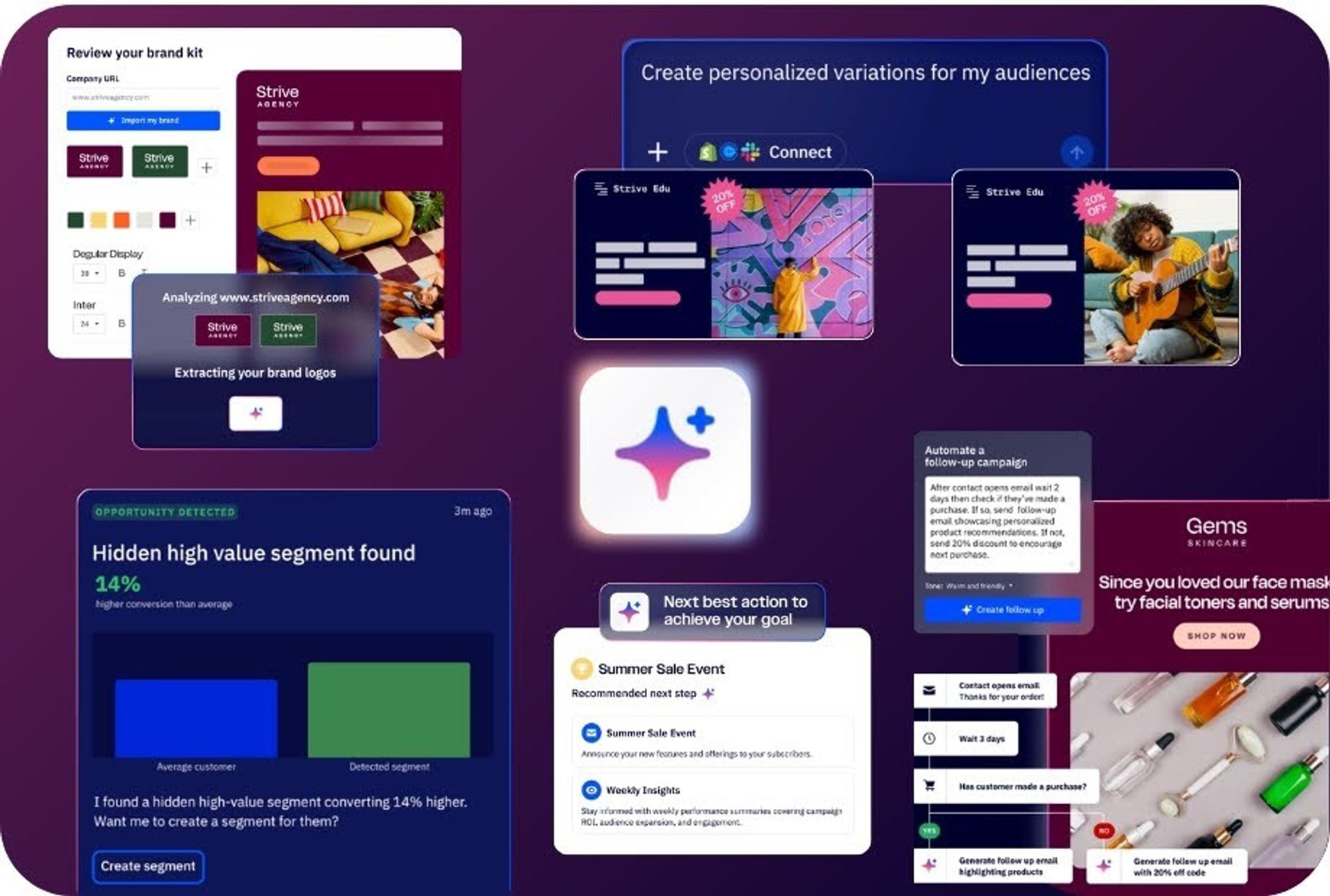
You still own the most important decisions, but everything else, AI handles.
Every decision draws from the full customer picture
An AI-native model can only be as perceptive as its data is expansive. The more complete the picture across channels, touchpoints, and customer history, the better the decisions AI can make about what to send, when, and where. Fragmented data produces fragmented intelligence.
ActiveCampaign consolidates that context through 1,000+ integrations and a built-in CRM, pulling together email engagement, ecommerce behavior, site activity, sales interactions, and support history into a single layer that AI agents draw from when building campaigns, selecting audiences, and timing messages.
Customer optimizations are down to the contact level with features like:
- Predictive Sending, which optimizes send times for each individual contact based on their own engagement patterns rather than a broad list-level average.
- AI Translations that automatically localize campaigns into 75+ languages based on each contact's preferred language field. You don’t need a separate translation workflow.
- Conditional Content that dynamically adjusts what each contact sees based on their data, even within the same send. While not an AI-generated feature, it's designed to respond to AI-powered triggers and audience signals.
- AI-suggested segmentation that reacts to granular data inputs, from behavioral to demographic, and engagement signals, to keep your audiences current without manual upkeep.
When AI has the full picture—every touchpoint, channel, and behavioral signal–it can make decisions that are genuinely individual. Not segment-level approximations, but contact-level precision.
AI finds opportunities you didn't know to look for
It's usually up to the marketer to decide what to look for, which trends to investigate, and which audiences to test.
That works when the scope is manageable, but the more contacts, channels, and data a team accumulates, the harder it becomes to spot every signal. At a certain scale, you're not missing insights because you're not paying attention, but because there are simply too many to make sense of.
AI-native systems don't wait for you to look. ActiveCampaign's AI marketing analytics, for example, surfaces patterns and opportunities before you know to go in search of them:
- AI-suggested segments reveal high-value micro-audiences you didn't build, pinpointing how to take action on customer patterns that would otherwise stay hidden.
- Insight cards proactively flag performance trends, benchmark against industry data, and recommend specific next steps. Clicking any card opens a conversation to explore deeper.
- Segment growth visualization lets you ask Active Intelligence to generate a line graph of contact segment growth over time, export it as a table, or get an API endpoint to pull data through tools like Zapier.
- Conversational reporting lets you ask plain-language questions, e.g., "Which campaigns drove the most revenue this quarter?", and get answers instantly, without pulling a report manually.
- Business Goals lets you define what success looks like, and AI agents stay goal-aware throughout, understanding what you're working toward and taking steps to move you there.
- Sentiment analysis on deal emails surfaces how prospects feel about a conversation, so your team can respond to buying signals (and early signs of disengagement) before they become problems.
As AI gets better at pattern recognition across larger datasets, your role goes from finding the insight to evaluating the insight. Having them ready-to-hand also makes it easier to report on campaign performance and defend ROI in internal reviews.
Every campaign makes the next one smarter
In traditional marketing setups, learning is manual and slow. You run a campaign, review the results in a separate report, and apply those lessons to the next send. Each campaign is essentially a standalone effort.
AI-native marketing closes that feedback loop automatically. Every campaign's results feed into the next round of decisions, which means the system compounds learnings rather than resetting.
The process is structured through our AI agent framework:
- Imagine agents shape strategy and creation, generating campaigns, suggesting segments, and mapping goals to proven tactics.
- Activate agents execute across email, SMS, and WhatsApp with real-time customer context. ActiveCampaign's platform continuously analyzes customer behavior and campaign performance to automatically adjust messaging, timing, and targeting.
- Validate agents monitor performance and surface what to change. Active Intelligence proactively analyzes campaign performance, surfacing optimization ideas before you think to look for them. AI agents across the platform are goal-aware, so once you set a Business Goal, they understand what you're working toward and factor it into their recommendations throughout the campaign cycle.
For Amy Chinitz, the solopreneur behind Spark Joy New York, this framework turned a time problem into a growth engine. Campaign creation dropped from a week to a day, she tripled her booked sales calls, and grew revenue 10x after moving from local in-person services to online coaching.
"I feel like the AI tools are my creative partners,” says Amy. “Just sitting down and clicking that button helps me go from hesitation to inspiration."
Your marketing should work as hard as you do
AI has come barreling through business at a speed few anticipated. And yet, for all that momentum, the concept of AI-native marketing can still sound out of reach. Like something reserved for enterprise teams with bigger budgets and more runway.
It isn't. It's how some teams already work, and the gap between them and everyone else is widening every quarter. Fewer than 1 in 4 marketers currently use AI for true end-to-end marketing. Meanwhile, 86% of ActiveCampaign customers say they can focus on more strategic work after implementing the platform—because the repetitive building isn't theirs to do anymore.
Going AI-native doesn't require starting over. It begins with moving from task-level AI to a platform where AI runs the full cycle.
Try ActiveCampaign free to see our AI agents in action—and find out what you'd do with more of your time back.
AI-native marketing FAQs
What’s an example of AI-native marketing in action?
An example of AI-native marketing in action would be a retail brand wanting to re-engage lapsed customers ahead of a seasonal sale. Instead of building a segment, writing a sequence, and scheduling sends manually, the marketer types the goal into their marketing platform. AI agents identify which lapsed customers are most likely to convert, generate the campaign, send each email at the time that individual contact is most likely to open it, and flag what's working before the sale even ends.
What's the difference between AI-native and AI-assisted marketing?
AI-assisted marketing uses generative AI to speed up individual tasks like writing copy or suggesting send times, while the marketer still builds every workflow and manages execution. With AI-native marketing, the marketer sets goals and guardrails, while AI agents take on creation, execution, and optimization as a continuous cycle.
How does ActiveCampaign support AI-native marketing?
Active Intelligence is the AI engine that powers ActiveCampaign's autonomous marketing platform. It analyzes billions of data points from customer interactions to run the campaign creation, distribution, and optimization process end-to-end. It provides strategic recommendations, predicts what will work best for your audience, and creates campaigns and workflows.
Can ActiveCampaign AI build my automations?
Yes, ActiveCampaign allows you to build an automated campaign from scratch in just a few clicks, or describe your goal in plain language for AI to manage the setup. Active Intelligence creates full automation flows—triggers, tasks, tags, and wait steps—based on your goal description, then optimizes them as performance data comes in.