As prevalent as AI is in most organizations, most marketers still treat it like a glorified search engine or assistant. From brainstorming to writing assistance, AI is underutilized in ways that could be keeping marketers from unlocking its true potential.
- Our research reveals 82% of marketers use AI for at least one marketing activity
- Only 23% of marketers use AI for all three marketing pillars: Imagine, Activate, and Validate
Strategic marketers don't just use AI tools; they orchestrate AI agents across what we call the High-Performance Marketing Triad. This framework transforms scattered AI experiments into systematic marketing success, delivering compound benefits that drive business goals forward.
Why most AI marketing fails to take off
The "One-Pillar Trap"
In our latest report, we found that while 82% of marketers use AI for at least one marketing pillar, 63% use AI just for ideation or the “Imagine” phase for marketing. Marketers find themselves stuck in this one-pillar trap, using AI to generate ideas and content while manually handling execution and optimization.
The end result is great campaigns that struggle to launch or campaigns that fail to systematically improve. Meanwhile, the 23% of marketers who incorporated AI across all three marketing pillars are benefiting from more strategic insights and greater time and cost savings.
Introducing the High-Performance Marketing Triad
How we developed the framework
The High-Performance Marketing Triad was born out of our analysis of 1,000 US marketing professionals, where we noticed the high-performers, dubbed Power Users, using AI differently. Instead of treating artificial intelligence as a task assistant, they were building what we now recognize as autonomous marketing systems.
These systems consistently demonstrated three core capabilities that make up the foundation of our marketing triad:
- Imagine
- Activate
- Validate
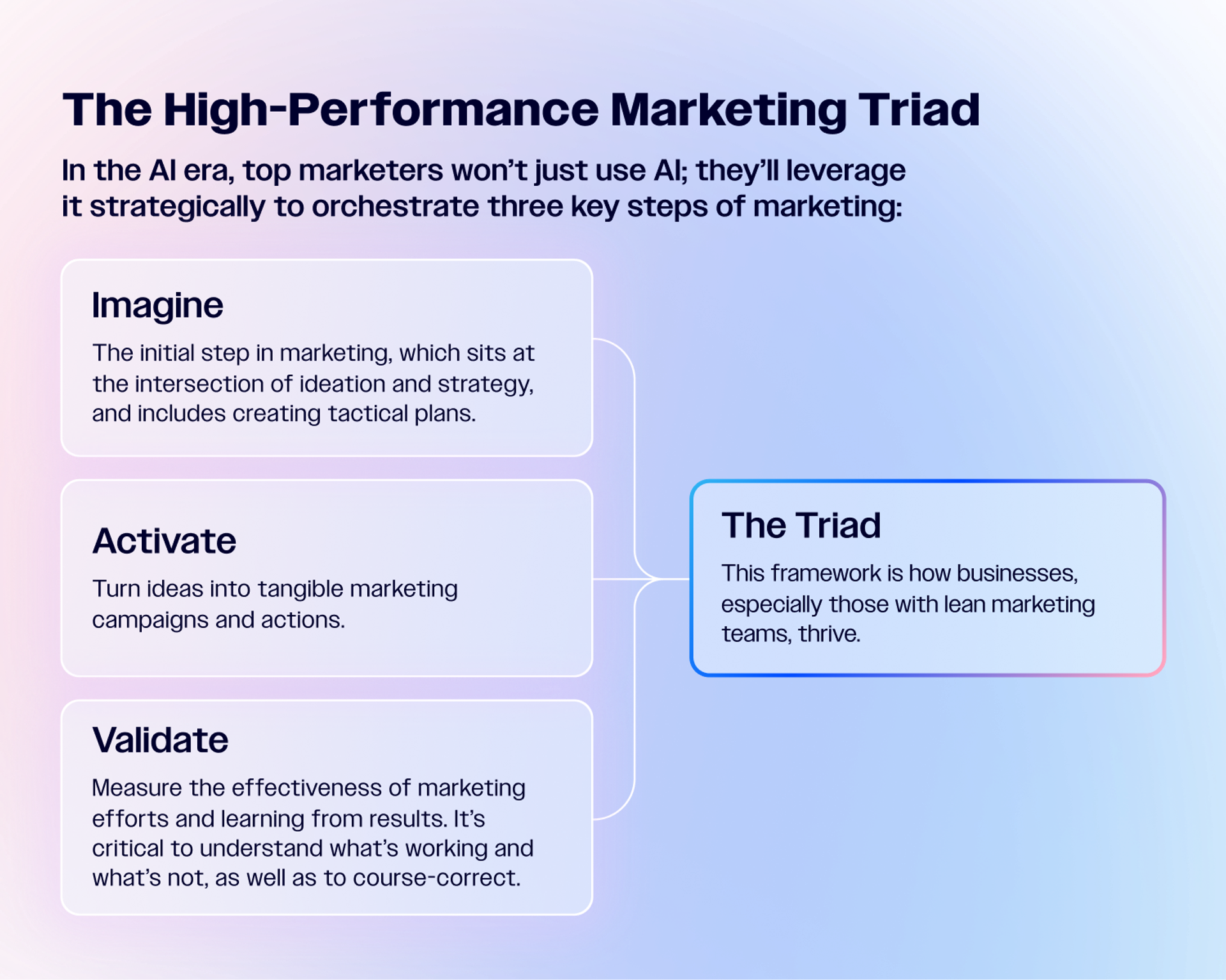
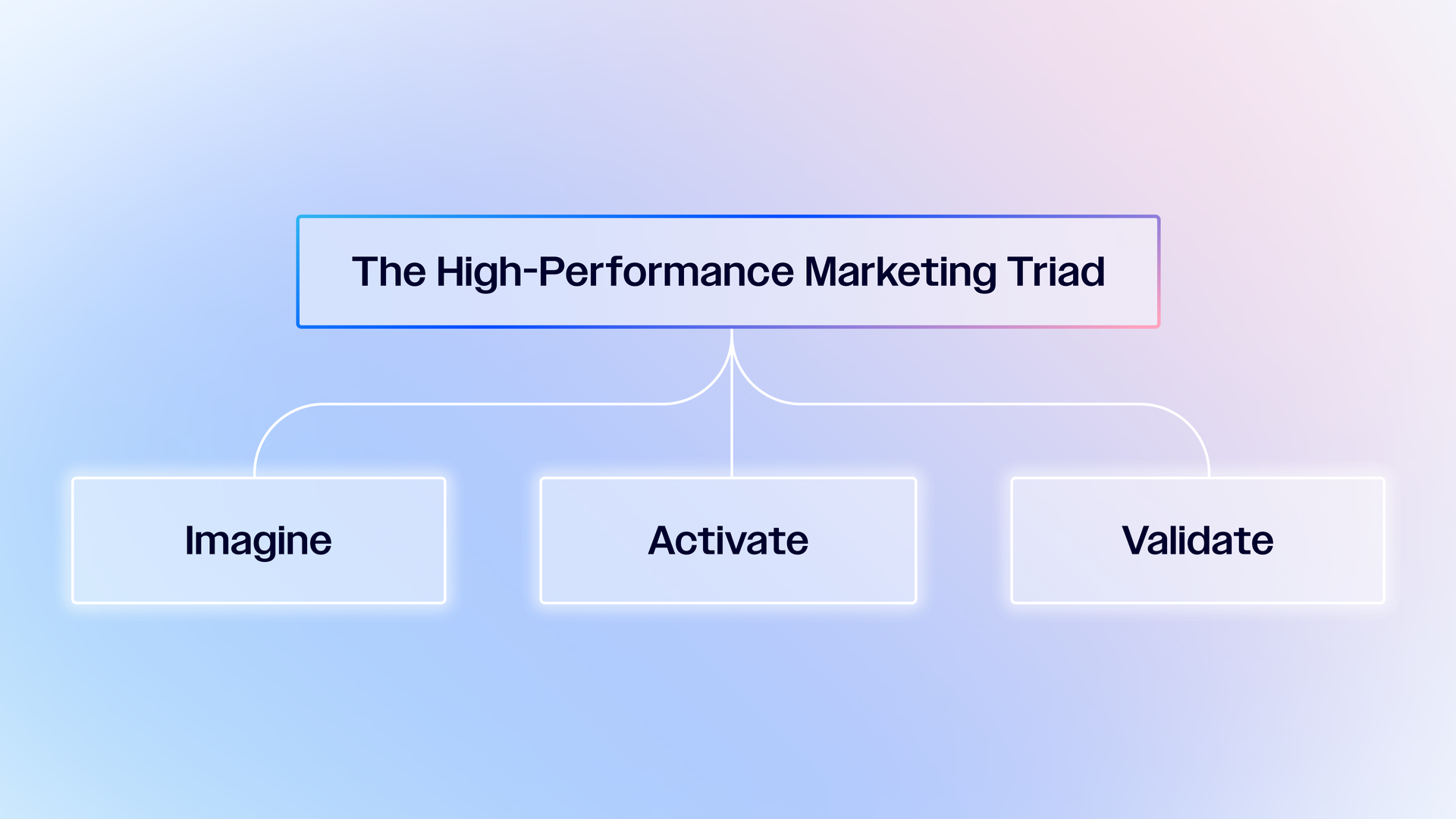
Image defines the three marketing pillars (imagine, activate, validate) and how they flow into what we call “The Triad”
Breaking down the three pillars
Imagine
The Imagine pillar encompasses strategic thinking, campaign conceptualization, audience analysis, and creative direction. This is where 63% of marketers currently focus their AI efforts, using AI to analyze customer behaviors, market trends, and competitor insights to inform their next campaigns.
Examples of Imagine activities:
- Customer personal development and journey mapping
- Competitive analysis and market research
- Brand positioning and messaging strategy
- Creative brainstorming sessions and concept development
- A/B testing multiple value propositions
Activate
The Activate pillar transforms strategy into action, or leveraging AI agents to build complete campaigns and coordinate 1:1 personalized experiences that scale with your business. AI agents can orchestrate workflows, integrate systems, and execute marketing strategies through automated sequences and personalized experiences. Only 59% of marketers leverage AI for activation, suggesting a missed opportunity for nearly half of marketers.
Examples of Activate activities:
- Building email marketing campaigns and drip sequences
- Social media content creation and scheduling
- Paid advertising execution
- Implementing marketing automation workflows
- Content production (blogs, videos, social assets, etc.)
Validate
The Validate pillar ensures your marketing performs at its peak through continuous analysis, optimization, and strategic refinement. It’s also where the biggest gap exists—only 53% of marketers use AI for validation, missing the compound learning benefits that create long-term competitive advantages.
Examples of Validate activities:
- Campaign performance tracking and analytics
- Conversion rate optimization testing
- Customer feedback collection and surveys
- ROI analysis and budget allocation reviews
- Regular reporting and strategy refinement
These agents don't just report on results; they predict optimal timing for individual contacts, track progress toward business goals, and automatically adjust strategies based on performance data.
Why all three matter: The compound effect
The magic happens when all three pillars work together, creating a continuous learning engine that gets stronger with every campaign. Performance data from Validate feeds back into smarter Imagine strategies. Execution insights from Activate improve both strategic thinking and measurement approaches.
Masthead, a content marketing company, has six full-time employees and uses AI agents to develop custom GPT workflows for prospecting, outreach, and follow-up cadences. By using AI agents to imagine, activate, and validate, Masthead is able to save 4-5 hours per week while scaling their outreach efforts.
Choosing your AI tools and LLMs
The LLM landscape for marketers
Not all AI tools are created equal, and depending on which pillar you’re focused on, you may need to adjust your tooling set.
- For Imagine tasks, conversational tools like ChatGPT or Claude are perfect for iterative brainstorming and strategic collaboration.
- Tools like ActiveCampaign’s AI Agents and other integrated solutions are ideal for Activation tasks, where you can directly integrate with your existing data and workflows.
- Finally, look for analytics-focused AI tools for your Validate tasks that connect to performance data for real-time insights and automated optimization.
Building your AI stack
The most successful marketers follow a three-step integration approach:
- Establish your strategic foundation: Pick one conversational AI platform and run a 2-week pilot for your content creation process.
- Layer in execution tools: Integrate the AI tool of your choice into your top 3 marketing channels (email, social, ads) for Activate tasks over the next month.
- Connect the optimization loop: Implement Validate capabilities that feed insights back into your strategic and execution layers.
AI stack implementation checklist
Use this 5-step checklist to build your AI marketing stack across all three pillars, moving from strategic thinking (imagine) to execution (activate) to performance optimization (validate).
- Map your imagine workflows: Identify three strategic decisions you make monthly (campaign themes, audience targeting, content strategy) and document how long each currently takes.
- Pilot your activate integrations: Test one AI tool with your highest-volume marketing channel for two weeks and measure the time saved on execution tasks.
- Build your validate feedback loop: Connect performance data from your activate workflows to your imagine decisions with automated reporting over a two-week sprint.
- Scale activate automations: Roll out your tested AI integration to two additional channels, using the same success metrics from your pilot.
- Close the optimization loop: Use 30 days of validate insights to refine your imagine decisions, then document which AI-driven changes improved performance by 10% or more.
The power of this approach lies in the connections between steps, not the individual tools. The goal isn’t just AI adoption, it’s building an intelligent system that gets smarter with every campaign.
Why prompting matters in marketing
Generic prompts produce generic results. Your marketing-specific prompts should include the business context, audience insights, and strategic objectives in order to generate the results you want. There’s a difference, for example, between saying “write an email” and “create a 3-email reactivation sequence for SaaS customers who haven't logged in for 30 days, addressing common barriers to product adoption".
The three types of marketing prompts
Strategic Prompts (imagine) These prompts help AI think like a marketing strategist:
You are a [industry] marketing strategist analyzing [specific situation].
Recommend [specific outcome] considering [business constraints and goals].
Provide strategic rationale for each recommendation and identify potential risks.
Execution Prompts (activate) These prompts turn strategy into action:
Create [specific campaign deliverable] for [target audience segment] that drives [desired behavior].
Use [brand voice and positioning] and include [required elements].
Format for [specific channel] and optimize for [key metric].
Analysis Prompts (validate) These prompts extract strategic intelligence from data:
Analyze this [campaign performance data] and identify [specific insights needed].
Compare against [relevant benchmarks] and provide [number] specific optimization recommendations with expected impact and implementation priority.
When you layer these three types of prompts together, you create a comprehensive AI-powered marketing workflow that thinks strategically, executes precisely, and learns continuously. This transforms AI from a content generator to a true marketing partner that can navigate the full spectrum of marketing activities.
The compound effect of AI in marketing
Just as traditional marketing automation created compound benefits over time, autonomous marketing powered by the High-Performance Marketing Triad creates exponential advantages. Each campaign makes your AI agents smarter, which in turn improves your strategic thinking and expands what you can attempt next.
The High-Performance Marketing Triad provides the strategic foundation, but transformation happens through systematic implementation. Our research found that marketers are feeling empowered by their AI usage.
97% of marketers say AI has changed how they feel about their work, and 75% believe AI helps them compete with larger businesses
Start with one workflow and master the connection between all three pillars. Build your prompt library and measure your overall transformation, not just your efficiency.
Most importantly, think systems over tools. The future belongs to marketers who orchestrate AI agents across complete marketing workflows over those who collect AI tools for individual tasks.
Eager to see real-world examples of autonomous marketing in action? Join us for our 4-part webinar series where we dive into how you can make the case for autonomous marketing, spotlight customers who have already made it work, and take home actionable resources that you can use, right now.