HubSpot is one of the best-known platforms for marketing, sales, CRM, and customer service. For some businesses, its all-in-one model is exactly the appeal. But that same breadth can also become a problem. As teams grow, many find themselves paying for more platforms than they actually use, while also taking on more operational complexity than their day-to-day marketing work really needs.
Many marketing teams find themselves looking for a platform that delivers strong automation and CRM functionality without the cost and complexity of a modular HubSpot stack.
There are plenty of HubSpot alternatives that could be a better fit for your business. If you’re looking for a platform that can support your future growth without the cost or complexity of a full HubSpot stack, or you’ve realized it may be time to switch to a tool that is easier to operate and easier to afford as your strategy expands, this guide can help. It will help you choose the platform that fits not just where your marketing is today, but where it’s headed next.
> ActiveCampaign’s AI offering in particular is an impressive differentiator.
What to look for in a HubSpot alternative
As you evaluate the best HubSpot alternative for your business, there are several key factors to consider. Instead of comparing generic feature lists—which don’t always reflect how platforms actually work in practice—focus on the pressure points that most often push teams to look elsewhere.
Across review platforms, HubSpot is frequently praised for its breadth of features and polished user experience. But recurring feedback highlights concerns around sticker shock and the operational overhead that comes with managing an all-in-one platform.
“As you start pushing HubSpot into more advanced GTM automation use cases, a few limitations become more noticeable.
The workflow engine, while powerful, can become difficult to manage at scale. When you have many automation flows running across different teams, debugging and maintaining them can get complex.
Pricing can also scale quickly once you start using multiple hubs or need higher contact tiers, which can make experimentation more expensive for growing teams.” — G2 reviewer
Here are a few things to assess when looking for a HubSpot alternative that will solve these common challenges:
- Pricing transparency and total cost of ownership (TCO): One of the most common reasons businesses switch from HubSpot is cost unpredictability. As teams grow, pricing can increase through contact tiers, onboarding fees, data enrichment charges, and usage-based overages, making it harder to forecast total cost. Many businesses look for alternatives with clearer pricing models that scale more predictably and don’t require additional spend just to maintain or use core functionality.
- Access to key features without paywalls or complexity: HubSpot’s modular “hub” structure can make it difficult to access the features you actually need without upgrading across multiple products and tiers. Advanced automation, reporting, AI functionality, and even data enrichment are gated behind higher plans or add-ons, which can lead to paying for unused features or managing multiple budgets. A strong alternative should give you access to meaningful capabilities without forcing you into a more complex and expensive bundle.
- Deliverability and campaign performance: As with any marketing platform, performance ultimately comes down to whether your campaigns reach your audience. Some teams switch when they want stronger deliverability infrastructure, more control over sender reputation, or better visibility into engagement and performance across campaigns.
The latest data from EmailToolTester’s email deliverability tests scored HubSpot with a deliverability rate of just 77.7%, in 12th place out of 15 tools tested.
- Less “all-in-one” bloat: HubSpot’s all-in-one model is built around multiple “hubs” for marketing, sales, service, and CMS, which are designed to work together as a unified system. This can introduce unnecessary complexity. Features, data models, permissions, and workflows are often tied across hubs, meaning you may need to configure, manage, or pay for parts of the platform that aren’t directly relevant to your role.
- AI that actually reduces work: AI is quickly becoming a key differentiator between platforms. HubSpot’s AI (Breeze) is deeply tied to its CRM and mainly focuses on productivity within that system. Many teams now look for platforms where AI helps create and execute campaigns end-to-end, and without requiring additional spend or complex setup. Breeze’s advanced capabilities are also gated behind subscriptions and usage-based credits (yet another budget to figure out).
HubSpot users often start with the appeal of an all-in-one platform, but begin to reassess as costs rise and operational complexity increases. Because of this, it’s important to choose an alternative that not only meets your current needs, but continues to make sense as your team, strategy, and budget evolve.
Your business’s needs will ultimately determine what to prioritize, for example:
- Growing SMBs or startups may prioritize lower total cost of ownership, faster onboarding, and access to core features without upgrading across multiple tiers.
- Busy marketing teams focused on automation may look for platforms with deeper workflow capabilities, more flexible triggers, and less reliance on separate hubs or add-ons.
- B2B companies with sales alignment needs may require CRM functionality that integrates cleanly with marketing without the overhead of a full enterprise system.
- Ecommerce businesses may prioritize automation for lifecycle marketing and integrations with their storefront and customer data.
- Lean teams or solo marketers may want a less expensive platform that is easier to operate day-to-day.
- Businesses scaling quickly may look for a solution that offers predictable pricing, flexible feature access, and the ability to grow without constantly re-evaluating plan tiers.
Our goal isn’t to suggest a like-for-like alternative to HubSpot, but to help you understand which platform fits how your business actually operates.
ActiveCampaign
ActiveCampaign is a strong HubSpot alternative for businesses that want powerful marketing automation and CRM capabilities without the cost and complexity of the modular platform. It’s designed to help teams run sophisticated, results-driven marketing while being easier to operate and more predictable to scale.
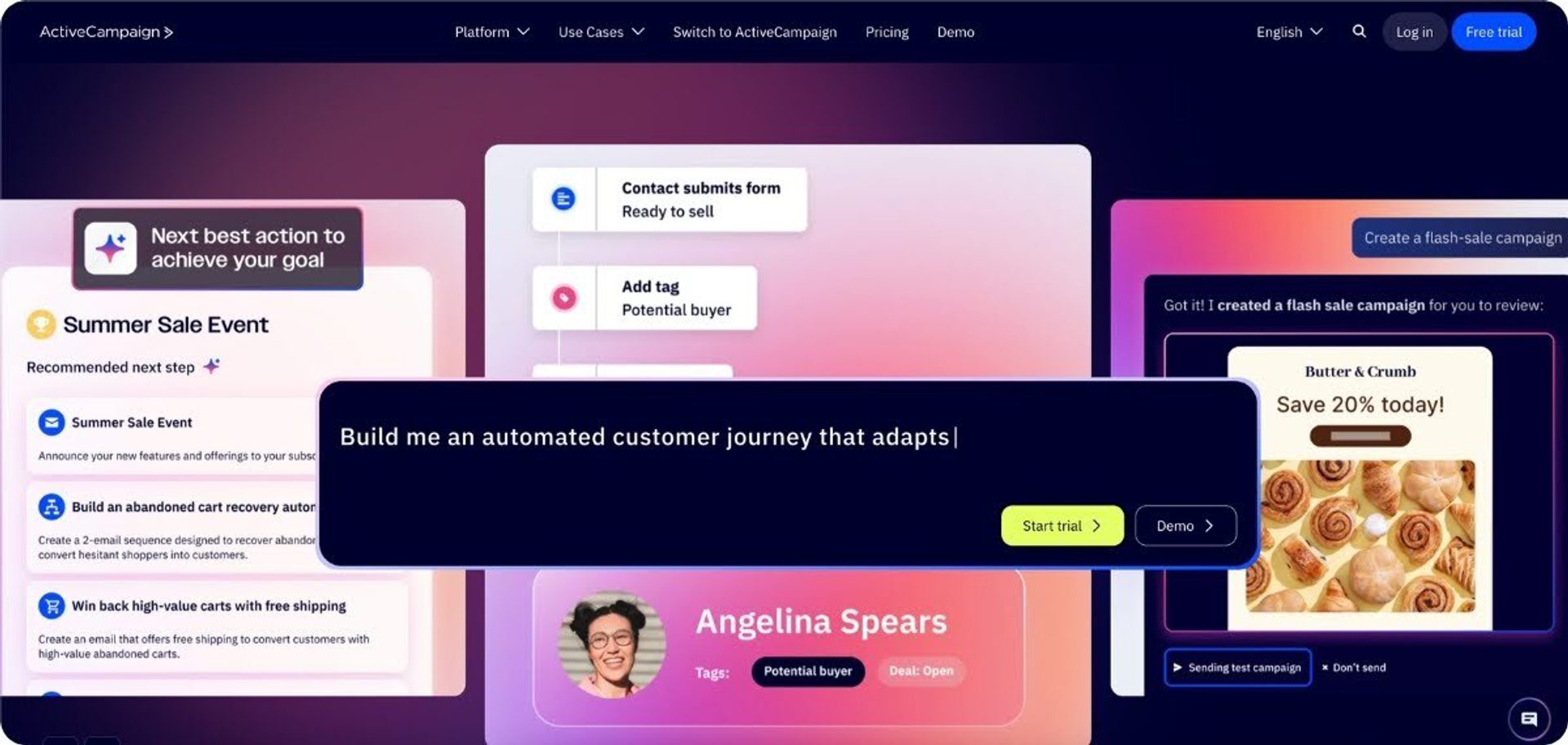
For businesses that have outgrown HubSpot’s pricing or operational overhead, ActiveCampaign offers a more focused approach. It delivers complex capabilities and makes them easy to launch, but doesn’t require teams to adopt and manage multiple systems.
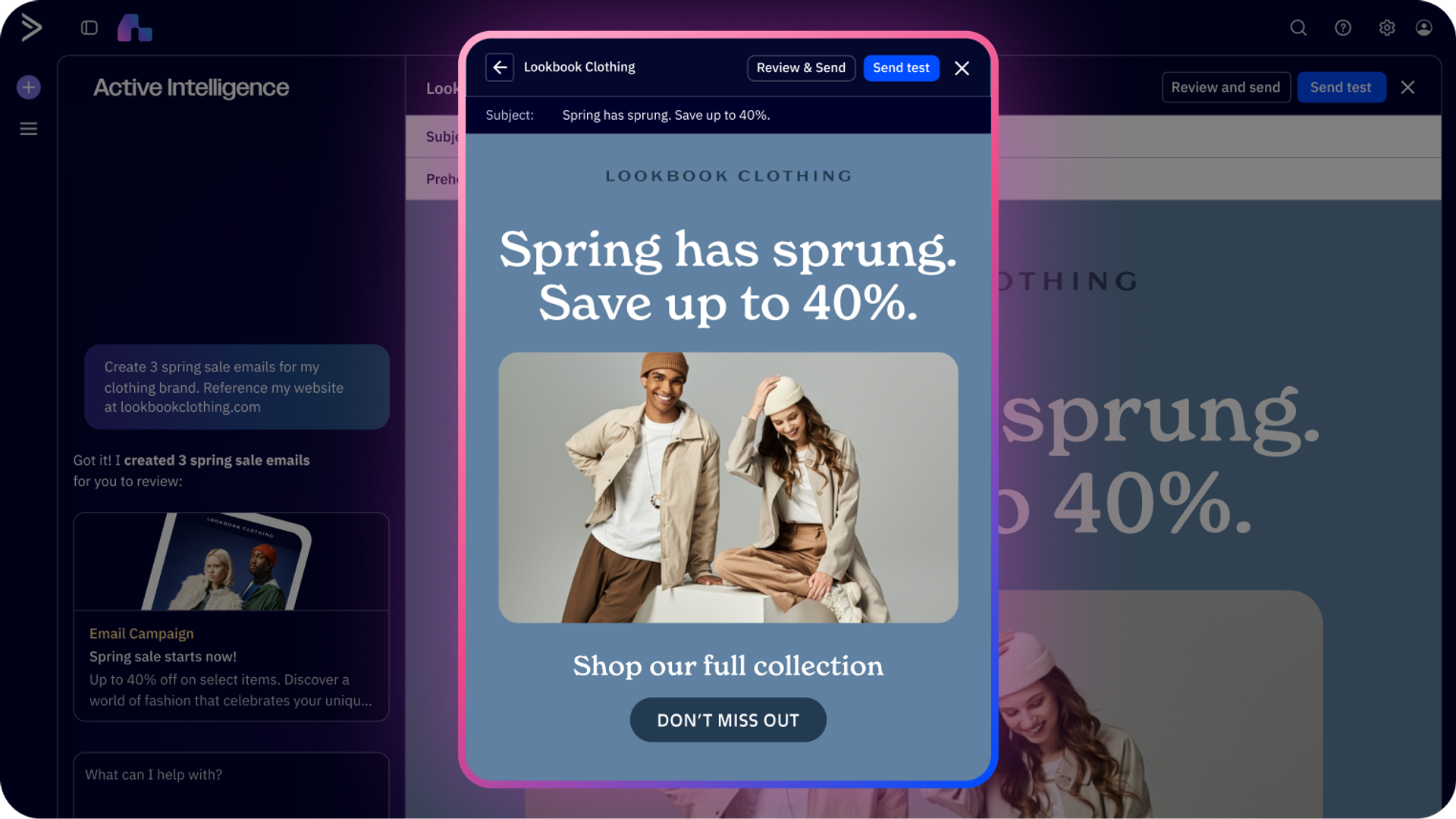
- AI for end-to-end creation, execution, and optimization: ActiveCampaign’s AI offering in particular is an impressive differentiator. It is centered on execution, not just assistance. The powerful Active Intelligence engine can generate campaigns, identify segments, optimize send timing, and analyze and improve performance automatically. It is built to support the full marketing lifecycle, not just isolated tasks.
Rather than focusing only on content generation or CRM productivity, it helps teams plan, execute, and optimize campaigns end-to-end. Plus, you have access to Active Intelligence on all plans, so it’s the perfect tool for getting started with automations quickly.
- Stronger deliverability and performance focus: ActiveCampaign is built with deliverability as a core priority, helping ensure campaigns reach the inbox and drive engagement. Features like domain verification tools, dedicated IPs, ready-to-use list hygiene automations, and proactive monitoring support sender reputation.
ActiveCampaign consistently performs at the top of third-party tests. With a 94.2% deliverability score from EmailToolTester’s latest data, it comes in 1st place out of the 15 tools tested.
- Customizable automations that significantly reduce manual work: ActiveCampaign focuses on enabling fully autonomous marketing. Advanced automation is available across plans, with reusable segments, flexible logic, and pre-built recipes that significantly reduce setup effort. Instead of building from scratch, teams can launch and scale campaigns much faster.
- CRM built for marketing and sales alignment (without the overhead): ActiveCampaign includes a built-in sales CRM designed to support sales workflows with AI-powered automations that handle deal and pipeline management, lead scoring, and task automation.
Unlike HubSpot’s modular system, where CRM functionality often expands into multiple hubs, ActiveCampaign keeps CRM tightly connected to marketing automation. Sales teams can share the same data, triggers, and workflows without needing to manage separate systems or pay to unlock additional functionality.
- Flexible, cross-channel workflows: ActiveCampaign allows teams to build automations that branch dynamically based on behavior, engagement, and conditions. The same logic can be applied across email, SMS, WhatsApp, CRM workflows, landing pages, and 1,000+ native integrations, so campaigns adapt automatically to dozens of goals, triggers, and actions as customer behavior changes. This eliminates the need to duplicate campaigns or manage separate workflows across channels (or hubs).
- More predictable pricing with broader feature access: ActiveCampaign is designed to provide access to core marketing features—like automation, segmentation, and testing—from the start, and at an affordable price point. Teams can also scale into more advanced capabilities over time using smaller add-ons, so there’s no need to unlock entire product suites just to meet a niche requirement. This makes it easier to manage long-term costs.
Due to ActiveCampaign’s rich feature set, absolute beginners might need some time to familiarize themselves with more advanced features, but the perceived learning curve is very easy to overcome. The goal-driven, conversational AI console, and extensive resources, including responsive templates and automation recipes make it very easy to kick off layered campaigns on day one.
Explore more of the ActiveCampaign platform in our immersive product tours.
Across review platforms like G2 and Capterra, ActiveCampaign is consistently praised for its automation depth, flexibility, and ability to support more advanced marketing strategies without requiring enterprise-level complexity. Users frequently highlight how much time they save through automation, as well as the platform’s balance of power and usability.
“Having transitioned from Hubspot, it was nice to have the functionality of Active Campaign at a fraction of the cost and we weren't having to constantly manage our # of contacts to stay within pricing parameters.” — G2 reviewer
| ActiveCampaign | HubSpot | |
| Which businesses choose this platform? | More often chosen by teams that want advanced automations and CRM that are easy to implement, at a reasonable price point. | More often chosen by organizations that aren’t budget-conscious and prioritize a unified CRM, pipeline management, and sales-first operations across teams. |
| Pricing & Long-Term TCO | Free trial available. Paid plans start at $15/month for 1,000 contacts. Core marketing features, including AI and automations, are available from day one. | Limited free plan available but this is intentionally constrained for real marketing execution. Paid plans start at $9/seat/month to access basic email marketing features for 1,000 contacts. Core marketing features like automation and advanced reporting are only available for Professional users at a steep jump to $800/month. This plan also requires a $3,000 one-time onboarding fee. |
| CRM | Built-in CRM designed to support marketing and sales alignment without added complexity. | CRM system available as additional module, designed to operate across multiple departments and use cases. |
| AI Tools | ActiveCampaign’s comprehensive AI engine, Active Intelligence, is built for campaign execution. It helps teams create, automate, personalize, and optimize marketing workflows end-to-end. The conversational interface makes it very easy to use, and it is available at a lower cost than HubSpot’s more basic, CRM-oriented Breeze tools. | |
To dive deeper into the differences between HubSpot and ActiveCampaign, read our full ActiveCampaign vs Hubspot comparison.
Marketo
Marketo is a HubSpot alternative for enterprise-level marketing automation and lead management. It’s designed for large teams running complex, multi-touch campaigns at scale, particularly in B2B environments.
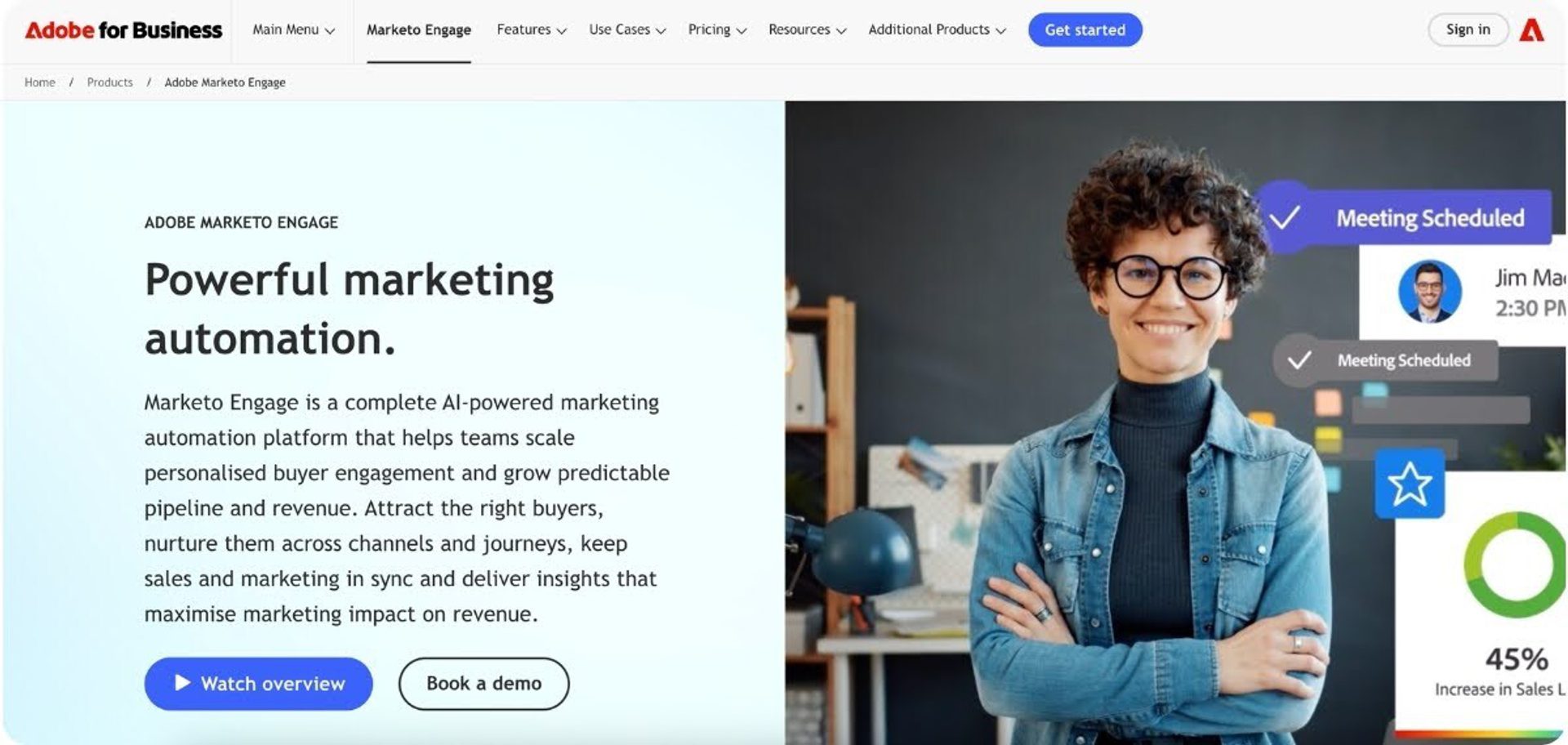
For businesses that have outgrown HubSpot’s mid-market limitations, but still need a configurable, enterprise-grade platform, Marketo offers more depth.
- Enterprise-grade automation and campaign orchestration: Like ActiveCampaign, Marketo has a flexible automation engine that allows teams to build complex, multi-step campaigns with detailed logic, scoring models, and lifecycle management. It’s well-suited to B2B organizations with long sales cycles and advanced lead nurturing requirements.
- Deep customization and extensibility: Marketo offers a high level of configurability across data models, workflows, and integrations. It integrates tightly with enterprise CRMs (especially Salesforce) and supports custom objects, advanced reporting setups, and API-driven extensions, making it a strong fit for organizations with dedicated ops teams.
- Advanced lead management and scoring: Marketo provides robust tools for lead scoring, segmentation, and lifecycle tracking, enabling teams to manage large volumes of leads across complex funnels. This is a key reason it remains popular with enterprise B2B marketing teams.
- AI and predictive capabilities (Adobe Sensei): Marketo leverages Adobe Sensei AI to support features like predictive content, lead scoring insights, and performance optimization.
Marketo’s flexibility and depth do come with a steeper learning curve. You may find that your team has greater reliance on technical resources, longer implementation timelines, and higher total cost. Additionally, it doesn’t offer a native CRM and will need to be connected to an external tool.
Because of these constraints, if your problems with HubSpot are down to complexity and cost, it may not be the right choice of alternative. It is most effective when supported by dedicated marketing operations teams, and may be less suitable for teams looking for faster time-to-value.
Across review platforms, Marketo is frequently praised for its power, flexibility, and ability to handle complex enterprise use cases. At the same time, users often note that the platform can be difficult to learn, resource-intensive to manage, and slower to implement compared to more modern, user-friendly tools.
“Overall, Marketo is extremely powerful, but it rewards experienced operators and can feel unforgiving for smaller teams or those looking for quick wins.” — Rishabh S., G2
| Marketo | HubSpot | |
| Which businesses choose this platform? | More often chosen by enterprise B2B teams that have dedicated marketing operations support to handle technical setup of deep customization and advanced lead management. | More often chosen by organizations that want a navigable, unified CRM and cross-functional platform across marketing, sales, and service. |
| Pricing & Long-Term TCO | Demos and consultations available on request. Enterprise pricing available on request with custom quotes. Higher implementation and operational costs often require dedicated resources. | Limited free plan available. Paid plans start at $9/seat/month for 1,000 contacts. Modular pricing across hubs with onboarding fees. |
| CRM | No native CRM. Typically paired with Salesforce or other enterprise CRM systems. | CRM system available as an additional module (priced separately), designed to support cross-functional use across teams. |
| AI Tools | Adobe Sensei supports predictive insights and content tasks, but Marketo’s AI is more enterprise-oriented and smaller teams may find it less user-friendly than HubSpot Breeze. | |
Want to see how Marketo compares to ActiveCampaign? Read our deep dive comparison of ActiveCampaign vs. Marketo.
Agentforce by Salesforce
Salesforce’s Agentforce Marketing (a rebrand of several combined tools including Marketing Cloud and Pardot) is a HubSpot alternative for large enterprises that want customizable, AI-powered marketing deeply integrated into the Salesforce ecosystem. It offers deep operational control for organizations running multi-channel campaigns across large Salesforce datasets.
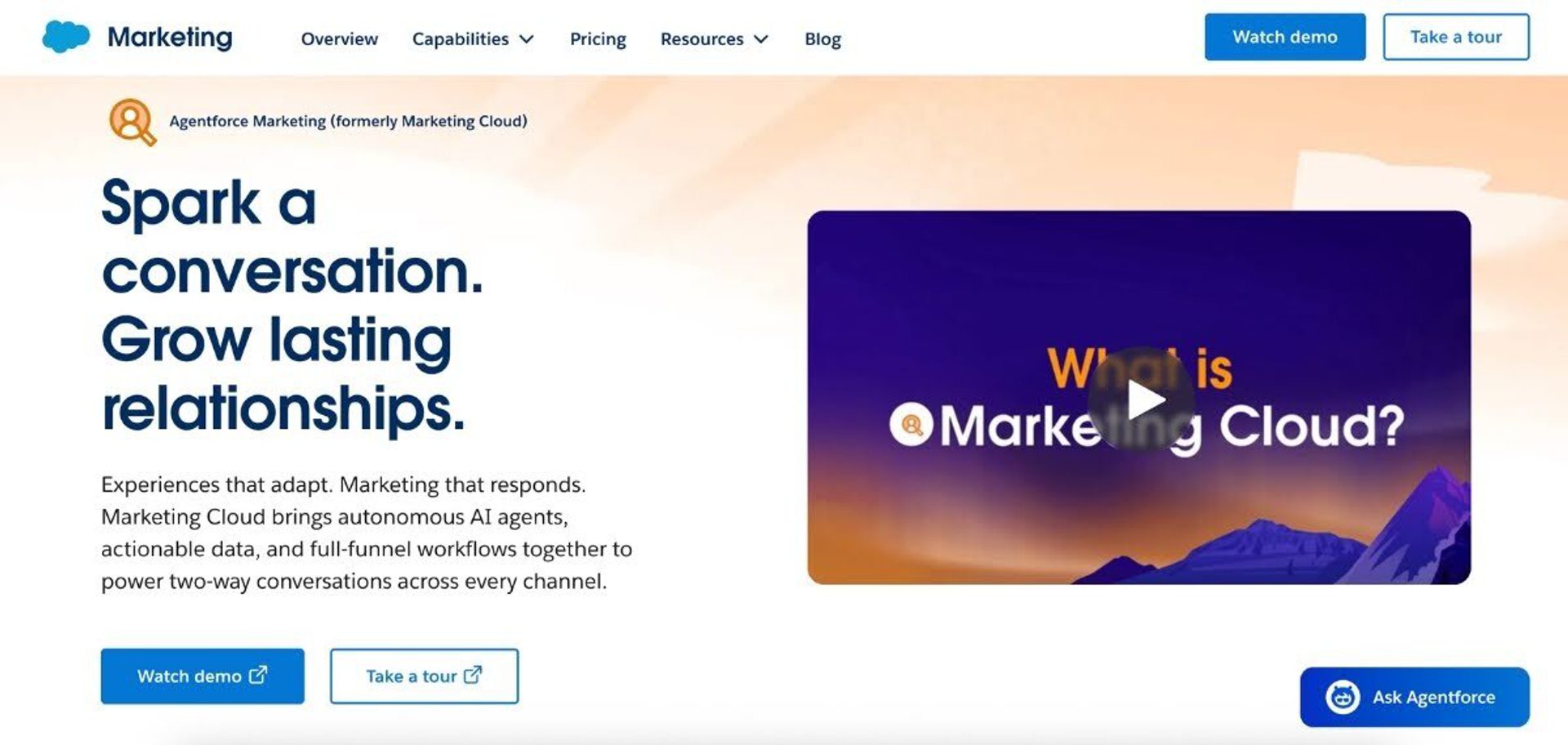
For businesses that have outgrown HubSpot’s simplicity and need more advanced orchestration, data activation, and autonomous workflow design, Salesforce offers more depth.
- AI-driven marketing workflows: Salesforce’s newer marketing direction centers on Agentforce and autonomous AI agents that help build segments, optimize campaigns, and support execution across marketing workflows. Combined with Salesforce data and workflow layers, it can be a fit for enterprises that want AI embedded deeply into marketing operations.
- Salesforce CRM integration: The tool integrates natively with Salesforce CRM, enabling shared data, real-time updates, and tighter alignment between marketing and sales activity. The platform becomes more powerful as businesses adopt more of Salesforce’s ecosystem. That can be a major advantage for enterprise teams already standardized on Salesforce, but can also increase long-term dependency and cost.
- Customizable campaign orchestration: Salesforce supports cross-channel orchestration across email, mobile, advertising, and broader journey workflows, with strong customization for organizations that need granular control.
- Built for complex data environments: Salesforce positions Agentforce Marketing around actionable data, connected workflows, and unified customer profiles, with Data 360 built into its broader platform story. This gives large organizations more room for coordination across business units.
Because Salesforce’s agentic focus is newer in the market, reliable performance depends on strong data preparation and guardrail design to avoid AI hallucinations. It’s more valuable to teams already heavily invested in Salesforce that want more advanced workflows, than those looking to resolve the complexity of HubSpot.
Across review platforms, Salesforce Marketing is regularly praised for its powerful automations and enterprise-scale CRM integration. Users sometimes describe it as complex to set up and as feeling like a collection of older, pieced-together tools rather than a cohesive product. Another common tradeoff is very high pricing to access the flagship, agentic features.
“[Salesforce Agentforce Marketing] is widely regarded for delivering a comprehensive 360-degree view of the customer, which helps me create deeply personalized, multi-channel marketing campaigns. It has a high cost, an extremely steep learning curve, and a complex, non-intuitive user interface that often requires technical expertise or dedicated consultants.” — Monalisha M., G2
| Salesforce Agentforce Marketing | HubSpot | |
| Which businesses choose this platform? | More often chosen by enterprise organizations already invested in Salesforce that need customizable, AI-driven marketing workflows and deeper data control. | More often chosen by SMEs and mid-market teams that prioritize ease of use and faster deployment. |
| Pricing & Long-Term TCO | No free plan/trial available. Paid plans start at $25/user/month for basic email marketing only. To access agentic automation capabilities and multi-channel journeys, pricing jumps to $1,500/org/month. Enterprise-oriented pricing, often with added cost from broader Salesforce adoption. | Limited free plan available. Paid plans start at $9/seat/month for 1,000 contacts. Also has a large pricing jump to access important features, with automations starting at the Professional plan for $800/month. Modular pricing across hubs with onboarding fees. |
| CRM | Most powerful when paired with Salesforce CRM (priced separately) and the wider Salesforce data ecosystem. | Most powerful when paired with HubSpot CRM (priced separately) and the wider HubSpot modules for sales and service. |
| AI Tools | Agentforce offers more ambitious agentic AI for enterprise orchestration, but it is typically more expensive and complex than HubSpot Breeze’s plug-and-play style productivity tools. | |
Want to see how Salesforce compares to ActiveCampaign? Read our deep dive comparison of ActiveCampaign vs Salesforce.
Mailchimp
Mailchimp is a HubSpot Marketing Hub alternative for small businesses and startups that want a simple, easy-to-use platform for email marketing and basic automation. It’s designed to help teams get campaigns up and running quickly without the cost, onboarding requirements, or operational overhead of a more complex system.
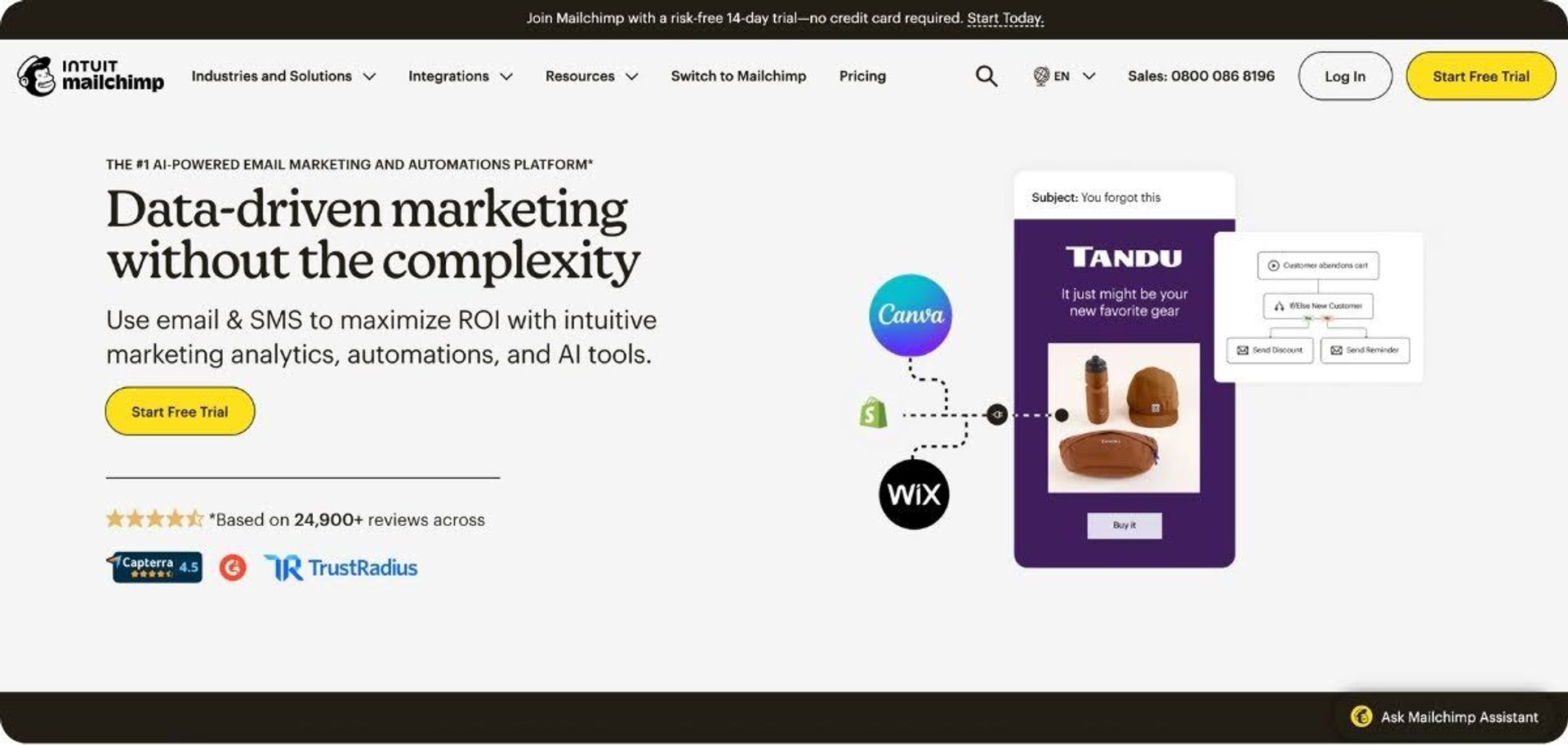
For businesses that find HubSpot too expensive or heavy for their needs, Mailchimp offers a more lightweight, accessible starting point.
- Simple, intuitive campaign creation: Mailchimp is best known for its user-friendly interface, drag-and-drop email builder, and pre-designed templates. This makes it easy for beginners or lean teams to create and send campaigns quickly without needing technical expertise.
- Good starting point for email-first marketing: Mailchimp’s UX and low entry pricing work well for newsletters, basic automations, and straightforward campaigns. It’s particularly well suited to small businesses, creators, and early-stage teams that are focused primarily on email as their main marketing channel.
- Broad integrations and ecosystem: Mailchimp integrates with a range of third-party tools, including ecommerce platforms, CMS tools, and other marketing systems. This allows businesses to extend functionality without adopting an all-in-one platform.
Mailchimp’s automation and segmentation offerings are limited compared to some more advanced platforms. It’s an accessible starting point, but may not be suited to long-term growth.
Across review platforms, Mailchimp is consistently praised for its ease of use and accessibility for beginners. Users do note limitations in automation, segmentation, and pricing as their needs grow.
“Mailchimp is a solid email marketing tool with an intuitive interface and a wide range of templates that make it easy to get started quickly. The segmentation and automation features cover the basics well. For teams that have outgrown simple newsletters and need advanced segmentation, behavioral triggers, or tight CRM connectivity, Mailchimp can quickly feel like a limitation rather than an enabler.” — Lionel T., G2
| Mailchimp | HubSpot | |
| Deliverability | Generally reliable, but not positioned as a leading differentiator | Not typically positioned as a deliverability-first platform |
| Which businesses choose this platform? | More often chosen by small businesses, startups, and creators that want a simple, cost-effective, email-first marketing tool. | More often chosen by SMEs and mid-market teams that want an all-in-one inbound marketing platform with CRM and broader capabilities. |
| Pricing & Long-Term TCO | Limited free plan available. Paid plans start at $26.50/month for 1,000 contacts. Up to 4 marketing automation flow steps available on lowest cost paid plans. | Limited free plan available. Paid plans start at $9/seat/month for 1,000 contacts. Upgrade to $800/month Professional plan required to access automation workflows. |
| CRM | Basic CRM-style tools and audience management. Usually paired with external tools for full functionality. | Native CRM available as an additional module (priced separately) designed to support marketing, sales, and service in one platform. |
| AI Tools | Mailchimp’s Intuit Assist tools (currently in Beta) are simpler and more accessible for basic content support, but it is narrower and less operationally powerful than HubSpot’s CRM-linked AI. | |
Want to see how Mailchimp compares to ActiveCampaign? Read our deep dive comparison of ActiveCampaign vs Mailchimp.
Kit (formerly ConvertKit)
Kit is a HubSpot Marketing Hub alternative designed for creators, educators, and other audience-first businesses that want a simple platform focused on email, subscriptions, and monetization. It’s designed to help individuals and small teams grow and engage an audience without the operational complexity of a B2B platform.
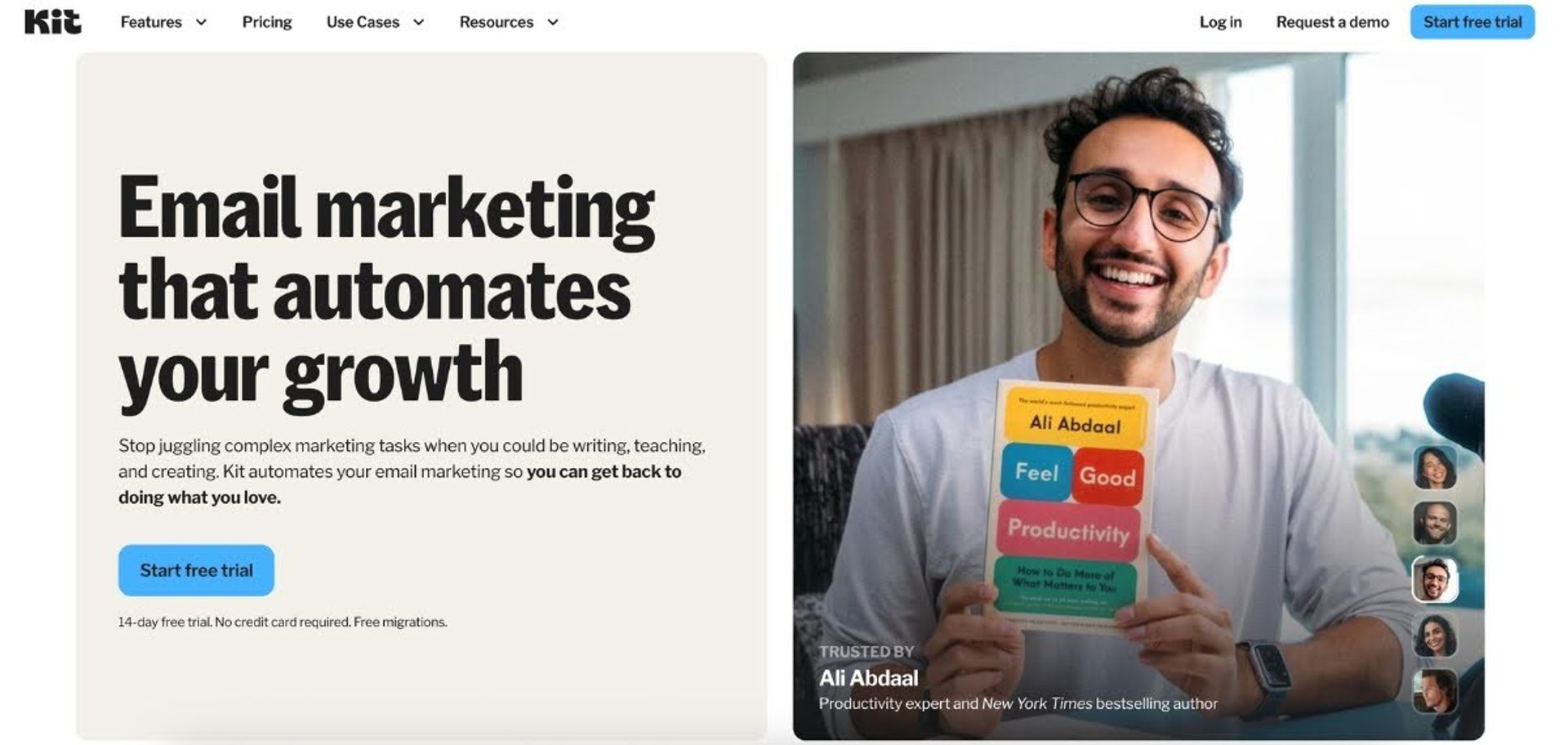
For businesses that find HubSpot too complex or sales-heavy for their needs, Kit offers a more focused approach built around newsletters, content, and audience relationships.
- Built specifically for creators and audience growth: Kit is designed around subscriber relationships, making it easy to grow, segment, and engage an audience. Features like tagging, forms, landing pages, and newsletter tools are tailored to creators, coaches, and media-style businesses.
- Simple automation and segmentation for content workflows: Kit offers visual automations and tagging-based segmentation that are easy to use and effective for nurture sequences, product launches, and subscriber journeys. It’s well suited to email-first strategies, but less flexible than more advanced automation platforms.
- Monetization and audience-first features: Kit includes tools for selling digital products, subscriptions, and paid newsletters, along with a creator network to help expand reach. This makes it particularly appealing for businesses focused on content-driven revenue.
Kit may be less suited to larger B2B teams with cross-functional marketing operations. It lacks the deeper CRM functionality, advanced reporting, and more complex automation capabilities required by big, data-driven teams.
Across review platforms, Kit is frequently praised for its simplicity, creator-focused design, and ease of use. At the same time, users often note limitations in automation depth, integrations, and broader marketing capabilities compared to more comprehensive platforms.
“I really appreciate how effortless Kit makes small-business marketing. It's perfect for people who aren't experts in social media or advertising, and that shows in every part of the tool. It does a good job with simple social posts and retargeting ads, but you can’t customize sequences, set up more specific rules, or tailor the messaging to different customer groups. It’s very 'one-size-fits-all,' so we can’t fine-tune it to match our brand voice or customer journey as closely as we want.” — Krishna K., G2
| Kit | HubSpot | |
| Which businesses choose this platform? | More often chosen by creators, educators, and audience-first businesses focused on newsletters, subscriptions, and content monetization. | More often chosen by SMEs and mid-market teams that want an all-in-one inbound marketing platform with CRM and broader capabilities. |
| Pricing & Long-Term TCO | Generous free tier available. Paid plans start at $33/month for 1,000 contacts. Fairly large jump in cost for users who need more than one automation, monetization features, and white-labelling. | Limited free plan available. Paid plans start at $9/seat/month for 1,000 contacts. Onboarding fees and feature gating can increase total cost as usage grows. |
| CRM | Lightweight CRM-style functionality for subscriber management rather than full sales pipelines. | Native CRM available as an additional module (priced separately), designed to support marketing, sales, and service teams. |
| AI Tools | Kit’s AI is lightweight and creator-focused, making it simpler than HubSpot, but it is less capable for teams needing advanced AI execution across marketing and sales. | |
Want to see how Kit compares to ActiveCampaign? Read our deep dive comparison of ActiveCampaign vs. Kit.
How to pick the best HubSpot alternative for your team
Choosing the right HubSpot alternative shouldn’t involve simply replacing one all-in-one platform with another. You need to decide what kind of system will actually support your future marketing needs. Do you need a full cross-functional system, or do you need marketing automation and CRM functionality that makes it easier to operate, scale, and explain ROI as your business grows?
When comparing platforms, focus less on feature checklists and more on how each tool performs in the areas that actually impact results:
- Automation depth: Many platforms claim to offer “automation,” but the flexibility and usability of those workflows can vary significantly. Look for tools that allow dynamic branching, reusable segments, and automation that adapts to real customer behavior—not rigid, campaign-based setups.
ActiveCampaign enables advanced, multi-step automations across channels using shared logic, reusable segments, and pre-built recipes—so teams can build once and scale without duplicating work.
- Deliverability and performance: It doesn’t matter how advanced your campaigns are if they don’t reach the inbox. Deliverability infrastructure, sender reputation tools, and ongoing monitoring are critical to ensuring consistent results.
With a 94.2% deliverability rate, ActiveCampaign ranks among the top platforms tested, supported by built-in tools for authentication, list hygiene, and sender reputation management.
- Straightforward pricing and long-term cost control: HubSpot’s modular pricing, onboarding fees, and feature gating can make it difficult to predict long-term costs. Look for platforms that offer transparent pricing and let you access core features without unlocking entire product suites.
ActiveCampaign provides access to core automation, segmentation, and AI capabilities from the start, with flexible add-ons as needed—making it easier to scale without sudden pricing jumps.
- AI capabilities that actually reduce work: AI is becoming a major differentiator, but not all platforms use it the same way. Some focus on content assistance, while others enable full campaign execution, optimization, and decision-making.
ActiveCampaign’s AI-native approach helps teams plan, build, execute, and optimize campaigns end-to-end—reducing manual work rather than just assisting with isolated tasks.
It’s also important not to overlook migration when choosing a HubSpot alternative. It often determines whether a switch is successful or not. HubSpot’s onboarding process is notoriously expensive. If you want to unlock the Professional plan (where the automation workflows and other essential marketing components become available), your onboarding fee will set you back $3,000.
Each of the tools in this list offer a more accessible onboarding experience, but a strong migration process doesn’t just move contacts. It preserves your lists, automations, forms, and reporting structure so your team can continue operating without disruption.
Here’s how the platforms in this list compare:
- ActiveCampaign: Offers free agentic migration, including data migration on qualifying plans for contacts, lists, automations, and templates. Additional support includes:
- Agentic onboarding
- AI chatbot
- Email support
- Self-serve resources including a Help Center and Community
- Certified consultants for strategy support
- Educational resources like webinars, courses and in-person training events
- Marketo: Marketo migrations tend to be more resource-intensive, especially for teams moving from a simpler platform. Because the platform is built for enterprise-scale customization, setup often requires significant ops support to rebuild workflows, manage integrations, and operationalize the system effectively.
- Salesforce (Agentforce Marketing): Migration typically requires implementation partners or internal technical teams to help map HubSpot properties to Salesforce objects especially when integrating with Salesforce CRM and Data Cloud. This offers flexibility, but increases time-to-value and cost.
- Mailchimp: Provides basic import tools and integrations, making it easy to get started, but migration is largely self-serve and may require rebuilding more advanced workflows.
- Kit: Offers creator-focused migration support, including subscriber and automation transfers on paid plans, with a relatively straightforward onboarding experience.
Thousands of customers have stopped paying premium prices for poor performance after switching from HubSpot to ActiveCampaign.
The best HubSpot alternative is not the one with the most features, but the one whose capabilities, pricing model, and operational demands match the way your business expects to grow.
If you want a simple, email-first platform with minimal setup, Mailchimp or Kit may be enough.
If you need enterprise-scale customization and data orchestration, and can afford to commit more budget and operational resources, Salesforce or Marketo may work for you.
If your priority is advanced automation, better performance, and long-term scalability without enterprise complexity, ActiveCampaign is a strong choice.
ActiveCampaign consistently stands out for teams that want powerful marketing without unnecessary complexity:
- Best for advanced marketing automation without all-in-one bloat: It provides best-in-class deliverability, with sophisticated automation and CRM capabilities that don’t require teams to adopt and manage multiple hubs or systems.
- Best for value as complexity grows: As your marketing becomes more advanced, ActiveCampaign helps reduce manual work and operational overhead—without requiring enterprise-level pricing or onboarding.
- Best for support during migration and setup: ActiveCampaign is designed to help teams switch quickly and start seeing value without rebuilding everything from scratch.
Based on customer data:
- 68% of ActiveCampaign customers say the platform helped reduce acquisition costs.
- 93% of surveyed customers say ActiveCampaign's deliverability beats competitors.
- ActiveCampaign achieves 94.2% deliverability—16.5% higher than HubSpot's 77.7%. For every 10,000 emails, that's 1,650 more reaching the inbox.
Sign up for a free ActiveCampaign trial to experience the difference yourself.
Frequently Asked Questions
How does ActiveCampaign compare to HubSpot in terms of ease of use for beginners and new users?
Beginners typically get up to speed faster with ActiveCampaign than with HubSpot. ActiveCampaign’s focused, intuitive interface, AI-powered, visual automation builder, agentic workflows, and prebuilt templates/recipes reduce setup time so you can launch your first campaigns in minutes. Every paid plan includes free 1:1 or agentic onboarding, plus live chat and a robust help center for ongoing guidance.
HubSpot offers a broad all‑in‑one suite that’s powerful but can require a lot of configuration across hubs, which may introduce a steeper learning curve for new users. If speed to value and simplicity are priorities, ActiveCampaign is the quicker start.
How does ActiveCampaign’s pricing compare to HubSpot, and what value does it offer for growing businesses?
ActiveCampaign’s pricing is transparent and scales predictably with your contact list, offering advanced features at every tier without hidden fees or per-user charges. Unlike HubSpot, which can become costly as you grow and add hubs to serve different functions, ActiveCampaign’s straightforward model ensures you get enterprise-grade automation, segmentation, and integrations at a fraction of the cost. This structure allows businesses to budget confidently and unlock powerful capabilities as they expand.
What support and onboarding resources does ActiveCampaign provide for businesses transitioning from HubSpot?
ActiveCampaign provides 1:1 or agentic onboarding and migration for all plans, ensuring a smooth transition from HubSpot. Experts will move your data, recreate automations, and set up your campaigns, while ongoing support is available through live chat, help docs, video tutorials, and a vibrant user community. This hands-on approach helps businesses get started quickly and confidently.
How does ActiveCampaign help businesses maximize ROI without overcomplicating their marketing stack?
ActiveCampaign helps businesses maximize ROI by combining advanced automation, AI-driven insights, and a unified CRM in a single platform, allowing you to streamline operations and drive measurable results without unnecessary complexity. Its intuitive design, actionable recommendations, and scalable features empower teams to save time, stretch budgets, and focus on strategy, delivering enterprise-grade value without the overhead of bloated or fragmented marketing stacks.