Modern business growth is rarely linear. Customer expectations shift rapidly in today’s hyper-competitive market, pushing organizations to launch new products, enter new markets, or respond to competitors faster than ever.
To keep pace, the technology stack supporting customer experience (CX) must be equally agile. Traditional, rigid platforms often become bottlenecks, forcing teams into imperfect workarounds that stunt progress.
Composable platform architecture offers a better way: assemble your CX stack your way, connecting best-in-class tools as needs evolve. Leading platforms, like ActiveCampaign, are now designed around this composable model, prioritizing long-term adaptability so that businesses can move faster and stay ahead.
What is composable platform architecture?
Composable platform architecture is a modular approach to building business systems. Unlike monolithic platforms, which bundle every feature into a single, tightly coupled system, composable architecture lets you assemble your own stack from interchangeable components. This means you can choose the exact tools you need, connect them through APIs, and adapt workflows as your business changes.
Traditional monolithic platforms often force teams into rigid processes. For example, imagine a growing ecommerce brand trying to launch a personalized post-purchase journey. On a monolithic platform, the team may be limited to pre-defined automation paths and email templates, requiring manual workarounds or compromises that deliver incomplete experiences for customers.
With composable platform architecture, the same team can integrate their preferred CRM, email platform, loyalty system, and analytics tools. They can automate personalized follow-ups, segment customers dynamically, and adjust campaigns quickly as new products or promotions are introduced. Internally, workflows are streamlined, teams collaborate more effectively, and customers receive experiences that feel consistent across channels.
Characteristics of composable platform architecture
Composable platform architecture allows systems to be built like LEGO–fitting together with room for growth and change as companies evolve. This functionality relies on several key characteristics:
- Modularity: Each component (CRM, automation, analytics) can operate independently and be swapped or upgraded without affecting the rest of the system.
- Agility: Teams can quickly adapt to new requirements or market changes by adding or removing components as needed.
- Interoperability (API-driven): Open APIs ensure smooth data flow and communication between tools, reducing silos.
- Replaceability: Outdated or underperforming tools can be replaced with minimal disruption to the overall system.
- Reusability: Components and workflows can be reused across different business units or customer journeys.
- Scalability: The architecture supports growth, allowing you to add new features or handle increased demand without rebuilding your core systems.
These characteristics create a foundation for continuous innovation, and prevent the issue of teams being locked into yesterday's technology.
The benefits of composable platform architecture
Systems that can bend and adapt give businesses an edge. Here are some of the key benefits to adopting composable platform architecture:
- Scale without rebuilding: Add new channels or capabilities as you grow, without overhauling your core stack.
- Faster innovation: Launch new features or campaigns with minimal development time.
- Streamlined partner onboarding: Integrate new vendors or partners quickly, reducing time-to-value.
- Easy customization: Tailor workflows and experiences to your business needs, not the other way around.
- Unified customer journeys: Orchestrate connected experiences across all touchpoints, from email to chat to in-store.
- Freedom of choice: Combine your preferred technologies, avoiding vendor lock-in.
- Contained impact of issues: Problems in one component don't bring down the entire system.
- Stronger security: Limit data exposure by connecting only necessary systems.
- Operational agility: Respond to market changes and customer needs without waiting for IT backlogs.
Ultimately, composable platform architecture removes barriers to change, empowering teams to deliver better customer experiences, faster.
The building blocks of a composable CX stack
Composable platform architecture is especially powerful for CX impact, enabling rapid response, resolution and growth in relation to customer expectations.
A modern composable CX stack is built from several key components, each playing a specific role in delivering personalized journeys. These components include the foundational tech stack, the orchestration layer that connects everything, and the plug-in tools that handle specific functions.
The tech stack
The foundation of composable architecture includes several core technologies:
- APIs: Enable secure, real-time data exchange between systems.
- Microservices: Small, independent services that handle specific tasks, making it easy to update or scale individual functions.
- Headless CMS: Separates content management from delivery, allowing content to be reused across channels.
- Cloud services (SaaS/IaaS/PaaS): Platforms like ActiveCampaign provide scalable, always-on infrastructure for automation, messaging, and analytics.
- Packaged business capabilities (PBCs): Pre-built modules (e.g., payment processing, chatbots) that can be plugged into your stack as needed.
These technologies work together to create a flexible, future-proof foundation for CX.
The orchestration layer
In a composable system, one platform typically acts as the connective tissue: moving data between tools and automating customer journeys that tie everything together. This is the orchestration layer.
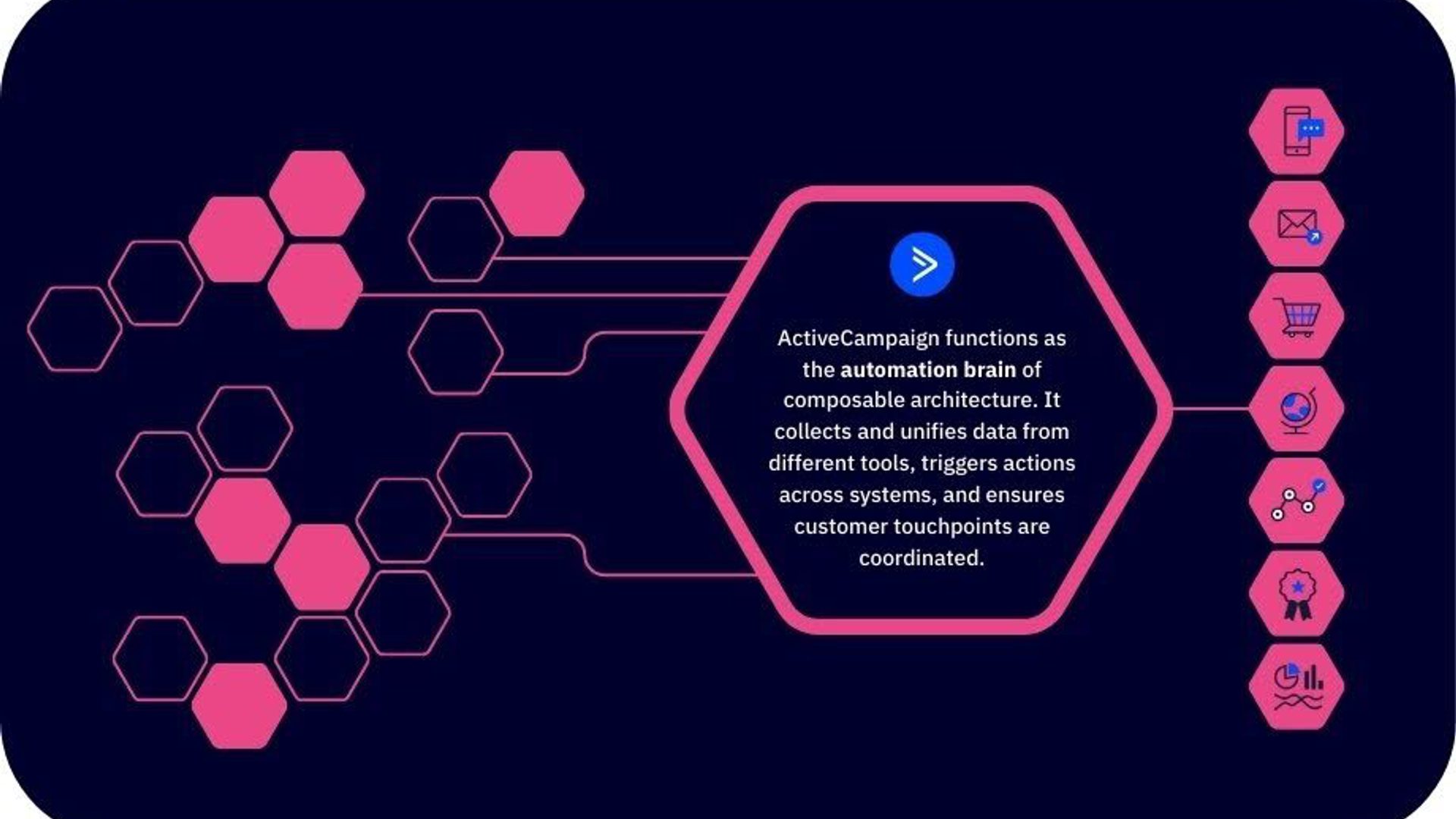
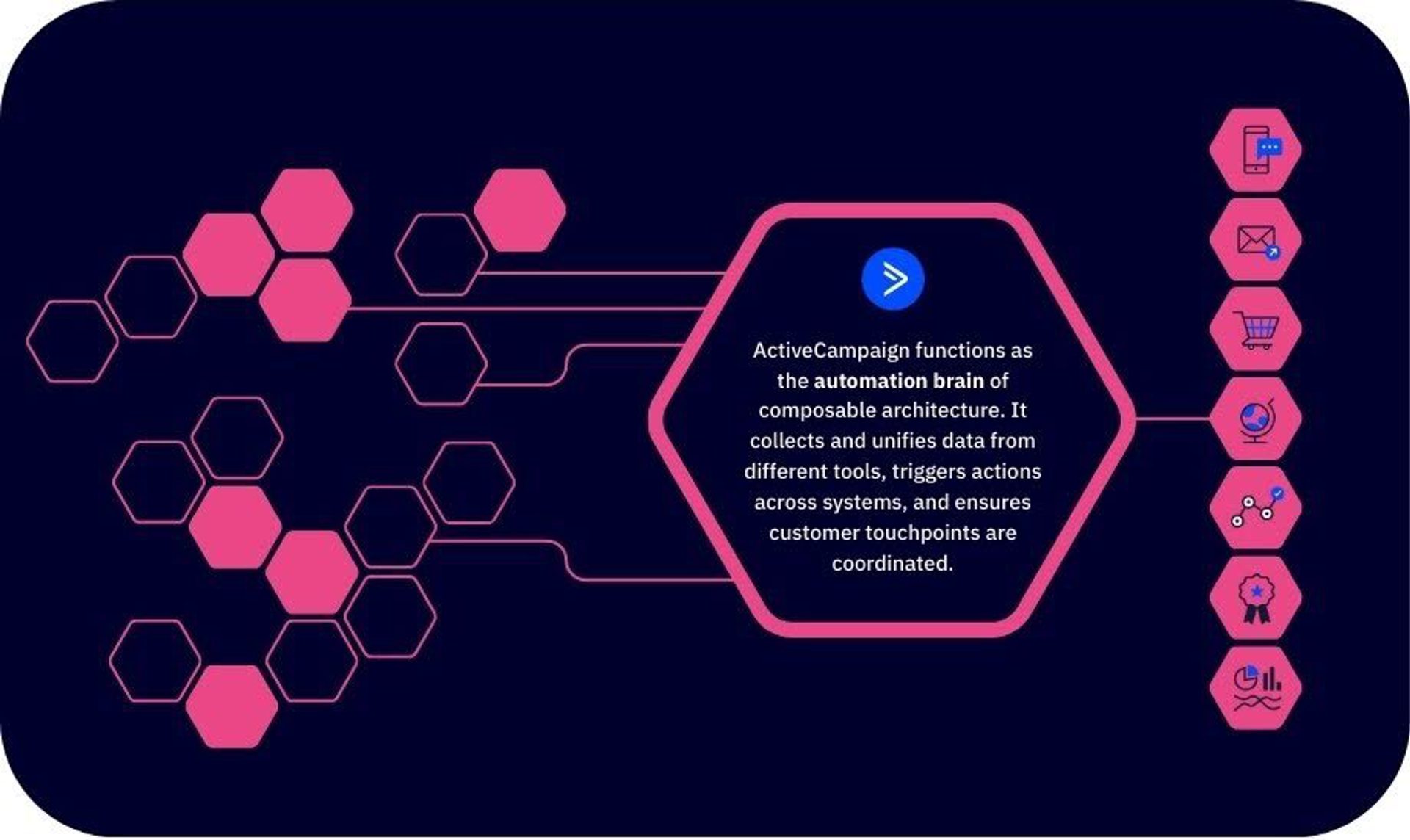
Platforms like ActiveCampaign serve this role by acting as the “automation brain” of the stack. They collect and unify data from different tools, trigger actions across systems, and ensure customer touchpoints remain consistent and coordinated. With native integrations and open APIs, teams can connect even more applications like CRM, ecommerce, messaging, or analytics, without forcing the rest of the stack to change.
ActiveCampaign also includes pre-built Automation Recipes that allow teams to implement one-click advanced automations and connect multi-component workflows seamlessly.
The orchestration layer ensures every part of your stack works together to deliver a cohesive customer experience.
The plug-in components
In a composable system, businesses assemble their own stack by selecting the plug-and-play components that best fit their needs. Some key components you might want to include in your composable system include:
- CRMs centralize customer data, interactions, and history. ActiveCampaign’s custom CRM allows businesses to model unique customer relationships and feed this data into other tools.
- Messaging channels enable direct communication with customers. ActiveCampaign provides native messaging capability for email, SMS, and WhatsApp. These channels can be fully integrated with other tools to boost message personalization and contextual triggers.
- Customer support systems manage inquiries, tickets, and feedback. When integrated with CRM and messaging tools, support interactions inform automated journeys and ensure timely responses.
- Ecommerce platforms like Shopify power online sales and capture transactional data, which can feed into CRM and messaging channels to personalize communications and trigger targeted follow-ups.
- Payment processors like Stripe are more niche ecommerce tools that manage transactions and subscription data. When connected to other components, payment events can trigger receipts, post-purchase journeys, or upsell campaigns.
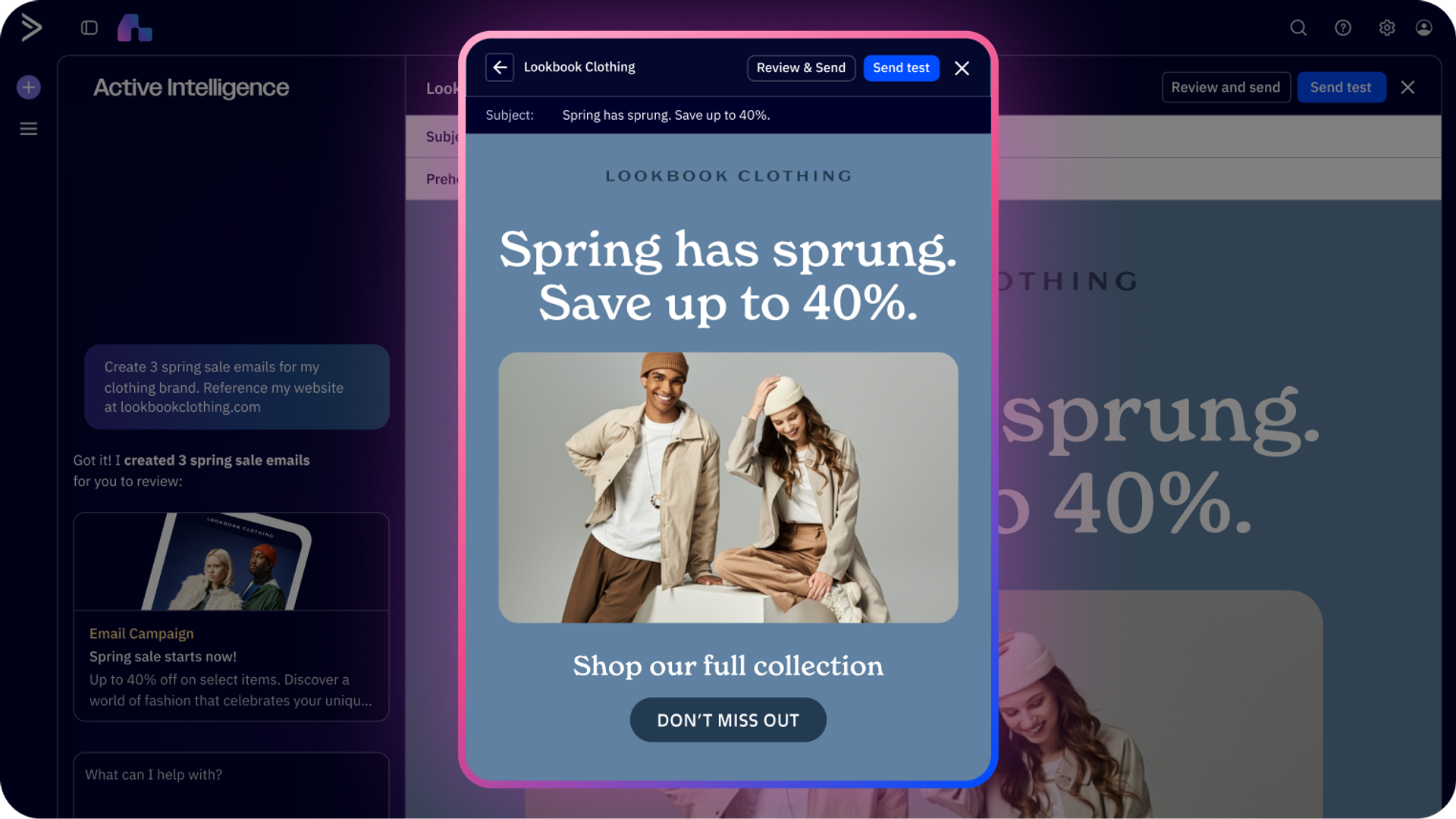
- Analytics & reporting tools provide insights on customer behavior, campaign performance, and trends. ActiveCampaign’s analytics provide a connected view by consolidating data from CRM, messaging, and other integrated systems. Additionally, Active Intelligence offers low-touch, high-gain insights automatically from plain-language prompts. It can identify trends, predict customer behavior, and highlight opportunities to feed directly into automation and messaging.
- Loyalty & review solutions track customer engagement, rewards, and feedback. When linked with CRM and messaging systems, the data can trigger personalized campaigns, reward notifications, and retention-focused journeys.
These systems are more powerful when carefully selected to fit your specific needs. By connecting the top tools you’ll create a CX stack that's greater than the sum of its parts.
For example, a retail brand would connect their ecommerce platform, CRM, and messaging channels to trigger personalized post-purchase emails and SMS campaigns, using analytics to identify repeat-purchase opportunities.
Or, a subscription business would integrate a support system, loyalty platform, and automation engine to streamline onboarding, resolve issues proactively, and send reward notifications—all orchestrated automatically across channels.
“The agility of the ActiveCampaign API has proven really useful in being able to connect our different systems. With an integrated tech stack, the small administrative steps necessary to update each project are now automated, saving what would add up to hours of tedious, error-prone data entry every month, and freeing up resources to do what we do best — provide custom research solutions for our customers.”
How composable CX evolves over time
One of the biggest advantages of a composable CX stack is its ability to grow alongside your business. Unlike rigid, monolithic systems, composable architecture allows teams to iterate quickly and experiment with new strategies without overhauling the entire stack. They can:
- Swap tools without disruption, replacing or upgrading individual components while keeping workflows and customer journeys intact.
- Add new channels as the strategy grows to integrate additional messaging, social, or channels seamlessly and reach customers wherever they’re engaging lately.
- Personalize experiences as data expands. The greatest potential of collected data is in advanced segmentation and personalization, delivering increasingly relevant, context-driven customer experiences. These practices become more powerful with the data you collect from a connected composable system.
This flexibility ensures your CX stack evolves alongside your business, not against it.
Inside a real-world composable CX: Internet Strategy Labs + ActiveCampaign
Internet Strategy Labs (ISL) needed a system that could adapt to the complexity of franchise sales. They chose ActiveCampaign not as a single, all-in-one replacement, but as a customizable orchestration layer that could connect a wide range of technologies into one cohesive FranTech stack.
“We started using the ActiveCampaign CRM for our own platform because we knew it was customizable and could integrate a lot of non-traditional things.” - Jimmy Weeks, Owner & CEO
Using ActiveCampaign’s open architecture, ISL built custom CRM fields to capture franchise-specific data like financial qualification status and desired territory. They then connected tools like Calendly, Zoom, and DocuSign via APIs and webhooks to automate handoffs across the sales journey. When a lead books a meeting, ActiveCampaign updates the CRM, triggers personalized follow-ups, and tracks contracts—all without manual intervention.
This composable setup led to impressive results:
- Reduced manual tasks by 50%
- Increased lead conversion rates by 40%
- Supported 25% year-over-year revenue growth
A large number of users have embraced a composable platform approach by adopting ActiveCampaign as their orchestration layer:
"I love how ActiveCampaign integrates everything. Whether it’s Google Ads, Facebook, or our chat bot, everything funnels into ActiveCampaign, and it makes our marketing seamless."
-Sherri Candelario, Co-Founder, Frank and Sherri
“One of the things we love about ActiveCampaign is the ability to integrate and capture data and take action from other systems that we use. This was part of our reason for choosing ActiveCampaign because it does so much for us. It has such great expandable capabilities.”
- Vent Thomas, Marketing and Systems Manager, Cancer Wellness Support
“ActiveCampaign has the best balance of usability, and most importantly, has a lot of integrations. The automations are more powerful than anything else that I've found elsewhere.”
- David Kennett, co-founder and COO, Optimale
“As soon as I started using ActiveCampaign, I realized that I hadn’t just picked the right platform, I’d chosen the right tech stack. That’s because there are so many integrations I can leverage to make email do the things that I want.”
- Russ Henneberry, Founder, theCLIKK
Build a platform architecture that moves as fast as you do with ActiveCampaign
Composable platform architecture gives CX teams the freedom to build systems that adapt as their business evolves—and ActiveCampaign is designed to support that flexibility at every layer. Our features act as building blocks that can be assembled and reassembled as you require:
- Modular, interchangeable features like automations, CRM, email, forms, and custom objects act as independent components that can be combined and adapted as your CX strategy evolves.
- Flexible, event-driven data models leverage tags, events, conditional logic, and custom objects to support growing data complexity and enable more precise, personalized customer experiences.
- Seamless extensibility connects native integrations, APIs, and automation triggers to unify tools across your stack, with ActiveCampaign acting as a central orchestration layer.
- No-code and low-code scalability empowers marketers to move quickly with intuitive tools, while giving advanced teams the flexibility to build, customize, and scale sophisticated workflows.
Composable platform architecture doesn’t hold your CX growth back, but moves with it.
Request a demo to explore how ActiveCampaign can help you build a composable CX stack designed for speed, adaptability, and long-term impact.
Composable Platform Architecture FAQs
Is composable platform architecture difficult to implement?
No, composable platform architecture doesn’t have to be difficult to implement. Many platforms, including ActiveCampaign, offer no-code and low-code tools that make composable architecture accessible. Most businesses start by connecting a few key tools and expand their stack as needs evolve.
How does composable architecture improve customer experience?
Composable architecture enables businesses to deliver personalized customer experiences by connecting best-in-class tools and automating workflows across channels. This results in faster response times, more relevant messaging, and unified customer journeys.
Is composable architecture only for large enterprises?
No, composable architecture can work for businesses of any size. Small and mid-sized businesses benefit from composable architecture by gaining flexibility, reducing vendor lock-in, and scaling their CX stack as they grow—without the complexity of traditional enterprise systems.
How does ActiveCampaign fit into a composable tech stack?
ActiveCampaign acts as the orchestration layer of a composable stack, connecting data and automations across your tools. Its modular features, open APIs, and deep integrations make it easy to unify your tools in a single, flexible system.