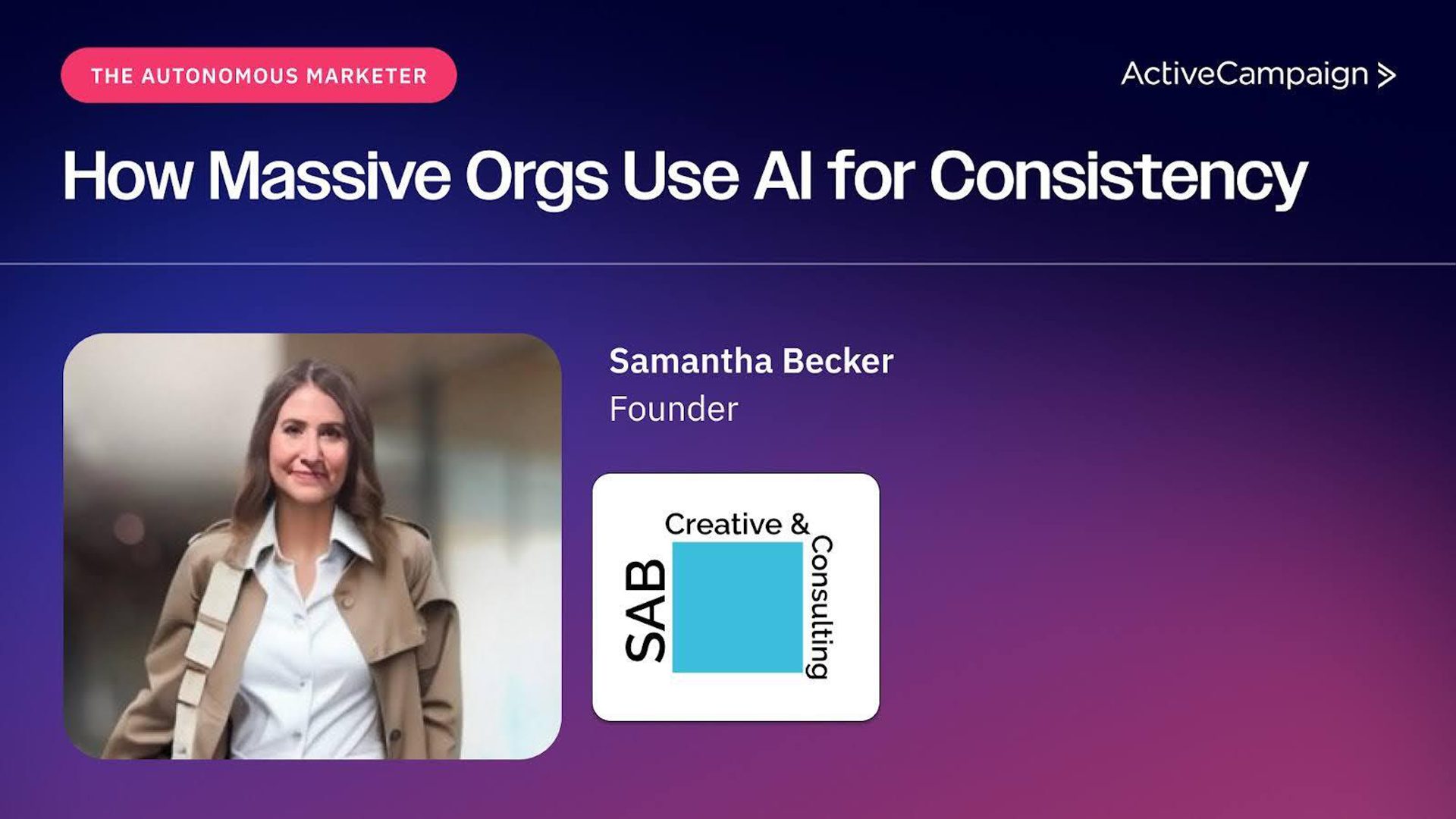
When marketing and communications consultant Samantha Becker started working with Arizona State University's Learning Enterprise she faced a critical challenge: how do you maintain consistent, high-quality communications across a sprawling ecosystem of programs, departments, and voices?
Her solution was surprisingly straightforward: she built an AI bot named Lenny.
"Every facet of marketing and communications requires strategy, intentionality, and collaboration between departments—and that's where my team and I come in," explains Becker, founder of SAB Creative & Consulting, a storytelling agency specializing in education marketing. "AI has enabled us to take the essence of each department and create capacity for anyone within those organizations to share consistent, powerful stories."
But Becker's approach goes deeper than simply using ChatGPT to draft social posts. She's created custom-trained bots that understand organizational voice, brand guidelines, and even administrators’ individual voices. Her work is helping educational institutions scale their communications while maintaining authenticity.
The real skills required: Communication strategy, not code
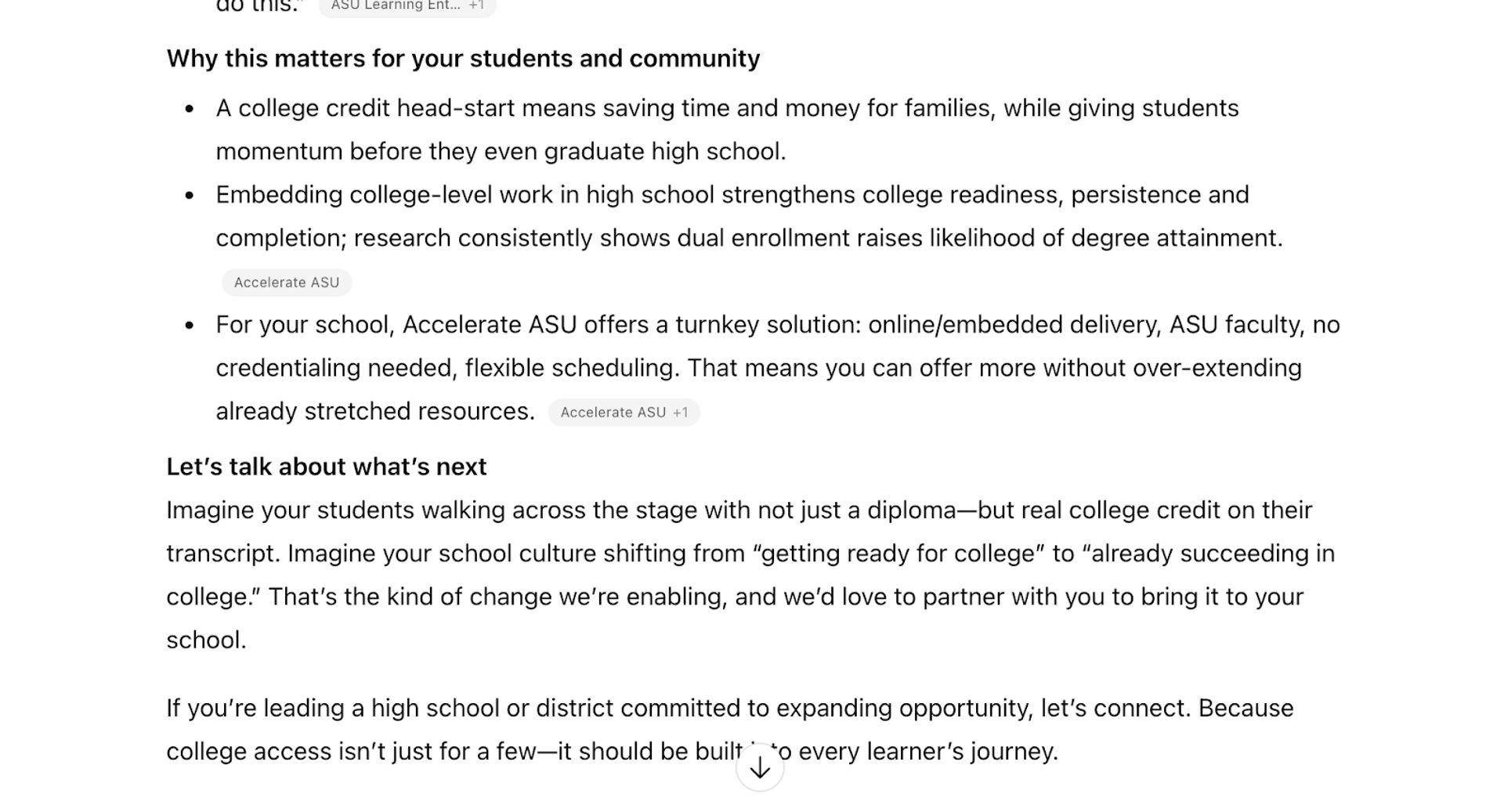
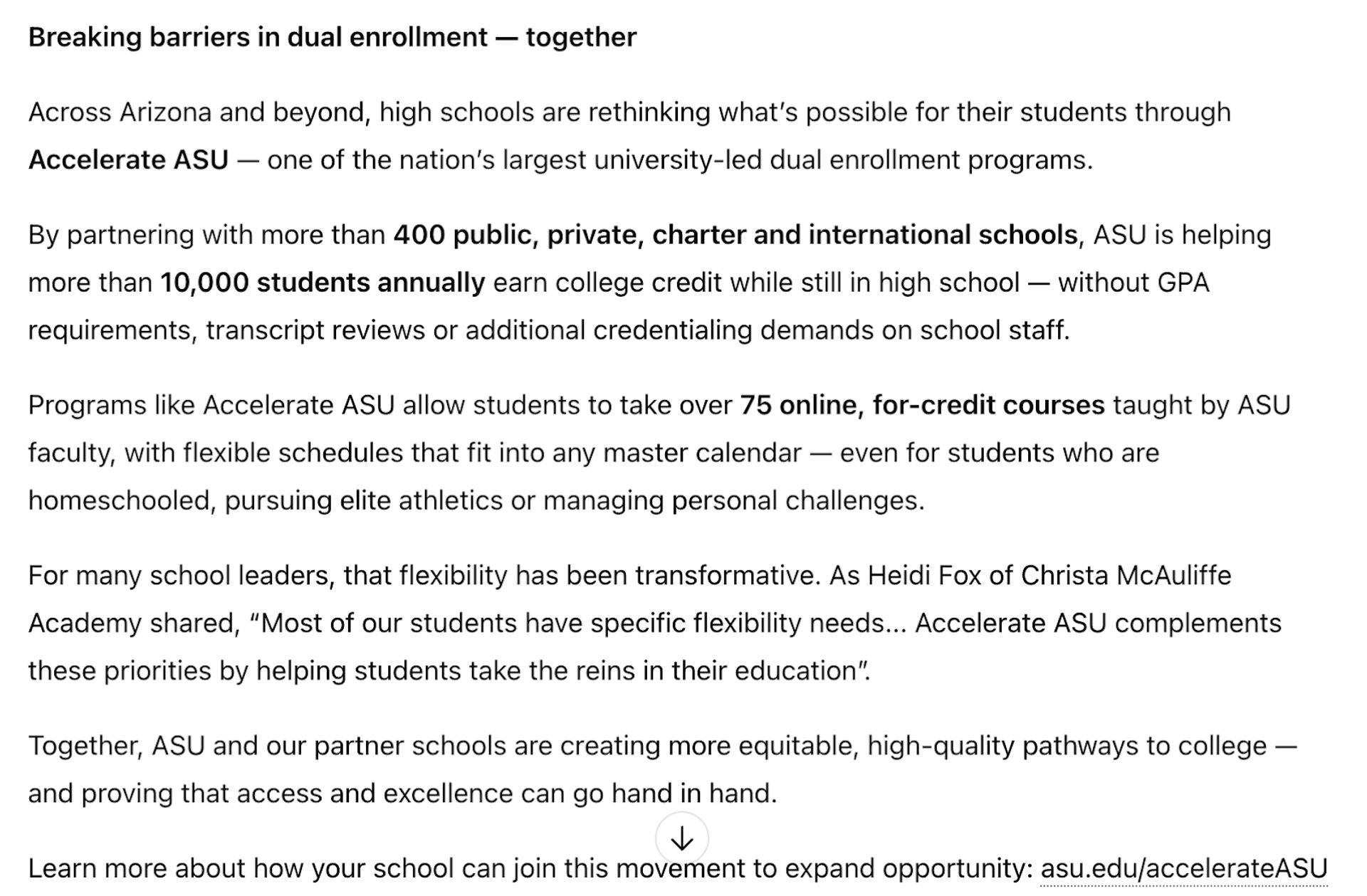
When Becker demonstrates Lenny in action, the difference between generic AI and a custom-trained bot becomes immediately clear. She prompts both standard ChatGPT and then asks Lenny to write a LinkedIn post about Accelerate ASU, the university's dual enrollment program that allows high school students to earn college credit.
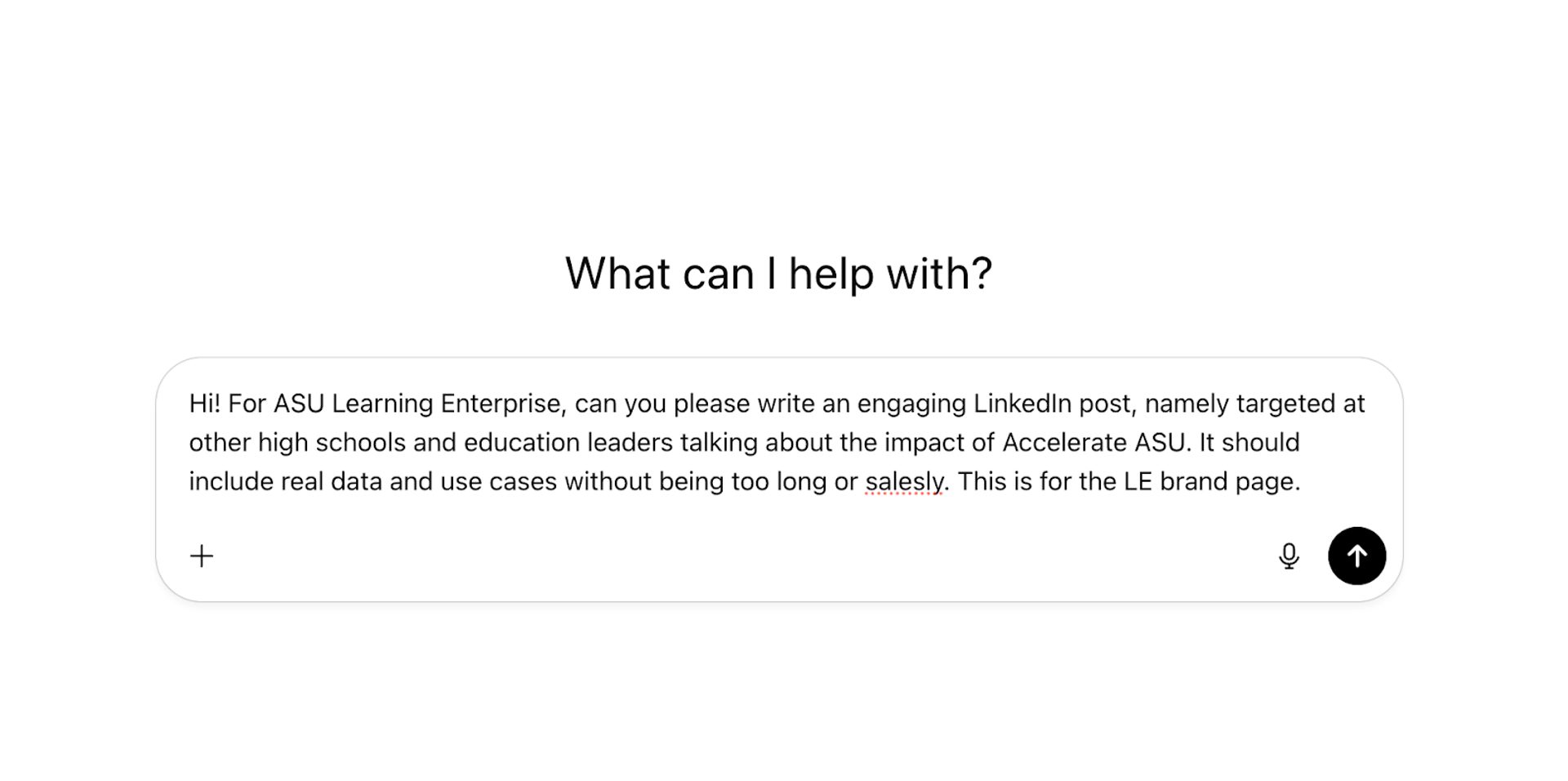
ChatGPT prompt
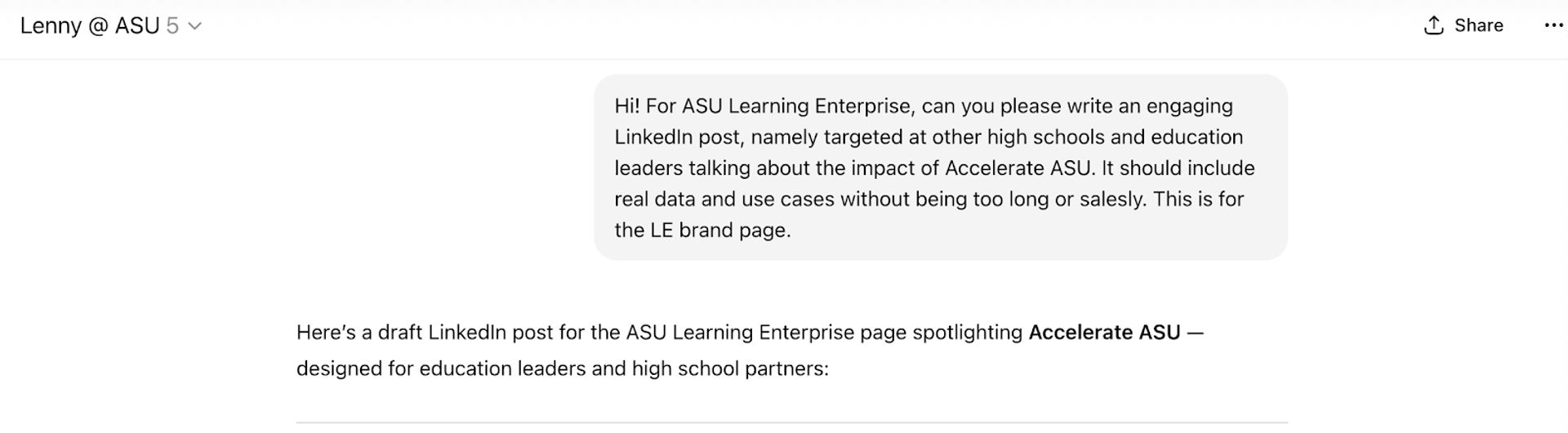
Lenny prompt
Standard ChatGPT produces a lengthy, article-style response riddled with bullet points and generic language.
"One of the best groups of people to create bots is professional communicators."
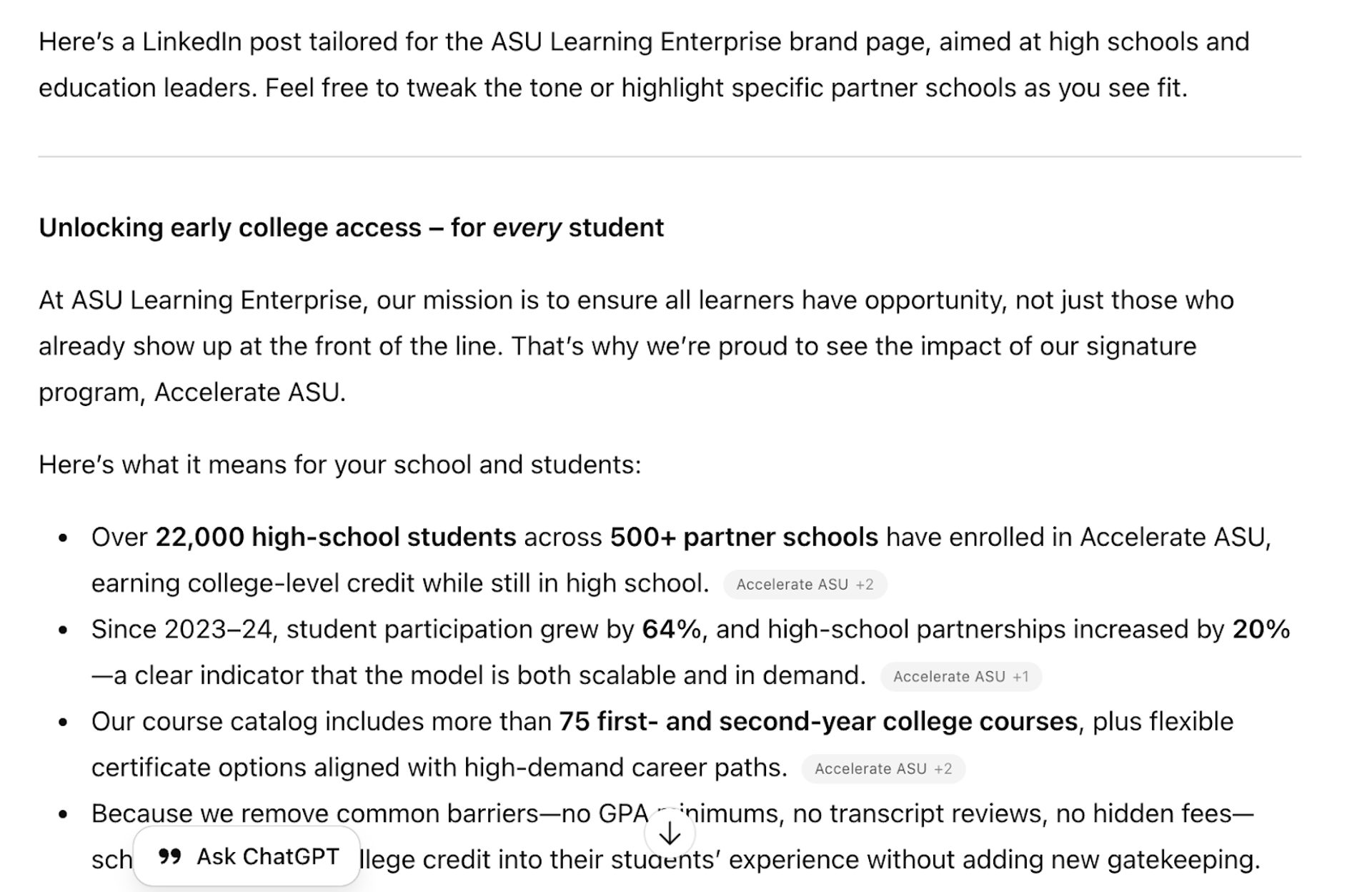
Lenny generates a concise, platform-appropriate post that incorporates specific statistics, such as how many learners are enrolled at any given time and uses ASU's brand guide and internal positioning to better communicate in the organization's preferred voice.
"People assume a lot of technical prowess is needed, but I'm here to demystify that," Becker says. "One of the best groups of people to create bots is professional communicators."
Why communications professionals? Building a bot requires the same skills you already use to create a communications strategy.
"Building a bot is no different from creating a communication strategy. You need to know your organization's voice, style, audience, and channels," she explains. "All AI is doing is dipping into your knowledge base. Whatever documents or instructions you give it is exactly what it's pulling from every time you prompt it."
Stop guessing and start strategizing.
Subscribe to The Autonomous Marketer for deep dives into the strategies that power effective AI implementation.
This reframing matters because it reveals where autonomous marketing differs from traditional marketing automation. Instead of just setting up triggers and workflows, you're training an agent that understands context, maintains voice consistency, and adapts outputs based on comprehensive brand knowledge.
How to build a custom bot: A step-by-step workflow
For ASU's Learning Enterprise, Becker followed a systematic approach that any marketing and communications professional could replicate:
Step 1: Compile your knowledge base
First, Becker gathered style guides and brand positions for the university’s various institutions and brands, transcripts from leadership talks, past owned media articles, and social posts that exemplified the organization's voice and detailed style guidelines.
She organized these materials into machine-readable documents: Word docs, PowerPoints, and PDFs.
(Read more about creating your own customer knowledge center.)
Step 2: Consolidate strategically
Because AI platforms limit the number of files you can upload, Becker recommends putting all voice attributes and brand position data into a single document.
A document like this is available to ASU staff. People can suggest changes to the document to update Lenny’s existing knowledge base. This approach makes the knowledge base transparent.
Step 3: Feed materials into your chosen platform
Next, Becker uploaded her consolidated documents into ASU’s enterprise ChatGPT workspace to create Lenny. She says that she programs AI chatbots in a "platform-agnostic way" that could work across any tool.
Step 4: Train for individual voices
Here's what makes Lenny particularly powerful: it knows how individual leaders at ASU communicate.
When Becker prompts Lenny to write a social post in a specific executive’s style, the bot generates content that matches the executive’s specific voice and tone, without additional context.
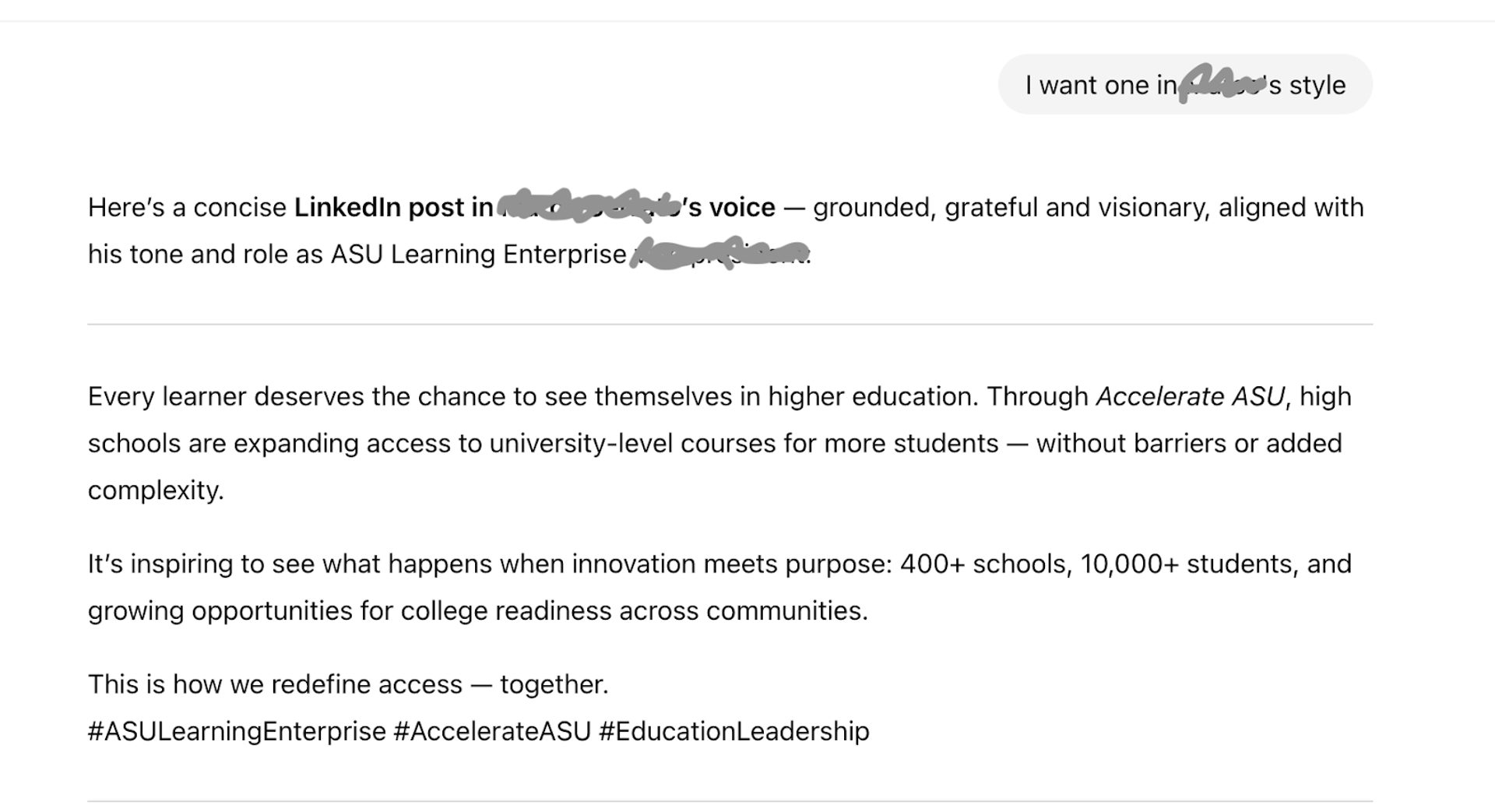
The result? An executive uncertain about what to post on LinkedIn can prompt Lenny for a draft. A new communications team member can use the bot to understand the organization's writing style. ASU’s staff can access Lenny to become more confident storytellers.
"ASU was the first university to adopt ChatGPT at an enterprise level, meaning everyone in the community has access," Becker explains. "It means anyone can feel empowered to be a communicator and a storyteller."
How custom chatbots solve real marketing problems
For organizations with numerous brands, multiple stakeholders, and limited resources, custom bots address specific pain points that generic AI can't touch:
Problem 1: Inconsistent brand voice across departments
When a university has hundreds of programs, each with its own communicators, maintaining voice consistency becomes nearly impossible. Lenny ensures everyone pulls from the same brand knowledge, whether they're in admissions, alumni relations, or academic affairs.
Problem 2: Lack of communications capacity
Many nonprofits and smaller institutions describe themselves as "scrappy." They lack the budget to build robust communications teams but need to tell compelling stories.
"AI becomes a creative muse for humans and helps set a tone for the team," Becker explains. "This is a repeatable and scalable strategy to start telling more stories and getting your voice out there."
"This is a repeatable and scalable strategy to start telling more stories and getting your voice out there."
Problem 3: Non-communicators forced to communicate
From program directors who need to write newsletters to faculty members who want to promote their research, custom bots can give reluctant communicators a starting point that matches organizational standards.
Why education can’t afford AI skepticism
While helping organizations like ASU, the University of Massachusetts Amherst, and Washington University in St. Louis integrate AI into their communications, Becker has witnessed plenty of skepticism surrounding AI in education, particularly around student cheating.
Her response is pragmatic: "Never in the history of history has banning something been effective."
She points to the irony of AI detection software that flags legitimate student work as AI-generated. A colleague submitted papers he'd written in high school and college—years before AI existed—and the software flagged them for cheating. Had he been a modern student who'd done authentic work, he could have faced academic probation.
"There are very real dangers and unknowns and complexities that surround the use of AI," Becker acknowledges. "But ignoring that is only going to make the divide worse."
Instead, she encourages educational institutions to accept that AI is already achieving mainstream adoption.
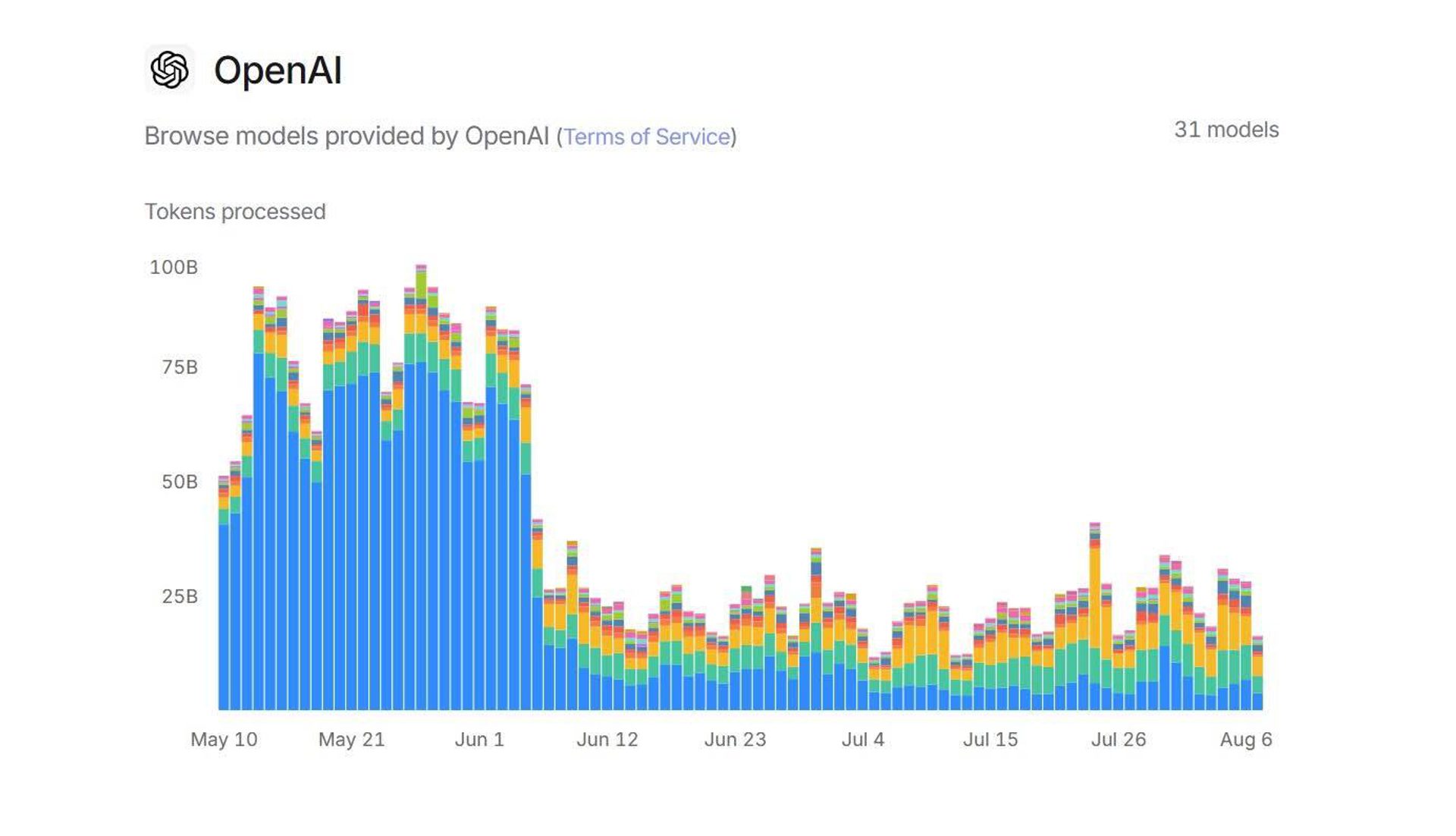
ChatGPT usage across higher ed institutions
Global ChatGPT usage falls across institutions when school is not in session. Data from OpenRouter via Futurism.
"It would be a disservice for education to ignore AI. We're training students for the future, and AI is already shaping every industry," she says.
The solution isn't prohibition but engagement. Universities are uniquely positioned to ensure AI development prioritizes ethical considerations and privacy protections, but only if they engage with the technology.
“A lot of AI innovation from an ethical standpoint has come from our universities. These institutions are coming together to make sure there are guide rails in place and that cybersecurity and privacy are acknowledged,” Becker says.
"Instead of banning AI, education and the private sector should go hand in hand to put ethics in and help eliminate bias," she argues.
What marketers can learn from Becker’s approach
Becker's work with educational institutions offers a blueprint for any organization struggling with brand consistency, limited resources, or distributed teams:
- Start with strategy, not tools: If you have a communications strategy, you have everything you need to build a custom bot. The technical work is minimal; the strategic work is everything.
- Treat your bot like a team member: Schedule regular maintenance. Gather feedback. Update its knowledge base with new materials. Monitor its outputs for quirks and biases. A bot trained once and forgotten will degrade in quality.
- Make training materials transparent and collaborative: When team members can see what instructions the bot follows, they can suggest improvements. Store voice attributes and brand positions in shared documents that you can evolve over time.
- Never skip the human review: Expect that AI outputs to always require editing. Use the bot to overcome blank-page syndrome and generate solid first drafts, then apply human judgment to refine tone, accuracy, and nuance to get it ready to ship.
As for concerns about AI replacing human communicators? Becker isn't worried. The skills required to build effective custom bots—strategic thinking, audience understanding, and storytelling expertise—are exactly what professional communicators already possess.
"When it comes to building a conversational bot, you might call that person a prompt engineer, but all that really means is I'm really good at asking questions."
"When it comes to building a conversational bot, you might call that person a prompt engineer, but all that really means is I'm really good at asking questions and building instructions for the bot, which is a communications skill set," she says. "This is not just for the tech bros. This is for anyone who knows the power of a good story and a good marketing strategy."
Master the strategy behind the tools. Subscribe to The Autonomous Marketer for expert insights on building custom bots, scaling your communications, and leading the way with AI.