ActiveCampaign vs. HubSpot

HubSpot customers are tired of paying premium prices for an overly complex platform that forces costly upgrades for basic features. ActiveCampaign gives them true value through powerful email marketing and automation at a fraction of HubSpot's cost, with better deliverability and an interface that's easy to use.

Free 14-day trial with email sign-up
Join thousands of customers. No credit card needed. Instant setup.

ActiveCampaign and HubSpot pros and cons

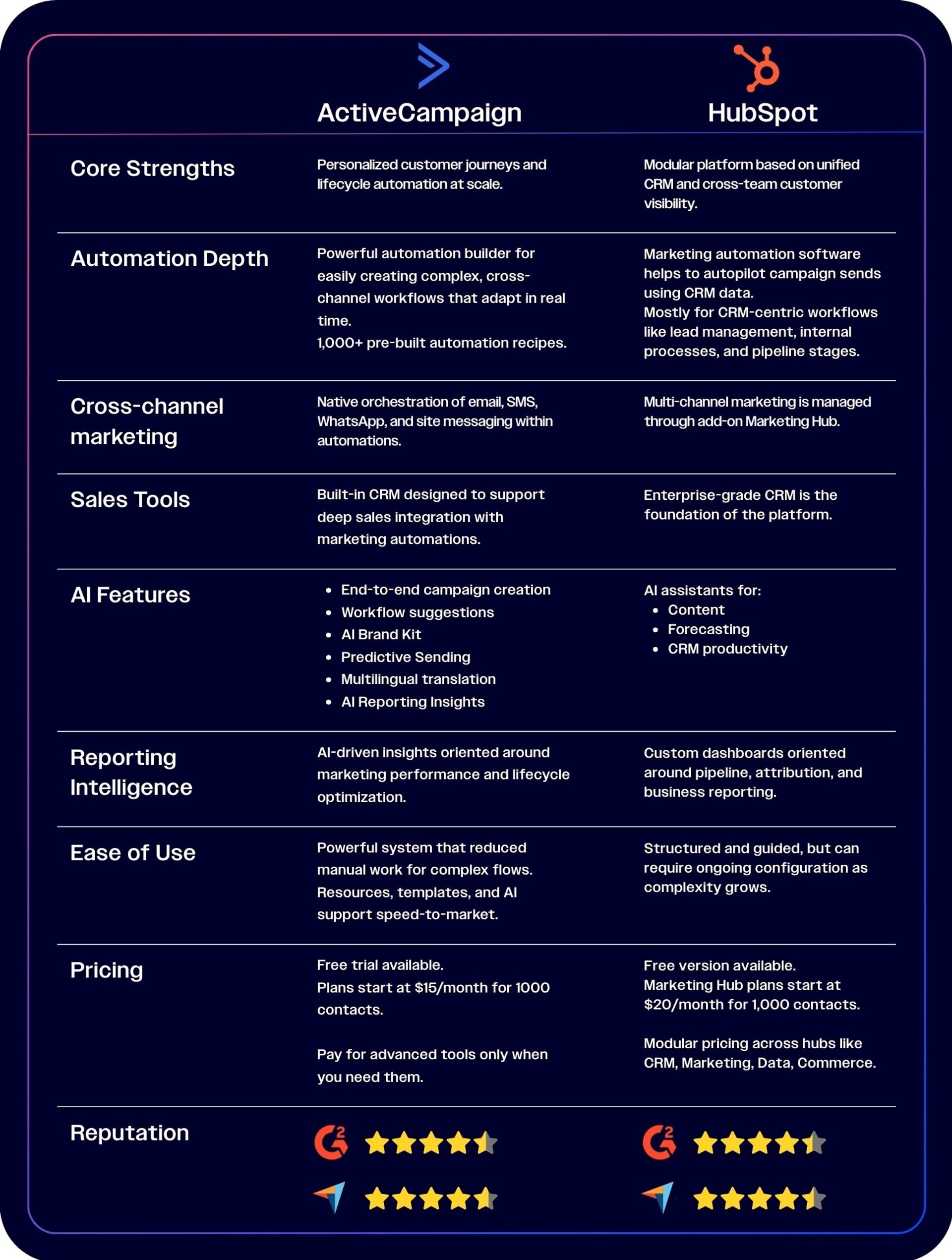
ActiveCampaignHubSpot
Starting price

Starting from $15/month billed annually

There’s a 14-day free trial, and it’s more affordable as you scale

Starting from $15/month/per seat billed annually

There’s a limited free version, and a 30-day free trial

Who's it best for?Best for small to medium businesses, agencies, and marketers that want an integrated platform of email, WhatsApp, and SMS marketing with AI agents that help to autonomously imagine, activate, and validate their campaigns.Best for growing companies with dedicated sales teams that need a comprehensive sales and marketing platform with CRM, lead management, and full-funnel automation capabilities.
Integrations950+1600+
Deliverability rate93.4%79.8%
Email templates250+99
Monthly email sends10,0005,000
AI capabilitiesForward-thinking with their number of AI agents, advanced segmentation, and their belief in an autonomous marketing framework. AI features are available on all paid plans.Comparable AI features but still lacks in AI-driven self-optimizing workflows and advanced segmentation. Many of their AI features are locked behind high-tier plans like Premium or Enterprise.
A/B testingAvailable on all plansOnly available on higher plans
Marketing automationExcels in automation, offering pre-built sequences and common recipes with advanced segmentation and conditional logic so you can follow up at the right time.Offers automation, though it’s a little less intuitive. The tool has more app integrations with its automation builder.

What are customers saying about why they switch?

Customers are tired of HubSpot’s expensive bundles that cost them more for features they never end up using anyway. They’re choosing ActiveCampaign because they’re seeking:

  • A more reasonably priced platform (with many customers reporting that HubSpot’s pricing is “egregiously priced,” “astronomical,” and “not justified” for what they’re getting
  • An easy-to-use platform without unnecessary feature bloat
  • Fair pricing tiers without forced upgrades for basic features and a pay-for-what-you-use pricing model
  • Superior email deliverability and inbox placement
  • A streamlined, non-clunky onboarding process and free migration assistance
  • Flexible, modular solutions that they can customize
  • Better integrations with existing tools like Salesforce, WordPress, and Zapier
  • Responsive, personalized customer support
  • Advanced automation tools included in basic tiers, many HubSpot customers have said that even basic automation or onboarding sequences require moving to much higher-priced plans
  • A platform designed for small business needs, not enterprise complexity

Your peers are making the switch. Hear why in their words:

Real customers are sharing their thoughts:

"Better than HubSpot"
“ActiveCampaign is straightforward to use. It's offering the perfect amount of features without being too bloated (I'm looking at you, HubSpot!). We mainly use automations, email campaigns, and landing pages, and it has already saved us hundreds of hours.”

– Dennis V., G2 review

"Best value at this price range"
“Automations are the best! ActiveCampaign is a great newsletter software, but automations is what you need to be able to scale your business. I’m using multiple ESPs, and ActiveCampaign is the smartest in this area (even has smarter functions than HubSpot).”

– David B., G2 review

“We felt ActiveCampaign had the strongest capability.” 
“We used HubSpot before, but ActiveCampaign has a lot more logical flow to it. This has allowed us to create a more complicated set of automations based on people moving through that pipeline…. And it was relatively intuitive to get all that set up with you. ”

– Alec M., Party Headphones

When you switch from HubSpot to ActiveCampaign, enjoy free 1:1 migration

Adopting a new or switching to another platform can be an undertaking but it’s inevitable if you’re hitting certain limits with your current tool. When you sign up for an ActiveCampaign Pro or Enterprise plan, we’ll migrate your email lists, transfer your templates, rebuild your automations, and set up your forms and landing pages. All for free.

You’ll get one-on-one sessions with a dedicated team member, along with resources like help articles and our community to get you set up fast.

Watch along for a high-level view of where each platform wins.

See how ActiveCampaign and HubSpot compare feature-by-feature

Download the free comparison table now.

Autonomous marketing that truly works for you

Traditional marketing automation promised to make your life easier, but ended up creating a new headache. You’re stuck building complex “if this, then that” workflows, constantly A/B testing, and manually coordinating campaigns across different channels. ActiveCampaign’s goal-driven autonomous marketing unifies all of your marketing activities in one place, turning sophisticated marketing coordination into something as simple as having a conversation.

From marketing automation to autonomous marketing

  • Marketing automation: You build it, configure it, and optimize it
  • Autonomous marketing: You set goals, AI agents help you achieve everything

At its core, autonomous marketing is the process of your marketing technology orchestrating seamless cross-channel journeys with minimal human intervention. It’s beyond just taking orders and carrying out tasks. To truly reach a level of autonomy, your tools should be doing more than automating single-channel, repetitive tasks, connecting a few channels, or using some if/then logic.

A lot of marketers are stuck in the idea that AI can only help with the task-level components of your day. But a truly advanced platform will weave AI through all three pillars of autonomous marketing so you can not only use AI to help you get started, but to also measure your success and make sure you’re taking the right approach.

The three pillars of autonomous marketing are:

  • Imagine: Conceptualize and create campaign strategies, from generating complete email campaigns to building brand-consistent templates.
  • Activate: Execute your marketing intelligently across channels, embedding real-time customer insights directly into your automations.
  • Validate: Learn from every interaction to continuously ensure your marketing doesn’t just automate tasks—it gets smarter with every customer interaction.

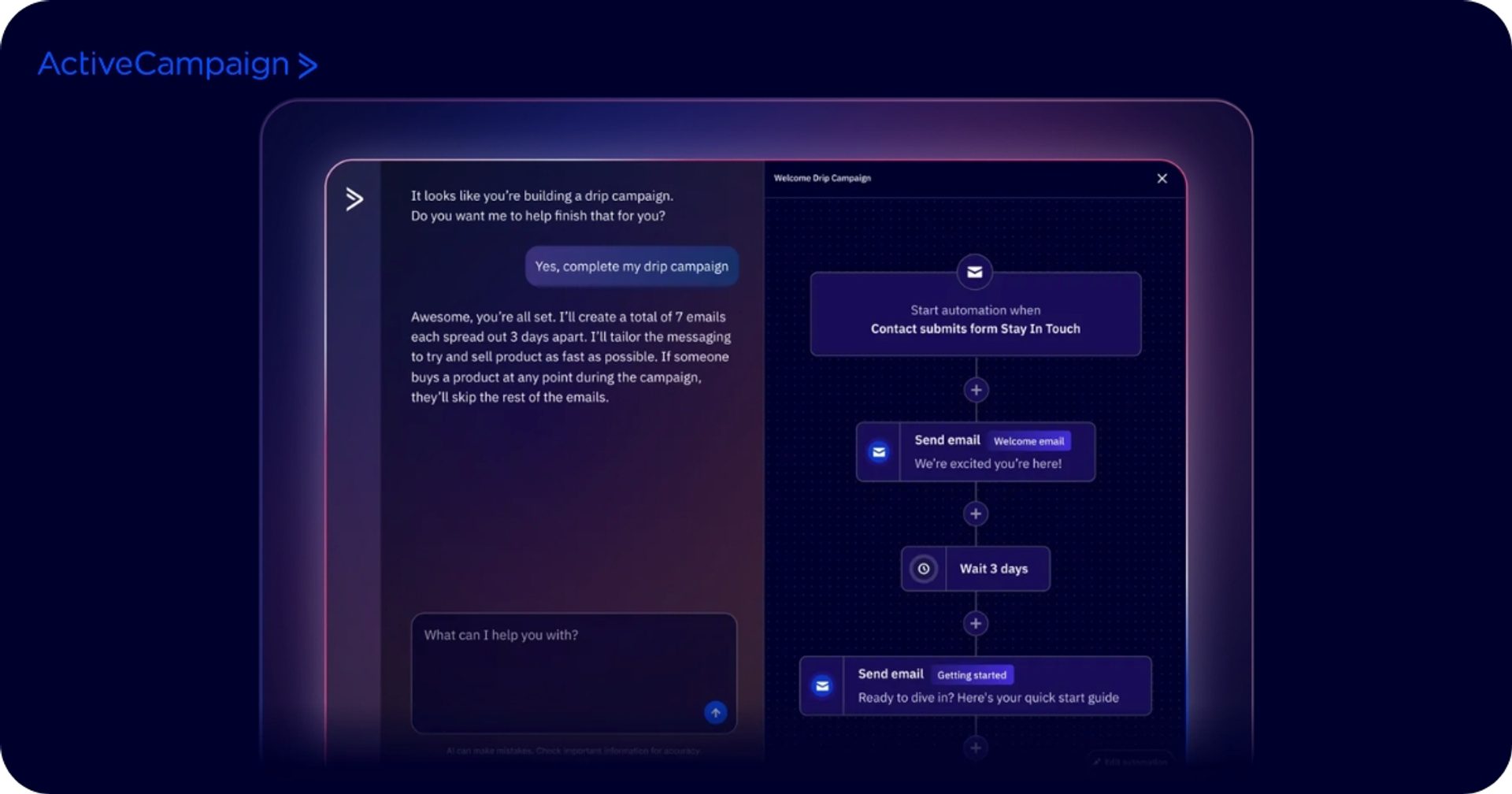
To see one of these pillars in action, let’s look at ActiveCampaign’s AI Campaign Builder. Give it a single prompt and it generates complete email campaigns, including subject lines, layouts, images, content, and CTAs in seconds.

No more starting at blank templates or spending hours crafting the perfect workflow. ActiveCampaign’s AI agents help you get a running start. 

This perfectly exemplifies the Imagine pillar of autonomous marketing. AI is helping you to conceptualize and create campaign strategies from a single prompt, instantly transforming your idea into executable campaign assets.

While most marketing platforms are still asking you to build workflows step-by-step, ActiveCampaign is flipping the script entirely. Instead of making you the workflow architect, we’ve created Active Intelligence, a conversational workspace where you simply tell the platform what you want to achieve, and AI handles the heavy lifting.

The AI handling it? They’re called AI Agents, and ActiveCampaign has over a dozen that help you imagine, activate, and validate your campaigns.

Your new coworker: Active Intelligence

What sets ActiveCampaign apart is our multi-agent approach. While competitors bolt AI features onto existing platforms, ActiveCampaign has Active Intelligence that puts autonomous marketing front and center. Active Intelligence drives the AI agents to do the work you need to do faster so you can have more time to focus on what matters.

Let’s dive deeper into some of the AI agents both platforms offer.

Brand consistency: What each platform offers

When it comes to brand consistency in your marketing efforts, both ActiveCampaign and HubSpot offer compelling solutions—but they take distinctly different approaches. Here’s what sets them apart.

What ActiveCampaign brings to the table

ActiveCampaign’s AI Brand Kit is laser-focused on email marketing efficiency, automatically pulling your existing brand elements from your website to create email templates in seconds.

Let AI do the tedious work for you, so you have more time to do the rewarding work. 

Looking at both platform’s features, ActiveCampaign’s AI Brand Kit is straightforward and efficient: Simply type in your website URL, click import, and it does the rest. ActiveCampaign analyzes your fonts, colors, and images, and builds you ready-to-go email templates in no time. It’s built for businesses that already have an established brand identity and want to quickly translate that into their email marketing.

It all happens in a few clicks:

  • Smart website analysis: ActiveCampaign’s AI Brand Kit scans your existing website and automatically extracts your brand’s DNA—fonts, colors, imagery, even your mission statement.
  • Instant email template generation: Rather than just giving you raw brand assets, ActiveCampaign creates actual, usable email templates that are ready to send.
  • Multiple brand support: Your ActiveCampaign account can hold up to five different brand kits (on Plus, Professional, and Enterprise plans), perfect for agencies or businesses managing multiple brands or seasonal campaigns.

The user experience feels effortless. You’re not starting from scratch or manually inputting hex codes. You’re leveraging work you’ve already done on your website to power your email marketing.

See the AI Brand Kit in action.

What HubSpot brings to the table

HubSpot’s Brand Kit Generator is a more general-purpose tool that helps you create brand elements from scratch, with broader integration across its platform.

HubSpot’s Brand Kit Generator is a good solution for businesses with limited budgets and not looking for intricate brand assets. 

Their Brand Kit Generator is designed for businesses that need to create a brand identity from the ground up. HubSpot creates custom logos, color palettes, and brand icons, allowing you to build guidelines that ensure consistency across marketing materials.

Here’s what they promise:

  • Logo creation from scratch: Complete AI-powered logo generator with industry-specific templates and customization options.
  • Comprehensive asset package: Export high-resolution files compatible with both web and print in multiple formats (JPG, PNG, WebP, SVG).
  • Broad platform integration: Assets sync across HubSpot's CMS, email tools, and other marketing features.

The strength here is breadth—you get a complete branding toolkit that works across HubSpot’s entire ecosystem.

Who comes out on top?

Both tools offer impressive features for maintaining your brand identity, but ActiveCampaign’s Brand Kit is more mature and purpose-built for practical marketing execution.

To start, the speed to value is unmatched. ActiveCampaign’s URL-to-templates workflow is impressive. You can go from entering your website to having branded email templates ready to use in under a minute. HubSpot’s approach, while comprehensive, requires more manual setup and decision-making.

ActiveCampaign also offers multi-brand flexibility, giving you the option to manage multiple projects and hold up to five brand kits at once.

Don’t be limited to just one brand kit. ActiveCampaign allows up to five. 

This is a game-changer for agencies, franchises, or businesses with seasonal campaigns. In comparison, HubSpot limits you to one brand kit per account unless you pay for their Brands add-on.

ActiveCampaign doesn’t just give you brand assets—it creates email templates already optimized for the platform. HubSpot’s assets are more generic and require additional work to implement in email campaigns.

It’s important to note that if you don't have an established brand identity, HubSpot's logo generator and comprehensive asset creation might be exactly what you need. For most businesses with existing websites and established branding, ActiveCampaign's AI Brand Kit offers a more practical, efficient solution.

The takeaway: HubSpot's offering is broader but less focused. It's excellent if you're building a brand from scratch or need assets for a wide range of marketing materials. But if your primary goal is consistent, on-brand email marketing, ActiveCampaign's targeted approach wins out.

ActiveCampaign’s AI Brand Kit demonstrates how the Imagine pillar works in practice, taking your existing brand identity and instantly translating it into campaign-ready assets. This sets the foundation for consistent execution across all channels.

AI that turns your data into action

ActiveCampaign and HubSpot have taken different approaches to embedding AI directly into their marketing automation workflows. ActiveCampaign’s AI Actions Library and HubSpot’s Ask Breeze functionality both promise to transform your automations from simple trigger-and-response sequences into intelligent, data-driven customer journeys.

What ActiveCampaign brings to the table

ActiveCampaign has built what feels like an "AI action marketplace" designed for marketers who want intelligence without complexity. The AI Actions Library treats artificial intelligence as modular building blocks that you can drop into any automation sequence with minimal setup.

The brilliance lies in the simplicity: you select an action, assign it to an automation step, and write plain-language instructions. Want to analyze customer sentiment or translate content for global campaigns, or organize messy data to enrich customer profiles? There’s an action for each one.

Core functionality:

  • Plug-and-play intelligence: Each AI action is purpose-built for specific marketing tasks. You don't need to become a prompt engineer or worry about data access—the actions are designed to work automatically with your existing contact data and behaviors.
  • Real-time customer insights: The AI Actions Library embeds live customer intelligence directly into your automations. Every touchpoint becomes informed by the latest data about that specific contact, enabling true 1:1 personalization without manual intervention.
  • No-code customization: You can orchestrate complex AI-powered tasks using plain, conversational language. Just write out your instructions and let the AI handle the technical implementation.

This is a decision-making engine that can automatically route customers, customize content, or trigger specific follow-up sequences based on their real-time insights. The experience is effortless. You’re not building custom AI agents or crafting perfect prompts. You’re selecting pre-built intelligence that immediately understands your marketing context and gets to work.

What HubSpot brings to the table

HubSpot's Breeze functionality takes a conversational approach, essentially embedding an AI analyst directly into your workflows. Rather than offering pre-built actions, Breeze lets you have a dialogue with artificial intelligence about your customer data.

You can ask Breeze to analyze enrolled records, summarize customer behavior, categorize contacts, or draw insights from complex data patterns. The AI processes your request and feeds the output directly to subsequent workflow actions.

Core functionality:

  • Conversational flexibility: Instead of being limited to pre-defined actions, you can ask Breeze to perform virtually any analysis or data processing task using natural language prompts.
  • Deep CRM integration: Breeze leverages HubSpot's comprehensive customer data, accessing contact histories, deal information, and engagement patterns to provide nuanced insights that inform your automation decisions.
  • Custom analysis capabilities: You can request specific types of analysis that go beyond standard marketing actions—complex data categorization, custom scoring algorithms, or unique business logic that fits your specific needs.

The AI can analyze patterns across multiple contacts and suggest optimizations or identify trends that inform broader strategic decisions.

However, this flexibility comes with complexity. Breeze requires you to explicitly include all relevant context in your prompts—it won't automatically access other record properties or timeline activity unless you specifically add them through personalization tokens. You need to understand which data to include and how to structure requests for optimal results.

FYI: ActiveCampaign offers greater flexibility and cost savings compared to HubSpot, especially as your business scales. With pay-as-you-go pricing starting at just $1/month for 200 credits (vs. HubSpot’s $30/month for 100 credits), you get better value at every level. HubSpot’s Breeze Intelligence forces costly bulk purchases (like $5,000 for backfill enrichment for bulk data updates), while ActiveCampaign scales with you, no overpaying for unused features.

ActiveCampaign’s pay-per-use model ensures you never overpay, ideal for small, medium, and growing businesses.

Who comes out on top

Both platforms represent significant advances in AI-powered marketing automation, but they serve different audiences and use cases. ActiveCampaign's AI Actions Library emerges as the more practical solution for most marketing teams.

ActiveCampaign wins on ease of implementation and consistency. The pre-built actions eliminate guesswork. You don't need to craft perfect prompts or become an AI expert to get predictable results. You can implement sophisticated AI-powered hyper-personalization in minutes rather than hours.

HubSpot has advantages for specific scenarios. If you have technical resources and need highly customized AI analysis beyond pre-built actions, Breeze offers more flexibility. It's also deeply integrated with HubSpot's broader ecosystem.

ActiveCampaign's AI Actions Library democratizes artificial intelligence for everyday marketers, while HubSpot's Breeze offers depth for those willing to invest in the learning curve.

The takeaway: For most businesses, ActiveCampaign's approach represents the future of autonomous marketing—intelligent enough to deliver sophisticated results, but simple enough that your entire team can implement and benefit from it immediately.

The AI Actions Library showcases both the Activate and Validate pillars working together to execute real-time intelligence within your automations to hyper-personalize contact’s messages while simultaneously learning from customer interactions to improve future touchpoints.

AI reporting: What each platform offers

Both ActiveCampaign and HubSpot have developed distinct approaches to AI-powered reporting, each addressing the challenge of transforming data abundance into actionable business intelligence.

What ActiveCampaign brings to the table

ActiveCampaign’s reporting solution is a strategic decision-making tool that emphasizes actionable insights over traditional data visualization.

Business Goals represents a shift from descriptive analytics toward predictive recommendations. You’re able to get AI recommendations tailored to your goal, whether it is reallocating resources, adjusting timelines, or doubling down on what’s working to optimize your path to success.

Core functionality:

  • Pattern recognition: The system identifies trends across large datasets that would typically require extensive manual analysis.
  • Predictive analytics: Leverages historical performance data to forecast future outcomes and campaign effectiveness.
  • Strategic recommendations: Provides specific, actionable guidance tailored to business objectives, whether that involves resource allocation, timeline adjustments, or campaign optimization.

Rather than generating additional dashboards, ActiveCampaign consolidates campaign performance data across channels to deliver contextualized recommendations. The platform connects campaign activities directly to business outcomes, enabling marketers to understand how individual initiatives contribute to broader organizational goals like lead generation and conversion optimization.

The idea is to move organizations from reactive reporting toward proactive strategic planning.

What HubSpot brings to the table

HubSpot has developed a comprehensive AI reporting framework built around natural language interaction and intelligent data enrichment. Their Breeze Intelligence emphasizes accessibility and data completeness across the customer lifecycle.

Core functionality:

  • AI report generation: Users can create custom reports through conversational queries, eliminating the need for technical report-building expertise. The system generates complete visualizations with automated descriptions and allows real-time parameter adjustments.
  • Breeze Intelligence data enrichment: Enhances CRM records with external data sources, populating missing contact and company information from a database spanning over 200 million profiles. This includes industry classifications, company size, revenue estimates, and organizational details.
  • Buyer intent analytics: Analyzes website visitor behavior to identify high-intent prospects, tracking engagement patterns and page interactions to prioritize leads based on demonstrated interest levels.

HubSpot's strategy centers on democratizing data analysis while simultaneously improving data quality. The conversational reporting interface makes complex data exploration accessible to non-technical users, while the intelligence layer ensures reports are built on comprehensive, accurate information.

Who comes out on top?

Both platforms address the fundamental challenge of converting data volume into business value, though they pursue different methodologies. The choice between them largely depends on whether you prioritize strategic advisory capabilities or comprehensive data exploration and enrichment functionality.

The takeaway: 

ActiveCampaign excels in scenario-based strategic planning and campaign optimization guidance. It may be more suitable for those seeking clear strategic direction and campaign optimization recommendations.

HubSpot provides data exploration capabilities and customer intelligence for prospect segmentation. It may better serve teams that require flexible data analysis capabilities and comprehensive customer intelligence.

Here we see the Validate pillar in action. ActiveCampaign’s Business Goals transforms campaign data into strategic recommendations, while HubSpot focuses on data enrichment and exploration. Only ActiveCampaign connects insights directly back to campaign optimization.

AI that translates for you: What each platform offers

Both platforms offer AI translations, but as we’ve seen, how they approach it differs. ActiveCampaign has built AI translation directly into their platform’s DNA, while HubSpot focuses on broader content localization with significant gaps in email capabilities.

What ActiveCampaign brings to the table

ActiveCampaign’s AI Translations is built specifically for email marketing, allowing you to send personalized email campaigns in each subscriber’s language with one send.

This drives engagement, builds trust, and increases conversions across global audiences.

Core functionality: 

  • Single campaign, multiple languages: Create one standard email campaign, enable translations, and ActiveCampaign’s AI immediately translates the email to all preferred languages based on each contact’s “Preferred Language” field.
  • Smart contact detection: The system automatically checks the language selected in the “Preferred Language” field for each contact and generates appropriate translations. If a contact doesn’t have a preferred language set, they receive the default version.
  • Review and refine capability: ActiveCampaign doesn’t just dump AI translations on your audience. Once translations are generated, you can review each language version and edit the content and images before sending, ensuring accuracy and cultural appropriateness.
  • Comprehensive reporting: You can view performance metrics for each translated version individually, allowing you to optimize messaging for specific language audiences based on actual engagement data.

The user experience is effortless. You’re not managing multiple campaigns or worrying about complex setup. You create one email, enable translations, review the results, and send it to your entire global audience with confidence.

ActiveCampaign supports 75 languages. HubSpot supports 40.

What HubSpot brings to the table

HubSpot has built a content localization system, but their approach reveals a significant gap when it comes to email marketing. Their Breeze AI translation capabilities are powered by DeepL and can only automatically translate page and post content into other languages for websites, blogs, and landing pages.

Core functionality: 

  • Web content translation: HubSpot's automatic translation is available for website pages, landing pages, and blog posts, with the ability to create automatically translated content as new language variations or replace existing content. Create blogs in multiple languages The system integrates seamlessly with their CMS for comprehensive website localization.
  • Professional translation partnerships: HubSpot uses DeepL's AI translation in their localization workflow and has scaled their efforts to deliver high-quality, multilingual content faster than ever before. This enterprise-level approach ensures high translation quality for web content.
  • Multi-language content management: HubSpot excels at organizing and managing translated content across their platform, with language switchers, SEO optimization for different languages, and centralized content management tools.

Landing pages and blog page AI translation is possible, but not marketing email translation. Users have specifically requested this functionality, with one noting "Would also be fantastic" to have email translation capabilities.

This means businesses using HubSpot for email marketing must either create separate email templates for each language manually, use third-party integrations, or rely on external translation services—a significant workflow disruption compared to their seamless web content translation experience.

Who comes out on top?

When it comes to translation, one of the most critical touchpoints for customer engagement, ActiveCampaign delivers an impressive solution while HubSpot still has gaps to fill.

ActiveCampaign’s native AI translation features transforms the complex challenge of multilingual email marketing into a single-click solution. You can reach global audiences without the operational overhead of managing multiple campaigns or coordinating separate translation processes.

If your primary need is translating web content, blog posts, and landing pages, HubSpot’s DeepL-powered system may be what you’re looking for. Still, HubSpot users have been requesting email template translation since 2021, with one noting “It’s 2025 and this idea was from 2021, please consider, we have 48 votes and counting!” This is a fundamental limitation for businesses where email marketing is central to their global strategy.

The takeaway: ActiveCampaign has solved the email translation challenge that most global businesses actually face day-to-day, while HubSpot has built impressive web content translation capabilities but left email marketers to manage translations manually.

True cross-channel intelligence

True autonomous marketing doesn't think in channels—it thinks in customer experiences that happen to use multiple channels. Most platforms handle email, SMS, and social as separate channels requiring manual coordination. ActiveCampaign’s unified intelligence orchestrates everything automatically.

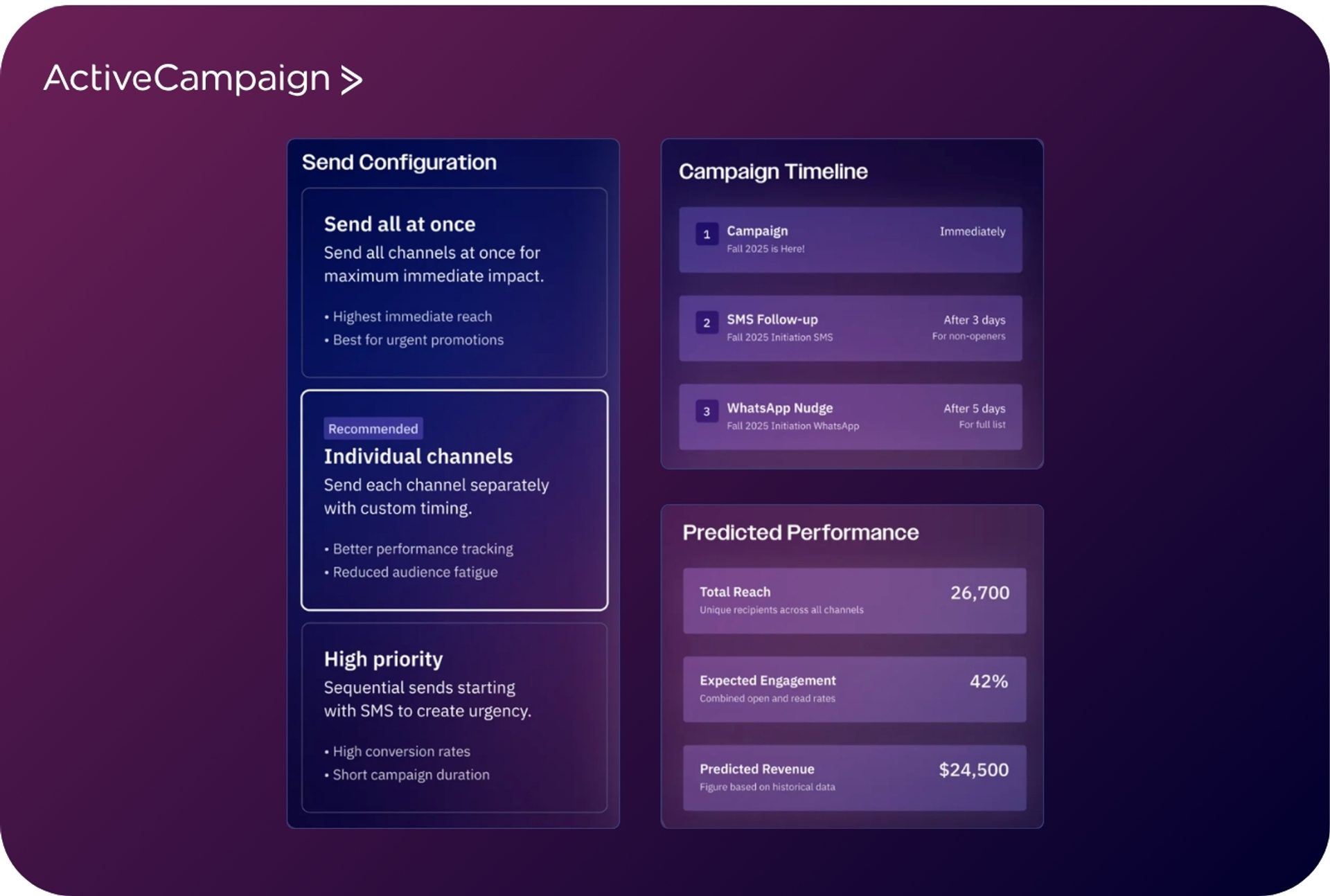
The AI Content Generation works seamlessly with SMS marketing campaigns, crafting perfect SMS copy for your customers by means of a few simple clicks.

At the same time, Dynamic Content transforms generic campaigns into tailored experiences by automatically customizing content for every recipient using their individual profile information, buying patterns, and engagement behaviors.

By automatically coordinating AI-generated SMS content with email campaigns while simultaneously personalizing all messaging based on individual customer data, the platform creates one seamless experience that flows intelligently across channels rather than treating each touchpoint as a separate, disconnected interaction.

This cross-channel orchestration demonstrates how Imagine (AI Content Generation creating SMS campaign content), Activate (Dynamic Content executing personalization), and Validate (behavioral data informing future campaigns) work together. Unlike competitors who may excel in individual areas, ActiveCampaign’s AI features are designed to span all three pillars within a single workflow.

Which platform is closer to the “set it and actually forget it” promise?

Perhaps most importantly, ActiveCampaign learns and improves your campaigns automatically. AI-Suggested Automations and AI Campaign Calendar don’t just execute your current strategy, they continuously optimize and suggest improvements based on performance data from billions of interactions across their entire user base.

Use AI Campaign Calendar to ensure your campaign lands at the perfect time with AI-powered insights for send optimization.

The result? You get enterprise-level marketing sophistication through a conversational interface that anyone can use. No technical expertise required, no complete workflow builders, no constant manual optimization. Just describe what you want to achieve and let the AI agents make it happen.

Similar to ActiveCampaign’s AI-Suggested Automations, HubSpot’s Breeze AI allows users to generate workflow enrollment triggers and actions using natural language prompts through Breeze. Users can describe what they want to achieve and receive AI-generated workflow components.

In terms of a feature that stacks up to ActiveCampaign’s AI Campaign Calendar, HubSpot falls a bit short. They do not currently offer any AI functionality that can predict best send times for entire campaigns. However, they do offer time zone-based email scheduling to send emails at the time with the highest open rate percentage within the next 24 hours, based on the contact's timezone.

ActiveCampaign offers this as well.

The takeaway: The difference is that ActiveCampaign learns individual recipient behavior patterns and continuously optimizes send times based on personal engagement history. In contrast, HubSpot provides timezone-based scheduling and basic AI timing for emails, but lacks true personalized send time optimization.

Other AI Agents ActiveCampaign offers:

  • AI-Suggested Segments: Analyzes your customer data to surface high-impact audiences you might never have thought to create.
  • Predictive Sending: Optimize send times at the contact level to ensure your emails land when they’ll drive the most engagement.
  • AI Image Generation: Instantly and effortlessly generate unique, high-quality images to enhance your emails.
  • AI Content Generation: Remove writer’s block and save time by using conversational prompts to compose and finetune email copy. 
  • Suggested Actions: Take the guesswork out of what’s next by asking AI to pinpoint the next action to take across your automations, fine-tuning their effectiveness.
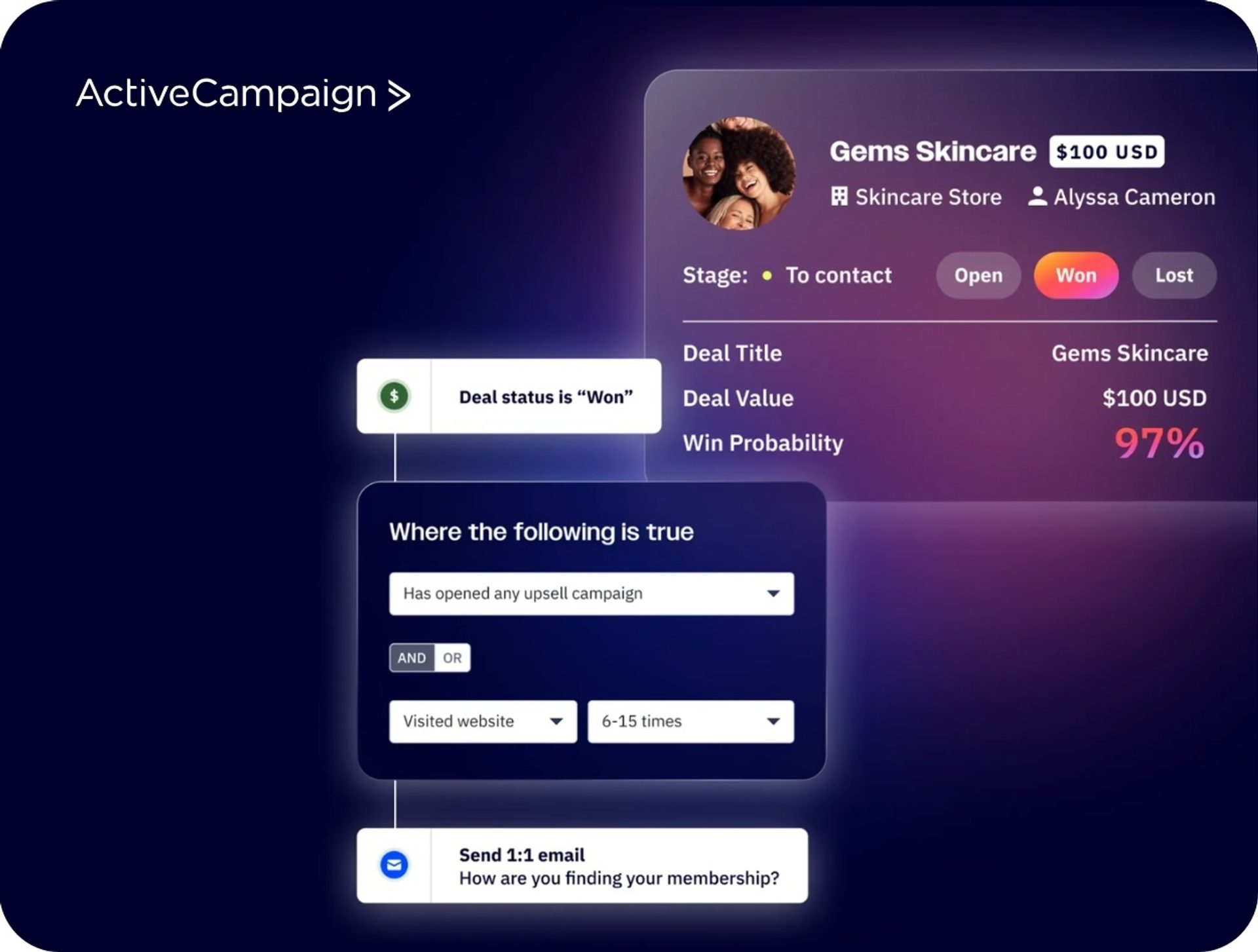
  • Win Probability: Analyze your sales touchpoints and automatically update a real-time score that shows how likely each deal is to close.
  • AI-Suggested Goals: Generate relevant goals based on what matters most to your business, so you can always find your next step.

ActiveCampaign’s autonomous marketing platform transforms how marketers work when budgets, skills, and time are stretched thin. But what truly sets it apart is how features span all three pillars of autonomous marketing: Imagine (AI Campaign Builder, AI Brand Kit, AI-Suggested Goals), Activate (AI Actions Library, AI Campaign Calendar, Predictive Sending), and Validate (Business Goals, sentiment analysis, continuous optimization).

To truly lean into autonomous marketing, the features you use should help you span all three activities. While competitors may excel in one area, ActiveCampaign’s integrated approach creates the complete autonomous marketing experience that actually delivers on the ‘set it and forget it’ promise.

Advanced automation vs. automation for a hefty price

ActiveCampaign offers a powerful visual automation builder that lets you create complex, multi-step workflows involving email, SMS, site messages, and CRM actions. The platform is designed to be intuitive, allowing you to drag and drop different elements into your workflow, making it easy to see how everything connects.

What really sets ActiveCampaign apart is its ability to create highly personalized automation based on user behavior, lead scoring, and CRM data. This means your messages can be tailored to each individual, making your campaigns much more effective.

Some of ActiveCampaign’s standout features include:

  • Dynamic content: Customize content within your emails based on the recipient’s behavior and preferences.
  • Advanced segmentation: Easily segment your audience based on various criteria, ensuring that each group gets the most relevant messaging.
  • AI features: ActiveCampaign’s AI can suggest improvements to your campaigns with predictive content and automation features, helping you optimize your strategy without extra effort.

Creating detailed, custom workflows in ActiveCampaign is straightforward, thanks to its user-friendly design. Even if your workflows are complex, the visual builder keeps everything organized and easy to manage.

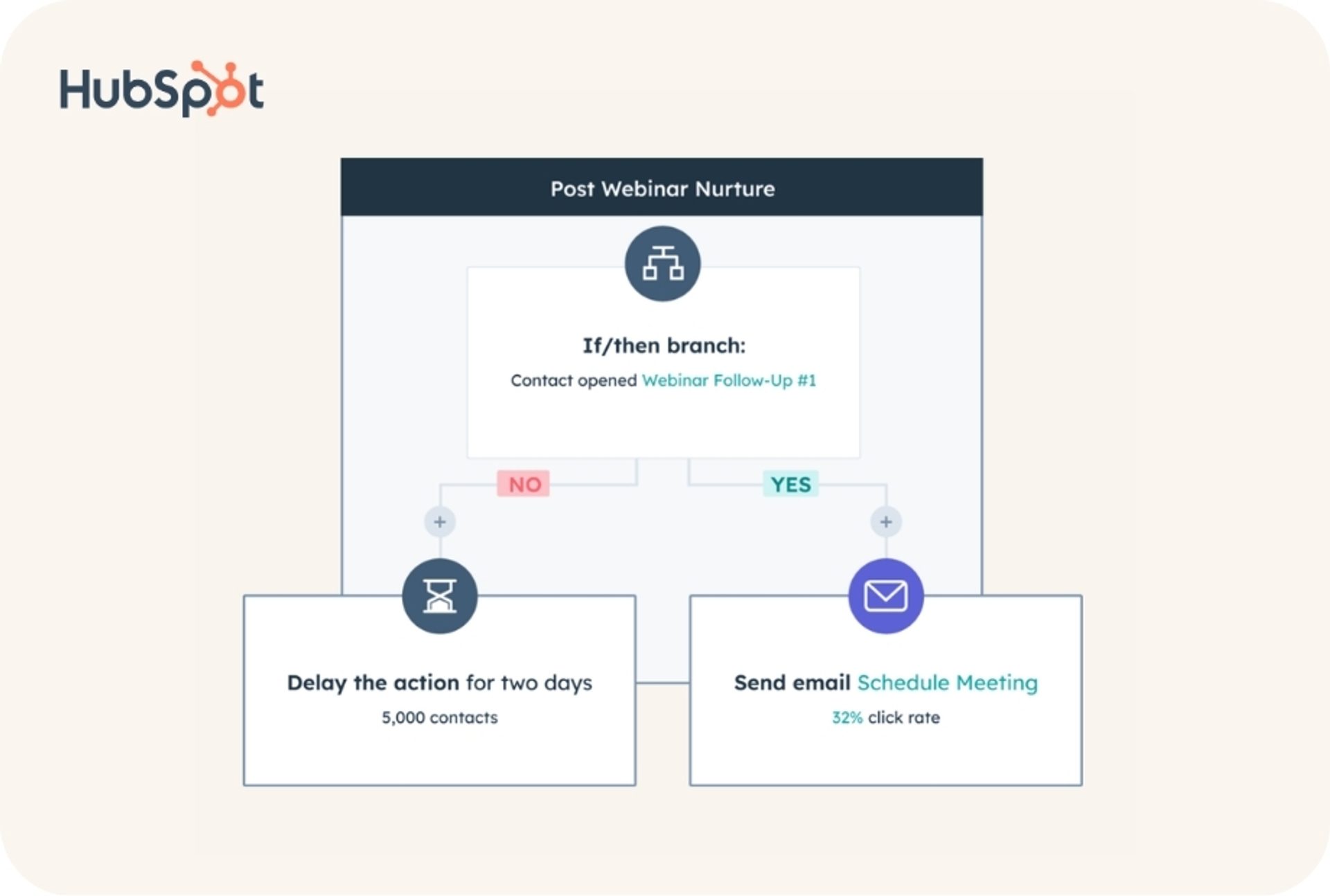
HubSpot’s automation rules are customizable, allowing you to personalize and segment your audience in great detail, so your campaigns hit the mark every time.

They also excel at lead nurturing, with a variety of options for triggering workflows based on user actions, data points, or a combination of both.

HubSpot’s key features include:

  • Customizable workflows: HubSpot offers flexibility in building workflows, enabling you to tailor each step to meet your business’s unique needs.
  • A range of trigger options: You can start workflows based on a wide range of triggers, from form submissions to page views, ensuring timely and relevant follow-ups.
  • Good reporting: HubSpot provides in-depth reports on how your automation is performing, helping you gauge effectiveness and make data-driven improvements.

With HubSpot, the focus is on integrating various aspects of your business into cohesive workflows. While the builder is powerful, it might require a bit more time to master, especially if you’re setting up highly detailed processes.

#1 in email deliverability vs. 12th place…

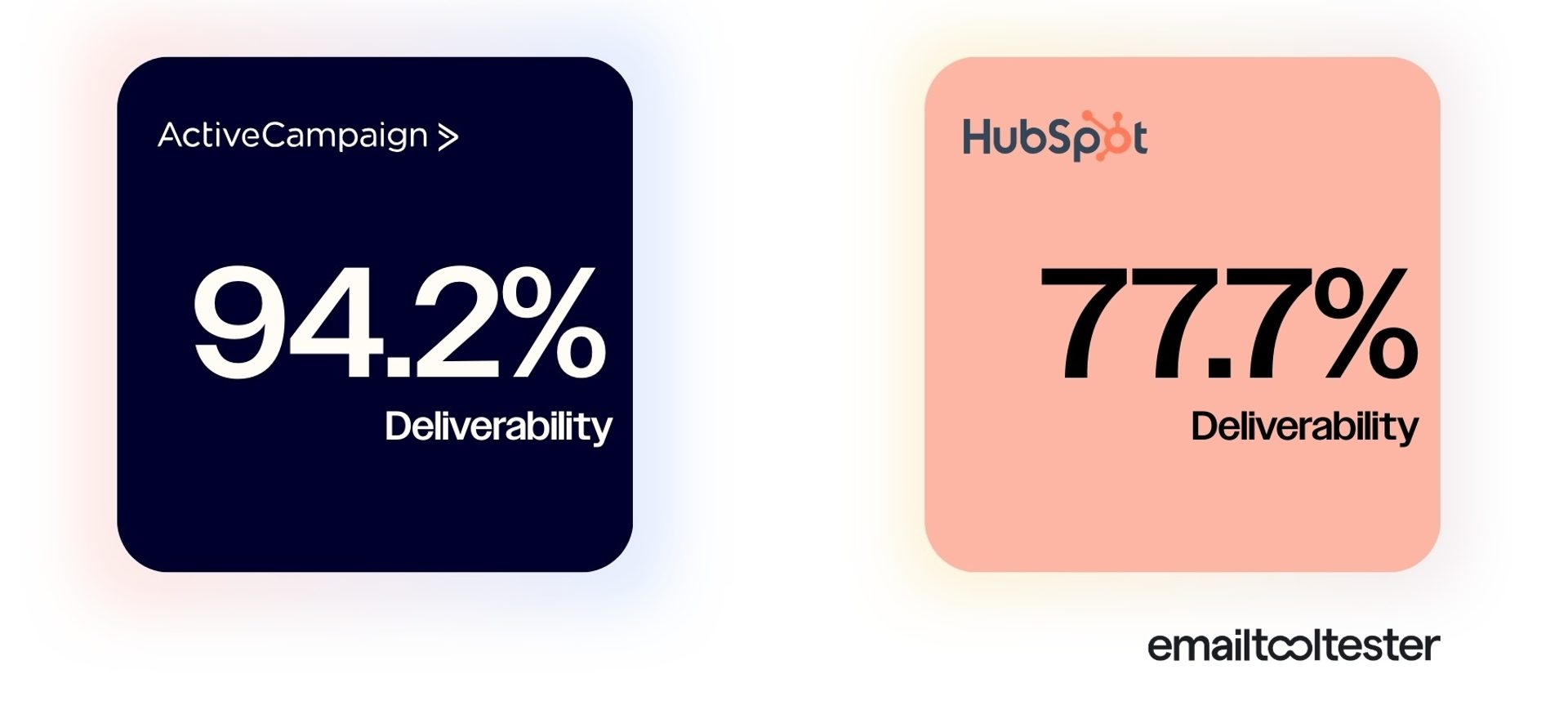
What good is your email campaign if nobody sees it? From the past three deliverability tests EmailTooltester ran this year, ActiveCampaign scored first over all other platforms with a 93.4% deliverability rate.

Source: EmailTooltester’s email deliverability report

On the other hand, HubSpot scored pretty poorly here with a 79.8% deliverability rate, coming in twelfth place overall. This proves that ActiveCampaign is the platform you should choose if you care about deliverability.

And you should, because an undelivered or lost to the spam folder email is practically useless.

Reporting: Both platforms are a good choice

When it comes to reporting, both ActiveCampaign and HubSpot offer impressive functionality.

ActiveCampaign offers a range of reporting tools that give you deep insights into your marketing campaigns. One of the standout features is the Marketing Revenue Report, which ties your marketing efforts directly to revenue. This report shows you exactly how your campaigns are impacting your bottom line, making it easier to see what’s working and where you might need to make adjustments.

ActiveCampaign’s Marketing Revenue report helps you directly link your marketing activities to actual sales, giving you a clear picture of your ROI.

With ActiveCampaign’s reporting, you can track email engagement, customer behavior, and sales performance. Customers can expect detailed analytics on everything from open rates and click-throughs to more advanced metrics like automation effectiveness and customer lifetime value. It’s designed to help you understand the full impact of your marketing strategies, whether you're focused on email campaigns, SMS, or broader automation workflows.

Key features of ActiveCampaign reporting:

  • Use first-party data and ActiveCampaign’s industry expertise to score your performance and determine next steps
  • Filter out unreliable metrics and click fraud to ensure data accuracy
  • Use ActiveCampaign’s real-time reporting toolkit to spot trends, find new opportunities, and uncover actionable data about your customers
  • Predict how likely a deal is to close with win probability
  • Bring data in or send data to any app with over 900 integrations

ActiveCampaign’s reporting features are great for businesses that prioritize detailed marketing analytics and want to build an automation strategy based on real, concrete data.

HubSpot also offers powerful reporting tools that cover a wide range of metrics across marketing, sales, and service. With HubSpot, you can create custom reports that pull data from different parts of your business, giving you a holistic view of your performance. Their reports can track everything from lead generation and customer acquisition to sales pipeline progress and customer satisfaction.

HubSpot’s reporting is designed to be highly customizable, allowing you to tailor your reports to focus on the metrics that matter most to your business. The platform also offers detailed dashboards where you can visualize your data in real time, making it easier to stay on top of key trends and make informed decisions.

HubSpot’s reporting is especially useful for companies with larger teams or more complex sales processes, as it allows you to track and report on a wide range of activities across different departments.

Pipeline management: Simple and effective vs. complex

When it comes to pipeline management, both platforms deliver.

ActiveCampaign comes with a built-in CRM that’s tightly integrated with its marketing and automation tools, making it easy to manage your sales pipeline alongside your marketing efforts. The platform offers flexible, kanban-style dashboards that let you visualize your sales process at a glance. You can drag and drop deals between stages which makes it straightforward to track progress and manage your pipeline.

One of the key benefits of ActiveCampaign’s pipeline management is how easily you can integrate deal management with automation. This means you can automatically move deals forward, send follow-up emails, or update contact details based on specific triggers. This integration is crucial because it saves time and guarantees that nothing slips through the cracks, allowing your sales team to focus on closing deals rather than managing tasks.

In contrast, HubSpot’s pipeline management is designed with large teams and complex sales processes in mind. Whether you need to create multiple pipelines for different products or tailor every stage of your sales process, HubSpot gives you the tools to mold the platform to fit your specific business needs. Customization like this ensures that even the most intricate sales processes can be managed effectively.

HubSpot is a good choice for giant teams because of the in-depth reporting and analytics it offers on pipeline performance. You can track everything from deal velocity to win rates, and even monitor the health of your entire pipeline. These detailed insights are crucial for large teams that need to stay on top of their sales metrics, identify bottlenecks, and forecast future sales accurately.

All of these features are powerful, but they’re really aimed at large operations that need to manage high volumes of leads and deals. If you’re on a leaner team that’s looking to integrate pipeline management alongside their marketing efforts, ActiveCampaign is probably the better option.

A CMS with the features you’ll use vs. feature overload

If you don’t currently have a dedicated content management system, you’ll be happy to hear that both ActiveCampaign and HubSpot offer CMS functionality. ActiveCampaign’s CMS is built with a focus on simplicity and effectiveness, offering just the features you’ll actually use, making it both powerful and practical.

Here’s a breakdown of what you can expect with ActiveCampaign:

  • Intuitive landing page and form builders: Their landing page and form builders are designed to be user-friendly, so you can create on-brand content that keeps your messaging consistent across both marketing and sales. Building forms or landing pages is straightforward, allowing you to focus on capturing leads rather than getting bogged down in complicated design tools.
  • Versatile form options: You can create various types of forms—inline forms, floating bars, and floating boxes—that help you capture leads effectively. These forms are customizable, so you can make sure they fit easily into your website or landing page. Plus, once someone fills out a form, you can automatically trigger actions within your automated workflows, like sending a welcome email or assigning a lead to a specific sales rep.
  • Lead management and follow-up: All the information you collect from forms and landing pages is stored directly in your ActiveCampaign account. This makes it easy to follow up with relevant messaging and offers that are tailored to each lead. You can also segment your audience based on the data you’ve collected, ensuring that your emails are personalized and targeted to the right people.
  • AI-powered messaging: ActiveCampaign’s AI tools add another layer of sophistication. By analyzing customer data, AI can help you craft messages that resonate with your audience, making it easier to connect with leads and move them through the sales funnel.

ActiveCampaign's CMS is easy to use and effective because it simplifies content creation and personalization with intuitive tools, so you can focus on engaging your audience without the headache.

HubSpot’s CMS is packed with features. It’s a comprehensive tool for managing your customer relationships and content all in one place but for small businesses, it can be a bit overwhelming.

Here’s a breakdown of what HubSpot offers:

  • All-in-one content management: HubSpot is built like a CMS platform, offering everything you need to track customers who engage with your content. The platform allows you to manage the creation of landing pages, forms, blog posts, or running ads which makes it easy to see how your content is performing and how it’s driving customer engagement.
  • Integrated marketing tools: HubSpot allows you to build landing pages, create forms to capture leads, manage your blog, and even run your social media campaigns. This integration ensures that all your marketing efforts are aligned and allows you to track how each piece of content contributes to your overall strategy.
  • AI-powered content creation: They offer AI tools you can use to edit existing text or come up with new body copy and headlines. This is particularly useful for teams that need to produce a lot of content quickly.

HubSpot’s CMS is ideal for teams that require extensive tools and while not every team will need this level of functionality, it’s a decent option if you’re looking for an all-in-one platform.

Do you want advanced or just okay email marketing?

When it comes to email marketing, ActiveCampaign will give you more features for what you pay. Plus, a lot of the features you’ll enjoy come at a much lower price than HubSpot.

ActiveCampaign is well-known for its powerful email marketing features, offering specific packages tailored to different needs—whether you’re looking for email and marketing automation, sales CRM, or transactional emails through Postmark.

Here’s a breakdown of what makes ActiveCampaign’s email marketing stand out:

  • Advanced personalization: With ActiveCampaign, you can create highly personalized email campaigns. The platform allows you to segment your audience based on a variety of criteria, ensuring that each recipient gets the most relevant content. You can even use conditional content, which changes based on the recipient’s behavior or preferences. This level of personalization is what turns a customer into a brand advocate.
  • Versatile campaign options: ActiveCampaign gives you the flexibility to choose from various types of email campaigns. Whether you want to send a one-time blast, set up autoresponders, create custom email sequences, or schedule posts for a later time, you can do it all. You can also set up RSS-triggered responses, which are perfect for automating updates, and run A/B tests to optimize your messaging.
  • User-friendly email builder: The email builder in ActiveCampaign is designed to be intuitive and easy to use, so you can focus on crafting the perfect message without any confusion. You can drag and drop elements, customize your layout, and add personalized touches, all within a straightforward interface.
  • Segmentation and automation: You can divide your audience into segments based on their behavior, demographics, or engagement levels, and then target each segment with tailored messaging. This makes your campaigns more relevant and increases the chances of engagement.
  • A/B testing: You have the ability to test different subject lines, content, and send times to see what resonates best with your audience. A data-driven approach like this helps you continually improve your email marketing performance over time.

In short, ActiveCampaign’s email marketing features are designed to give you everything you need to run successful campaigns, from simple blasts to complex automated sequences.

HubSpot offers a comprehensive suite of email marketing tools that are well-integrated with its CRM. You can use its drag-and-drop builder to create professional emails, personalize them based on customer data, and set up automated workflows for tasks like nurturing leads.

In terms of email marketing, HubSpot offers:

  • Integrated email tools: HubSpot’s email marketing tools are tightly integrated with its CRM, allowing you to create and manage email campaigns that are fully aligned with your customer data. This makes it easy to tailor your emails based on customer interactions, helping you send the right message at the right time.
  • Drag-and-drop email builder: HubSpot offers a user-friendly drag-and-drop email builder, which lets you create professional-looking emails without needing any design or coding skills. You can easily add text, images, buttons, and personalize content blocks to match your brand’s style.
  • Basic automation: You can set up automated email workflows in HubSpot, such as welcome series, follow-up sequences, and lead nurturing campaigns. These automated sequences help you engage with your audience consistently without manual effort.
  • A/B testing: HubSpot provides A/B testing options so you can optimize your emails. You can test different subject lines, content variations, and sending times to see what works best for your audience, helping you improve your campaign performance over time.

While both HubSpot and ActiveCampaign offer excellent email marketing functionality, they cater to different needs. ActiveCampaign stands out with its deep focus on email features and design, offering more advanced options for segmentation, personalization, and automation. HubSpot, on the other hand, provides a more integrated approach, combining email marketing with its broader CRM and marketing tools, making it ideal for big businesses looking for an all-in-one platform.

To sum it up: If email marketing is a major priority, ActiveCampaign is a good choice due to its specialized approach.

CRM functionality: Efficiency vs. complexity

There are some differences between the two platforms when it comes to CRM features.

ActiveCampaign provides a user-friendly CRM that integrates well with its marketing automation tools, making it ideal for smaller teams or businesses looking for efficiency without complexity. HubSpot, on the other hand, is built for larger teams and offers extensive customization, in-depth reporting, and advanced features that can handle high volumes of data.

ActiveCampaign’s CRM is all about simplicity and effectiveness. It’s designed to provide just what you need to manage your sales and customer relationships without getting bogged down in unnecessary extras.

Here’s a quick look at what it offers:

  • Built-in CRM: ActiveCampaign comes with a built-in CRM that’s integrated with its marketing automation tools. This means you can track deals, manage customer interactions, and automate follow-ups all from one place.
  • Kanban-style dashboards: You get flexible, kanban-style dashboards that let you easily visualize your sales pipeline. Dragging and dropping deals between stages is a breeze, so you can quickly see where everything stands.
  • Lead scoring: ActiveCampaign’s CRM includes lead scoring features that help you prioritize your leads based on their interactions and engagement. You can set up custom scoring rules based on factors like email opens, clicks, website visits, and more. This way, you can focus on the leads that are most likely to convert and tailor your follow-up strategies accordingly.
  • Deal management integration: ActiveCampaign lets you integrate deal management with your automated workflows. This helps ensure that your sales tasks are aligned with your marketing efforts and that nothing falls through the cracks.

HubSpot’s CRM is built for scale and customization, making it well-suited for large teams with complex needs. Here’s what you can expect:

  • Extensive customization: HubSpot offers a highly customizable CRM that lets you tailor pipelines, sales processes, and contact properties to fit your business’s unique needs. This level of detail is great for managing intricate sales workflows.
  • Automation and customization: You can set up complex workflows and automation rules, which is ideal for managing high volumes of leads and deals. HubSpot’s CRM is built to handle sophisticated processes and provide detailed insights.
  • Comprehensive integration: It integrates deeply with HubSpot’s marketing, sales, and service tools, providing a unified view of customer interactions across different departments.
  • Good reporting and analytics: HubSpot’s CRM comes with powerful reporting and analytics features, allowing large teams to track performance metrics, monitor sales activities, and forecast future performance.

ActiveCampaign’s CRM is perfect if you’re looking for a tool that offers the essentials you need to manage your sales and customer interactions without any extra fluff. Its simplicity and integration with marketing automation make it great for teams big and small.

HubSpot’s CRM, on the other hand, is designed for larger teams that need extensive customization and in-depth reporting. It’s ideal if you have complex sales processes and need that extra functionality.

Integrations: Both offer extensive options

In ActiveCampaign’s app marketplace, you’ll find 950+ apps that integrate with various tools and platforms, including CRM systems, e-commerce platforms, and other marketing tools. It supports connections with popular services like Salesforce, Shopify, WooCommerce, and hundreds more.

HubSpot also offers a sizable number of integrations with over 1000 on their app marketplace. Both platforms have no shortage of integrations to choose from, most likely connecting with the tools you’re trying to use them with. It will just depend on what your tech stack looks like and which platform can properly support you.

One tool is more affordable as you scale

ActiveCampaign and HubSpot have pretty different pricing structures so we’ve broken it down for you below.

HubSpot pricing

For the sake of this comparison (and the number of plans/bundles HubSpot offers), we’ll be focusing on their Marketing plans.

While HubSpot does offer a free plan, it’s severely limited. For example, if you create a form on their free plan, you’ll only be able to automate one email on that form. Plus, you can only send up to 2,000 emails per month and are unable to remove the HubSpot branding.

Other limits that come with HubSpot’s free plan include:

  • A limit of 10 active lists for list segmentation
  • 1 automated action per email
  • A limit of 3 dashboards where other plans offer 25+
  • Limited form features
  • No 1:1 technical support
  • No simple marketing automation
  • No CTAs
  • No A/B testing
  • No personalization
  • No campaign reporting

Their Marketing Hub Starter plan runs you $15/month per seat and includes up to 1,000 contacts. This is the exact same pricing as ActiveCampaign’s entry-level pricing so let’s dig in here.

The Marketing Hub Starter plan allows you to send 5x your contact limit, so to stay at the $15/month price, you can send up to 5,000 emails a month. In contrast, ActiveCampaign allows up to 10,000 emails a month.

With HubSpot’s Marketing Hub Starter plan, you get:

Standard web analytics dashboardUp to 10 automated actions on emails
Mobile optimization (email only)Email reply tracking
Up to 10 automated actions on forms1,000 custom properties per object
Remove HubSpot branding on forms, live chat, and emailsUp to one million products
Ad retargeting on two audiencesOne shared inbox
Limited email health reporting featuresOne-to-one technical support for email and in-app chat
Basic SEO recommendationsSimple marketing automation
50 active lists for segmentationAnd more

We should note here that HubSpot offers another plan at $15/month per seat with their Starter Customer Platform. This plan is under their Customer Platform plans which are bundled and discounted. Find more information here.

Because HubSpot is an enormous platform that branches off into different areas of business, their plan structure can be pretty confusing. They offer Platform Solutions plans as well as Product plans, all with different pricing and features included.

  • Their Platform Solutions plans include Customer Platform, Free Tools, Create a Bundle, and Marketing +.
  • Their Product plans include Marketing, Sales, Service, Content, Operations, and Commerce.

Find up-to-date pricing and plan information here and use the tabs on the left to browse the plans available to you.

The final Marketing plan they offer is the Marketing Hub Professional plan which costs $800/month for three seats. Additional seats will start at $45/month. The Professional plan comes with 2,000 contacts and up to 20,000 email sends a month.

In the Marketing Hub Professional plan, you get:

Custom user permissionsDynamic personalization
Email reply trackingFull mobile optimization
Remove HubSpot branding on forms, live chat, and emailsAdvanced SEO recommendations and full site auditing
Ad retargeting for five audiences1:1 technical support for email, in-app chat, and phone
Up to 100 inboxesUp to 30 currencies
Unlimited actions for emails and omnichannel marketing automationUnlimited simple workflows per form, with unlimited actions
1,000 custom properties per objectSmart content for marketing email
Up to 15 million productsCampaign management
25 dashboards and 30 reports per dashboardSimple marketing automation
1,200 active lists for segmentationABM tools and automation

If you need a more extensive plan that offers things like lead generation and additional marketing automation tools, you may need to opt for one of HubSpot’s Marketing+ plans which cost $900/month or $3,800/month respectively.

ActiveCampaign pricing

Overall, ActiveCampaign is much more affordable as you scale.

For example, let’s say you have 10,000 contacts on an Enterprise plan. ActiveCampaign will cost $589/month while HubSpot will cost you $3,600. You get five seats in both plans but it’s clear that one platform is much more affordable.

Compared to similar enterprise-level automation tools like HubSpot or Salesforce, ActiveCampaign is pretty budget-friendly for the amount of features you get. They don’t offer a free plan (just a free two-week trial), but their Starter plan gives you access to some pretty advanced features for only $15/month.

The prices above are based on a max of 1,000 contacts.

To start, ActiveCampaign’s entry-level pricing starts at $15/month. This plan, aptly named the Starter plan, gives you access to multi-step marketing automation right out of the gate. HubSpot’s Marketing Hub Starter plan only gives you basic automation. None of HubSpot’s plans, not even their Professional or Enterprise plans, state that they come with advanced automation.

With ActiveCampaign’s Starter plan, you get access to features like:

10,000 monthly email sends900+ automation recipes
5 actions and triggers per automationAn AI-powered automation builder
Email campaigns and newslettersThe ActiveCampaign Marketing CRM
Basic and inline web forms950+ integrations including standard e-commerce apps
Over 250 email templatesLimited reporting and analytics
A/B testing on emailsSite tracking
Limited segmentation

Moving up to the Plus plan, you unlock more automation and powerful customer insights for $49/month with 1,000 contacts.

The Plus plan adds features like:

Unlimited triggers and actions for your automationsProspecting and retargeting ads for Google, Facebook, and LinkedIn
Web formsBasic segmentation
Landing pages (and templates)Basic reporting and analytics
Generative AI functionalityRevenue reporting

With the Plus plan and up, you can add on the pipeline enhanced CRM to manage your sales automation or the sales engagement CRM that includes additional email and AI capabilities.

ActiveCampaign’s Pro plan will cost you $79/month to unlock full omnichannel marketing automation. This is where you can truly elevate your email marketing. You’ll have monthly email sends 12x your contact limit and three users instead of one.

You’ll also have access to additional features like:

A/B testing on automationsConditional content
Advanced segmentation, reporting, and analyticsAttribution and conversion tracking
Predictive sending

The Pro plan allows you to get more granular about how your email campaigns are performing and understand what content, messaging, and offers move the needle for your business. You’ll have total control over your email cadence.

Finally, ActiveCampaign’s Enterprise plan starts at $145/month for 1,000 contacts and allows you monthly email sends 15x your contact limit plus five users.

With the Enterprise plan, you get everything previously mentioned plus:

Premium segmentationCustom objects
Premium CRM integrations with Salesforce and morePremium reporting and analytics
Single sign-on (SSO)And a dedicated account team

No matter which ActiveCampaign plan you choose, ActiveCampaign offers services like contact migration, customer enablement workshops, chat and ticket support, video tutorials, a knowledge base, and help guides to help you get the most out of the platform so you can focus on running your business.

Why do people switch from HubSpot to ActiveCampaign?

We know you’re aware that you’re on the ActiveCampaign website reading a comparison between us and a competitor but there really is a reason why so many people choose to migrate away from HubSpot. We’ve seen plenty of customers migrate and see real results.

Artivive realized they lacked the resources they needed to create the engagement levels they wanted to reach. Plus, their communication gaps were creating issues with booking artists which was integral to their business.

To start with 100 artists and get to 100,000 with just one community manager shows that ActiveCampaign was the right choice. We didn’t have to hire anyone to take care of the communication with our community, because it’s been very easy to scale with you.
Sergiu Ardelean
CEO and Co-founder of Artivive

After Artivive switched from HubSpot to ActiveCampaign they saw a 1000x growth from 100 to 100K users. They also improved their email interaction rate by 47%.

Onboarding: free vs. thousands of extra dollars

Free onboarding and extensive hands-on support are the only right answers.

ActiveCampaign offers free onboarding on all Professional and Enterprise plans as well as migration from your existing tool so you can get set up quickly. This will help you import contacts, preserve custom fields, remake your forms and landing pages, recreate email templates, and even translate your current workflows to their platform.

Some support perks you can expect with ActiveCampaign:

  • In-person Study Hall workshops that allow you to learn how to use the platform in a hands-on experience
  • Extensive support by means of video tutorials, help articles, 1:1 calls, and an active community you can go to when you have a question

HubSpot offers onboarding on their Professional and Enterprise plans but they will cost you ($3,000 and $7,000 to be exact). With this onboarding program, you’ll get recommendations on how to utilize your data in HubSpot, learn how to create automation and nurturing processes, and get best practices around lead generation and qualification

Some support perks you can expect with HubSpot:

  • Email and chat support, with advanced phone support at the Professional level and up
  • Their migration service for an additional $500
  • Email template building service for an additional $250

ActiveCampaign and HubSpot: which is best for you?

The platform you choose will depend on which features above are most important to you (and which you need to grow your business).

HubSpot is best suited for large teams with substantial budgets and complex needs. It’s a comprehensive platform that offers a wide range of tools for marketing, sales, and customer service, but it can get expensive, especially as your team grows and you need more advanced features.

Choose HubSpot if… you have a huge team and no shortage of money to spend, value detailed reporting, and need extensive CMS functionality to create and keep track of content.

ActiveCampaign is a great fit for smaller teams or businesses that want powerful automation features without the hefty price tag. It’s packed with valuable tools that make it easy to manage your marketing and sales processes, all while keeping things simple and effective.

Choose ActiveCampaign if… you value email marketing and easily automating your processes, want to scale without spending big money out the gate, and want to send truly customized content.

What are real customers saying about each platform?

Are customer stories too biased for you? We get it. Let’s look at a few reviews from real users.

"HubSpot allows us to take our communications and email it to the masses”

Source: G2

"HubSpot is the best all-in-one marketing software for sophisticated marketing teams”

Source: G2

Pros: “The email tool to run multiple campaigns quickly and A/B test the best performing campaigns. Plus, the landing page and form builders that allow us to quickly choose templates and build engaging product pages for campaigns.”Cons: “The learning curve is long. We had to enlist the help of a consultant to get acquainted. I wish AI was a part of HubSpot reporting so that the tools could generate specific custom reports based on the specific requirements.”

“ActiveCampaign is very user-friendly. It was easy to get started, even with no experience.”

Source: G2

“ActiveCampaign is supportive and feature-rich”

Source: G2

Pros: “I’ve been a customer with ActiveCampaign for 8 years after having initially tried Mailchimp. I never looked back, and have managed email lists ranging from a few hundreds subscribers up to close to 10k. Plus, they have so many integrations with other apps.”Cons: “The only downsides is that sometimes pages are a little slow to load when you have grand email automation set-ups.”

Frequently asked questions

Lingering questions? We've got you.

💡 Is ActiveCampaign good for e-commerce businesses?

ActiveCampaign is a great choice for e-commerce businesses, especially if you’re looking to automate your marketing and streamline customer interactions. With features like personalized email campaigns, automation workflows, and deep integration with platforms like WooCommerce and Shopify, it helps you engage customers, boost sales, and keep everything running smoothly.

Learn more about ActiveCampaign’s e-commerce features.

💡 Who is ActiveCampaign best for?

ActiveCampaign is best for small to mid-sized teams that want powerful marketing automation and CRM features without the high cost. It’s perfect for businesses that need advanced tools like personalized email campaigns, lead scoring, and segmentation, all wrapped in a user-friendly platform.

If you’re looking for a solution that’s effective and straightforward, without unnecessary bells and whistles, ActiveCampaign is a great fit.

💡 Who is HubSpot best for?

HubSpot is best for large teams and businesses with complex needs and the budget to match. It’s ideal if you’re looking for an all-in-one platform that covers everything from CRM to marketing automation. If you have a big team and need a powerful, integrated system to manage your sales, marketing, and customer service, HubSpot is a strong choice—just be prepared for the price tag.

💡 What is the biggest difference between ActiveCampaign and HubSpot?

The biggest difference between ActiveCampaign and HubSpot is that ActiveCampaign focuses on powerful, affordable automation tools for small to mid-sized businesses, while HubSpot is built for larger teams that need an all-in-one platform.

In short, ActiveCampaign is great for those who want simple, effective tools, whereas HubSpot is better suited for bigger companies with complex needs and bigger budgets.

💡 Is there a learning curve when switching to ActiveCampaign from another marketing platform?

ActiveCampaign is designed to be intuitive, combining a user-friendly interface with powerful features so you can get started quickly without a learning curve—even with advanced automation. AI agentsprebuilt templates, and guided workflows make setup easy, and most users find they can launch campaigns or automations in just a few clicks. For more complex needs, responsive support and extensive resources are available every step of the way, ensuring you’re never stuck or overwhelmed.

💡 How does ActiveCampaign make advanced automation accessible for users without technical expertise?

ActiveCampaign’s visual automation builder, AI-powered suggestions, and conversational prompts allow anyone to create sophisticated workflows without coding or technical skills. You can build automations by dragging and dropping elements or simply describing your goals, letting AI handle the setup. This approach empowers users to leverage advanced marketing strategies with confidence and minimal training.

💡 How does ActiveCampaign’s pricing scale as my contact list or user count grows?

ActiveCampaign pricing is intrinsically tied to your success and the value you derive from our platform. Our structure ensures that your investment scales predictably as your contact list grows and you unlock more powerful features. This commensurate scaling model means your pricing only moves when you gain more value, eliminating surprising cost spikes. With clear contact bands and unlimited users on every plan, we ensure your budget remains straightforward, transparent, and built for sustainable, high-growth business expansion.

Ready to take ActiveCampaign for a spin?

Try it free for 14 days.

Free 14-day trial with email sign-up
Join thousands of customers. No credit card needed. Instant setup.