Every day, businesses lose qualified leads in the 3-10 minute window between an initial chat interaction and the first email follow-up. In this article, we’ll cover (1) why having a chat-to-email gap loses revenue, (2) how AI detects the perfect moment to capture email addresses, (3) how the Kommo + ActiveCampaign integration works, and (4) examples of automated workflows for E-commerce, Education, Real Estate, and other industries.
The revenue leak: Quantifying the chat-to-email gap
Most businesses approach channel transitions in one of three ways–all of which are potentially leaky when it comes to revenue.
- Manual handoffs: Sales reps decide when to ask for an email address based on intuition. Result: Inconsistent timing, high workload, missed opportunities during off-hours (39% of all conversations happen outside of normal business hours).
- Immediate email gate: A chat widget asks for an email address before engaging. Result: It’s a poor user experience resulting in a high abandonment rate–and that happens before any meaningful connections and conversations with your brand.
- No handoff strategy: Chat ends without email capture. Result: There is no way to re-engage leads who weren’t already ready to convert right away.
The cost to your business. If you receive 100 chat inquiries per month and convert 50% to sales:
- Losing 50% of leads in the handoff = 50 customers lost/month
- At $2,000 average customer value = $100,000/month in lost revenue
- Annual impact: $1,200,000
That’s a significant revenue leak, but by using AI lead nurturing, you can close that gap and capture leads at the exact moment they’re ready to convert.
What is AI lead nurturing?
AI lead nurturing is the use of behavioral intelligence and natural language understanding to automatically identify high-intent prospects, capture contact information at the optimal moment, and transition them into structured email sequences.
Unlike rule-based automation (“if user visits pricing page 3x, send email”), AI evaluates:
- Semantic meaning of the questions being asked
- Sentiment shifts in conversational tone
- Intent signals like comparison requests or timeline questions
- Hesitation patterns that indicate needing more information
- Buying stage indicators that show readiness to advance
Instead of guessing, AI evaluates a lead’s real-time behavior–questions asked, keywords used, hesitation shown, etc.--to determine the perfect moment to move them from a short-form chat to a more structured conversation.
Traditional lead nurturing relies on human judgment (i.e., assumptions). While well-intentioned, those rules are time-consuming and result in missed conversion opportunities because they fail to capture nuance. AI lead nurturing operates based on individual behavior to determine intent. For example: “This person just asked about implementation timelines, so they're in active evaluation mode.”
How AI lead nurturing works
AI lead nurturing combines real-time intent analysis with automated email nurturing, empowering businesses to seamlessly take leads from an initial chat conversation into more structured, in-depth email communications.
AI flags when the best next step for a prospect is to move them along the sales process, including transitioning them from one channel to another. By combining Kommo AI agent with ActiveCampaign’s automation power, you can identify leads in chat and automatically usher them into email campaigns for deeper engagement.
Step 1: Analyze for real-time intent
The Kommo AI agent has been trained on thousands of sales and other conversations to recognize high- vs. low-intent signals using context (not just keywords):
High-intent signals
- “How much does it cost?”
- “We need…”
- “Can you send me more information?”
- “Does this integrate with [tool]?”
- “What’s your implementation timeline?”
- “I need to show this to my team.”
- A prospect asking for detailed documents (API/developer docs, onboarding guide, etc.)
Low-intent signals
- “Just browsing”
- “Let me think about it.”
- “Not sure yet.”
- Generic questions answered in FAQs
The perfect moment
The Kommo AI agent’s main goal is to facilitate real-time intent analysis. The AI identifies when a conversation is at the optimal, perfect moment to ask for an email address and transition the conversation to that channel. By looking at the conversation’s context, the sentiment of interactions, and question patterns during the chat, it’s able to flag when a lead is ready for deeper conversations that can be better handled over email.
Step 2: Find the perfect moment (i.e., capture email, contextually)
When the AI identifies a potential “transition moment,” it requests a user’s email address in a natural way informed by a user’s context.
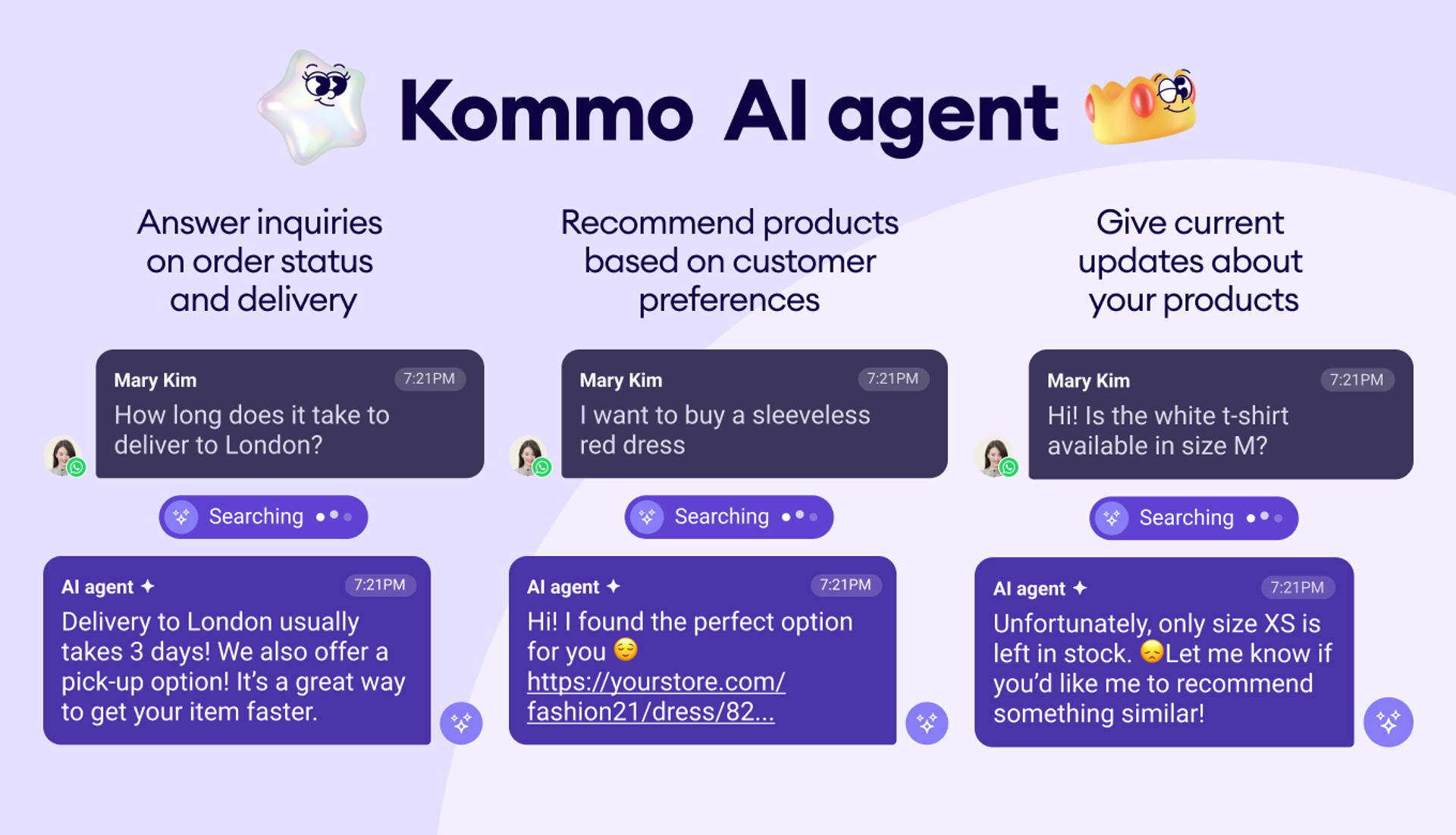
The Kommo AI agent recognizes natural language and responds appropriately
When done poorly, requests for contact information can feel intrusive and robotic rather than helpful. Rather than build trust that answers questions and accelerates a buyer’s journey to purchase.
AI-optimized email capture
Visitor: How does your platform compare to [competitor]?
AI: Provides a detailed comparison
Visitor: That’s helpful. Does it work with Salesforce?
AI: Yes, and I can send you our integration guide plus 3 case studies from companies that switched from [competitor]. What email should I send them to?
Result: Higher likelihood of email capture
The AI offers something valuable because of the conversation you just had—not despite it. It knows the right moment to suggest email, for example, because a prospective customer has informational intent. Things like requesting information that lives in long-form documents, navigating a detailed onboarding process, and seeking competitor comparisons.
How Kommo AI agent determines the “perfect moment”
The Kommo AI agent is built with advanced natural language understanding, intent detection, and decision logic that evaluates every message in real time. It doesn’t just respond to questions from clients; it also interprets signals that they give.
Step 3: The Kommo + ActiveCampaign integration powers automated nurturing
As soon as the Kommo AI agent captures a lead’s email address, it instantly syncs that data to ActiveCampaign. This seamless handoff moves leads from a quick chat to a structured nurture sequence automatically and without manual processing, making sure your initial chat is just the beginning of a longer conversation.
Pro tip: Don’t just sync the email address. Sync the ‘context’ tag (e.g., ‘interested in pricing’) so your ActiveCampaign welcome email references exactly what they were chatting about.
Once an email address is received:
- A lead profile is created in Kommo, with full conversation history
- Data is pushed to ActiveCampaign via native integration (webhook-based, real-time)
- Contact record includes:
- Email address
- Conversation transcript
- Intent tags (e.g., “pricing inquiry,” “competitor comparison,” “implementation-questions”)
- Source channel (website chat, WhatsApp, Instagram, etc.)
- Engagement score based on conversation depth
- A predefined, personalized, automated ActiveCampaign nurture sequence is triggered based on intent tags (not a generic welcome series).
The benefits of using the Kommo AI agent with ActiveCampaign
1. Eliminate subjectivity with precision lead qualification
AI reduces the subjectivity of human evaluation by relying on real-time indicators of readiness. This will help ensure that leads who enter ActiveCampaign flows are truly sales-ready.
2. Strike while the iron is hot: Improve lead engagement
Leads are most responsive and receptive the moment they ask a question. This integration triggers email sequences immediately after capture, maximizing open and click-through rates while your brand is still top-of-mind.
3. End manual data entry: Streamline sales operations
Free your sales team from copy-pasting email addresses. This workflow automatically captures, syncs, and tags lead data, so your team saves hours doing manual work (and can reinvest that time in closing high-quality opportunities).
4. Scale your “best rep” experience
Automate high-quality follow-ups for every lead. Whether you get 10 or 10,000 inquiries, you can handle large traffic spikes without additional headcount or manual monitoring.
An example: Lead tagged "competitor-comparison-hubspot" enters a sequence that specifically addresses HubSpot vs. ActiveCampaign differences, references pain points mentioned in the chat, and includes relevant case studies—not a generic nurture campaign.
Integration deep dive:
Setup requirements:
- Active Kommo account (starts at $15/user/month)
- ActiveCampaign account (Plus plan or higher for CRM features)
- Native integration available through the ActiveCampaign App Marketplace
Setup time: Usually 15-30 minutes to set up a basic connection. Typically, 2-4 hours for a full workflow configuration.
Data sync capabilities:
- Real-time: Email capture and contact creation (< 5-second latency)
- Bidirectional: ActiveCampaign can update Kommo contact records
- Custom field mapping: 20+ standard fields, unlimited custom fields
- Conversation history: Full chat transcripts attached to the contact record
Kommo provides messenger-based CRM and AI agent capabilities across WhatsApp, TikTok, Instagram, website chat, and more. ActiveCampaign delivers marketing automation, email sequencing, and CRM features. Together, they enable businesses to capture leads at the optimal moment in conversation and nurture them through intelligent, contextual email campaigns.
Step 4: Unified cross-channel nurturing (no more chat-to-email gap)
ActiveCampaign continues the conversation via email while Kommo maintains chat availability:
- If a lead replies to an email, the ActiveCampaign workflow continues.
- If a lead returns to chat, AI acknowledges the prior conversation and picks up where it left off.
- If a lead goes silent, automated re-engagement sequences deploy across both channels.
- If a lead converts or books a meeting, the system automatically pauses nurturing sequences to prevent redundant follow-ups.
Want to dive deeper? Learn how to orchestrate cross-channel campaigns to maximize your impact.
Why AI lead nurturing wins over traditional lead nurturing
Traditional lead nurturing relies heavily on human judgment. Sales or support teams interpret signals, request contact information, and manually transfer leads into follow-up workflows. Sometimes there is no process in place at all to move leads between channels. These approaches are costly. They consume time, resources, and leak revenue, especially if your team is managing a high volume of inbound traffic.
Behavior-based AI handoffs work better
AI changes bridges the chat-to-email gap by automating intent detection and decision-making. With some of the marketing automation assigned to AI, it’s easier for the sales/marketing team, and it stops revenue from leaking when leads are lost or poorly handled. It helps capture email addresses at the optimal moment, provides rich intent data for segmented nurturing, and gives even lean teams the ability to scale. This solution strikes a solid balance of efficiency and automation, without risking overbuilt, complex features.
Who benefits the most from a solution like AI lead nurturing?
There is no single right way to connect with clients, only the formula that will work best for your business. Some ideal use cases for this integration include:
- High chat volume, limited staff. If you receive 500+ monthly inquiries but have fewer than 3 people to handle all of those, manual handoffs don’t scale. AI maintains conversation quality while automating email capture, which benefits lean teams and sales/marketing teams of one.
- Outside-business-hours inquiries. If 25% or more of your leads arrive when your team is offline (evenings, weekends, international time zones), you’re losing to competitors who respond faster.
- Complex, multi-touch sales cycles. If prospects need, say, 3-7+ interactions before buying, chat alone can’t deliver enough information. You can strike a balance: email provides depth, while chat provides immediacy.
- Multiple product lines or services. If leads need different nurture paths based on interest, AI tagging ensures they enter the right email sequence.
- High lead volume, tight budgets. If you can’t afford a full sales team but need to maintain personal communication, AI-based automation extends your reach without headcount.
- SMBs who are scaling or getting ready to scale: Whether you are in SaaS, real estate, hospitality, or an online course provider, you need a system that scales personalized communication without losing human touch.
- If you “just want what works” or don’t want the hassle of DIY manual builds. You prefer simple, effective solutions over overly complex, high-maintenance tech. You want tools that work for you, not tools you have to work on.
There are some uses where current AI lead nurturing may come up short, including:
- If your average sales happen in a single chat conversation (no need for nurturing)
- If you have a low volume of monthly inquiries (i.e., a manual process is sufficient)
- If your product requires extensive discovery that AI can’t replicate (you really do just need to get prospects on a demo call)
- If you’re in a highly regulated industry where AI chat isn’t compliant
- If you need complex lead scoring that requires human judgment
Best-fit industries
Many different businesses can bridge the chat-to-email gap:
1. SaaS: The “free trial” concierge
When a user on a free trial asks a technical question, the AI doesn’t just answer; it pivots to conversion. It offers a Feature Guide or API docs via email, captures a customer’s intent to upgrade, and triggers an ActiveCampaign sequence to nurture them.
2. E-commerce: The abandoned cart saver
When a shopper hesitates on shipping or pricing, AI can intervene with a discount code offered via email. This secures the contact info and allows ActiveCampaign to follow up if they don’t buy immediately.
3. Agencies & professional service providers: The case study bridge
Convert window shoppers into serious prospects by offering relevant case studies in chat. The AI sends the proof they need, and ActiveCampaign can follow up with an email that includes a portfolio, pricing, and a calendar link so the lead can easily book a consultation.
4. Education & training: The 24/7 admissions advisor
Instead of burying prospective students in website menus, the AI answers curriculum questions and immediately offers a downloadable syllabus or scholarship guide. This captures the applicant’s email, allowing ActiveCampaign to start an automated enrollment sequence that includes reminder emails nudging them to enroll by the deadline.
5. Real estate: The virtual tour guide
Don’t let listing inquiries go cold. The AI confirms availability and offers a video tour via email, tagging the lead as “High Intent” for an agent to call within the hour.
Capture every lead at the perfect moment
Stop losing leads in the gap between chat and email. Connect your accounts today and start nurturing leads at the perfect moment.
7 best practices for AI lead nurturing & common mistakes to avoid
- Don’t ask for email too early. Train AI to wait until a lead asks a question that genuinely requires follow-up resources.
- Don’t over-automate. Removing all human touchpoints is not likely to yield the results you want. AI is less likely to be able to handle escalation triggers, complex questions, etc.
- Train your AI agent with complete product and process documentation to improve intent recognition accuracy. Perform a weekly review of 10-20 conversations for the first 8 weeks, and a monthly audit thereafter.
- Segment ActiveCampaign workflows, for example, based on industry, intent level, product category, or behavioral triggers. Don’t treat all intent equally.
- Be relevant; build trust. Be sure that your email references conversational context that demonstrates your value and builds trust.
- Ensure consistency in tone and branding across chat and email channels for a unified customer experience.
- Monitor key performance metrics, including email capture rate (the percent of chat conversations that result in email capture), average time to email capture, chat-to-MQL conversion, email engagement rates, etc.
Moving a lead from chat to email is a critical inflection point in the digital sales journey. With the Kommo AI agent and ActiveCampaign working together, your business can bridge the gap between conversation and conversion with accuracy, consistency, and a strategic implementation.
The result is a scalable, intelligence-driven nurturing process that improves lead quality, enhances engagement, and supports stronger conversion outcomes.
Next steps: You chose your path
For the automation pro:
You've got the strategy—now build the engine. Connect your chat and email workflows in just a few clicks.
> Set up the Kommo & ActiveCampaign integration
For the fundamentals:
Want to brush up on nurturing fundamentals first? We’ve got you covered.
FAQs
What happens if the AI captures an email at the wrong moment?
AI accuracy improves over time, but you can:
- Manually adjust AI sensitivity in Kommo settings
- Review conversation transcripts to identify patterns where timing was off
- Create custom rules for your specific business (e.g., "never ask for email in first 3 messages")
Can I customize what triggers email capture?
Yes, extensively:
- Define specific keywords or phrases that indicate high intent.
- Set rules like "only ask for email if conversation exceeds 5 messages."
- Create industry-specific triggers (e.g., real estate: "mortgage pre-approval" = high intent).
- Adjust AI's assessment of urgency based on your sales cycle length.
What if a lead reaches out via chat after receiving emails?
The integration maintains conversation continuity:
- AI recognizes returning contacts
- References previous conversation: "Welcome back! Last time we discussed [topic]..."
- Has access to email engagement data (which emails they opened/clicked)
- Can pick up where an email sequence left off
Example: Lead received 3 emails about pricing but didn't respond. Returns to chat asking a technical question. The AI knows the lead has already seen pricing, so it focuses the next communication on technical details and offers a demo rather than re-sending pricing info.
What's the learning curve for my team?
Relatively quick!
- Setup: If you have marketing automation experience, estimate roughly 2-4 hours to configure the integration.
- AI training: Assume 30-60 minutes weekly during the first month to review and QA conversations.
- Ongoing management: Build in 1-2 hours monthly once optimized, e.g., for audits, feeding updated product information, etc.
Kommo and ActiveCampaign provide: Onboarding support, template workflows, and industry-specific training examples to speed implementation.
What if I'm already using another chat tool?
You can:
- Replace it: Migrate to Kommo for unified AI and multi-channel features.
- Run parallel: Keep your existing chat tool, deploy Kommo on specific pages/channels to test
- Integrate it: Kommo has APIs that can sometimes integrate with other chat platforms (contact support)
Migration consideration: Most businesses find that a unified platform is easier to manage than juggling multiple chat tools, even if their existing tool has features they like.
How is this different from basic chatbot-to-email capture?
Traditional chatbot approach:
- Rules-based: "If user clicks 'pricing', show email form"
- Same email request for everyone
- Enters generic welcome sequence
- No conversation context in email
AI lead nurturing approach:
- Behavior-based: Evaluates entire conversation context
- Email request customized to conversation: "I can send you the pricing breakdown and case studies we discussed."
- Enters intent-specific sequence
- Email references their chat conversation specifically
Result: You could target a 60-70% capture rate via AI lead nurture (vs. 20-30% for generic bots), which is significantly higher than email engagement because the content that’s offered is contextually relevant.