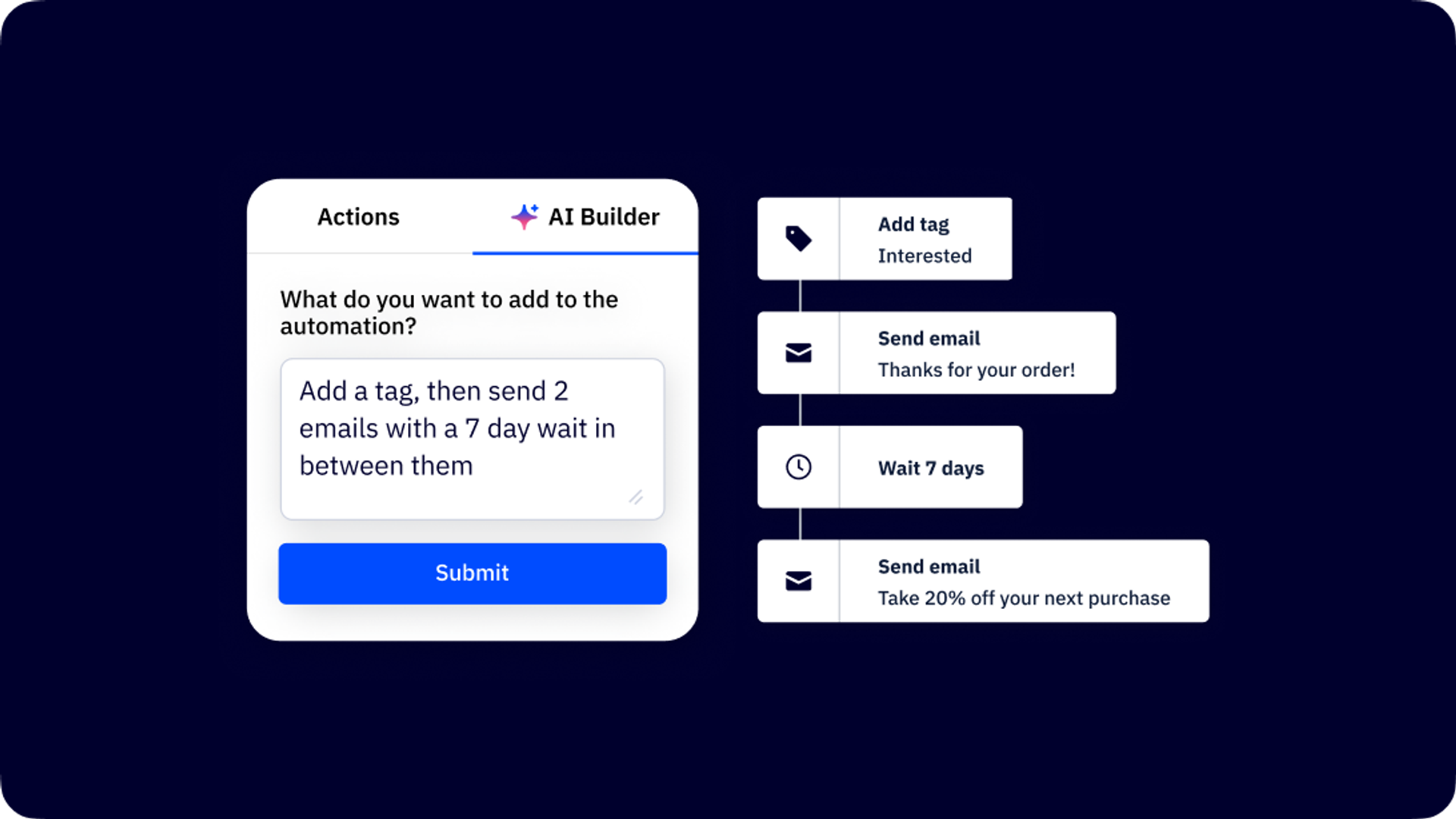
Not long ago, basic marketing automation felt revolutionary. Set up a few workflows, schedule some emails, and watch leads roll in. But today’s prospects are both more critical and less predictable. They move through non-linear paths that span online and offline touchpoints. The old playbook (manual segmentation, rigid automations, one-size-fits-all messaging) is breaking, and AI is the key to unlocking marketing's next evolution.
AI is now powering 17.2% of marketing efforts–up 100% since 2022. Leaders project that this integration will reach 44.2% by 2028. As AI becomes more capable, marketers need tools built for action, not just ideas. Modern marketers are passing the baton to AI agents, and they’re running with it faster than ever.
Unlike generative AI, which creates content based on prompts, AI agents autonomously plan and take actions toward goals. They don't just execute tasks—they make decisions. For marketers, that means fewer bottlenecks, smarter campaigns, and a path to real, scalable growth.
In this guide, we’ll explore how the capabilities of AI marketing agents are reshaping digital strategy and how to deploy them for sustainable, automated growth.
The AI evolution: from simple scripts to autonomous agents
Let's start with where we've been. Chatbots were the first step—simple, scripted programs that could answer common questions or route users to the right resources. They marked an important milestone in AI-powered marketing, but weren't truly “intelligent”.
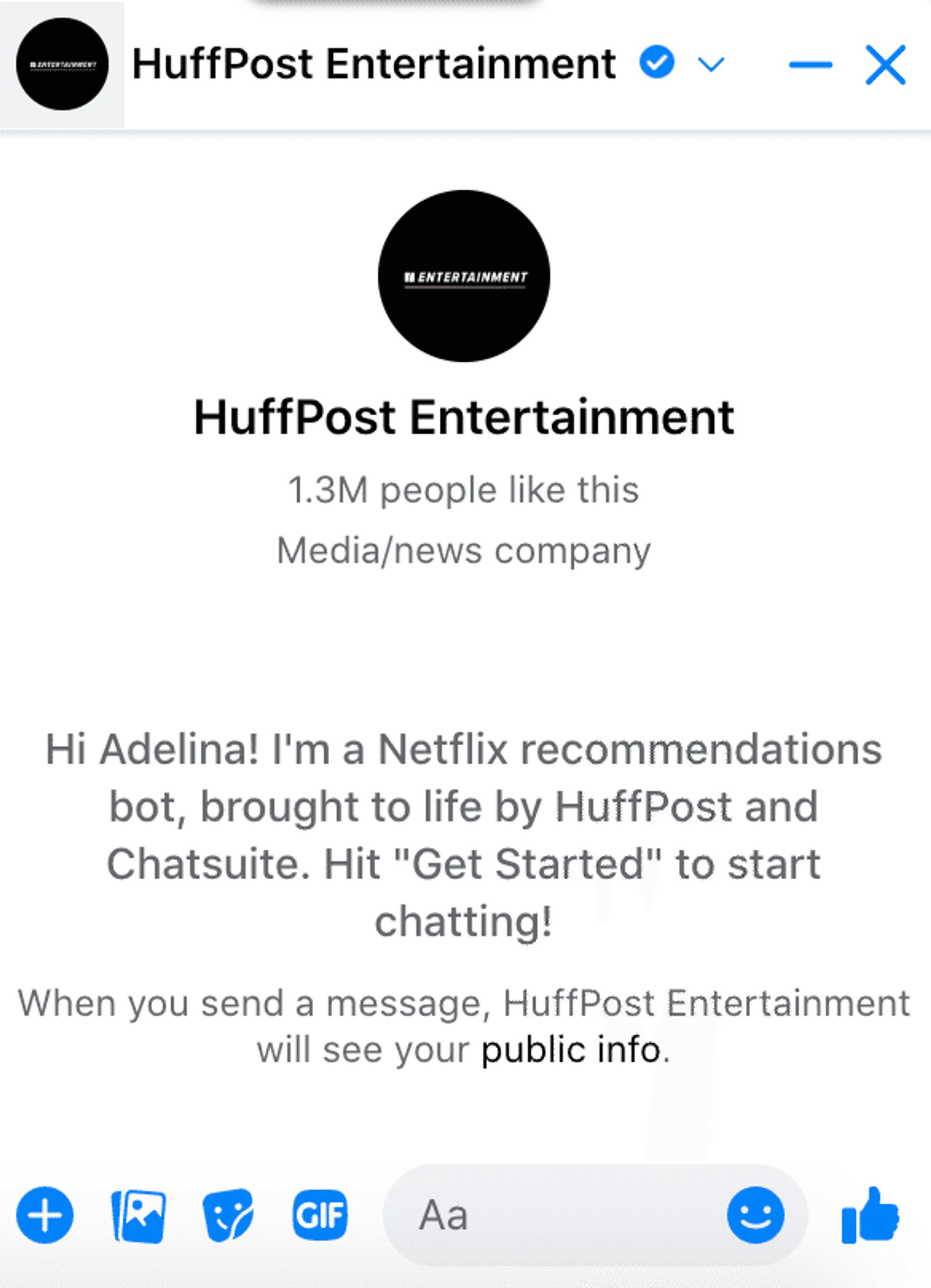
You might’ve found your first chatbot on a social platform like Facebook like this one from Huffington Post.
As machine learning advanced, generative AI gained traction. Most marketers have tried this: you prompt it ("write me a newsletter") and it produces output. Think of generative AI as a very fast, skilled specialist—useful for automating content creation, but ultimately reactive. It needs a prompt for every task, won't take action on its own, and doesn't remember long-term goals.
Fast forward to today, where AI agents operate on a different level: they don't wait for input—they anticipate needs. Agentic AI is built to decide and act on goals with minimal supervision. Instead of being a specialist, it's the strategist-coordinator who orchestrates the whole show. AI agents learn from data, adapt campaigns on the fly, and proactively identify opportunities human marketers might miss.
The key difference? Generative AI produces content when asked. Agentic AI plans, executes, and improves without hand-holding.
According to the World Economic Forum, AI agents will soon be able to assist with or autonomously manage nearly 70% of work tasks.
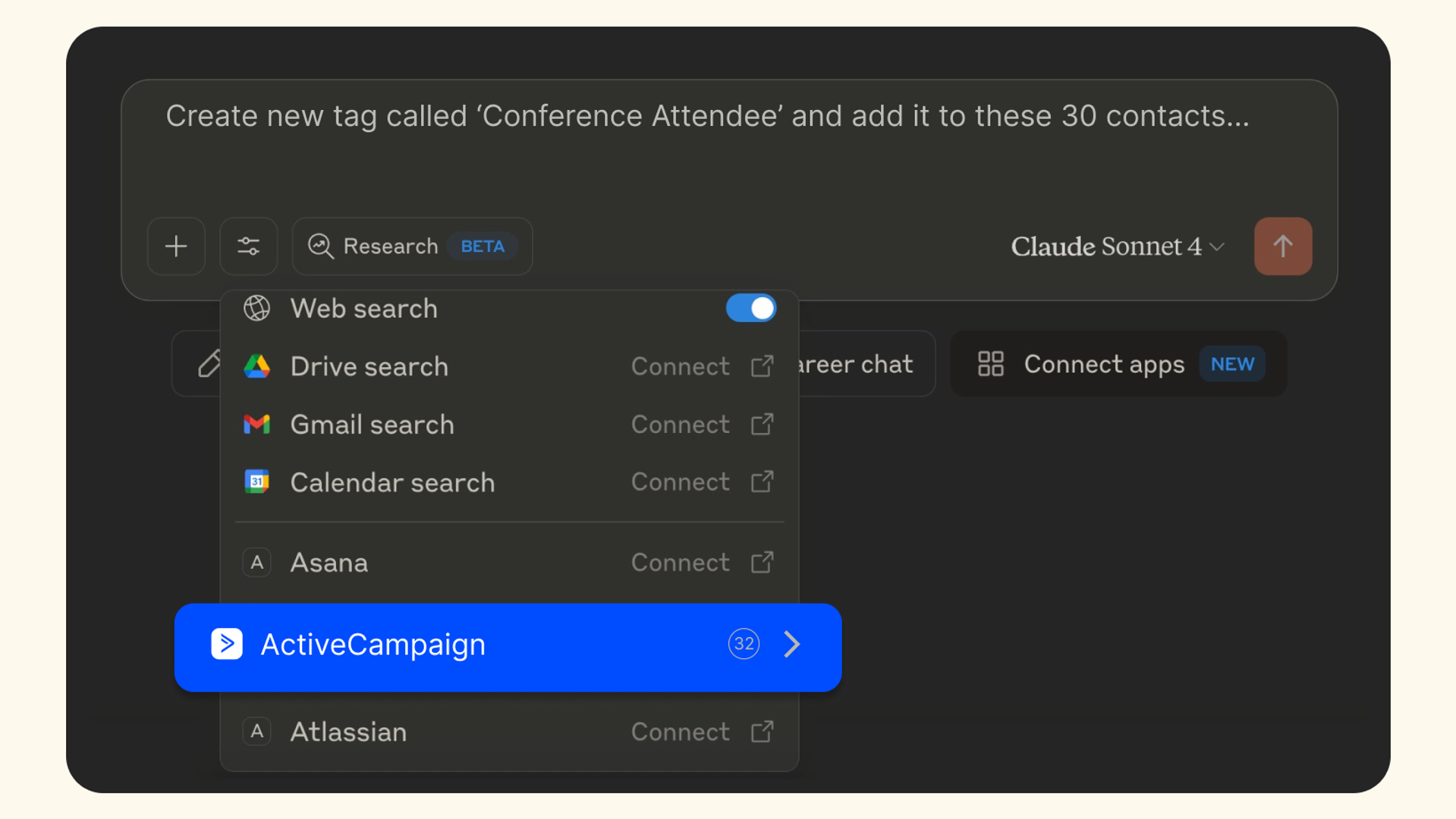
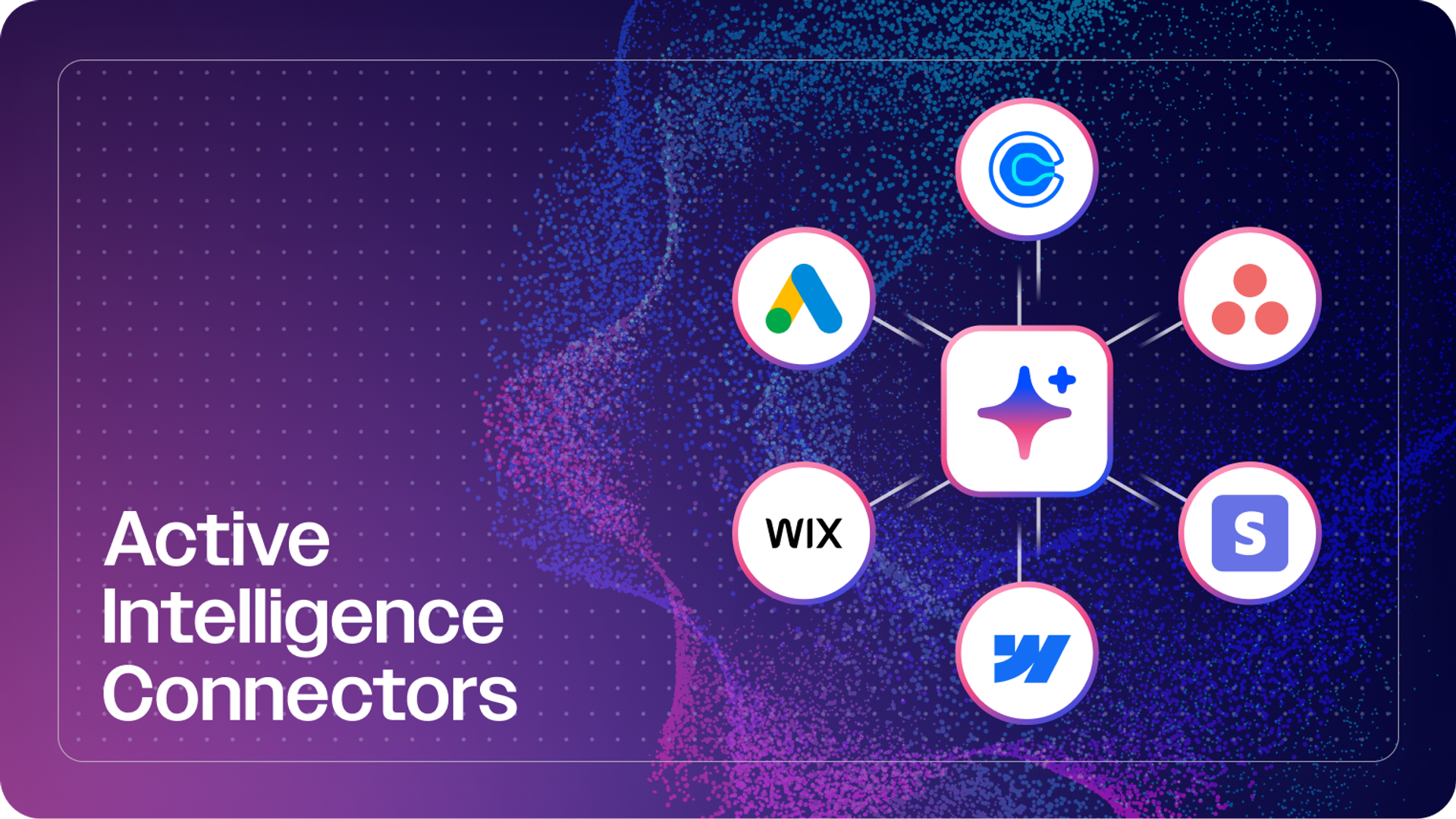
Modern platforms are beginning to embed these capabilities directly into the marketing workflow. In AI-native marketing tools like ActiveCampaign’s Active Intelligence, agents are helping teams to optimize send times, tailor content based on live engagement data, and generate campaign assets in seconds. Built to work alongside you, Active Intelligence helps you understand your campaigns and create better marketing experiences faster than before. And with the Active Intelligence sidebar, it's like having an intelligent marketing partner on standby to brainstorm, analyze, and improve your campaigns in real time.
Similarly, Autonomous Insights within ActiveCampaign serves as your always-on agent that continuously analyzes your email campaigns and automations. It benchmarks your results against industry data and your own historical performance, delivering weekly insights cards directly to your dashboard. No prompting required. Simply click any card and you’re in a live conversation with Active Intelligence to get the reasoning behind recommendations, follow-up Q&A, and a clear path to action.
When applicable, Autonomous Insights goes beyond analysis to deliver ready-to-use marketing assets. When Active Intelligence identifies an opportunity, it generates complete campaign drafts tailored to your brand style and performance data—with optimizations already built in. You get campaigns ready to review and send, not just advice on what to create.
→ See it in action: Watch the Autonomous Insights demo
The goal isn't to replace marketers—it's to give them intelligent collaborators that can keep pace with rising customer expectations.
Key use cases for AI agents in marketing
Even to marketers who have been in the game for some time, AI agents might seem like a futuristic or even daunting concept. But they’re already transforming marketing workflows across the entire customer lifecycle. Below are four core areas where AI agents are creating the most immediate value:
Lead generation and qualification
AI agents streamline the top of the funnel by automatically identifying and nurturing the most promising prospects. They generate higher-quality, more targeted lead lists that focus on prospects genuinely in-market rather than demographic lookalikes.
- Behavioral analysis detects high-intent signals to automate lead generation across email, web, and social activity. This pinpoints key buying signals across prospects' non-linear buyer journeys and provides sales teams with rich context for more effective outreach.
- Predictive lead scoring ranks leads based on likelihood to convert, not just demographic fit, drastically improving lead quality and sales efficiency by surfacing the most promising prospects to focus human effort on.
- Automated follow-ups trigger personalized messages and offers based on user actions—no marketer intervention required.
What does this look like in practice?
Consider a consulting firm where reps specialize by industry or solution type, and technical credibility is make-or-break. An AI agent would automatically route high-scoring prospects to the most appropriate team member based on lead source, company size, or industry expertise.
The system instantly alerts the assigned rep with a comprehensive engagement summary—emails opened, content downloaded, website interactions. Sales reps jump straight into informed conversations instead of starting from scratch.
Audience segmentation and targeting
Rather than relying on static lists or rule-based logic, AI agents dynamically segment audiences in real time. By orchestrating the optimal path forward for each individual, targeting becomes proactive, rather than reactive.
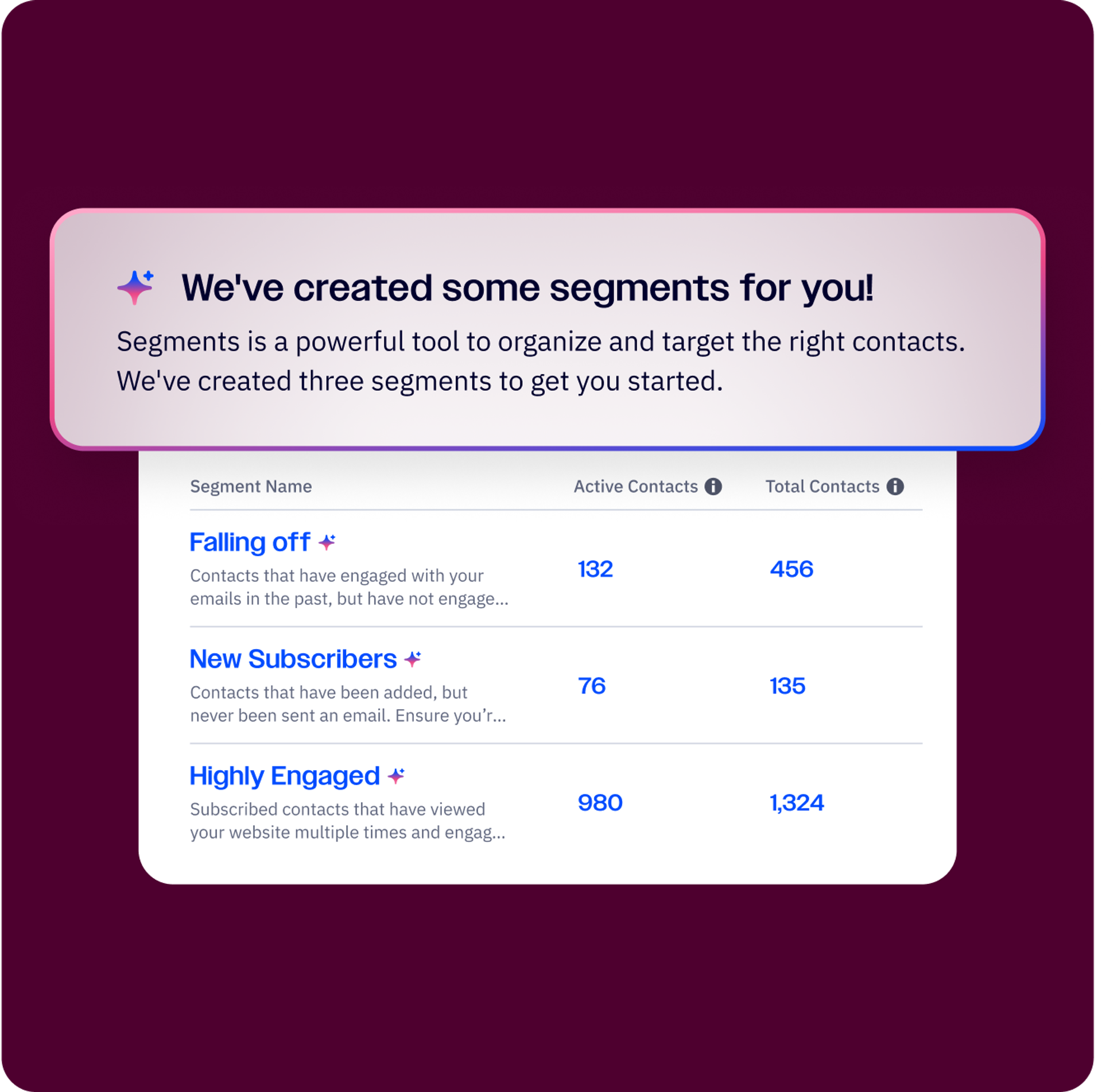
ActiveCampaign’s AI Suggested Segments give you more flexibility and control in how you reach your audience, eliminating the need to rebuild segments for every campaign.
- Behavior-based segmentation groups contacts by recent activity, preferences, and lifecycle stage, enabling more effective influence across channels and customized touchpoints.
- Pattern recognition uncovers hidden micro-segments marketers may overlook, revealing high-value audience clusters that respond to very specific messaging and timing combinations.
- Continuous refinement segments evolve automatically as new data comes in, boosting customer lifetime value through increasingly precise targeting over time.
What does this look like in practice?
A travel booking company with broad, generic email campaigns may well struggle with low engagement. AI could identify micro-segments like "last-minute weekend trip bookers" and automatically send flash deal notifications to last-minute bookers when inventory needs to move quickly.
Instead of treating these spontaneous bookers as confusing outliers, AI recognizes their niche behavior as a systematic conversion opportunity.
Content creation and personalization
AI agents now assist with both ideation and execution, generating high-performing content tailored to each user while delivering scaled personalization without overwhelming human teams. By automating repetitive writing and editing tasks, you can reduce content production costs and time while freeing up design resources for more strategic work.
- Generative content writes emails, subject lines, and even image captions on demand, enabling 1:1 tailored content experiences at scale.
- Personalized messaging adjusts tone, language, and offer based on individual customer data, eliminating the need for manual content variations.
- Cross-channel creation supports consistent messaging across email, SMS, and landing pages with automated adaptation for each platform.
What does this look like in practice?
An online retailer with a diverse catalogue would typically see low click-through rates on generic product ads. An AI agent could track the browsing behavior of someone who viewed hiking boots, read outdoor gear reviews, and then browsed camping equipment. Instead of showing them the same generic "shop now" ad, the system could instantly generate an ad with personalized outdoor adventure messaging and hiking boot recommendations.
Rather than treating varied browsing as scattered interests, AI recognizes intentional purchase journeys and creates compelling narratives that drive conversions.
Campaign optimization and timing
Timing and testing can make or break a campaign. AI agents optimize both at scale. Moving from static, reactive processes to dynamic strategies maximizes ROI on every campaign iteration and ensures your dollar targets the most effective channels and tactics.
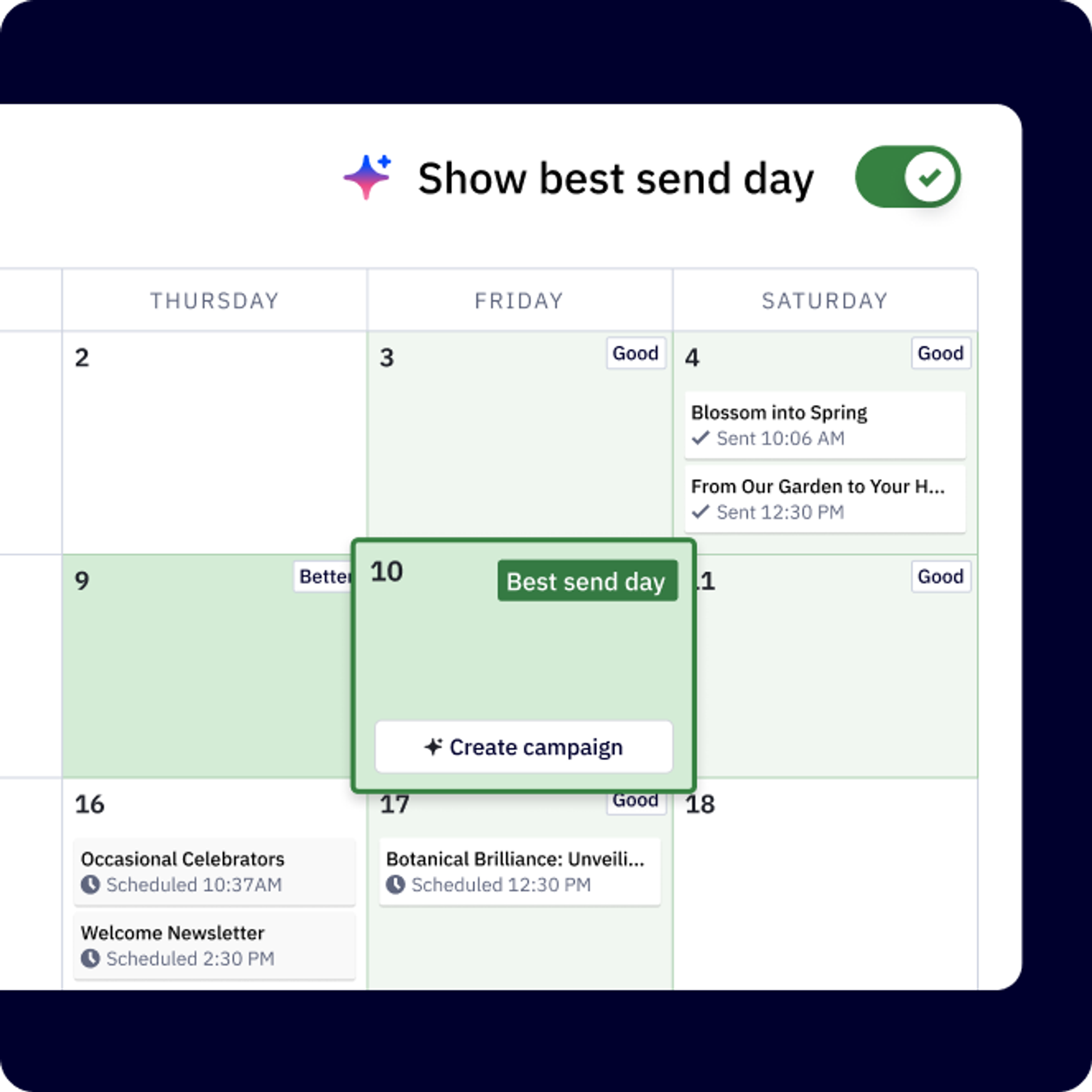
ActiveCampaign’s Predictive Sending uses machine learning to assess your contact’s behavior patterns and schedules the email for the time with the most engagement.
- Predictive send times identify when each contact is most likely to open and engage, maximizing the impact of every message sent.
- Automated A/B testing experiments with variables like subject lines, layouts, and CTAs without manual setup, enabling faster iteration and hypothesis testing.
- Real-time adjustments modify campaigns mid-flight based on early performance signals, rapidly scaling winning strategies while cutting underperforming elements.
What does this look like in practice?
Let’s imagine that a SaaS company launching a free trial campaign runs static ads with fixed budgets. They’d be missing opportunities to capitalize on high-performing segments. AI could identify that their cybersecurity messaging converts better for IT Directors or productivity features resonate with HR teams, automatically reallocating ad spend toward winning audience-message combinations and scaling successful variations, all while the campaign is running.
Instead of waiting for campaign results, every campaign becomes a continuously improving conversion machine.
Building brand-conscious AI agents
One of the biggest questions marketers ask when adopting AI is: Will it still sound like us? And it’s a fair concern. Brand development isn’t just a tone preference; it’s the fingerprint of a company’s identity. It shapes trust, sets expectations, and carries weight across every touchpoint. Plus, unlike features or pricing, it’s one of the few things competitors can’t replicate, so it’s vital that any tool working autonomously gets that right.
Early AI tools often missed the mark—churning out generic, off-brand content that missed nuance, tone, and context. But today’s AI agents are more than content engines. They’re brand stewards trained to understand not just what to say, but how to say it.
Modern AI agents can:
- Learn your tone: From playful and conversational to formal and authoritative, agents can be trained on past campaigns and brand guidelines.
- Adhere to messaging rules: Whether it's legal disclaimers, regional variations, or cultural sensitivities, agents can apply structured logic to language.
- Catch inconsistencies before publishing: AI can flag copy that strays from your voice or violates established rules before it goes live.
Quality assurance isn’t left to chance, either. Marketers can build review layers into the process, ensuring every AI-generated message meets human standards. Instead of losing control, teams gain a scalable way to maintain consistency while accelerating production.
AI agents don’t replace the creative process; they protect it at scale.
Tactical marketing with AI agents
Modern marketing doesn’t happen on a schedule—it happens in the moment. When a customer clicks, browses, buys, or bounces, the window to respond is measured in seconds. That’s where AI agents shine: not by planning months in advance, but by acting instantly and intelligently.
AI agents analyze behavior as it happens, triggering actions tailored to the individual:
- Viewed a product but didn’t buy? An AI agent can send a personalized follow-up with dynamic content reflecting what they browsed.
- Left a glowing review? That same agent can trigger a “Thank you” email with a loyalty incentive.
- Abandoned a cart twice in a week? AI might activate a banner with a limited-time discount to reinforce urgency.
This isn’t just automation. It’s context-aware responsiveness that adapts in real time.
Behind the scenes, AI agents continuously interpret behavioral signals like page visits, time on site, content engagement, or purchase frequency, and use that data to orchestrate highly relevant messaging across channels.
Why it matters:
- 58% of consumers say a brand earns their loyalty by delivering personalized experiences.
- 81% of consumers ignore irrelevant marketing messages.
- Conversion rates increase significantly when messages align with a customer’s intent in the moment.
- Retention improves when content evolves with customer behavior, not after the fact.
AI agents give marketers a way to act strategically at the same pace as the customer, creating moments that feel timely, relevant, and personal—because they are.
Strategies for choosing the right AI marketing agent
Not all AI is created equal. With dozens of AI marketing tools promising automation, personalization, and insight, the real challenge isn’t finding AI—it’s choosing the right one. The best AI agents don’t just check boxes—they integrate seamlessly into your workflows, scale with your business, and deliver measurable impact from day one.
Here’s how to choose wisely:
1. Assess your specific marketing needs
Before diving into features and platforms, take a step back. Don’t just say “improve marketing,” but identify: Where is your team losing time? What processes feel repetitive or slow? Is the goal to improve lead qualification time by 30%? Or is the top priority to focus on increasing the return on ad spend 15%?
Start by identifying the top 2-3 marketing use cases where an AI agent would have the most immediate and measurable impact. Start by considering:
- High-effort, low-impact tasks (e.g. manual list segmentation, follow-ups)
- Bottlenecks in campaign creation or personalization
- Areas where customer data isn’t being fully leveraged
Use the following steps to map where AI can offer the biggest lift—and build your case for ROI.
2. Evaluate integration capabilities
An AI agent is only as useful as the data it can access. Look for:
- Native integrations like pre-built native connectors with your current CRM, email, and ad platforms
- API flexibility to connect with custom tools, in case pre-built connectors don’t exist
- Low-friction onboarding that minimizes workflow disruption
- Structured data or, if you need to use unstructured data, ask vendors about data cleaning services
Seamless integration isn’t just convenient, it’s critical for getting accurate insights and driving automation at scale. As a marketer today, you don’t need more data siloes.
3. Consider scalability and flexibility
The right AI agent should grow with you. That means:
- Supporting both small, focused campaigns and complex, multi-channel strategies while adapting to non-linear buying journeys that span a variety of touchpoints.
- Getting started with minimal setup requirements but growing smarter over time, whether you begin with basic data inputs or comprehensive customer profiles.
- Adapting to changing goals, audiences, and business priorities through true AI learning (not just rule-based automation) that continuously acquires new inputs from customer behavior, campaign performance, and market shifts.
- Offering modular features you can turn on as you expand, while maintaining the ability to integrate your unique brand voice.
Avoid rigid solutions that can’t flex with your needs—or much worse, become obsolete as you grow. Look for agents that move beyond simple automation into adaptive intelligence that actually learns from your specific business context.
4. Prioritize transparency and control
An effective AI agent works with your team, not around it. That means:
- Clear visibility into what the AI is doing and why, including transparent data usage policies and compliance with relevant regulations, such as GDPR, CCPA, or HIPAA.
- Editable inputs and outputs, so you can refine results as needed.
- Built-in override options for when human oversight is critical.
- Transparent roadmap communication so you can be sure the platform will evolve with your needs rather than leaving you stranded.
- Configurable control levels that match your team's preferences—whether you need human-in-the-loop (HITL) approval for every campaign decision or prefer human-on-the-loop (HOTL) monitoring with intervention capabilities.
The goal isn’t a self-governing AI strategy—it’s smart augmentation that keeps marketers in the driver’s seat.
How to implement AI agents in your marketing stack
Bringing AI agents into your marketing isn’t about replacing your team; it’s about removing the inevitable human lag between insight and action. Smart implementation makes all the difference. Here's how to do it right.
1. Audit your data and tool stack
AI agents depend on accurate, real-time data and seamless integrations. Before introducing them, ensure your data and tools are aligned to support intelligent automation without introducing friction or silos.
Key actions:
- Map your customer journey and identify all key data touchpoints.
- Catalog all tools in your marketing stack, including your CRM, marketing automation platform, email flows, marketing analytics tools, ad platforms, chat systems, and customer support tools.
- Assess integration capabilities across platforms: Can data flow between them easily via APIs, native integrations, or middleware (like Zapier or Segment)?
- Evaluate your identity resolution: Can you reliably connect customer behavior across channels and sessions to a single profile?
- Check for real-time readiness: Identify which systems support real-time data sync and which are batch-based, as latency will limit AI responsiveness.
- Document data gaps and blind spots, such as missing attribution data, under-instrumented product pages, or CRM fields that are rarely updated.
- Create a remediation plan for data gaps: Prioritize gaps based on business impact, and work with cross-functional teams to improve tracking, standardize formats, or upgrade tooling where needed.
The goal: Make sure your data is structured (e.g., in tables), reliable, and ready to inform real-time decisions.
2. Define clear objectives and metrics
“More automation” isn’t a strategy. Be specific about what success looks like.
Ask:
- What are the end goals? Are you trying to…?
- Improve lead quality
- Shorten campaign build times
- Increase email engagement
- What’s the baseline, and how will you track progress?
Set metrics tied to real business outcomes: conversion rate, time-to-launch, customer lifetime value—not just opens and clicks.
3. Draft effective training inputs and prompts
AI agents are only as good as the instructions you give them. Well-crafted prompts and training inputs are the difference between generic output and brand-aligned, high-performing content.
Best practices:
- Write specific, contextual prompts. Instead of "write an email about our product," try "write a welcome email for new trial users who signed up for our project management software, emphasizing ease of setup and highlighting the quick-start guide."
- Provide examples of ideal outputs. Give your AI agent 3-5 examples of your best-performing content in each category so it can learn your patterns and preferences.
- Include context and constraints. Specify audience, goals, tone, and any limitations.
- Test prompt variations systematically. Run the same brief through different prompt structures to see which produces the most on-brand, effective results, then document your winning formulas.
- Create prompt templates for common scenarios. Build reusable frameworks for frequent tasks like product launches, event promotions, or nurture sequences that your team can customize quickly.
4. Start small with a high-impact use case
Instead of rolling out AI agents in your marketing cycle everywhere at once, it’s more realistic to choose a single process with clear friction and an easy win use case. Start small, fold in more as you build.
Examples:
- Automate follow-ups for demo requests to catch leads while they’re hot. Ask your AI agent to set up trigger-based sequences that send personalized follow-ups within minutes of form submission, include relevant case studies based on company size or industry, and automatically schedule reminder sequences if no response is received.
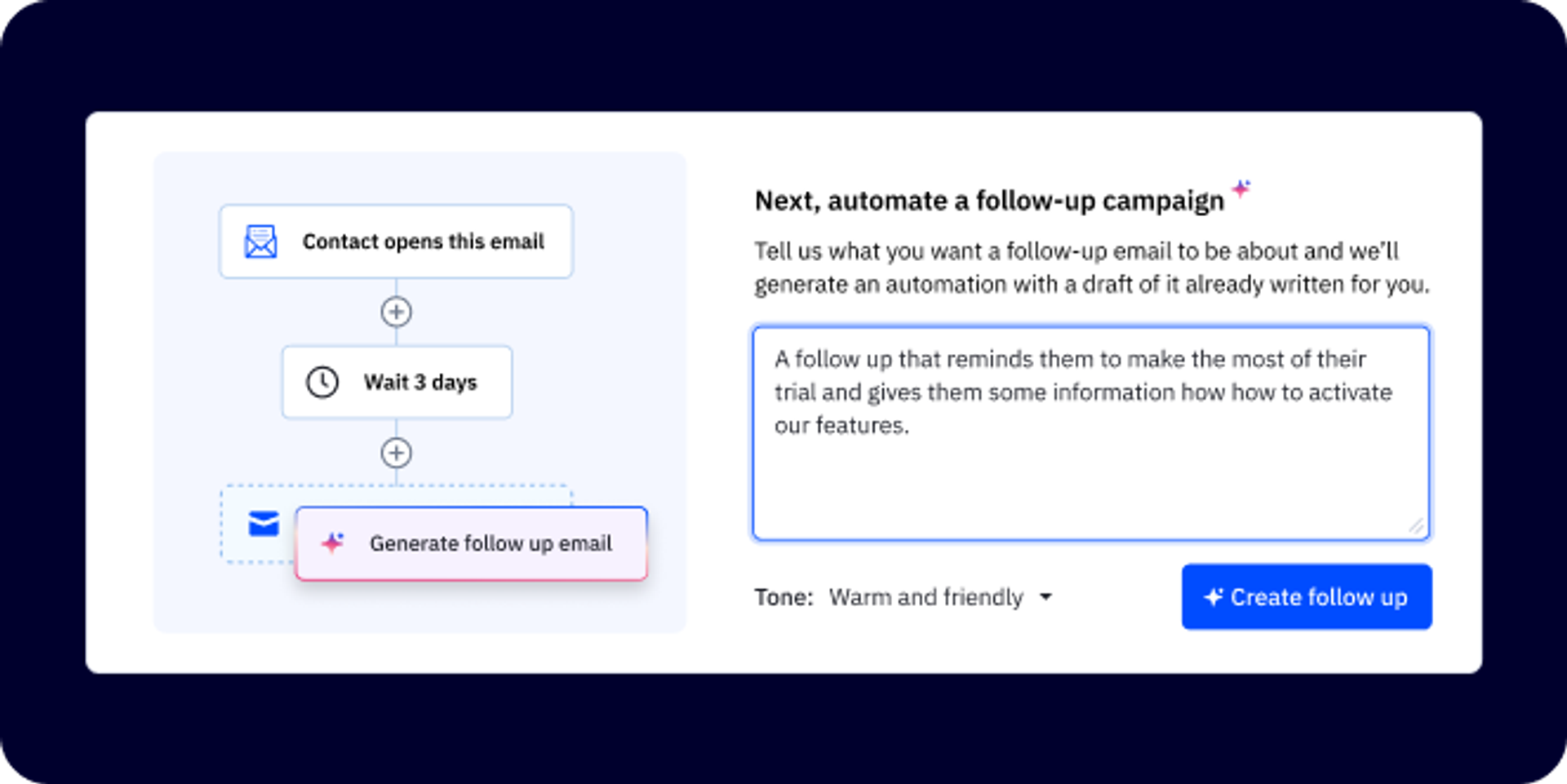
Think smarter, not harder. AI can quickly automate relevant and timely follow-ups.
- Create dynamic segments for email campaigns so your messaging adapts in real-time to user behavior. An AI agent can configure behavioral triggers that automatically move contacts between segments based on real-time actions like email opens or content downloads. Then, tailor messaging to match their current engagement level. No more static lists or missed signals.
- Generate personalized product recommendations based on browsing behavior to lift average order value and create more relevant buying journeys with zero manual input. When you connect an AI agent to browsing data, it can automatically populate email templates and website sections with relevant product suggestions.
5. Build guardrails for your brand
AI agents can write—but they need direction. Create inputs that guide brand voice, including tone, structure, and messaging style. If you have a brand style guide or brand tone doc, feed it to the AI agent and have it memorize the rules you’ve set.
Actions to take:
- Document your brand voice in simple, functional terms (e.g. "confident, not boastful," "clear over clever").
- Build sample inputs and outputs that demonstrate your ideal tone. ActiveCampaign's AI Brand Kit can analyze your company website for you and automatically extract brand voice guidelines, saving time on manual documentation.
- Create a process for reviewing AI-generated content before it goes live.
6. Create a feedback loop
AI doesn’t improve without continuous input. Treat every campaign as an experiment.
To optimize over time:
- Undertake AI retros regularly. What worked, what missed? Feed retro insights back into your AI training inputs to update brand guidelines, refine targeting parameters, and adjust content rules so the agent gets smarter with each campaign cycle.
- Tag content or campaigns with metadata to track performance trends.
Refinement is where the real performance gains happen.
Less busywork, more great work with ActiveCampaign’s AI agents for marketing
The real value of AI agents for marketing isn’t about doing less work—it’s about doing the right work. Marketers don’t need another dashboard or data stream. They need a less bloated SaaS stack with faster paths from idea to execution. ActiveCampaign’s Active Intelligence is a suite of over a dozen autonomous agents built into its platform—a growth engine embedded in everyday workflows.
Picture this: You start your day with a question—“Which campaign needs the most attention right now?” Instead of digging through reports, your AI agent gives you an actionable answer (and actions!). It not only flags underperforming sequences but also suggests new automations and recommends timing adjustments based on predictive data.
When it's time to launch, Active Intelligence accelerates everything. Instead of staring at a blank page, you generate ready-to-send emails with on-brand content and images in seconds. Campaigns are optimized before they go out—AI identifies the best send time for each contact, predicts performance, and even identifies untapped audience segments to target.
Teams using ActiveCampaign’s AI agents report:
- 10 hours saved per week by automating content creation and campaign setup.
- 3x more sales volume from predictive, behavior-based automations.
- 20% higher open rates with contact-level send time predictions.
Active Intelligence orchestrates the entire marketing lifecycle from initial spark through campaign reporting. Because it does the work of connecting insights, actions, and outcomes, marketers get back more time for strategy, creativity, and actual impact.
After launch, Autonomous Insights takes over: it automatically analyzes campaign and automation performance, benchmarks results against industry data, and surfaces specific recommendations on your dashboard each week. No report-pulling, no prompting. Just a clear view of what’s working, what isn’t, and what to do next.
Want to see how Active Intelligence can help you dynamically automate your marketing? Start your free 14-day trial today.
AI agents for marketing FAQs
How do AI agents differ from traditional marketing automation?
Traditional marketing automation relies on fixed rules and workflows set by humans. AI agents learn from data patterns and can adjust campaigns dynamically, making decisions to improve performance without manual intervention. This shift enables more personalized, timely, and effective marketing efforts.
What’s the typical ROI timeline for implementing AI agents?
ROI varies based on factors like data quality, integration complexity, and use case. Some businesses see improvements in weeks, especially by automating repetitive tasks, while others realize full revenue impact over several months as AI-driven personalization and optimization scale. Starting with high-impact pilot projects often accelerates returns.
How can I get started with AI agents if I have limited technical expertise?
Use tools that eliminate complex AI integration by handling the orchestration behind the scenes. So, instead of scripting logic or training models, you’ll simply need to define goals and outcomes. Modern platforms like ActiveCampaign offer prebuilt agents, templates, and data-driven recommendations, giving marketers access to automation capabilities without requiring a background in data science or code. You don’t need to be an engineer to use AI agents; you just need to think like a strategist.