ActiveCampaign vs. HubSpot
A side-by-side look at how two powerful enterprise platforms support modern growth teams.
A side-by-side look at how two powerful enterprise platforms support modern growth teams.

We're so confident you'll grow with us, we'll give you a full refund if you're not satisfied after 30 days.
Between ActiveCampaign and HubSpot, how do you know which platform is the right fit for your business—and the way you actually run marketing day to day?
Both are trusted, well-known platforms that combine marketing and CRM capabilities. There is plenty of overlap in the features each platform lists on its website, but those features are positioned differently.
HubSpot is an enterprise growth platform with a CRM focus, including modular hubs for marketing, data, content, and customer service.
ActiveCampaign is an AI-native platform for end-to-end autonomous marketing.
This changes how the features are actually built, and how you use them: how quickly you can launch campaigns, how much manual work it takes to keep personalization running, and how easily your marketing and sales motions adapt as your database grows.
This guide offers a practical, side-by-side comparison of ActiveCampaign vs. HubSpot to help you really understand the differences between what the two platforms offer, and how that shapes your day-to-day work.
Both platforms give you serious tools for managing customer relationships and running marketing.
The main difference is what each platform organizes itself around:
Here's a high-level look at how the two platforms compare across key categories:
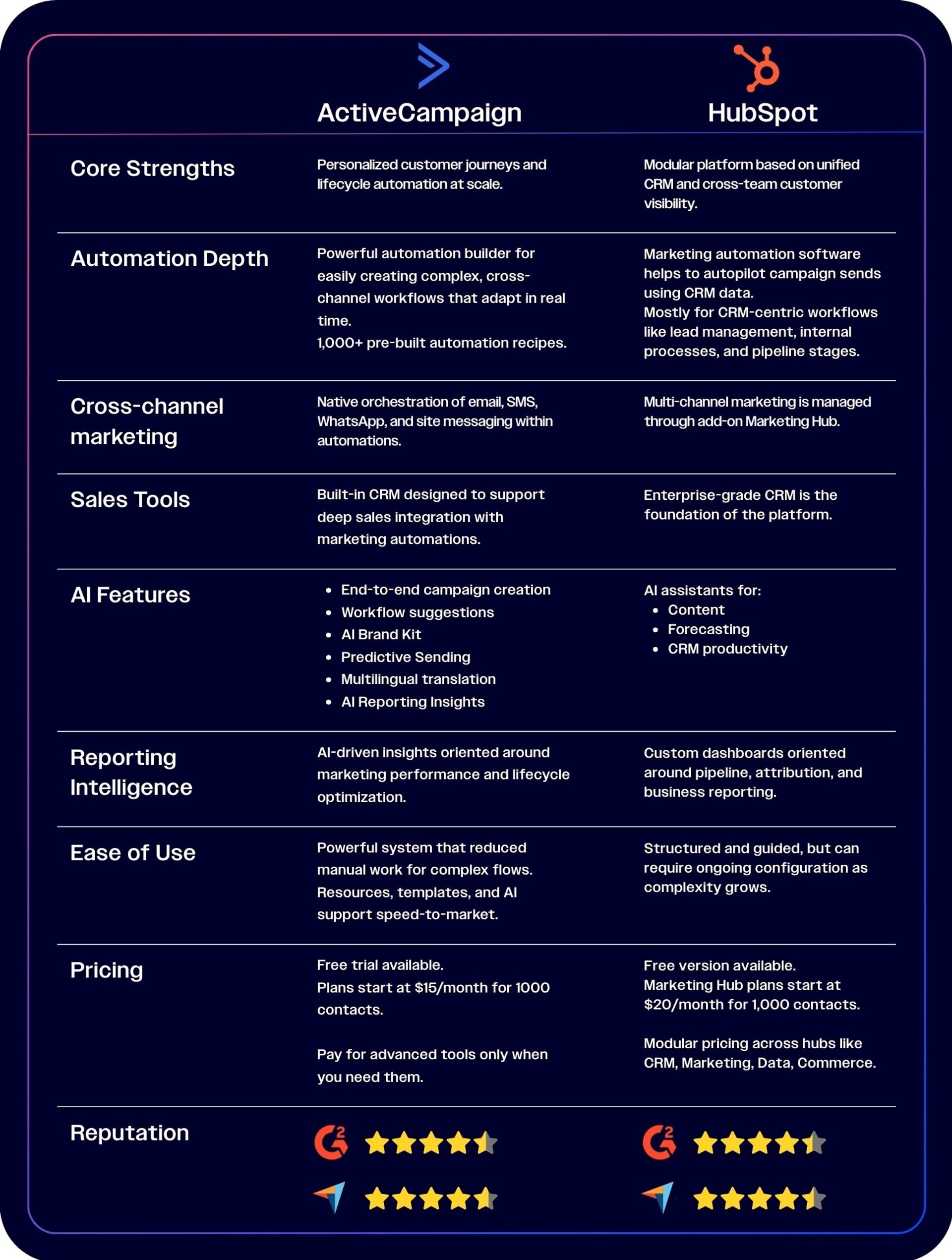
Comparison data accurate as of February 2026.
Feature names can sound almost identical across platforms—automation, segments, reporting, AI—so it’s easy to assume they work the same way. In reality, the differences show up in depth, flexibility, and the strategic impact of how much work the platform removes (or creates) as your marketing gets more complex.
Let’s take a look at how features behave in real workflows: what you can build, how much configuration it takes, and whether it scales.
The gap between ActiveCampaign and HubSpot’s automation capabilities lies mainly in what workflows are built to do, and how they adapt to real behaviors.
ActiveCampaign’s automation is designed to orchestrate customer experiences across channels based on real behavior.
HubSpot’s automation is capable, but is most often anchored to CRM records, lifecycle stages, and internal process efficiency.
ActiveCampaign automations give you a wide range of triggers and actions so journeys can react to what a contact does. This means you can create highly personalized automation based on user behavior, lead scoring, and CRM data.
Workflows can be triggered by 45 different signals—including engagement, behavioral activity, purchases, and custom events—then shaped using more than 50 responsive actions and advanced multi-step logic that can be based on extensive triggers, actions, and goals.
Your messages can be tailored precisely to each individual. It’s easy to build reusable, dynamic segments from many signals—so audiences stay current automatically and journeys stay accurate without manual list cleanup. AI-suggested segments can also surface high-value audiences to target or suppress, reducing over-mailing.
Built-in landing pages and lead forms connect directly into automations and segmentation, so every signup can instantly trigger the right journey and personalization.
On the campaign-building side, ActiveCampaign also reduces production work: email templates build themselves based on your goals, with full HTML access for editing.
In-platform AI tools are also specifically built for marketing outcomes: the AI Campaign Builder can generate a complete email from a prompt, and AI Brand Kit helps keep designs aligned by importing and analyzing your brand identity. Conditional content blocks make it easier to tailor specific sections with special offers or visuals and appeal to different customer segments.
The net effect is that a single automation can handle multiple lifecycle paths—adapting as engagement changes—rather than relying on repeated “clone, tweak, resend” work.
Once running, you’re not boxed into a small number of workflows—teams can run as many automations as they need to expand the program.
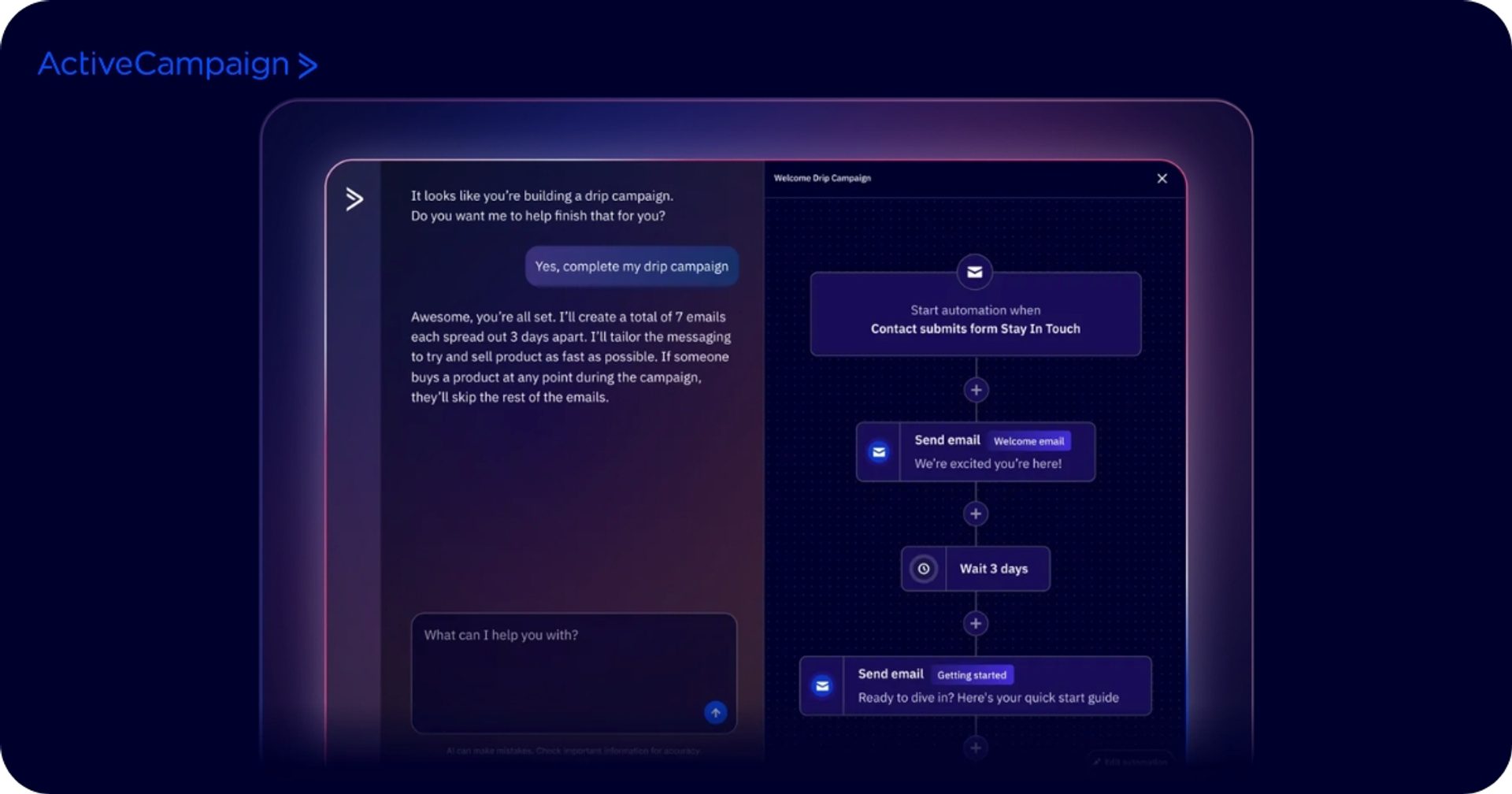
The engine is powerful, but it’s still easy to set up and designed to reduce build effort over time. The visual automation builder is AI-powered. AI agents automatically map strategy based on billions of data points and coordinate campaigns across a number of channels. The platform also includes 1,000+ pre-built automation recipes to fast-track building.
HubSpot provides automation workflows based on a range of triggers, from form submissions to page views, ensuring timely and relevant follow-ups. They also support if/then branching to route records down different paths.
It supports granular targeting via CRM lists and smart content, but advanced personalization and automation features are gated to higher tiers. While the CRM foundation is strong, teams sometimes find the email creation experience less consistent for polished formatting, and that they have to put in extra effort for professional content.
Landing pages and forms are tightly integrated with the CRM, but deeper automation-driven follow-up often depends on higher-tier Marketing Hub plans.
HubSpot automation is particularly effective when the job is to automate CRM-driven processes—like lead handling, lifecycle management, handoffs—and keep teams aligned around the same customer record.
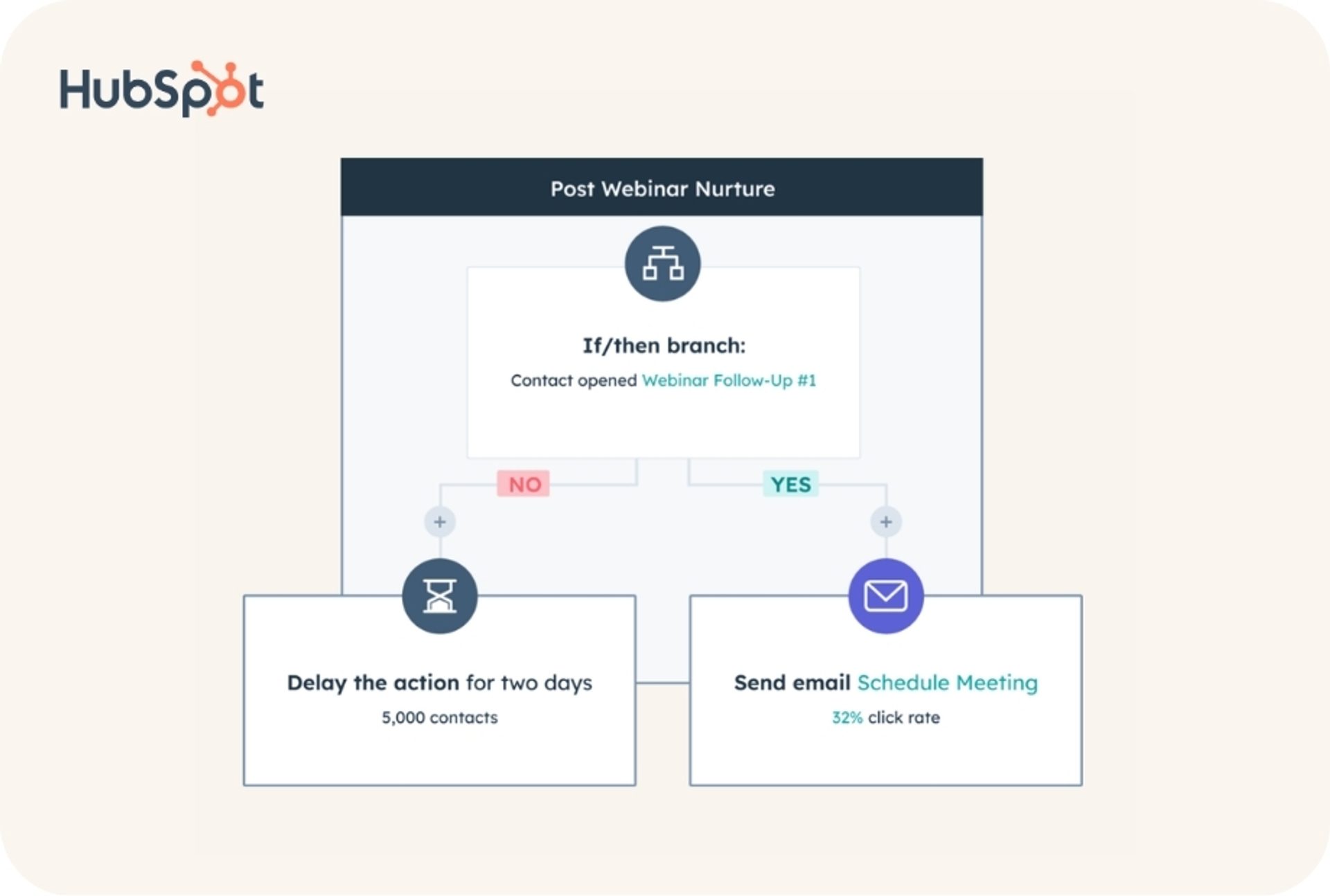
However, automations in HubSpot come at a very high cost; available for the Professional Marketing Hub tier and above, at a starting cost of $800 per month.
HubSpot is useful for automating CRM-driven operations and lead handling inside a unified system of record, but comes at a high price. ActiveCampaign is built to automate the customer experience itself—multi-branch, behavior-based journeys that adapt across channels.
“Cross-channel” is easy to claim. Most platforms can point to multiple channel features (email here, SMS there, social integrations somewhere else). True orchestration is harder.
ActiveCampaign can orchestrate multi-channel journeys from one automation, using shared behavioral triggers and branching.
HubSpot centralizes communication and customer context in the CRM, then extends into channels via hubs, add-ons, and integrations.
ActiveCampaign is designed to coordinate cross-channel marketing inside a single workflow. It natively supports orchestration across email, SMS, WhatsApp, and web experiences.
Channels share the same targeting logic, messages coordinate with each other, and next steps change automatically based on what the customer does. That means one automation can decide when to email vs. text, trigger follow-ups based on engagement, and shift contacts into different paths as intent changes.
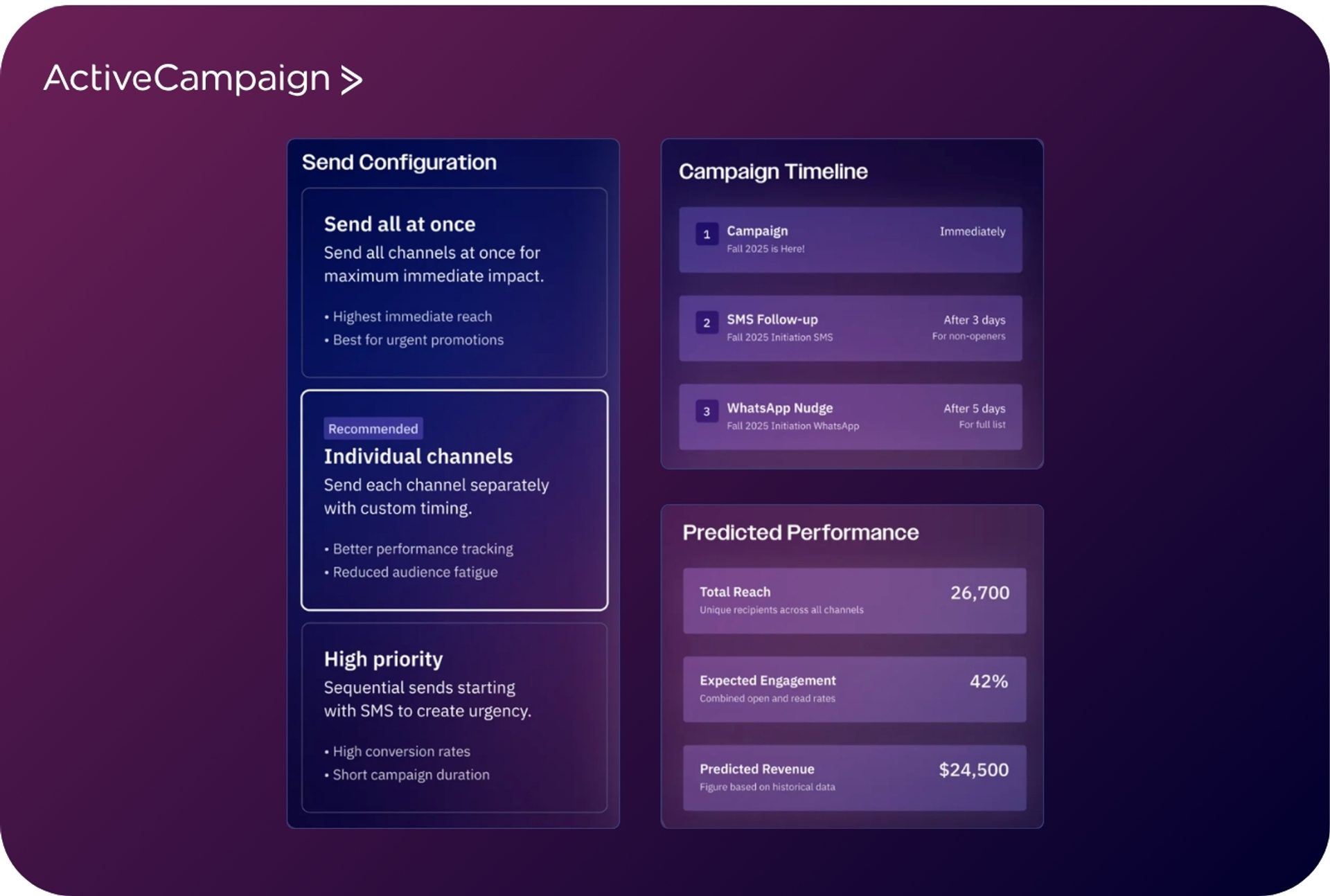
All of ActiveCampaign’s native messaging options are built for compliant business use. WhatsApp messaging is covered by Meta’s approved Business Solution Provider (BSP), so you can natively access, set up, and manage the WhatsApp Business API. The SMS add-on includes explicit opt-in/opt-out, company branding, and link shortening tools.
ActiveCampaign also supports extending into additional channels using 1,000+ native integrations, so the same “brain” (automation logic and segmentation) can coordinate activity beyond native messaging.
HubSpot supports multi-channel execution, but key capabilities often depend on which hubs and add-ons you’re using. For example, automated SMS in workflows requires a Marketing SMS Add-On on Marketing Hub Professional or Enterprise, and WhatsApp messaging is also tied to higher-tier hub access.
It is strongest when cross-channel strategy focuses on shared context and visibility for the CRM, centralizing customer context and communication so teams can see and act on engagement from the same record.
WhatsApp in HubSpot is primarily implemented as a channel connected to the Conversations Inbox (message management inside HubSpot). This is valuable for visibility and response workflows—but it’s ultimately a basic integration, rather than a full BSP provider.
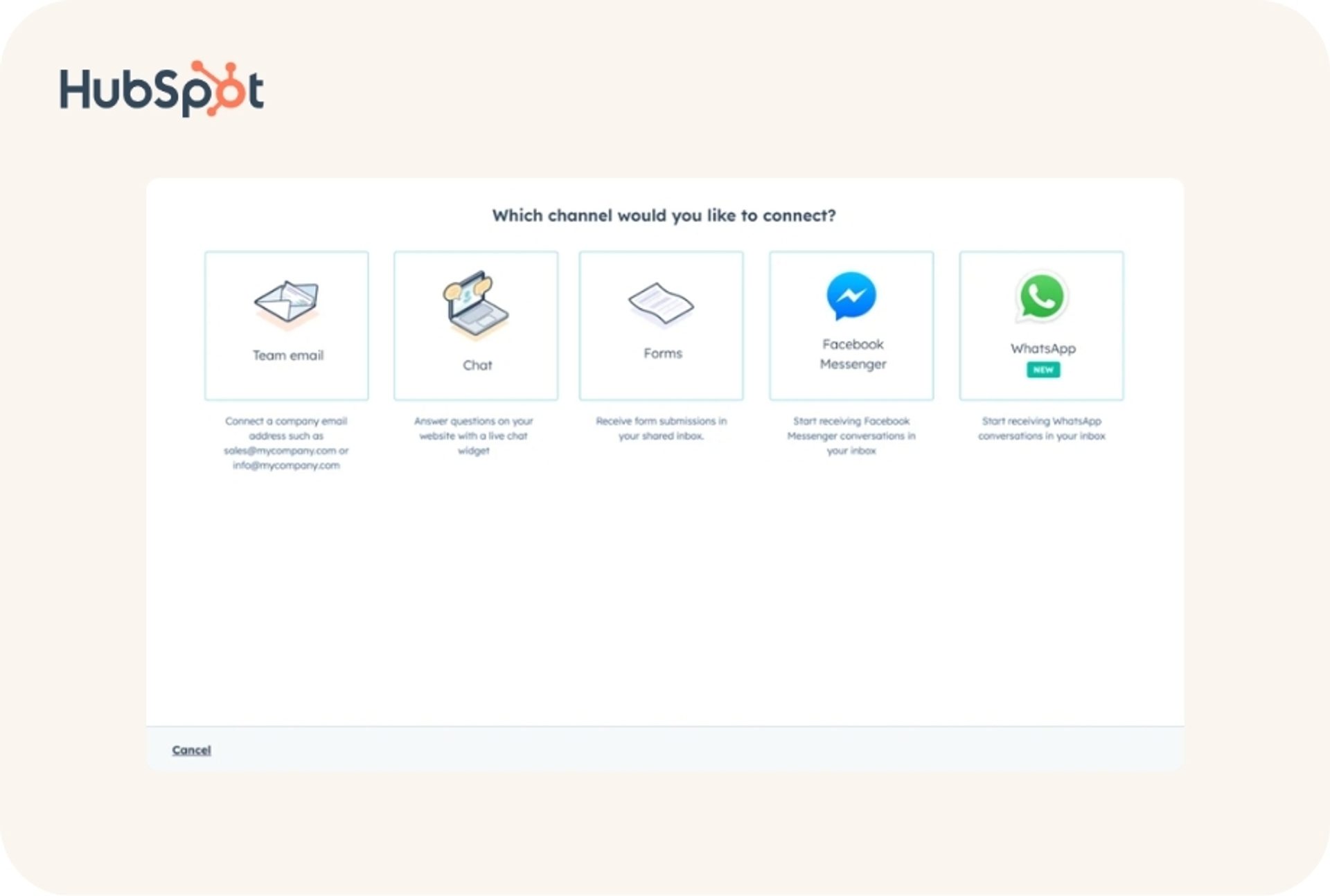
To extend beyond the limited platform capabilities, HubSpot relies heavily on its ecosystem. The app marketplace includes 2,000 integrations, enabling broader connectivity depending on your stack and hubs.
This model works well for teams that prioritize CRM coordination and want channels connected through shared customer data, even if the “single automation across channels” experience is less central than in an automation-first platform.
HubSpot is focused on CRM-centered execution—a unified customer record and inbox-driven communication layer, with channel depth expanding through hubs and integrations.
ActiveCampaign is best when you need orchestrated journeys: one automation that coordinates email, SMS, WhatsApp, and on-site touchpoints in one flow and adapts to behavior across all channels.
Both platforms include a built-in CRM, but they solve different problems.
ActiveCampaign’s CRM is built to turn marketing intent into sales action.
HubSpot’s CRM is built to be the system of record for sales-led teams.
ActiveCampaign’s user-friendly Sales CRM includes stages, deals, and tasks with support for unlimited pipelines, which makes it easy to model different funnels or teams. Designed for ultimate flexibility, it allows you to build workflows that perfectly match your unique sales process.
Pipeline management is intentionally lightweight and fast to operate, with Kanban-style boards that visualize deal flow and drag-and-drop opportunities between stages without a lot of admin overhead.
It prioritizes tight coupling between marketing and sales motion; CRM objects are designed to be manipulated by automations and follow-up happens immediately when intent shows up.
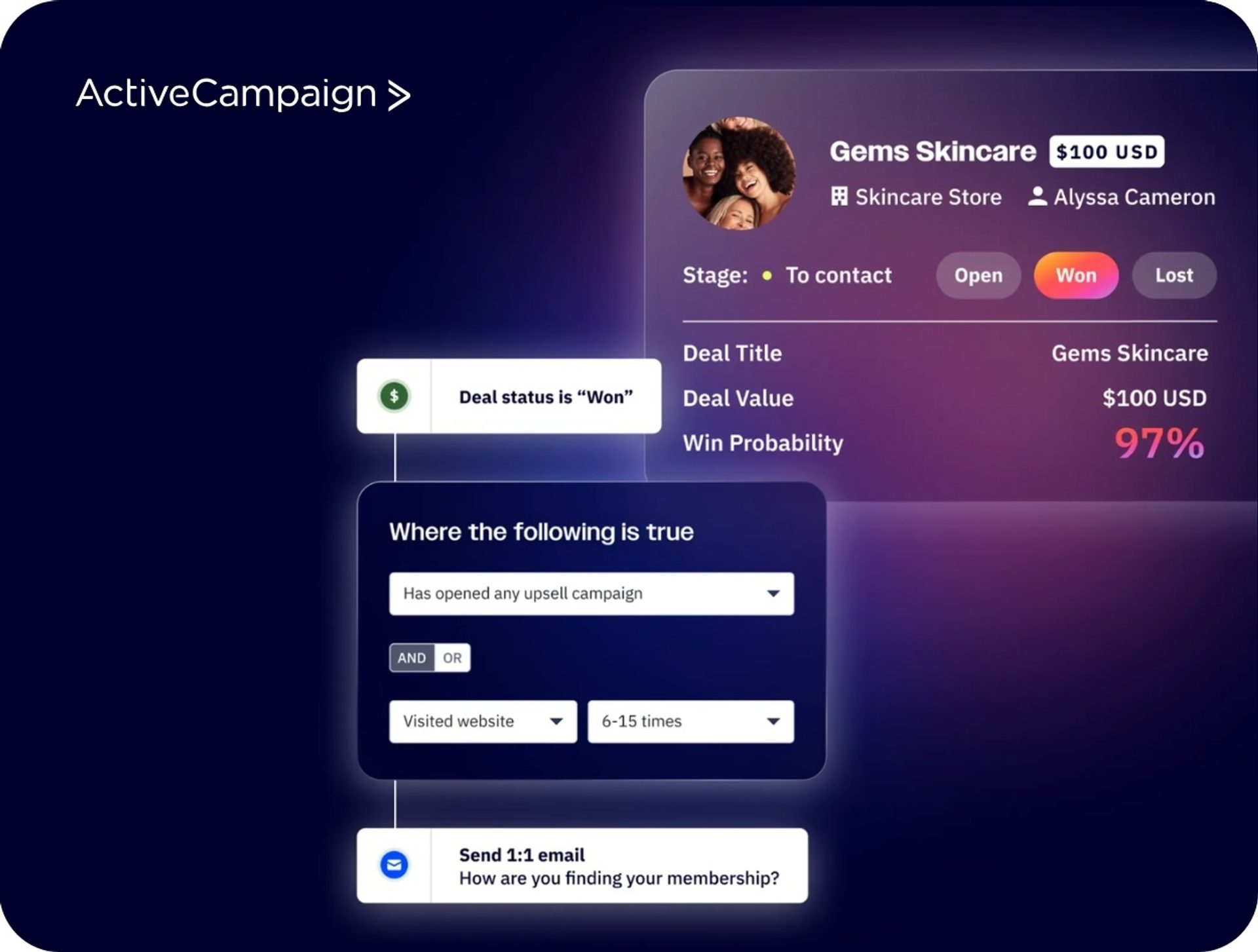
CRM actions can be embedded inside automations, reducing the risk of leads stalling because someone forgot a manual step. You can use automation logic to create and update deals, move stages, assign owners, and trigger sales tasks when contacts engage. It also supports both lead scoring and Win Probability, which help reps prioritize work based on deal quality and historical patterns rather than gut feel.
HubSpot’s Smart CRM is built for larger teams and offers extensive customization, in-depth reporting, and advanced features that can handle high volumes of data. It’s designed to become more powerful as you add Sales, Service, and Marketing capabilities on top.
Pipeline management is built for complex, customizable sales operations—multiple pipelines, deeply configurable stages and properties, and stronger management-layer reporting for tracking velocity, win rates, and pipeline health across teams.
Sales productivity features and forecasting workflows help managers run a sales org with consistent process and visibility.
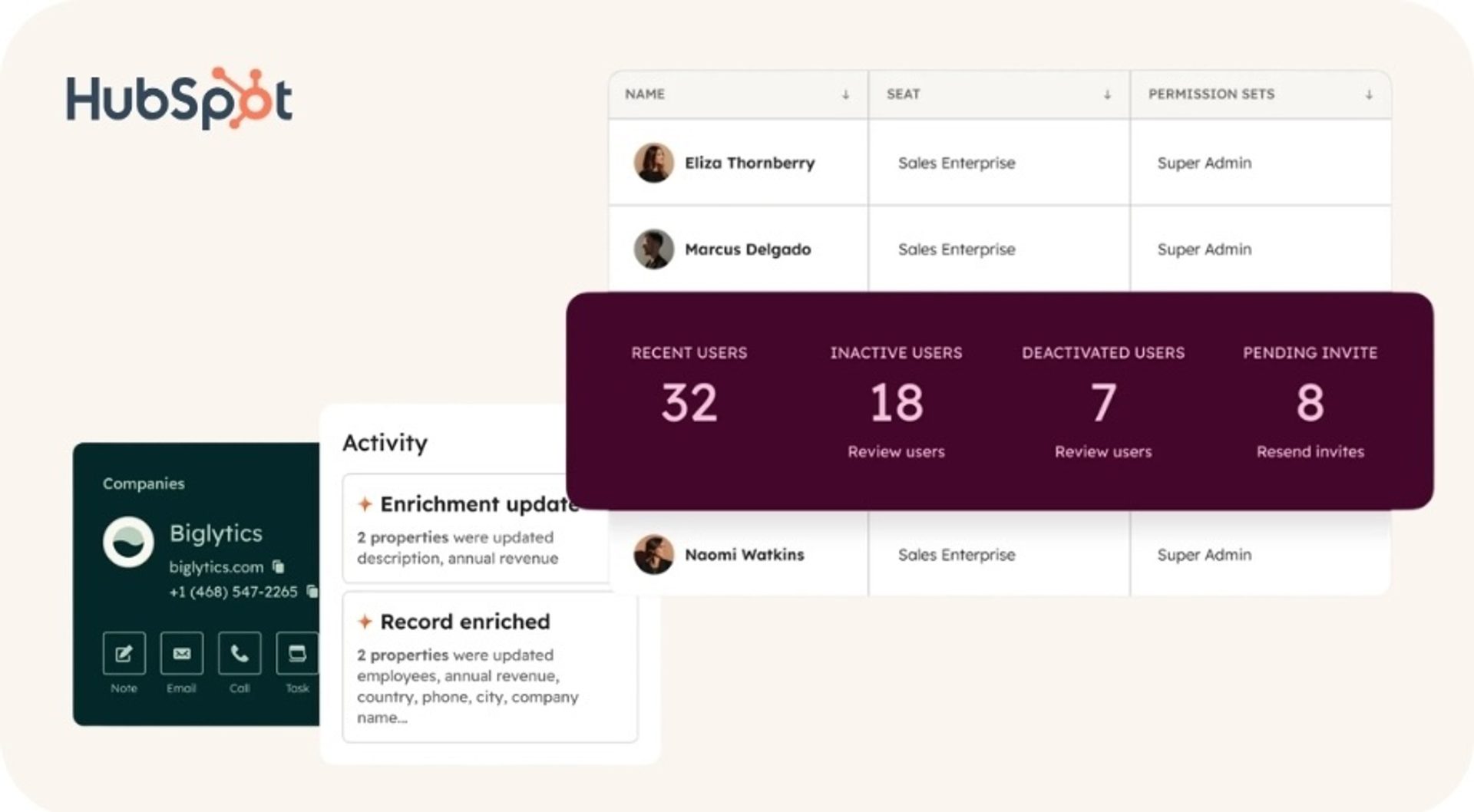
The customizable dashboard lets you tailor pipelines, sales processes, and contact properties to fit your business’s unique needs. This level of detail is great for managing intricate sales workflows.
ActiveCampaign’s CRM is built to keep marketing and sales working in sync, so marketing signals directly trigger sales execution and both teams operate from the same automation-driven workflow.
HubSpot’s CRM makes sales the center of gravity—a centralized operating system where pipelines, forecasting, and sales processes lead, with cross-team visibility layered around that core.
Good reporting tools shouldn’t just track what happened, but help you understand why it happened and what to do next. Both platforms cover the basics, but they optimize for different decision-making styles.
ActiveCampaign leans toward actionable guidance, surfacing patterns, explaining drivers, and nudging the next best step with AI.
HubSpot leans toward organizational visibility, with custom dashboards and enterprise-grade attribution across teams and hubs.
ActiveCampaign’s analytics and reporting software helps track performance across campaigns, automations, and deals in one system.
Automation reporting evaluates how contacts move through workflows, and diagnoses journey performance for deep optimization. When you’re using the CRM, reporting extends into pipeline context, connecting marketing activity to deal movement so you’re not exporting data to understand impact.
AI tools make analytics very accessible to all stakeholders: they proactively surface trend-based insights and recommended actions directly in the product, or you can simply prompt Active Intelligence with queries about your campaigns. It will immediately surface insights including how to optimize and meet your specified Business Goals.
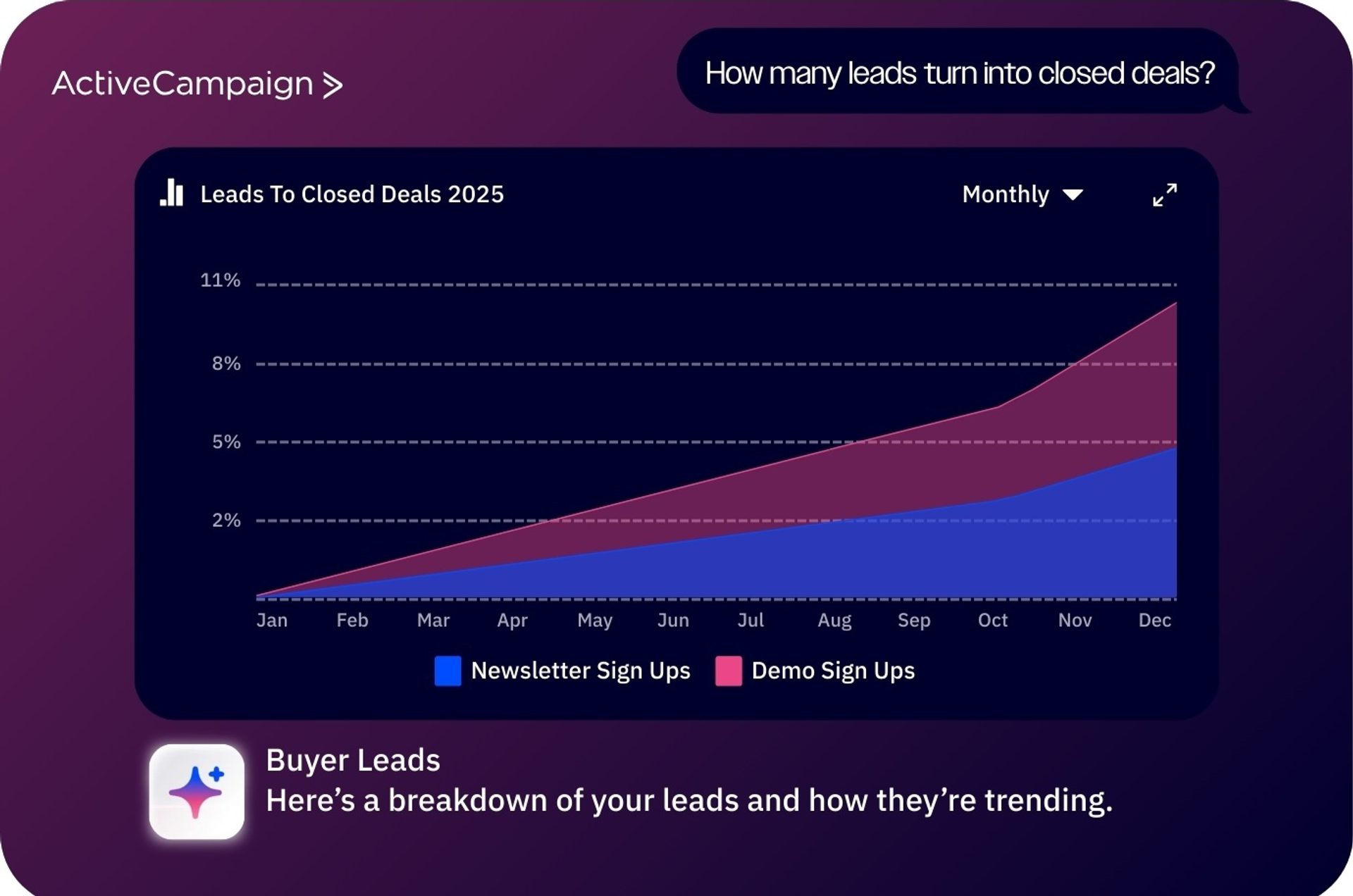
You can also easily build Custom Reports using a drag-and-drop builder and dashboards with reusable reporting recipes.
HubSpot’s reporting strength is breadth and customization across its CRM-driven ecosystem. It supports building dashboards and reports that can span marketing, sales, and service data—depending on the hubs you’ve chosen to work with. This is helpful when different stakeholders need different views of performance, but the modular nature of the systems can be complex (and expensive) to run.
It leans into revenue and pipeline reporting, including attribution-style views and pipeline performance analytics that map marketing outcomes to business metrics inside the CRM.
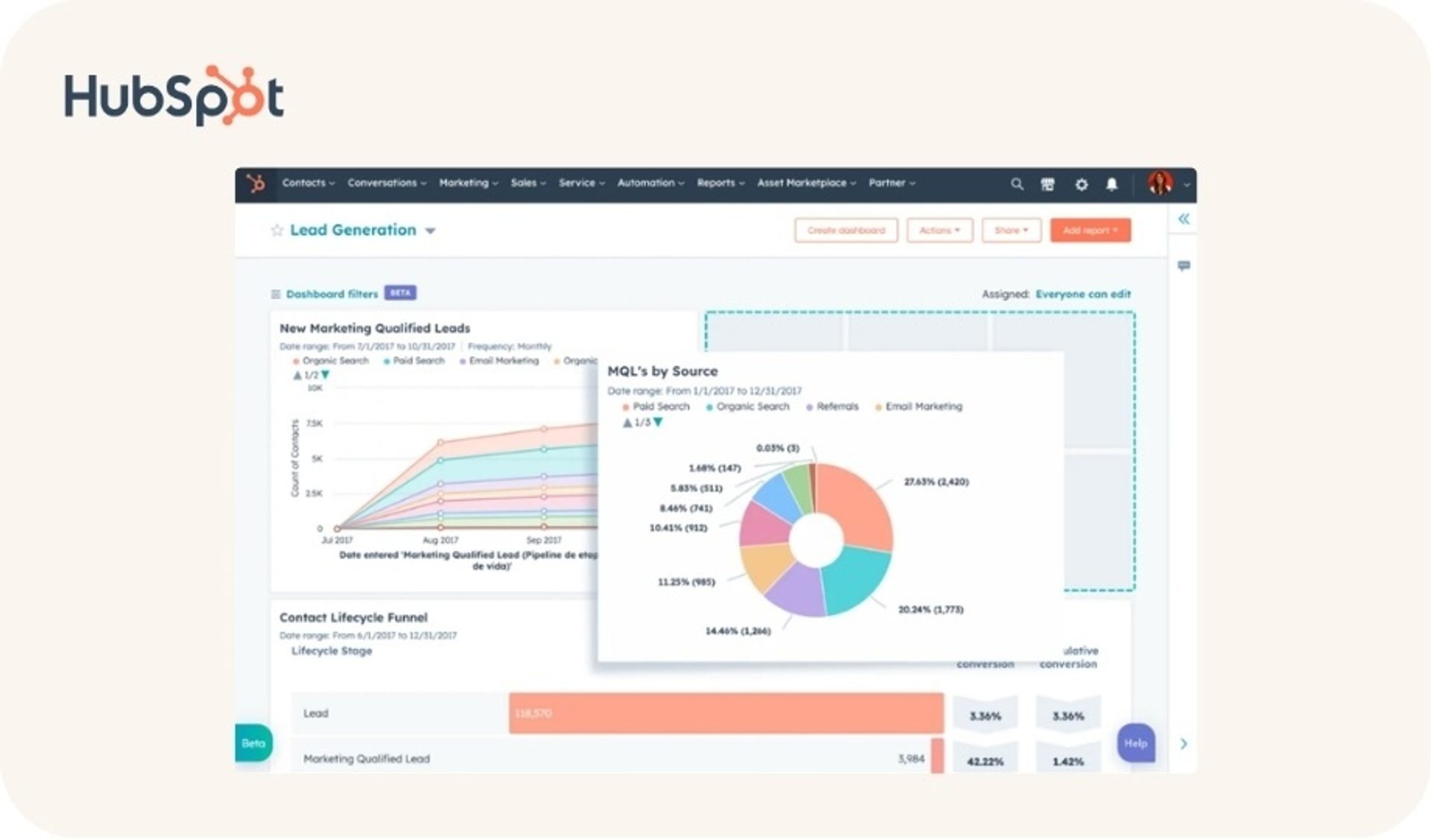
In practice, HubSpot is especially strong when you want reporting to function as a shared measurement layer across teams, with dashboards tailored to leadership and operational reporting needs.
ActiveCampaign does reporting best when you want insights that translate quickly and automatically into optimization. It focuses on what changed, why it matters, and what to do next.
HubSpot is useful if you need highly customizable, enterprise-grade visibility; especially for attribution and pipeline reporting across departments.
What good is a great campaign if it never reaches the inbox?
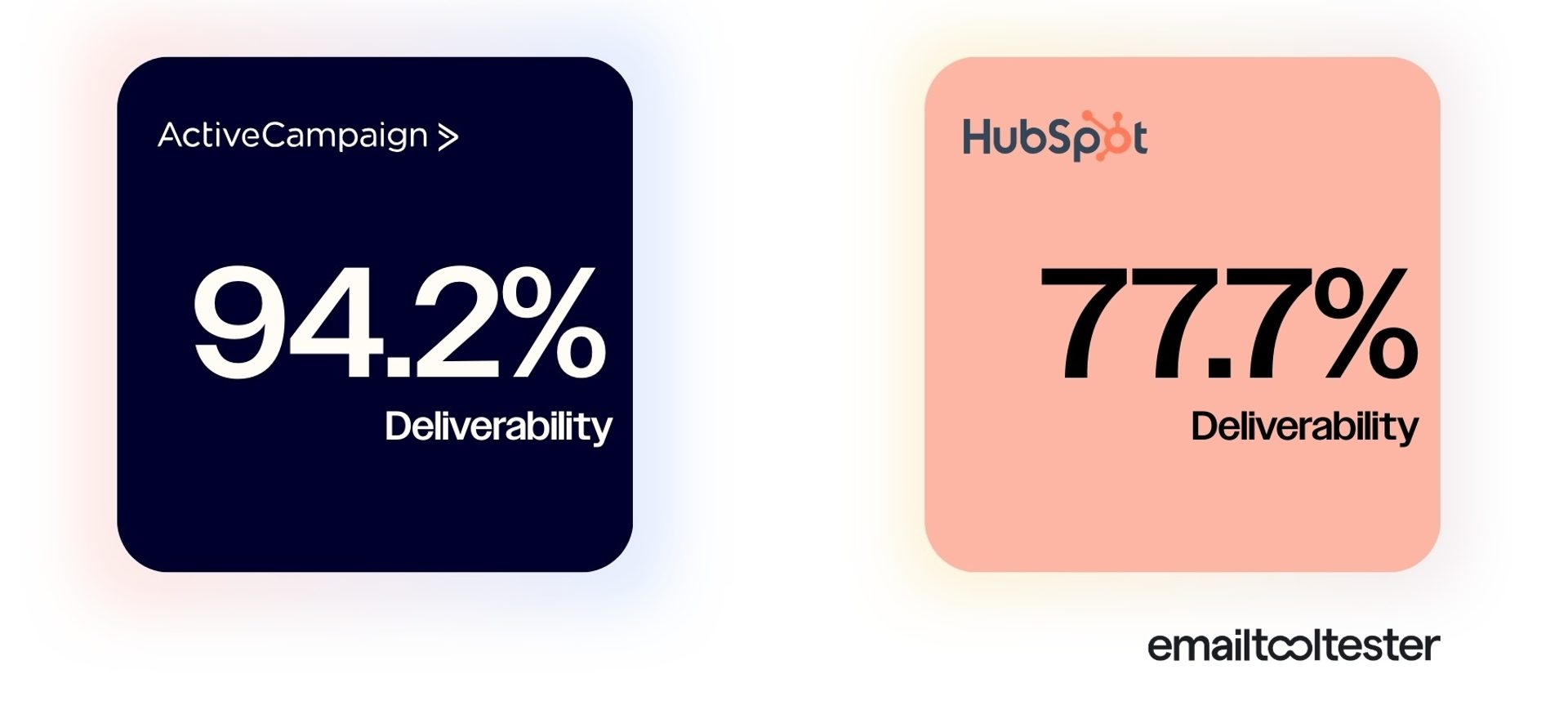
Both platforms can deliver email, but ActiveCampaign scores far higher in the most recent deliverability comparison done by third-party platform EmailToolTester.
ActiveCampaign is ranked #1 out of 16 tools, with 94.2% deliverability.
HubSpot comes in at the bottom end of the rankings. It is #12 of 16 tools, with 77.7% deliverability.
Each platform offers tools that help you protect sender reputation and troubleshoot issues.
ActiveCampaign pairs a strong baseline with practical levers to protect deliverability and inbox placement as you scale, including:
For teams with more complex or specific needs, a one-on-one deliverability consultation is available to book for $79.
HubSpot focuses on deliverability fundamentals:
ActiveCampaign provides a number of strong deliverability “instruments” to keep inbox placement steady as volume and complexity grow.
HubSpot also has solid fundamentals, but its weaker third-party deliverability results are a real red flag if inbox placement is mission-critical for your growth.
AI is quickly becoming a real differentiator in all marketing platforms. Some tools have invested more heavily—or more innovatively—than others. The most common approach is offering AI features that speed up execution by building content and campaigns. Other AI leans more toward operations, analysis, or productivity.
ActiveCampaign is the only platform offering AI built around both MCP Server and Client, enabling true bidirectional AI. So, supported tools like Claude and ChatGPT can not only read your marketing data but also take actions like updating contacts, triggering automations, and executing actions.
HubSpot’s AI is server-only and currently in beta. It's focused on assisting workflows and insights within the CRM ecosystem with more limited integration capabilities.
As an AI first platform, ActiveCampaign is designed to reduce workload across the entire marketing workflow, from building complete journeys to analyzing and optimizing performance.
Active Intelligence is the engine behind this; it is a conversational interface that can create campaigns, build automations, and analyze insights in one place.
It includes a cross-platform suite of tools:
Active Intelligence surfaces the insights. I just need to apply the learning and keep the cycle going. I’m steering strategy. I’m not pulling reports. I’m not guessing what to test next. The system does the heavy lifting.
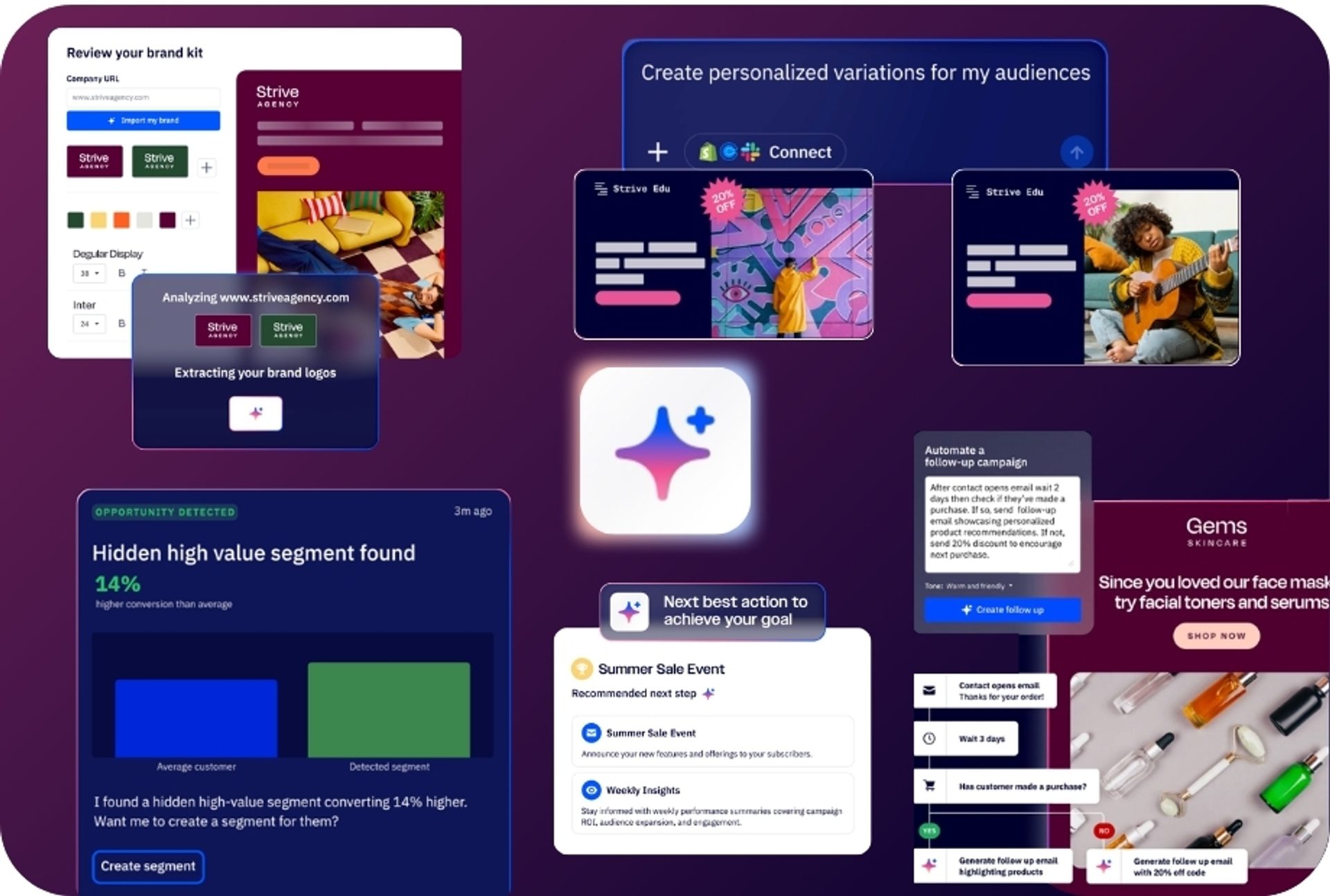
ActiveCampaign’s AI is oriented around full execution and optimization. You do less manual building; instead set up your strategy once, and let it adapt. And because the platform is AI-native, you can use Active Intelligence from day one, no matter which subscription plan you choose.
Active Intelligence was the game changer for us and definitely the life changer to me. The promise was that I could ask questions in plain language and get instant answers with visualizations combined with better segmentations and automation. So it was exactly what we needed.
You can explore ActiveCampaign’s AI capabilities yourself in the interactive product tours.
HubSpot’s AI is centered on Breeze, a CRM-native AI layer aimed at making teams faster and smarter inside the HubSpot system of record.
Breeze’s capabilities include:
Breeze usage relies on a credit-based system. You’ll need to purchase credits to unlock advanced functionality, but we’ll look more closely at this later.
Read our deep dive into ActiveCampaign’s Active Intelligence vs. HubSpot’s Breeze to explore how each platform approaches AI enablement.
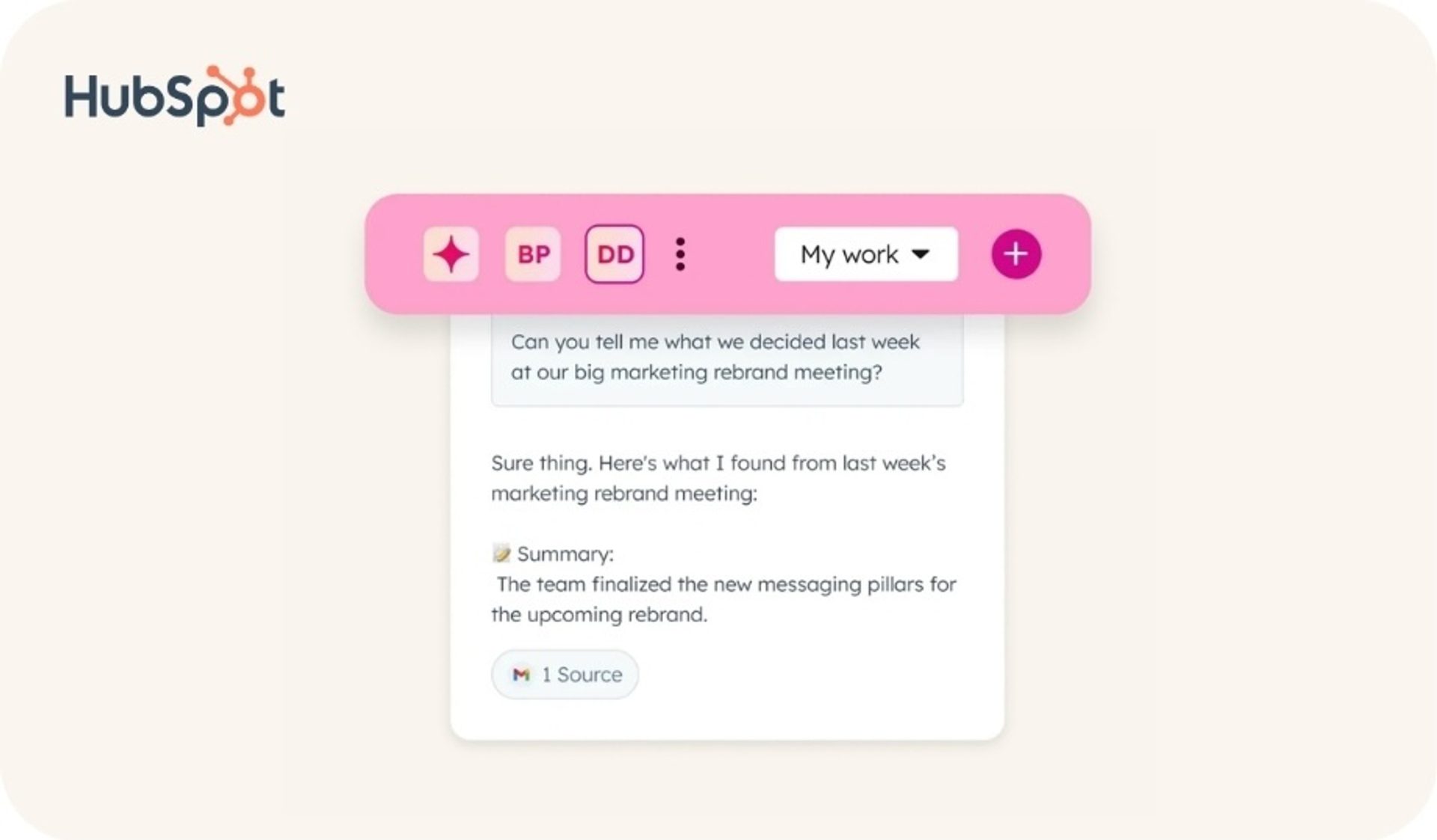
HubSpot’s AI positioning is, again, CRM-centric. It focuses on CRM-native intelligence and productivity. Most of the tools are built for decision support within the sales workflow. Following the common theme of the modular ecosystem, it often becomes more powerful as you adopt more of HubSpot’s tools.
Breeze usage relies on a credit-based system. You’ll need to purchase credits to unlock advanced functionality, but we’ll look more closely at this later.
“Easy” depends on what you’re trying to achieve. If your goals are simple, both platforms can feel straightforward. As your marketing gets more sophisticated, ease of use is better measured in how much manual work you end up needing to do, not just how fast you can send the first campaign.
There’s a common assumption that more capable platforms must be harder to use. ActiveCampaign offers more depth, but it’s still built to get you moving quickly—especially with templates, automation recipes, and AI-assisted setup. Plus, it gets easier over time: instead of rebuilding campaigns and follow-ups for every segment or scenario, you can build journeys that adapt based on behavior and attributes—so you set up once, then let the system handle more of the ongoing execution. You’ll spend far less time doing the same work over and over as your program matures.
ActiveCampaign is designed to reduce repetition and users report saving more than 10 hours every week on manual processes.
[ActiveCampaign’s] drag‑and‑drop workflow builder, AI‑powered segmentation, predictive sending, and deep personalisation tools make it easy to build complex customer journeys across email, SMS, and CRM.
HubSpot often feels easy initially because it’s highly structured around a CRM-first architecture: clear objects, clear processes, and a guided way of doing things across teams.
That structure is powerful, but once you’re fully rolling out advanced features like custom properties, pipelines, permissions, data migration, workflows, and integrations, it can become a lot to handle manually.
The extensive, hub-based ecosystem also creates a lot of complexity. Even partner guidance recommends that significant time will be dedicated to basic setup for hubs. For example, Marketing Hub basic setup is estimated to be 8–20 hours, and Sales Hub simple setup around 15 hours. More complete implementations can extend into weeks depending on scope.
[HubSpot] implementation is a bit complex, I believe due to the multitude of features, and with that, I think it might take a little while for the operation to run at 100%.
ActiveCampaign and HubSpot can both power serious growth — but they price that value very differently.
ActiveCampaign’s pricing is mostly a straight line: contact-based tiers paired with automation capability, with core automation available early and a predictable scaling curve as your list grows.
Plans are easy to understand. Let’s look at some prices based on a list of 1,000 contacts:
ActiveCampaign is designed to give you real automation from the start, so you don’t have to upgrade just to unlock basic workflows. As you grow, you can add extra capabilities like sales engagement or transactional email à la carte—without adopting separate “systems” for different teams. You start with the essentials and layer on advanced features only when there’s a clear need and ROI.
ActiveCampaign also bakes in a lot of adoption support as part of the value. There are no setup fees, plus free migration and onboarding, alongside the education and support ecosystem that helps teams get productive. Implementation is not sold as a separate project.
HubSpot’s pricing is more modular, because you build your stack across hubs like CRM, marketing, sales, and service. This means that you’re likely to be paying for multiple systems to ensure your data is fully integrated.
For the sake of simplicity, let’s look at HubSpot’s Marketing Hub plans:
Each tier offers a set number of marketing contacts: 1,000 for Free and Starter, 2,000 for Professional, and 10,000 for Enterprise. Once your marketing list hits these limits, there are (significant) additional monthly fees based on volume.
If you want to add on a CRM or other tools, you’ll be looking at additional costs on top of this. The Smart CRM starts at $45 per month, per seat.
This structure means that, no matter the size of your list, you’re forced to upgrade to unlock advanced functionality, seats, onboarding services, and AI features.
HubSpot’s AI layer runs on a credits model for certain usage-based features. Limited use of the foundational AI copilot is free, but you’ll need to purchase credits to unlock advanced functionality like Breeze Intelligence. Agent functionality typically requires a Professional subscription or higher, starting at $800 per month before you even purchase credits.
ActiveCampaign typically delivers stronger ROI when your priority is marketing automation depth without enterprise overhead.
HubSpot is a broader platform investment that only pays off when you’re standardizing multiple teams on a single, enterprise CRM ecosystem. Many teams report feeling an “all-in-one tax” as they scale, with bundles you can’t unbundle and upgrades for basics. The full cost of HubSpot (hubs, onboarding, and usage-based elements like credits) is often significantly higher.
I couldn’t imagine our product without ActiveCampaign. If ActiveCampaign didn’t exist, we would have to create it ourselves, which we wouldn’t be able to afford.
Support is an important differentiator when it comes to platform choice—especially if you’re migrating or rolling out new processes. Both platforms invest heavily in enablement, but they support different adoption paths:
ActiveCampaign is built to help you get set up quickly and keep leveling up your automation.
HubSpot is built to help teams implement a structured, CRM-centered operating system across departments.
ActiveCampaign offers multiple support paths including:
Onboarding is also geared toward getting you to a working system quickly, with free personalized onboarding for qualifying plans and complimentary data migration, so you’re not rebuilding from scratch.
HubSpot’s support paths include:
HubSpot also sells formal onboarding. This structured implementation service is mandatory for Professional and Enterprise plans. Costs vary by scope, but tend to be high: generally ranging from $1,000–$3,000 for smaller businesses, while larger enterprises may pay $7,000–$10,000.
If you want support that accelerates setup and long-term growth, ActiveCampaign has impressive resources to help you get productive quickly and keep leveling up. HubSpot’s enablement is built enterprise-first. It’s strong for large-scale rollouts, but is paired with higher costs.
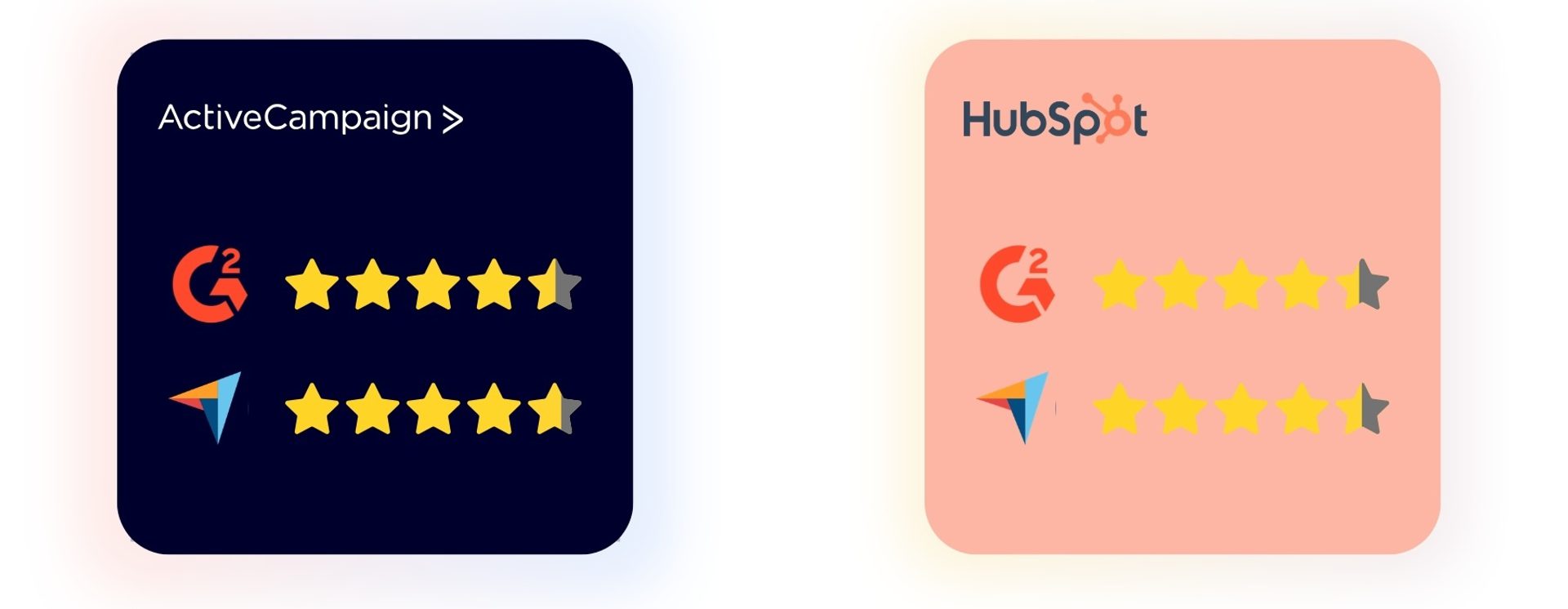
ActiveCampaign and HubSpot both have broadly positive sentiment on popular independent review sites, though ActiveCampaign is slightly ahead.
ActiveCampaign reviewers most often highlight automation depth. They mention how easy it is to connect campaigns, flexible segmentation, and CRM actions into coordinated customer journeys that scale from simple sequences to more advanced programs.
The most common caveat is a learning curve: some users feel it takes a bit more initial effort to set up properly, but that this is worth the input because it reduces repetitive manual work once workflows are running.
HubSpot reviewers describe the platform as an “all-in-one” ecosystem with “single source of truth” benefits. However, they note that the platform makes sales teams the first priority. Marketing automation often feels like it’s built to serve CRM process and pipeline visibility first.
Common complaints cite an “all-in-one tax” or paywalls, with concerns over price escalation and higher-tier gating as needs grow. Negative reviews concerning “missing features” and a “learning curve” also appear frequently for HubSpot.
We know we’re biased. You’re on the ActiveCampaign site reading a comparison. So, why not hear it from customers instead?
Once you move to a paid plan, [HubSpot’s] contract terms are rigid, and downgrading or canceling isn’t straightforward. If you value fair billing and flexibility, I recommend looking at Zoho CRM, Pipedrive, or ActiveCampaign. These competitors provide solid functionality without locking you into rigid contracts.
Having transitioned [to ActiveCampaign] from Hubspot, it was nice to have the functionality of Active Campaign at a fraction of the cost and we weren’t having to constantly manage our # of contacts to stay within pricing parameters.
If you’re deciding between HubSpot and ActiveCampaign, the best way is to match the platform to your growth strategy today—and what you’ll need once your programs, data, and teams get more complex.
Both are powerful. The difference is what each one optimizes for:
HubSpot prioritizes a centralized, sales-led CRM operating system.
ActiveCampaign prioritizes automation-led execution that reduces manual work as you scale.
Thousands of customers have switched from HubSpot to ActiveCampaign, looking for (and finding):
It’s always about how do you use the tools that are out there, trying to be as efficient as possible and not spend crazy money for extra features you’re not even using. We switched to ActiveCampaign, which provides the same features, and the transition was easy.
We used HubSpot before, but ActiveCampaign has a lot more logical flow to it. This has allowed us to create a more complicated set of automations based on people moving through that pipeline.
Startup Valencia doubled their click-through rate, increased their prospects by a factor of five, and increased their email open rate to 83% after switching from HubSpot to ActiveCampaign.
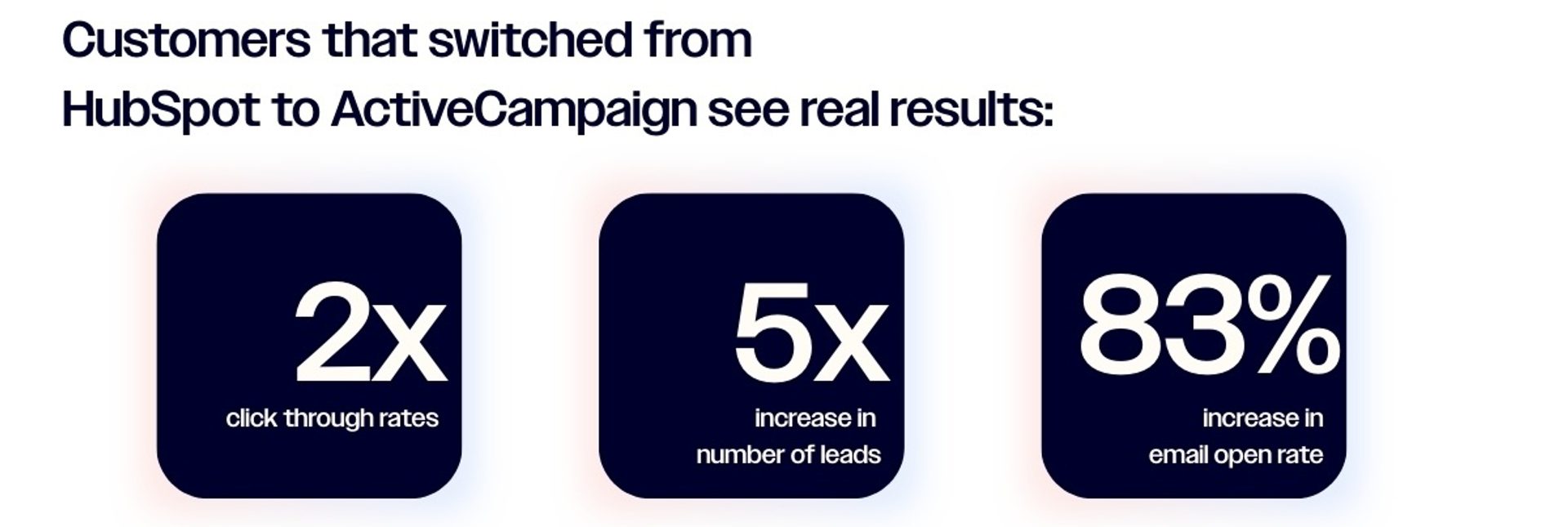
Startup Valencia switched from HubSpot to ActiveCampaign and saw incredible results.
Thanks to ActiveCampaign, we have managed to segment our audience in an optimal way… [and] are managing to be more efficient in attracting and retaining members and partners.
Before you decide, pressure-test three things:
If you’re ready for a platform that can do more with less manual work (and at a lower cost!) request an ActiveCampaign demo or take a look at our migration guide to see how easily you can switch platforms.
ActiveCampaign is best for lifecycle marketing automation, building journeys that adapt to behavior across email, SMS, WhatsApp, and your integrated stack.
HubSpot prioritizes being a centralized CRM operating system for sales-led teams. ActiveCampaign prioritizes automation-led execution for marketing teams.
ActiveCampaign’s pricing is straightforward and primarily scales by contacts and plan tier, with optional add-ons when you want extra capabilities.
Most users find they can switch to ActiveCampaign quickly with templates and prebuilt automation recipes, then deepen sophistication as needed.
HubSpot scores 77.7% in recent EmailTooltester’s independent deliverability testing, ranking 12th out of 16 platforms. That means roughly 1 in 4 emails never reach the inbox, costing a 50,000-contact list over 8,000 missed messages per send.
ActiveCampaign leads the same test at 94.2%, placing #1 overall. That 16.5‑point gap shows up directly in open rates, click-throughs, and revenue per campaign.
HubSpot’s Starter plan ($20/month) has no workflows or email sequences, so most teams need Professional at $890/month, according to their pricing page (March 2026). Add the mandatory $3,000 onboarding fee and forced annual billing, and year-one spend exceeds $13,000 before contact overages.
The equivalent capability on ActiveCampaign costs approximately $3,200 per year, with no onboarding fees, no forced annual commitment, and full automation on every paid plan.
HubSpot’s Starter plan has no marketing automation workflows and no email sequences. To access those core features, you jump to Professional at $890/month or Enterprise at $3,600/month.
ActiveCampaign includes full automation on all paid plans: 900+ automation recipes, conditional logic, and multi-step workflows from day one. There’s no paywall between you and the tools you need.
HubSpot’s Breeze AI gates most features behind Professional ($890/month) and Enterprise ($3,600/month) plans, with usage running on a credits system at $45/month per 5,000 additional credits. Starter customers effectively operate without AI.
ActiveCampaign’s Active Intelligence includes AI features on all paid plans with no credits or per-use charges: AI Campaign Builder, Predictive Sending (17% higher CTR), AI-suggested segments, and predictive content with up to 5 variations per contact.
HubSpot holds a D- rating with the Better Business Bureau, driven by complaints about billing practices, contract disputes, and cancellation difficulties. TrustPilot reviews describe accidental contact imports locking customers into higher billing tiers with no recourse.
ActiveCampaign holds an A+ BBB rating and a 4.5 average across 14,500+ G2 reviews. The platform scores 9.1 for ease of use on TrustRadius (vs HubSpot’s 8.6) and has been Top Rated there for 8 consecutive years.
Yes. HubSpot requires $3,000 for Professional onboarding and $7,000 for Enterprise, non-negotiable and due upfront. Combined with forced annual billing, the cash outlay to start HubSpot Professional exceeds $13,000, according to their pricing page.
ActiveCampaign charges no onboarding fees on any plan. You get free 1:1 or agentic onboarding, free migration of up to 10 objects (contacts, lists, forms, templates, automations), and month-to-month billing is available.
Try it free for 14 days.