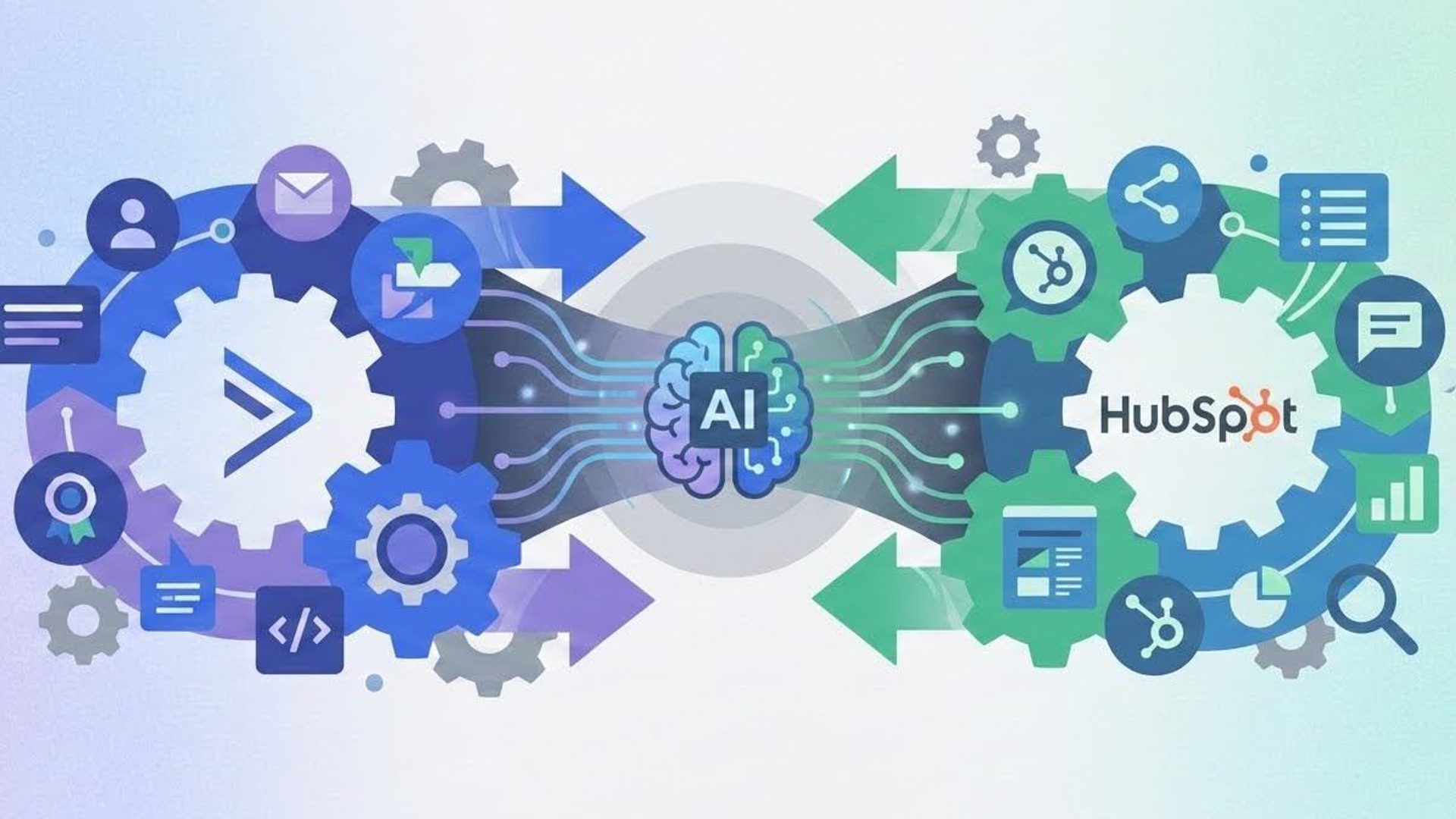
At some point in the last few years, every marketing platform looked at the AI opportunity and decided where it would fit within the scope of their product strategy.
ActiveCampaign and HubSpot represent two distinct philosophies in response to that question. HubSpot's approach centres on Breeze: an AI layer built on top of its ecosystem. ActiveCampaign created Active Intelligence, treating AI not as a layer but as the platform's operating logic, and the engine behind all workflows.
Neither philosophy is inherently right or wrong. Both reflect deliberate product decisions made by serious engineering teams. But depending on your organization's size, budget, and priorities, one approach will serve you meaningfully better than the other. The differences become especially pronounced when you move beyond the demo and into day-to-day execution, particularly when considering pricing accessibility, workflow integration, and which capabilities are available to which users.
Below, we’ve examined both tools in depth to provide you with a transparent, workflow-level comparison of ActiveCampaign's Active Intelligence and HubSpot's Breeze. Read it as a buyer's guide, not a verdict, so that you can make the right decision for your team.
| Feature | ActiveCampaign | HubSpot |
| Send-Time Optimization (per-contact) | Per-contact optimization available to Pro users (from $79/month) and above. | Per-contact optimization available to Enterprise users (from $3,600/month) and above. |
| AI Content Generation | AI Campaign Builder uses Active Intelligence to make full campaigns (content, design, everything else) from plain language prompts. | Breeze Copilot provides content drafting within HubSpot. |
| AI Automation Building | Natural language inputs can produce full multi-step workflows via the Active Intelligence engine. | Natural language inputs produce workflow suggestions via the Breeze Copilot. |
| AI Agents | 25+ specialized marketing AI agents. | 6+ AI agents and assistants available in GA. |
| Predictive Lead Scoring | Yes. Available to Plus plan customers and above. | Yes. Breeze Intelligence available as a credit-based paid add-on. |
| Data Enrichment | Billions of data points aggregated. Connections to 1,000+ integrations. | 200 million+ profiles in dataset and available via a credit-based add-on. |
| AI Segmentation | AI-Suggested Segments proactively surface high-value audiences. | Breeze Personalization Agent provides segment discovery via CRM data. |
| AI Forecasting | Win Probability available in the ActiveCampaign CRM for Plus plan customers and above. | AI Forecasting analyzes data and buyer signals to project future revenue ranges. |
| Multi-Channel AI | Email, SMS, WhatsApp in one agent workflow. | Email, social, and web available. |
| MCP Integration | Yes. Connect ActiveCampaign to your favorite AI tools including Claude and ChatGPT. | No MCP layer available. |
| Pricing Predictability | Flat monthly plan pricing, with AI tooling available on all tiers. | Credit-based consumption model for AI features can be unpredictable at scale. |
The fundamental difference: AI built-in vs. AI bolted-on
To understand what separates ActiveCampaign and HubSpot’s AI offerings, you first need to understand an architectural distinction that shapes everything else: the difference between intelligence that is built into a platform and intelligence that is bolted onto one.
Built-in AI means intelligence is embedded into the platform's core operating logic. It has direct, native access to workflows, data, and orchestration—not as separate modules it must bridge to, but as interconnected systems it can read and act across simultaneously. The AI doesn't sit alongside the platform but runs through it. When behavior changes, the platform can respond within the workflow and act on insights without requiring manual handoff.
Bolt-on AI describes a different pattern: capabilities added alongside an existing platform, often as a distinct product layer or a separate tool set, independent of core workflows. The AI may be sophisticated in isolation, but its output has to travel—sometimes through friction, sometimes through a paywall—to reach the workflow where a marketer actually needs it. Intelligence and execution live in different places.
These describe the real product architectures behind ActiveCampaign and HubSpot.
ActiveCampaign's AI is built in. ActiveCampaign actively tore down the marketing automation platform and rebuilt it over the Active Intelligence engine. It is not a product added to the platform, but the platform's operating logic.
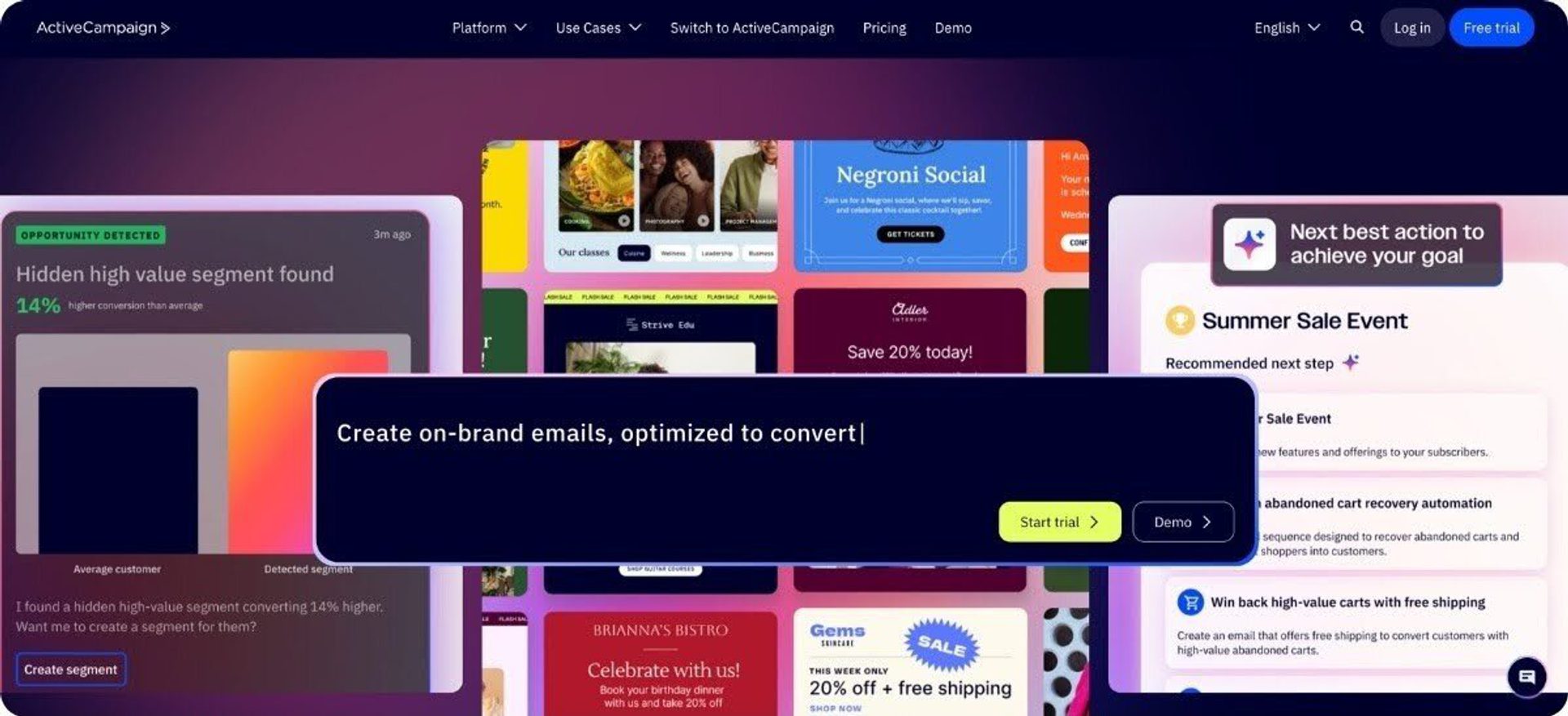
A single AI engine aggregates billions of data points across customer behavior, campaign history, and engagement signals, and applies that intelligence responsively and continuously across:
- Campaign creation
- Segmentation
- Automation
- Send-time optimization
- Performance reporting
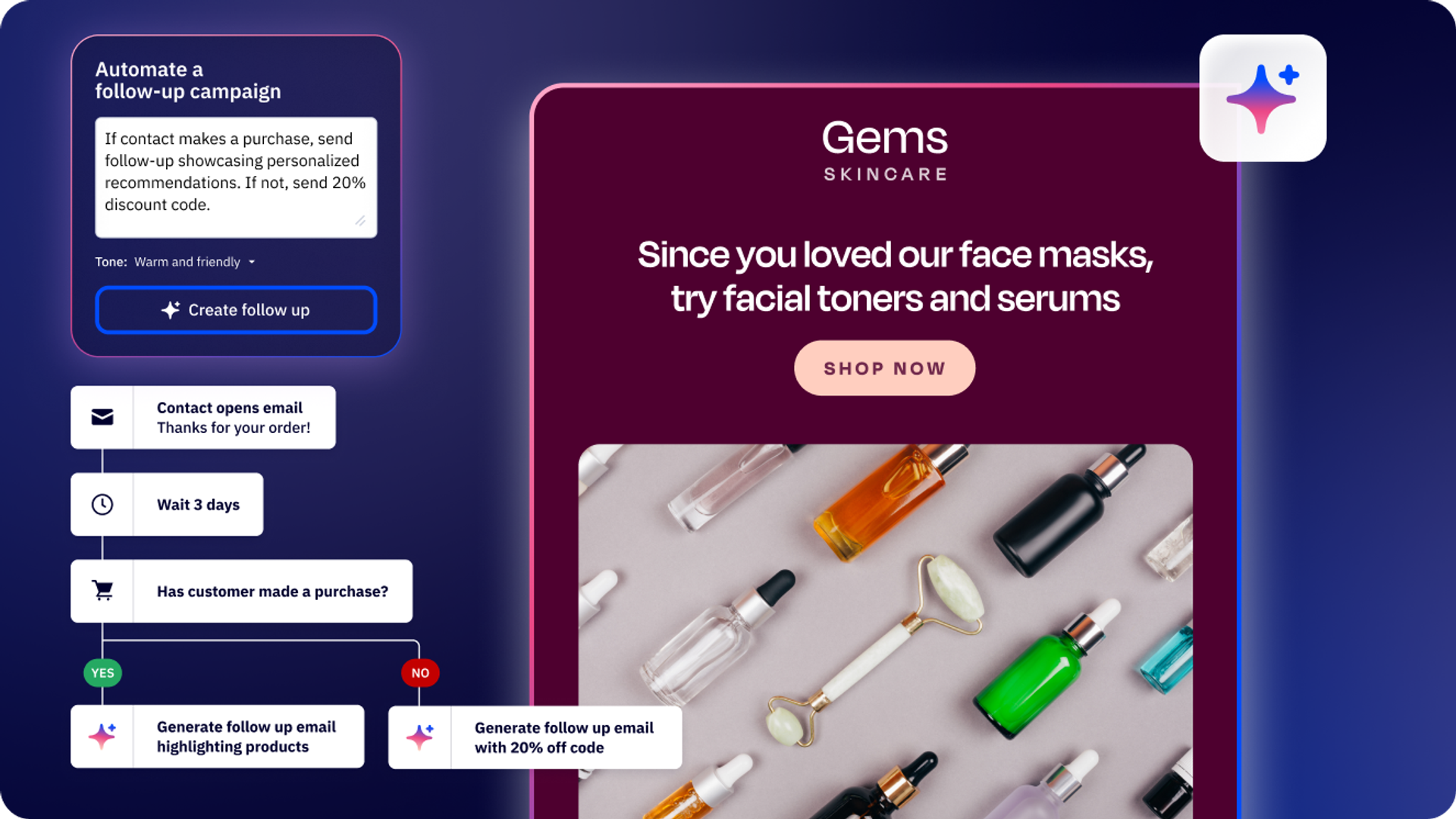
When you prompt Active Intelligence to build an automation, it doesn't generate a suggestion that you have to manually configure. It builds the workflow.
HubSpot's AI also provides genuine breadth. Breeze comprises three layers:
- Breeze Assistant helps with daily tasks across hubs.
- Breeze Agents handle content creation, prospecting, and customer service workflows autonomously.
- Breeze Intelligence enriches contact and company records from a database of over 200 million profiles.
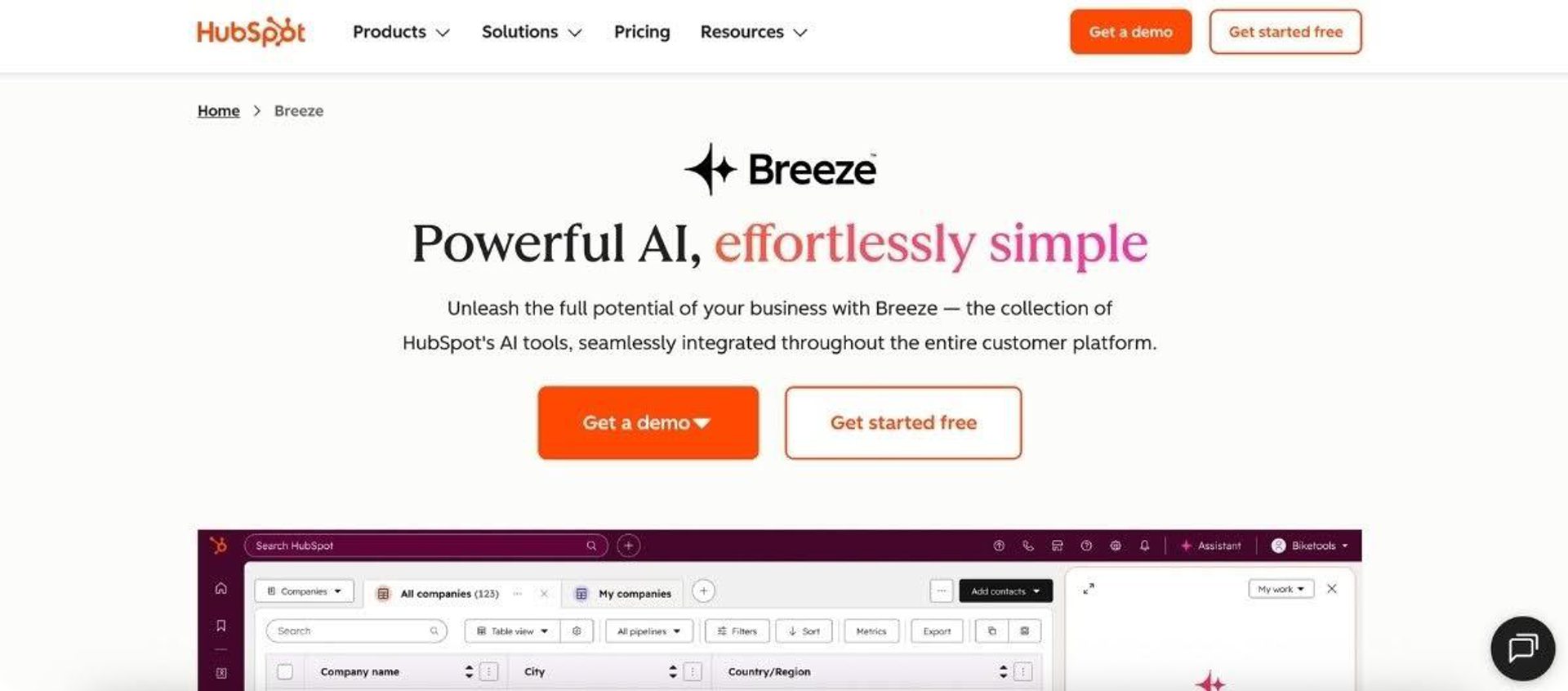
These are useful tools. But Breeze is, structurally, a layer added across HubSpot's (already very heavy) ecosystem. It is distributed across multiple tools, multiple tiers, and a consumption-based credit model.
Breeze Copilot's full functionality requires a Professional or Enterprise plan, with the AI features most directly tied to marketing performance gated behind these more expensive tiers. Lower tiers have significantly reduced or no functionality. Even where Breeze generates useful output, what it produces often requires a marketer to pick it up and apply it to the workflow it was meant to support.
For marketing teams evaluating these platforms, this distinction may determine whether AI is something your team uses in addition to your workflow—or the intelligence your workflow runs on.
ActiveCampaign's built-in approach means AI responds to customer behavior in real time, inside the automation it belongs to, without a separate tool, a manual bridge, or a credit meter running in the background.
HubSpot's approach means the AI is impressive, but getting it into the moment that matters can require a plan upgrade, a configuration step, or both.
ActiveCampaign AI vs. HubSpot AI across core marketing workflows
Comparing AI marketing platforms in the abstract tends to favor whoever has the longer feature list. A more useful test is workflow-level. How does each platform's AI perform inside the tasks your team runs every day? The comparison below examines specific workflows and looks at what each platform actually delivers within them.
AI agents and automation
Both platforms have invested significantly in AI agents that are built to handle marketing autonomously, but they reflect their respective architectures.
ActiveCampaign's 25+ AI agents are purpose-built specifically for marketing execution: the Campaigns Agent, Automations Agent, Segments Agent, Personalization Agent, Insights Agent, SMS Agent, Translation Agent, and others. What distinguishes them architecturally is that they operate within the same data layer as ActiveCampaign's automations, CRM, and cross-channel messaging. They don't generate outputs that then need to be applied to workflows, but instead act inside the workflows directly, with full context about what's triggered, what's been sent, and how contacts have responded.
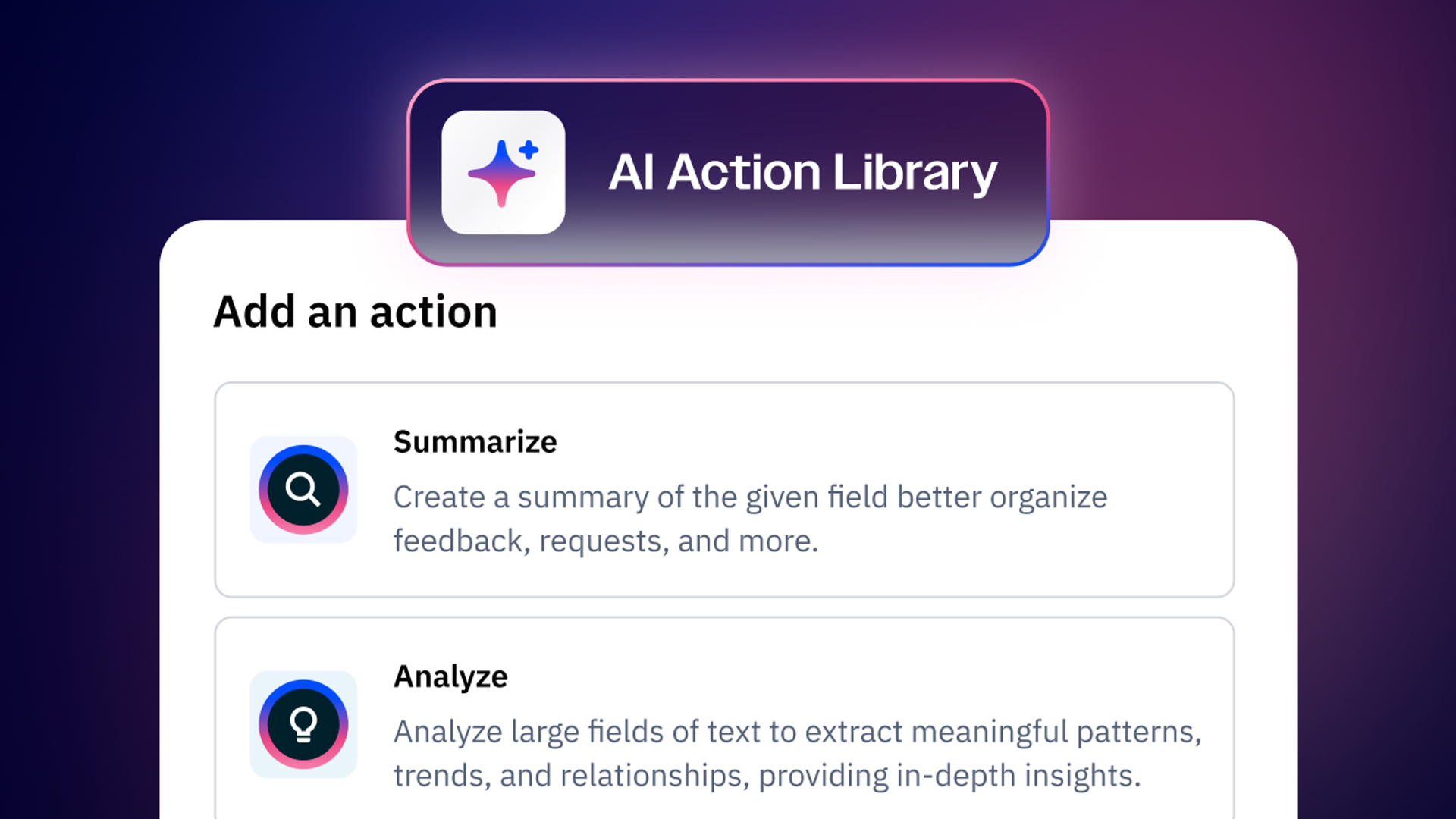
The AI Actions Library lets marketers drop AI capabilities directly into any workflow using plain-language instructions. You can analyze contact sentiment, categorize data, extract information, generate personalized recommendations, or translate content, all without technical setup. Where AI agents handle the higher-order work of building and orchestrating workflows, AI Actions handle the intelligent decision-making within them, turning individual automation steps into responsive, context-aware operations.
Click on the image to get a tour of the AI Actions Library:
The integration layer compounds this. ActiveCampaign's 1,000+ native integrations connect CRM, ecommerce, ads, and support tools into a unified data layer, giving agents complete cross-channel context to inform every action. And for teams already using external AI tools, ActiveCampaign's AI Connectors allow Claude, ChatGPT, and other models to connect directly to your marketing data. With these connections in place, your team can check campaign stats, update contact records, or trigger automations conversationally from within the familiar tools they already use daily.
HubSpot's Breeze Agents are built to cover the breadth of HubSpot's platform, but are focused mostly on sales and service workflows so you’ll need to pay for the CRM Hub to take advantage of most of them. Agents including Company Research, Prospecting, and Customer Service are capable autonomous operators within their domains. Breeze Assistant sits across all of this as a conversational AI companion, available throughout the HubSpot interface for drafting, summarizing CRM records, campaign ideation, and day-to-day task assistance. There are currently 6 agents available in general availability, with more in beta.
For organizations running on HubSpot's CRM and operating across marketing, sales, and service functions simultaneously, the AI layer spans the full customer lifecycle.
The trade-off is marketing depth: Breeze is designed to serve every hub and investment in execution depth is much lighter as a result. ActiveCampaign's agents are optimized for the specifics of marketing execution.
Campaign creation and content generation
Both platforms offer AI-assisted campaign creation, but the scope of the offering differs.
ActiveCampaign's AI Campaign Builder takes a single natural-language prompt and generates a complete campaign: subject lines, copy, images, CTAs, and layout, all formatted and ready to send. The Active Intelligence Workspace allows you to describe a goal like "launch a welcome series for new ecommerce customers" and the system will build the full automation sequence, not just individual content assets.
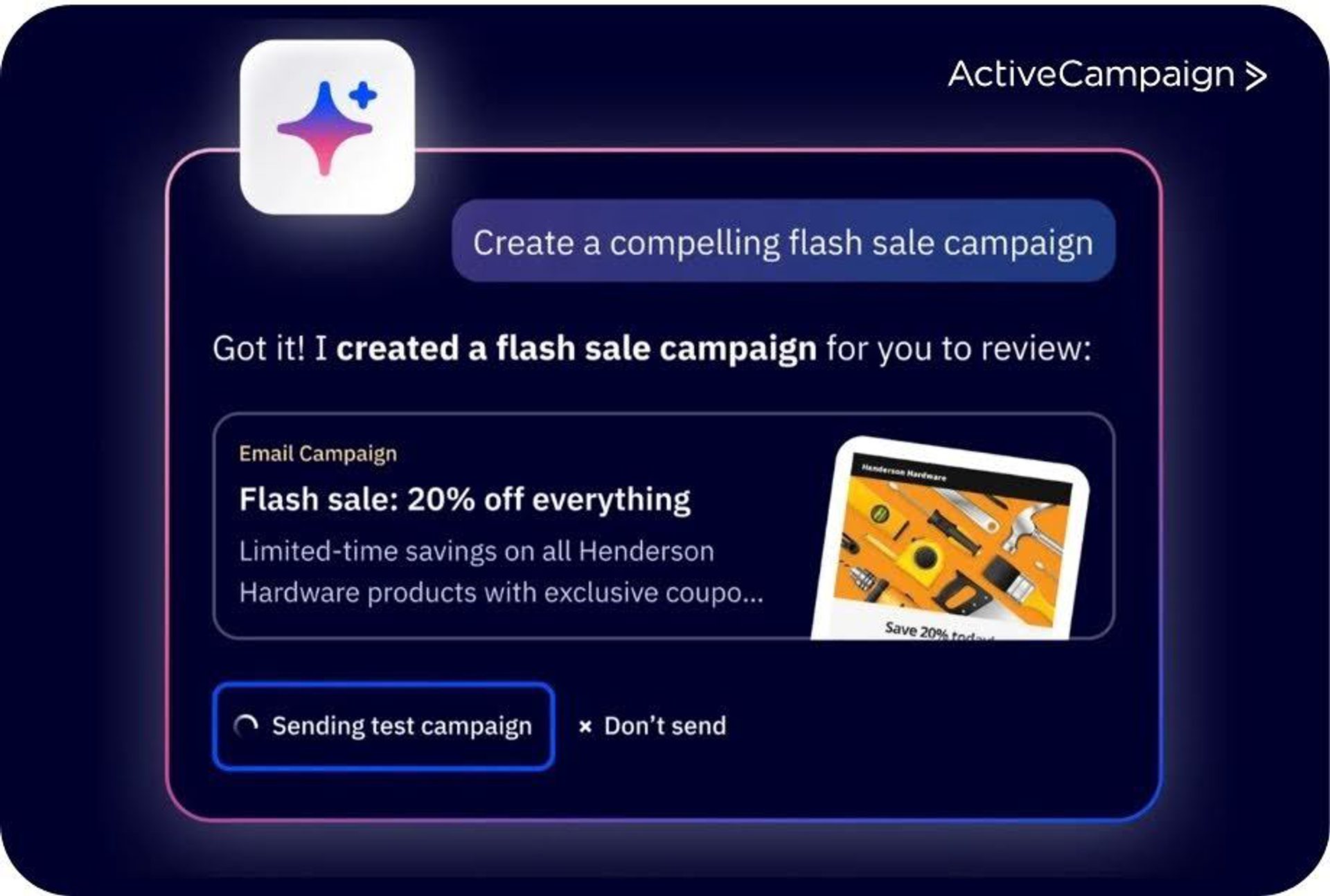
Every output is informed by the AI Brand Kit, which automatically imports your company's colors, fonts, logos, and imagery at setup, so AI-generated campaigns arrive on-brand without requiring a manual design pass. For teams managing global audiences, AI Translations for email extend this capability to 75+ languages to assist with localized marketing campaigns.
Take a look at the product tour below to see how easily Active Intelligence can create custom, on-brand campaigns:
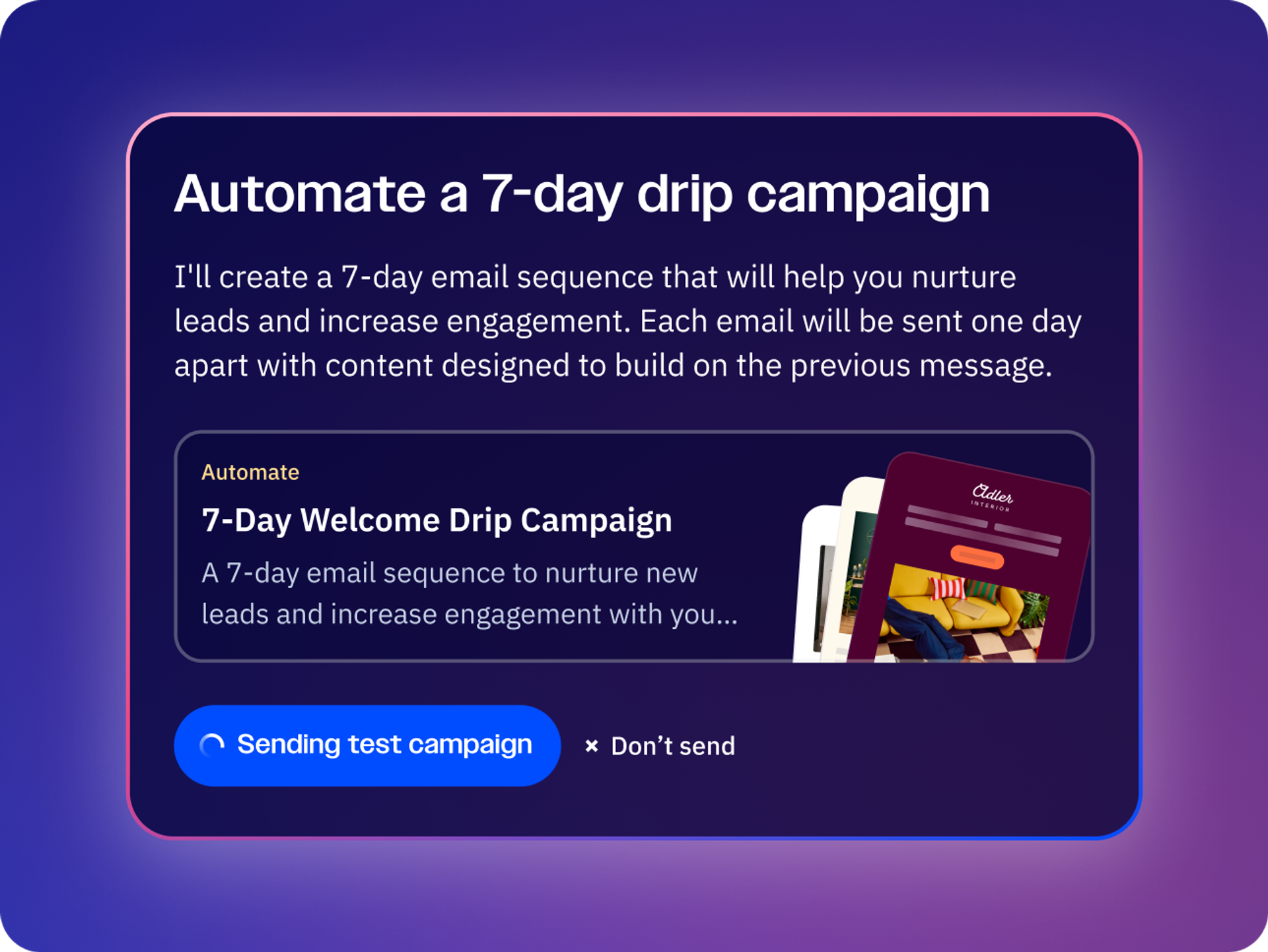
Spark Joy New York reported 85% faster campaign creation using ActiveCampaign's AI agents, and across the platform, Active Intelligence users build campaigns 3x faster on average.
HubSpot's Breeze Assistant can produce strong individual content pieces like blog posts, landing pages, social content, and case studies. The Content Remix feature is also able to repurpose existing material and is a real differentiator for teams running high-volume content programs.
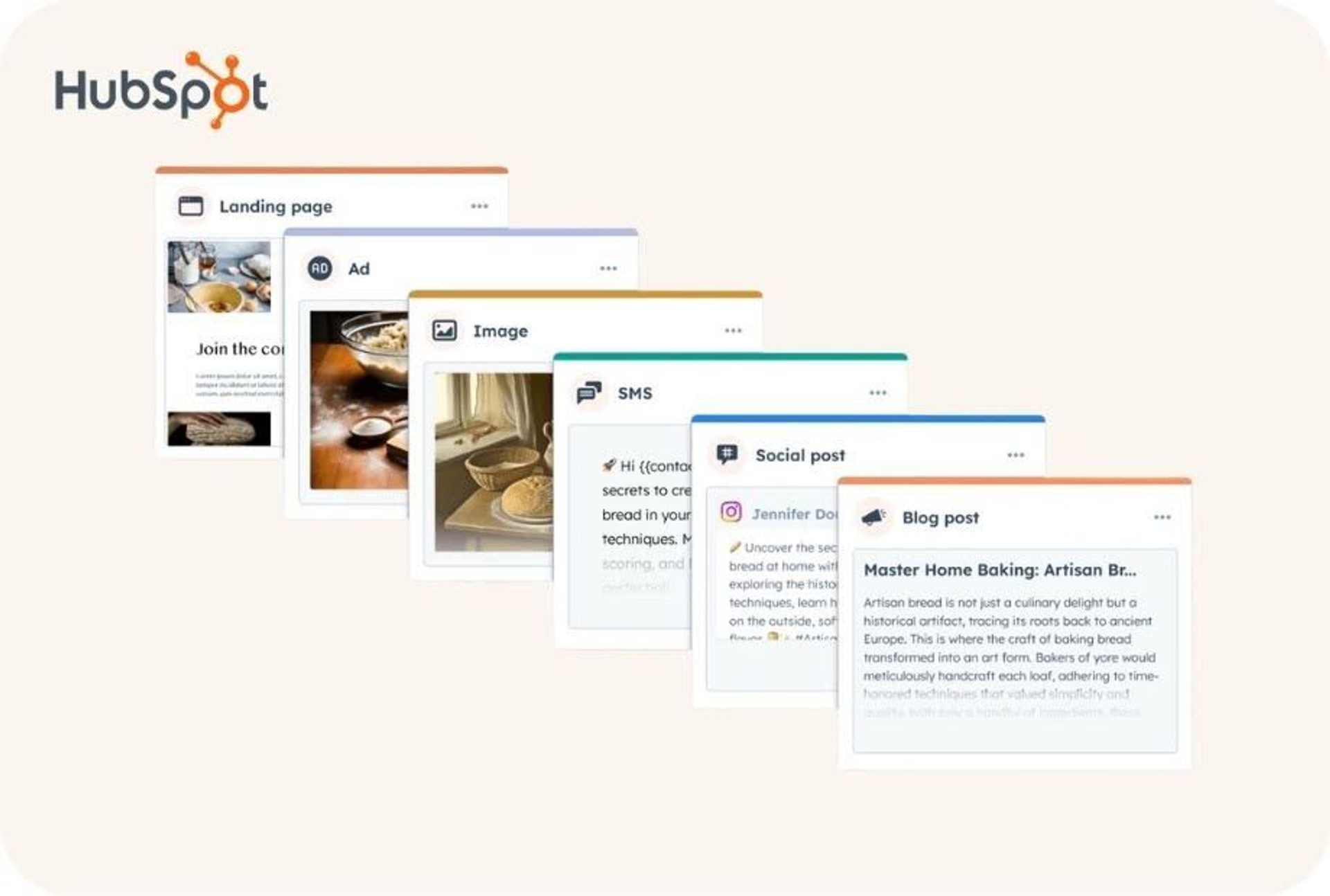
Where HubSpot requires more from the marketer is in assembling those individual outputs into a coherent campaign workflow: the generation and the orchestration are often separate steps, requiring manual bridging between what Breeze produces and where it needs to live.
The distinction is between AI that generates assets and AI that builds campaigns. If your primary need is content production at scale across multiple channels, HubSpot has meaningful depth. If your need is campaign execution—prompt in, automation sequence out—ActiveCampaign's approach requires fewer handoffs.
Audience segmentation
Most AI-assisted segmentation still requires the marketer to form the hypothesis first. You decide which audience you want to reach, you build the conditions, and the AI helps you execute faster.
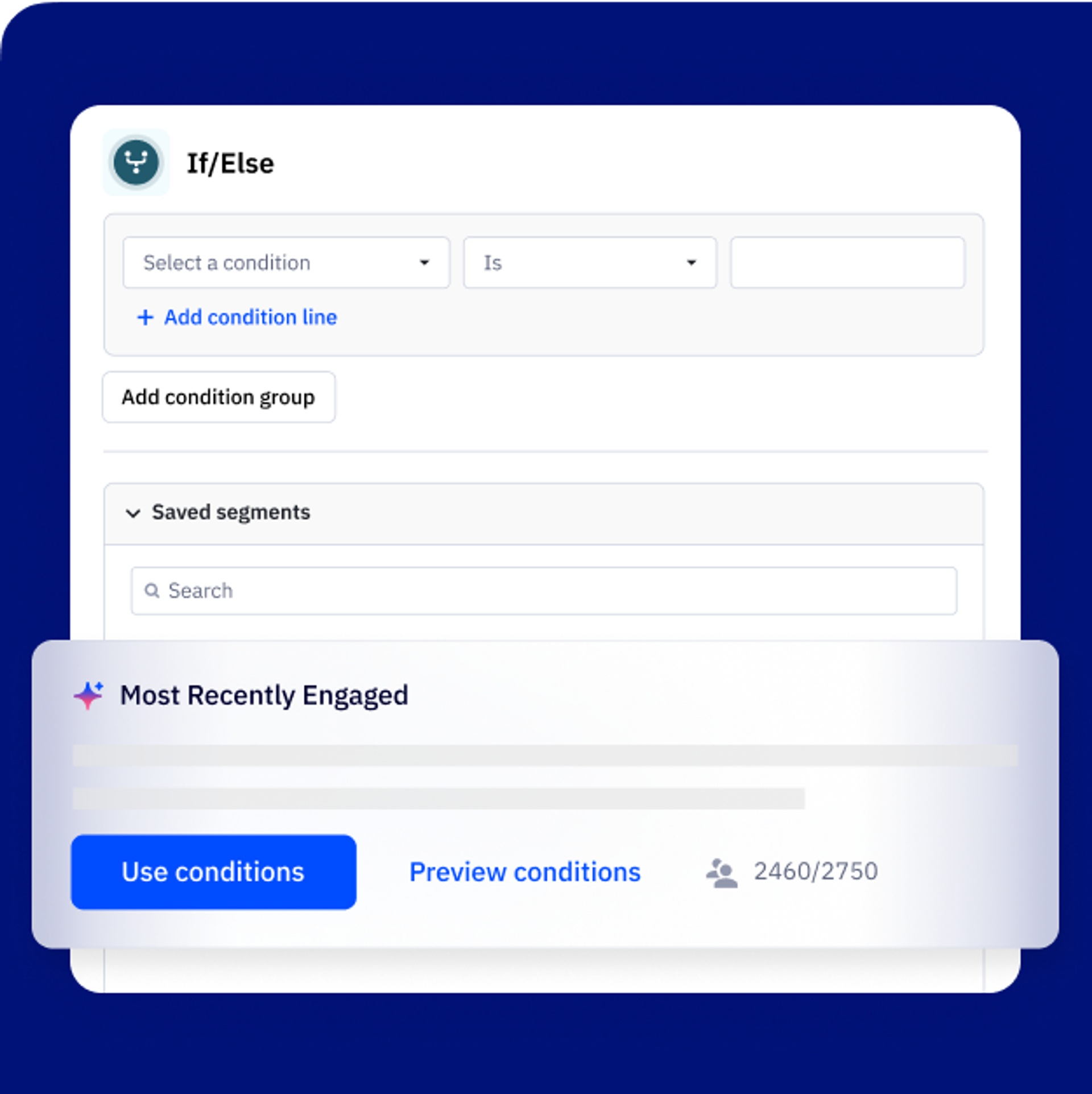
ActiveCampaign's AI segmentation software inverts that model. It analyzes your contact database proactively and surfaces high-value audiences as AI Suggested Segments you didn't know to look for. For example, repeat buyers who've gone quiet, high-spending contacts who've never been re-engaged, or at-risk customers showing early churn signals. These are patterns that require correlating behavioral, transactional, and engagement data simultaneously across your entire database, at a scale where manual analysis isn't realistic.
Explore AI segmentation in the tour by clicking on the image below:
HubSpot's Breeze Personalization Agent operates in adjacent territory, focused on segment discovery and website content tailoring with strong CRM-contextual capabilities. For B2B teams whose most valuable segmentation signals live in HubSpot's contact and company records, that CRM grounding is a genuine advantage. Breeze Intelligence's enrichment layer, drawing on 200M+ profiles, also gives HubSpot a meaningful edge for teams that need to build audiences from firmographic data rather than behavioral signals.
The underlying difference is one of initiative. Both platforms offer sophisticated segmentation tools, but only ActiveCampaign’s is designed to find the audiences before you know to ask for them.
Personalization
Where segmentation determines who receives a message, personalization determines what that message says, and when it arrives. The two are related but distinct, and the gap between these two platforms widens at the personalization layer.
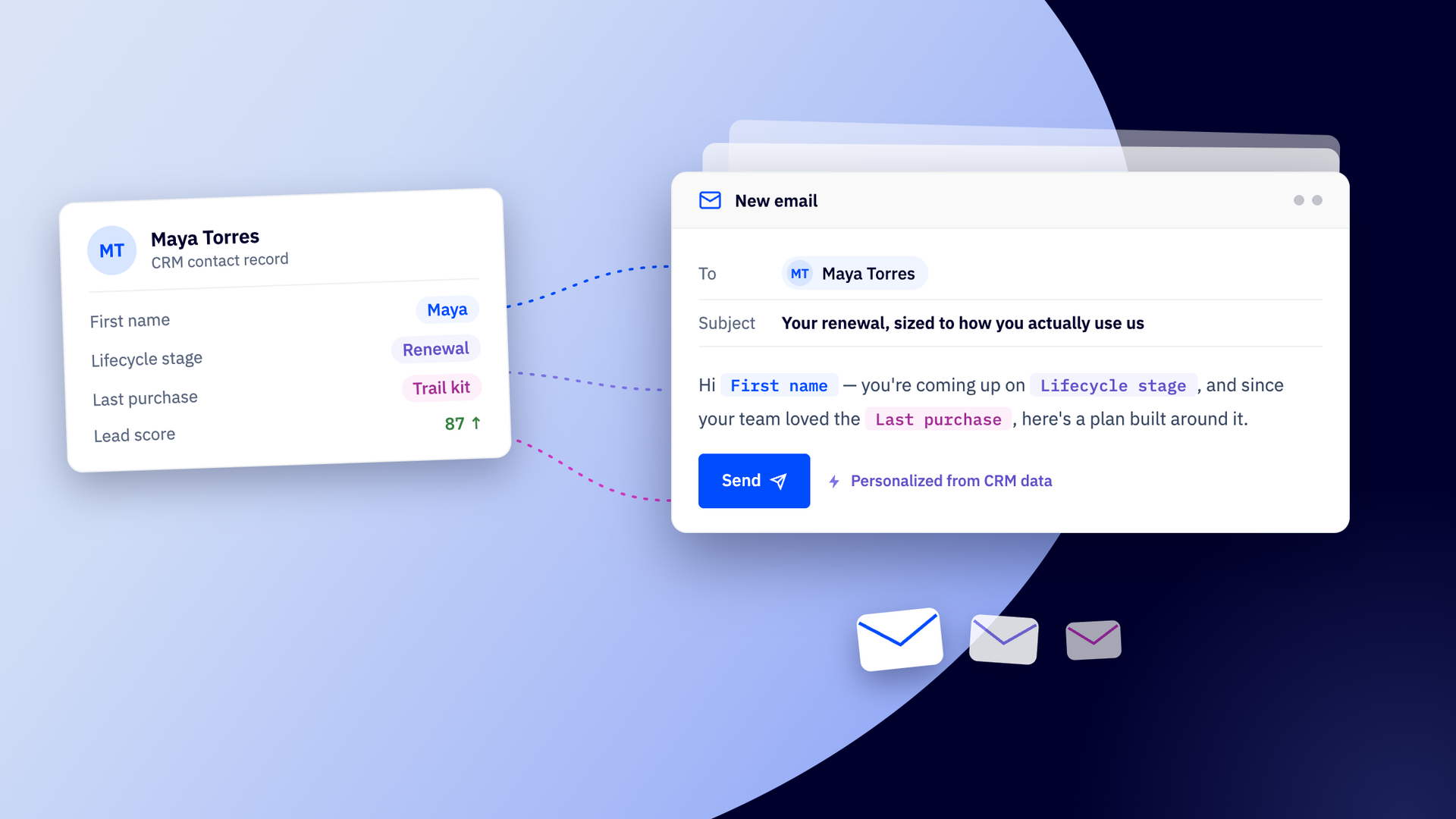
ActiveCampaign's Predictive Content allows up to five content variants within a single email, with machine learning selecting the best-performing variant for each individual contact based on their click behavior history. This means that two contacts on the same send can receive meaningfully different content without additional segmentation work. Meanwhile, the Personalization Agent generates individualized message content based on each contact's attributes and behavior, enabling 1:1 follow-up campaigns at scale.
Custom Instructions sit underneath all of this as a foundational layer: admins can define their target audience, communication style, content guidelines, and business context once at the account level. Active Intelligence automatically applies that context to every campaign, recommendation, and conversation, without anyone needing to re-specify it prompt by prompt. This improves consistency at scale: every piece of AI-generated content reflects the same understanding of who your customers are and how your business communicates, regardless of who on the team initiated it or which feature they used to do so.
Click the image below to learn more about how ActiveCampaign lets businesses tailor their Active Intelligence experience with Custom Instructions:
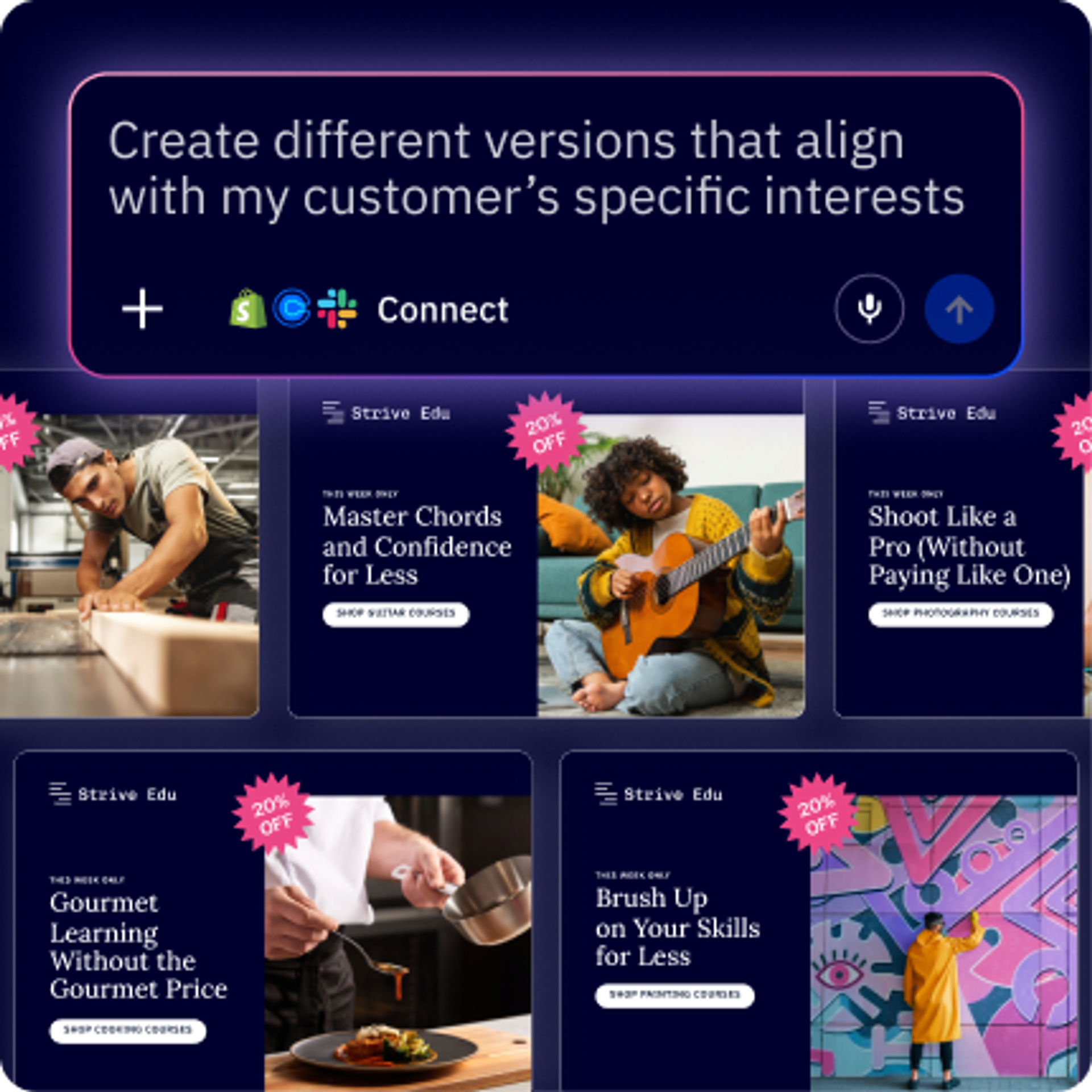
HubSpot offers personalization through tokens, conditional content, and smart content rules that can show different email content to different contacts. Breeze Assistant draws on CRM contact and company data to inform and draft personalized messaging.
These are meaningful capabilities, particularly for teams running account-based or sales-aligned marketing where CRM context is the primary personalization signal. However, HubSpot's smart content rules require the marketer to define the conditions and assign variants manually. The platform executes the logic you build.
The main distinction between personalization tooling on the two platforms is configuration. HubSpot's personalization logic is largely marketer-directed: you need to define the variants, the conditions, and the rules. ActiveCampaign shifts more of that work to the platform itself, determining rules autonomously based on behavioral history and reducing how much a marketer needs to configure to achieve individualized messaging at scale.
Send-time optimization
Send-time optimization has traditionally meant making broad generalizations. You find when most of your list has historically opened emails and schedule your send for that window. The result is a population average presented as personalization: useful, but not the same as optimizing for each individual contact. AI tools make it much easier to calculate optimal times at the per-contact level and stagger delivery accordingly. This way, each person receives the campaign when they, specifically, are most likely to engage.
ActiveCampaign’s Predictive Sending calculates an individual optimal delivery time for each contact based on their personal engagement history, recalculating weekly as patterns shift. This 1:1 optimization is available to all users of the Pro plan (from $79/month for 1,000 contacts) and above. It runs natively inside automations, requiring no third-party tool or additional configuration, and delivers an average 17% CTR lift across the platform. Soundsnap reported 20% higher open rates after enabling it.
Take a look at how ActiveCampaign’s Predictive Sending works by clicking on the image to launch a tour:
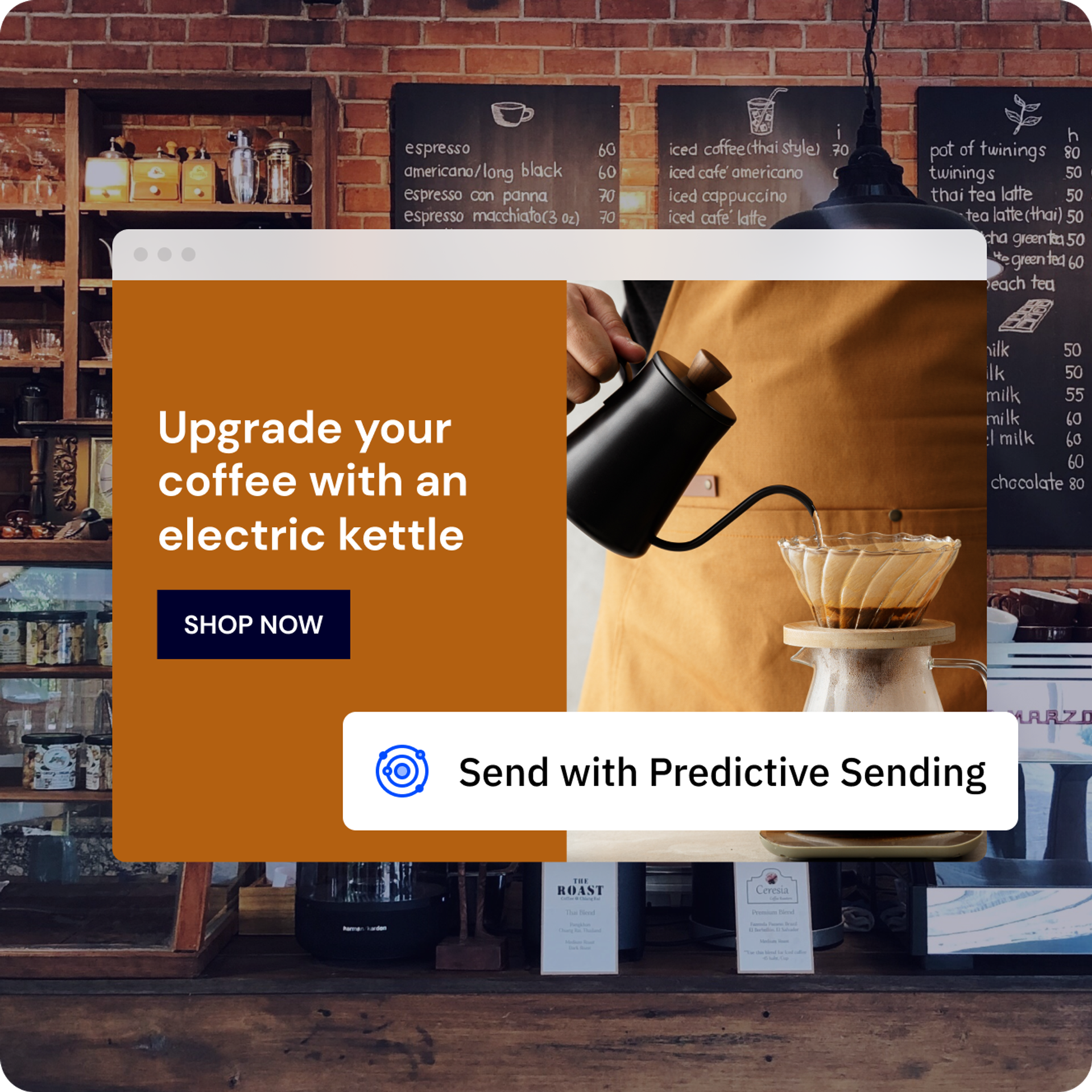
HubSpot's send-time optimization is available on lower tiers as a single averaged recommendation across all recipients. This is a population-level suggestion rather than a per-contact one. Per-contact optimization is available, but requires a Marketing Hub Enterprise plan at a very steep sticker price (from $3,600/month).
A single averaged send time is, by definition, optimized for no one in particular. It minimizes the distance from the average across your list, but matches the actual behavior of very few individual contacts precisely. For teams prioritizing deliverability and engagement, the accessibility of per-contact optimization is an important consideration.
Reporting, analytics, and AI-driven insights
The standard reporting model (comprising dashboards that display historical data) is well-represented on both platforms, and most modern marketing teams have plentiful access to data. But the gap between having data and knowing what to do with it is another issue. Answering these questions has historically been the marketer's job: export, analyze, conclude, act. Good AI marketing platforms not only make analysis faster, but close the gap between data and decision entirely.
ActiveCampaign's Autonomous Insights are proactive by design. They appear directly in the dashboard without requiring a query to flag performance shifts, identify anomalies, and recommend specific next actions, often before the marketers even notice something needs improving.
When you want to go deeper, the natural-language analytics and reporting interface lets you ask questions about your marketing performance. It can answer any performance query in natural language, provide root cause analysis, and deliver instant visualizations with tailored recommendations that you can implement in just a few clicks. The orientation is forward-looking: not just reporting what happened, but identifying what to do next.
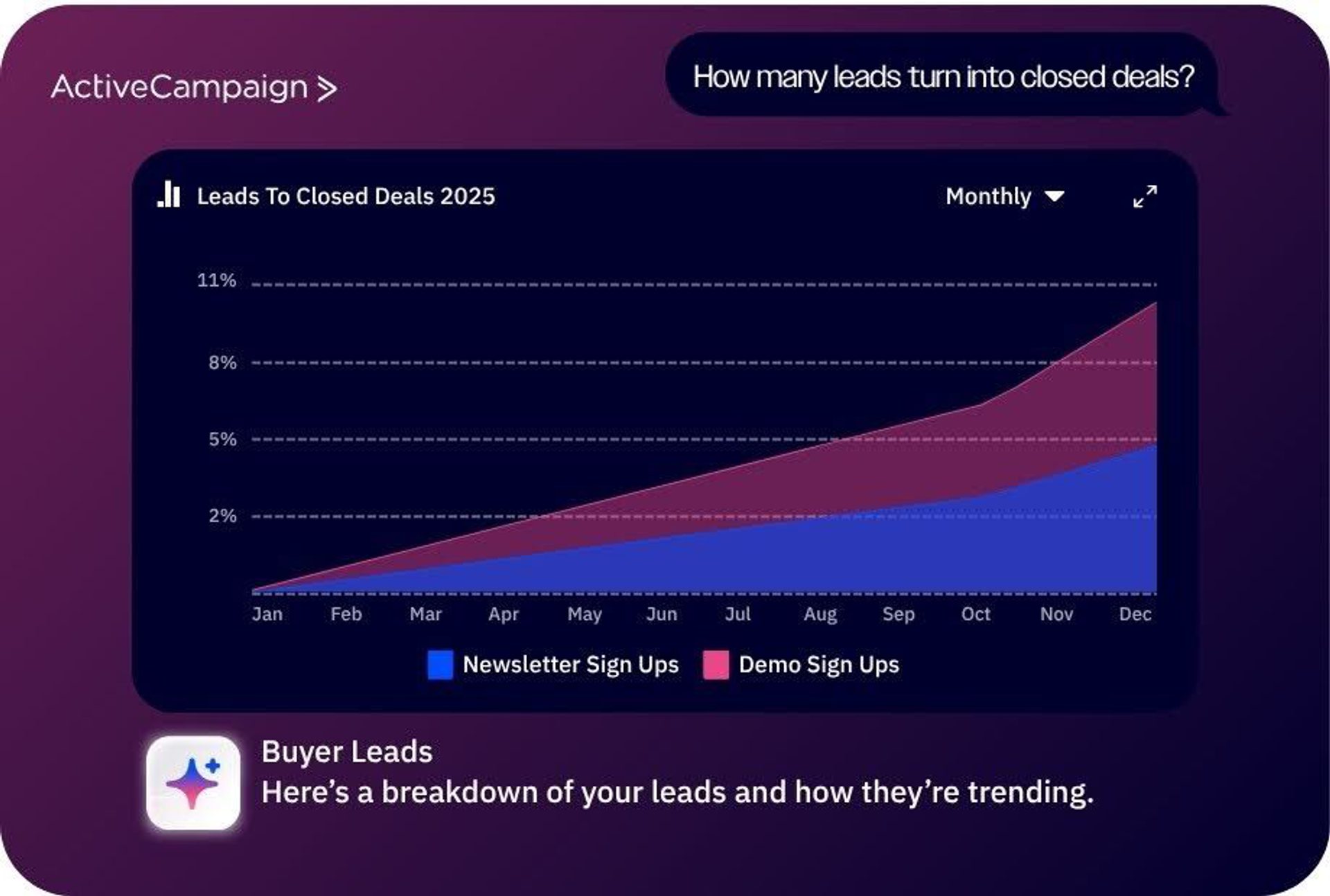
AI extends into how ActiveCampaign handles goal-tracking. Active Intelligence embeds defined Business Goals directly into automation workflows, meaning automations are aware of whether a goal has been met and can branch or exit accordingly. The Goals Agent monitors progress and surfaces performance recommendations aligned to those objectives, so the gap between what the platform reports and what the platform does in response stays as narrow as possible.
Click the image to learn about creating Business Goals in the tour below:
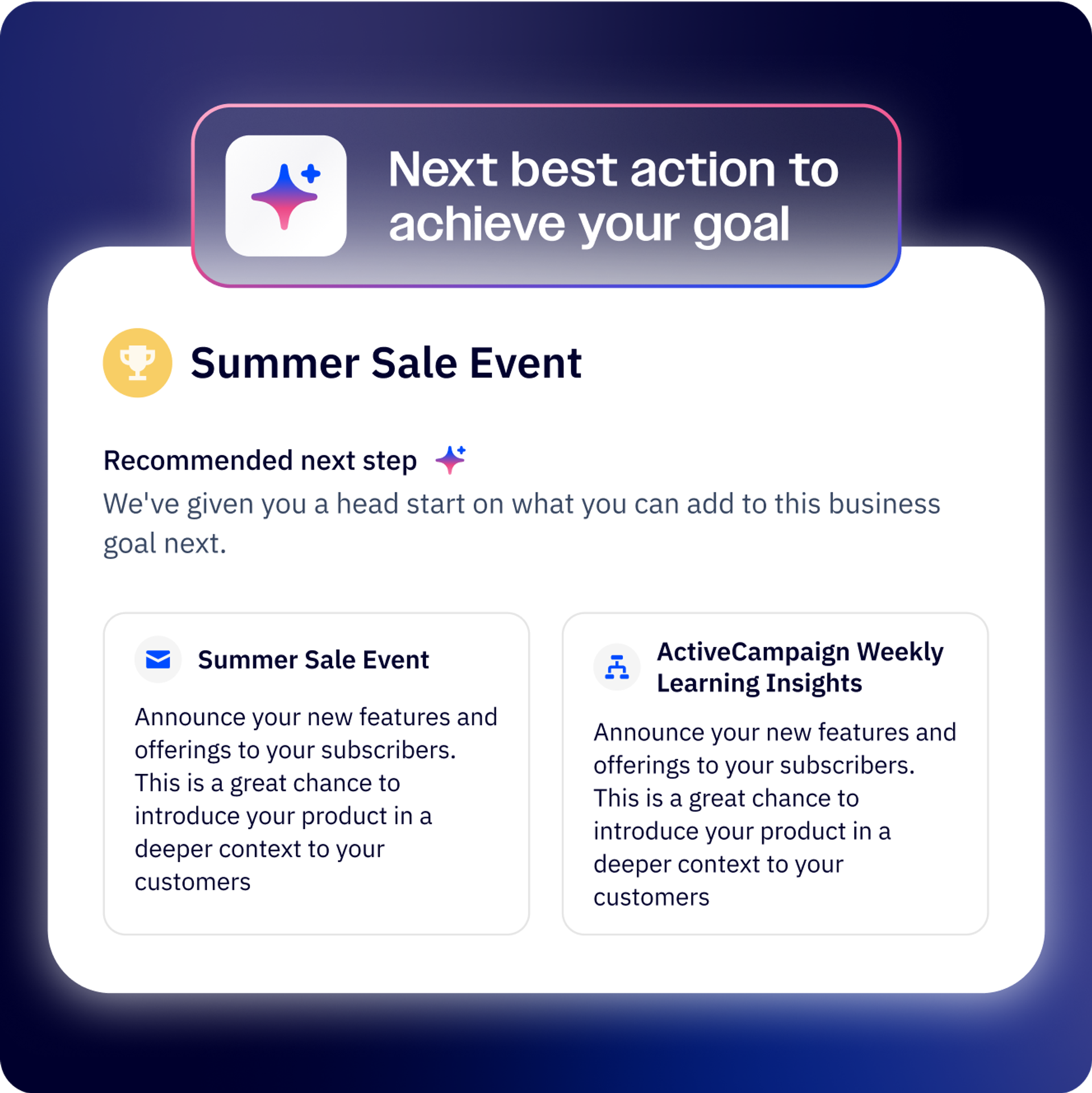
HubSpot's reporting and analytics capabilities are particularly strong for organizations running on the full HubSpot CRM. Custom dashboards can pull data across marketing, sales, and service hubs simultaneously, giving revenue-focused teams a unified view of the customer lifecycle that purpose-built marketing platforms can't easily replicate.
Breeze Intelligence adds a predictive layer for sales teams with AI Forecasting, buyer intent signals, and Smart Properties that automatically enrich contact records from unstructured data. The Data Agent can answer business questions by drawing on CRM records and external web research simultaneously. For teams asking questions that span pipeline health and customer behavior, the cross-functional depth is an advantage.
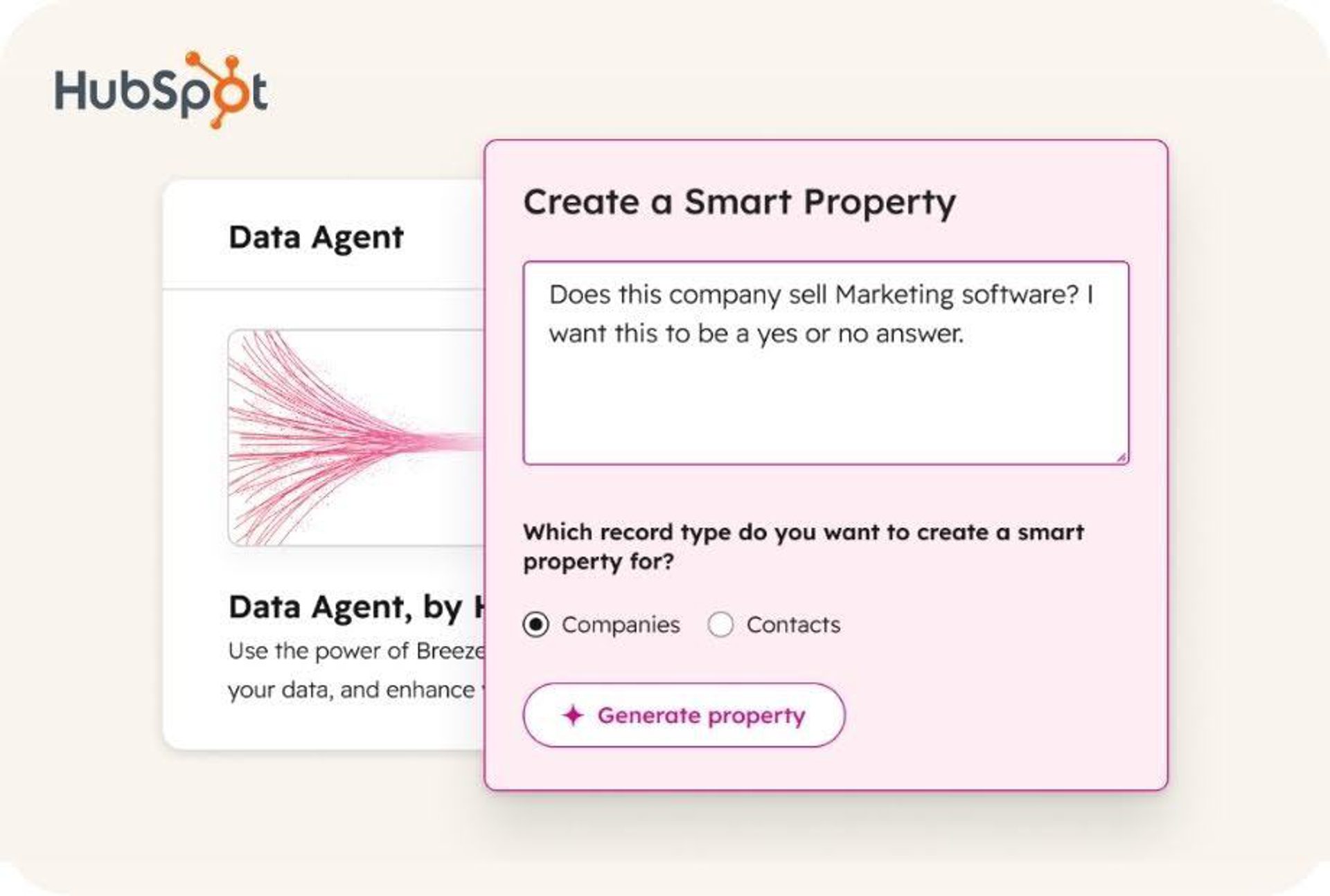
The distinction is one of scope and orientation. HubSpot's optimization AI is strongest when the question requires connecting performance to business context specifically. ActiveCampaign's is designed to make campaign-level optimization continuous and automated. It runs in the background, surfacing what matters, and proactively removing the gap between insight and action by executing improvements.
What AI actually costs: Pricing, tiers, and access limits
Platform pricing is easy to find. The cost of the AI you actually want is often not. List prices tell you what you pay to get in the door, but they don't tell you which features require an upgrade to use, which capabilities run on a consumption meter, or what the bill looks like once your team starts relying on AI at scale. We’ve looked past the headline numbers to show you what you’ll really be paying to use AI tools on each platform.
ActiveCampaign's core AI capabilities are embedded into plan pricing rather than metered or gated behind premium tiers. Predictive Sending, AI-Suggested Segments, the AI Campaign Builder, Active Intelligence Workspace, and the AI Actions Library are available to Pro plan users and above, not reserved for enterprise accounts.
The pricing model is contact-based and predictable: you know what you're paying, and AI usage doesn't add a separate consumption layer on top of it.
HubSpot's AI pricing operates across two dimensions that compound each other.
The first is plan gating: many of Breeze's most impactful marketing AI features require Marketing Hub Professional ($800/month minimum) or Enterprise ($3,600/month).
The second is consumption-based credits: certain AI features—including Breeze Intelligence enrichment, the Prospecting Agent, AI workflow actions, and the Data Agent—draw from a monthly credit allocation, with additional credits available at $45 per 5,000. Teams that use these features heavily will find their AI costs variable and difficult to forecast, with the meter running faster as usage scales.
| ActiveCampaign | HubSpot (Marketing Hub) | |
| Entry Plan | Free 14-day trial. Starter plan from $15/month for 1,000 contacts. | Free plan (very limited) for 250 contacts. Starter from $20/month for 1,000 contacts. |
| AI Features at Entry | Basic features available including access to: Active Intelligence Business Goals AI Campaign Builder AI Automation Builder AI Suggested Segments AI Brand Kit and more. | No access on Free plan. Marketing Hub Starter Plan provides limited access to Breeze Assistant only. |
| Core AI plan | Available on Plus plan from $49/month for 1,000 contacts ($95/month for 2,000 contacts). All core features included. | Available on Professional plan from $800/month for 2,000 contacts. Breeze Assistant fully available. Credit-based usage of other features. |
| Per-Contact Send-Time optimization | Predictive Sending available on Pro plan from $79/month for 1,000 contacts ($375/month for 10,000 contacts). | Available on Enterprise plan from $3,600/month for 10,000 contacts. |
| AI Credit System | No. AI is included in plan price | Yes. Additional Credits can be purchased at $45/month per 5,000. |
| Onboarding Fees | None. Free agentic onboarding and migration is available. | $3,000 compulsory onboarding for Professional plan. $7,000 compulsory onboarding for Enterprise plan. |
Pricing accurate as of April 2026.
Which AI marketing platform is right for your team?
Both platforms can credibly claim to offer AI-powered marketing. When it comes to making your decision, you should consider whether the AI each platform offers aligns with how your team works, what your budget allows, and where you need intelligence embedded most. Before committing to either, these are the questions worth testing:
Does this AI reduce my team's daily workload, or does it introduce new complexity to manage?
Are the AI features I need included in the plan I can realistically afford, or do they require an upgrade to unlock?
How deeply is AI embedded into the workflows I rely on most: campaigns, segmentation, reporting, automation?
Will my team actually adopt these features in day-to-day work, or will they go unused?
How does pricing change as AI usage and contact volume grow?
HubSpot may be the stronger fit if your organization is already deeply invested in its broader ecosystem. If you are already using the Hubs across marketing, CRM, sales, and customer service and you need AI capabilities that span all of those functions from a single platform, Breeze is a coherent and capable choice. The cross-functional depth of the Agents and the CRM intelligence layer might be difficult to replicate with separate tools. For enterprise teams with a serious budget, the breadth might justify the investment.
ActiveCampaign is likely to be the stronger fit if your primary need is marketing execution. It is purpose-built for that scope. If you’re looking for AI-native marketing that imagines, executes, analyzes, and optimizes campaigns from end-to-end in a single workflow, it’s a great choice. The AI isn't a layer added on top; it runs through the platform's core workflows.
There's also a compounding effect worth considering. Embedded AI like the kind ActiveCampaign provides improves over time as the system processes more data. Segmentation becomes more precise, send-time predictions become more accurate, and recommendations become more relevant, without the team having to manually reconfigure anything. The return on AI adoption grows as usage increases, which is only possible when that usage isn't constrained by plan tiers or consumption limits.
HubSpot's AI is genuinely impressive, particularly for CRM-connected tasks and cross-functional workflows. But the features that most directly improve marketing performance require a weighty investment in Marketing Hub Enterprise. ActiveCampaign delivers the same functionalities (and more) at a much more accessible pricing point.
If you're evaluating AI marketing platforms, you're probably already feeling the gap between what your current setup does and what you need it to do. More campaigns to run, smaller teams to run them, higher expectations for personalization and performance. ActiveCampaign is designed specifically to close that gap by embedding intelligence into the work that's already happening.
The difference isn't felt in a single campaign. It's felt in the cumulative hours not spent on manual tasks, the segments that surface without being requested, the emails that arrive at exactly the right moment for each contact.
ActiveCampaign users save an average of 10 hours weekly across tasks like campaign building, content creation, and lead follow-up. That’s 520 hours annually.
Your team shouldn't have to ask AI to do its job. Active Intelligence is already three steps ahead. See how much time that saves your team by starting free today.
FAQs
How does AI in marketing platforms improve efficiency?
AI in marketing platforms improves efficiency by reducing manual work. Instead of building every workflow by hand or exporting data to analyze it, AI tools can automate repetitive steps like content creation and surface insights proactively without requiring constant manual input.
Advanced AI marketing platforms like ActiveCampaign take this further by embedding AI directly into automation workflows, so intelligence is applied continuously across every campaign rather than consulted as a separate tool. The time savings let marketing teams focus on strategy and creative decisions rather than execution busywork.
What should you look for in an AI marketing platform?
Marketing teams should look for AI that is embedded directly into daily workflows, rather than functioning as an isolated content generator or add-on feature. Confirm that the AI capabilities you need are included in the plan you can realistically afford and prioritize platforms where AI acts on your data continuously and in real time. The most effective AI marketing platforms are the ones where intelligence is built in, not bolted on.
What is the difference between ActiveCampaign Active Intelligence and HubSpot Breeze AI?
ActiveCampaign provides AI via the Active Intelligence engine, which is built natively into the platform's core workflows. It continuously reviews data from customer interactions and uses it to imagine and generate complete campaigns from a single prompt, and analyze and optimize them—all within the same platform where those campaigns are executed.
HubSpot Breeze is a suite of AI tools distributed across HubSpot's Marketing, Sales, and Service Hubs, using CRM data to automate tasks, generate content, and uncover insights. Breeze is capable and broad, with particular strength in CRM-connected content generation and cross-functional workflows.
The primary differences are architecture and pricing accessibility. ActiveCampaign embeds AI natively into marketing execution, so intelligence and action live in the same place. It also provides AI tooling for all users. HubSpot distributes AI across multiple tools and tiers, with the most impactful marketing AI features reserved for expensive, higher-tier plans.
Which AI marketing platform is more affordable: ActiveCampaign or HubSpot?
ActiveCampaign offers plans starting at $15 per month, with many AI features available to all users, and the larger core AI offering available from the Plus and Pro tiers. AI features are included in plan pricing, with no consumption-based credit system adding variable costs on top.
HubSpot's Marketing Hub starts free but jumps significantly at the Professional tier, where most AI agent capabilities and advanced marketing automation become available. Mandatory onboarding fees add to the total cost of entry. Certain AI features, including Breeze Intelligence enrichment and advanced agent usage, draw from a monthly credit allocation, making costs harder to forecast as usage scales.
For teams that want AI as an everyday operational tool rather than an occasional resource, ActiveCampaign's total cost of ownership is significantly lower.