If you're a marketing manager or small business owner shopping for an email platform, you may have come across two platforms over and over: Constant Contact vs. Mailchimp. They're the default picks, two of the first tools most people try, and both dominate every "best email marketing software" list.
The right choice depends on what you’re actually doing today, but more importantly, where you'll be in 12 months. AI is changing marketing exponentially, and platforms that felt future-proof two years ago are already showing their age. In 2026, you need to make sure you choose a platform that will stay relevant.
In this comparison, we’ll walk through Mailchimp and Constant Contact across the features that matter most, explore how AI marketing automation has changed where these two tools sit in the competitive landscape today, and examine whether they’re the right choice to keep pace.
Constant Contact vs. Mailchimp: Different interface, same goals
Mailchimp and Constant Contact are two of the most established names in email marketing. Each has over two decades of history and a genuine claim to having shaped what the category looks like today.
Both platforms target the same core audience: small to mid-size businesses, solopreneurs, and marketing generalists who want accessible workflows and a short learning curve. It’s a substantial market that both tools serve well. The interfaces are clean, onboarding is fast, and neither requires a dedicated ops person to keep things running.
The main difference between the two platforms is audience fit.
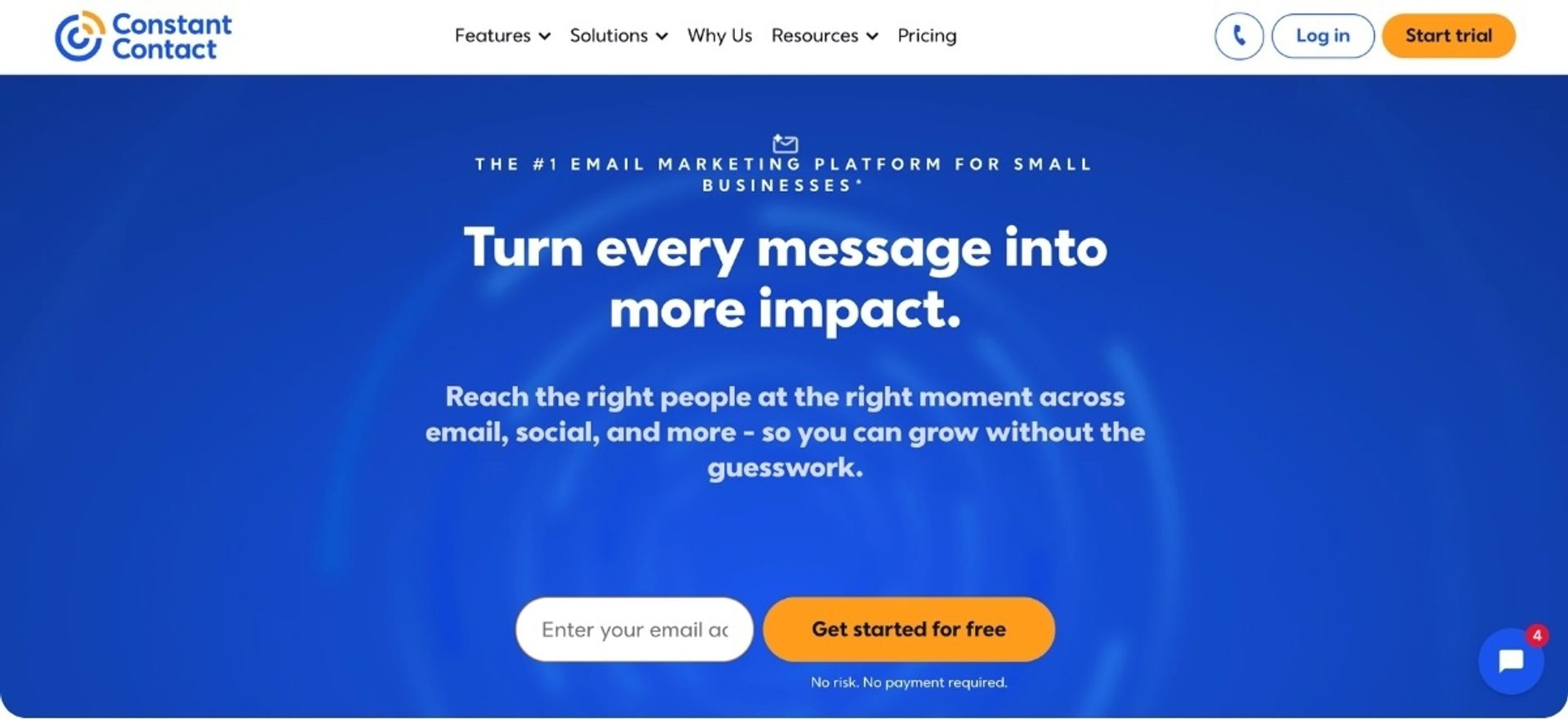
Constant Contact is built around accessibility and guided simplicity, with a stronger reputation for customer support, event marketing tools, and social media management. It tends to attract local services, nonprofits, community organizations, and brick-and-mortar retailers; teams where the person sending the emails isn't necessarily a marketer by trade, and where getting something out the door reliably matters more than optimizing every send.
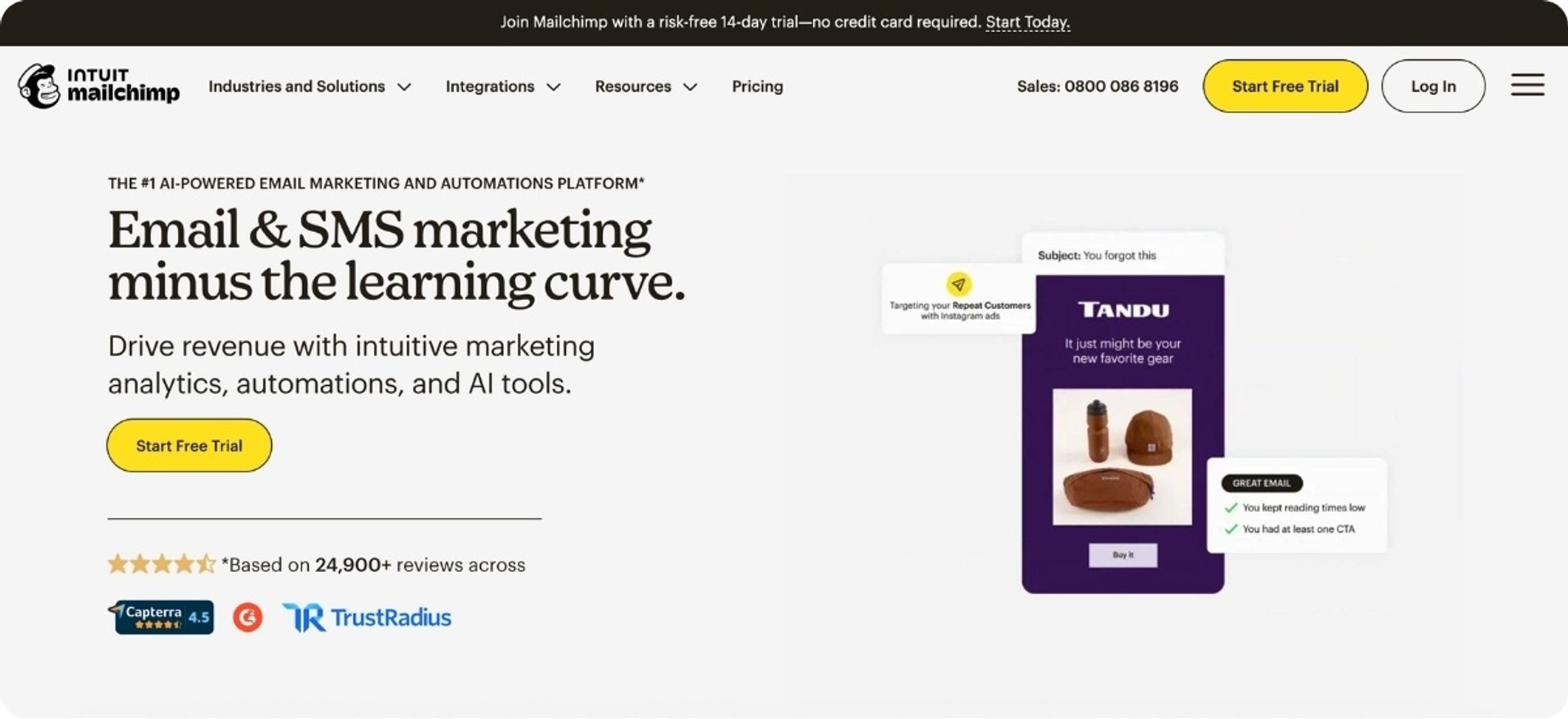
Mailchimp leans into design flexibility, ecommerce integrations, and audience analytics, making it a natural fit for content-driven brands, online retailers, and digitally native businesses that want more control over how their marketing looks and performs. Its feature set assumes a degree of marketing familiarity; the platform rewards users who know what they want to build.
Both platforms were built around the assumption that marketers would be doing most of the thinking: designing the journey, building the segments, deciding the timing, writing the content. For a long time, that was the only realistic model. That’s no longer the case.
Constant Contact and Mailchimp have evolved well beyond their origins as simple email senders, but the practical differences between the two platforms are fairly narrow. Let’s take a closer look at where they do differ, and whether they've evolved fast enough.
Mailchimp vs. Constant Contact: Core feature comparison
The sections below break down each platform across the categories that matter most when evaluating Mailchimp vs. Constant Contact side by side. From AI tools and automation to pricing and support, here's where each platform stands—and where they both fall short.
Here's a high-level overview before we look more closely:
| Feature | Constant Contact | Mailchimp |
| AI tools | AI content generation for email, social, and SMS with basic recommendations. Functional but unlikely to meaningfully reduce manual workload for most teams | Intuit Assist covers copy, images, and send-time optimization. Useful for speeding up email production, but still in beta and restricted to select markets. |
| Email marketing | 200+ templates built for speed over flexibility. Better suited to teams that want to get something out the door quickly without a design background. | 100+ templates with flexible drag-and-drop and HTML access. Rewarding for users who want design control and are comfortable using it. |
| Automation | Linear paths for welcome, birthday, and basic re-engagement. These work for simple trigger-based sequences but are not built for behavioral or conditional logic | Multi-step journeys with branching logic are capable for lifecycle sequences, but require a Standard plan to access. |
| Contact Management | Single-list structure with tags is simpler to manage and less likely to produce surprise billing, though less flexible for complex audience segmentation. | Audience-and-list model with a significant caveat: contacts appearing on multiple lists are billed multiple times, which can inflate costs as lists grow. |
| Reporting | Clean dashboards with some limited campaign comparison (5 at a time). This is sufficient for basic performance tracking, but limiting for teams managing higher volumes | Granular benchmarks, ecommerce revenue tracking, and comparative reporting are strong for understanding campaign performance in context |
| Pricing | Free trial available. Plans start at $12/month for 500 contacts. Limited allowances for features on lower-tier plans. | Free tier available. Plans start at $13/month for 500 contacts. Limited access to essentials on lower-tier plans. |
AI marketing tools
Mailchimp's AI lives under the Intuit Assist umbrella. It provides content generation for email copy and subject lines, plus more generic send-time optimization and predictive demographics on higher-tier plans. These tools make a noticeable difference for teams whose biggest bottleneck is content production.
The catch is availability. Intuit Assist is still in beta, geo-restricted to the US, UK, Canada, and Australia, and limited to certain Standard plan users and above.
Constant Contact's AI covers similar ground from a slightly different angle. Its AI Assistant generates email copy, subject lines, social posts, and SMS content from a prompt, and the Campaign Builder can translate a goal into a basic multi-channel strategy. Basic AI-assisted reporting recommendations and an AI-powered tech support chatbot round out the offering.
It's accessible and practical for teams focused primarily on getting campaigns out the door.
Both platforms primarily offer AI content acceleration tools, not marketing intelligence engines. Neither platform uses AI to support marketing in a truly intelligent way. The marketer still conceives the campaign, defines the audience, designs the journey, and makes the key decisions. AI speeds up the content layer, but everything upstream and downstream remains manual.
Considering the investments many other platforms are making in AI to actively reduce the operational workload of running marketing, both platforms will feel limited in the same ways.
Email marketing, campaign creation, and automation
Email marketing is what both platforms have been known for throughout their lifetime. For standard newsletters and one-off campaigns, both perform capably.
Constant Contact prioritizes speed and accessibility. Its 200+ templates are clean and functional. Teams that want to get something out the door quickly without a design background can use the easy drag-and-drop editor to build the essentials.
However, A/B testing is limited to subject lines, and automation is largely linear. Pre-built paths are available for simple use cases like welcome emails, birthday messages, and basic re-engagement sequences.
On deliverability, Constant Contact punches above its weight, scoring 91.7% inbox placement in EmailToolTester's most recent tests to rank second out of fifteen providers.
Mailchimp has the edge in most email marketing features. Design is supported by 100+ polished templates, flexible drag-and-drop editing, dynamic content blocks, and full HTML access for users who want granular control. A/B testing extends to multivariate testing across up to eight variations. Marketing Automation Flows support branching logic, delays, and if/else conditions across both pre-built and custom journeys.
Deliverability, however, tells a different story. Mailchimp scored just 89.5% in the same benchmark, placing seventh in the ranking. This is a notable gap given its scale and experience.
Despite slight differences in depth and design, Constant Contact and Mailchimp’s automations are both fundamentally email sequences. Neither supports complex journey orchestration that responds to what contacts actually do. For teams that want more dynamic flows, both tools will hit their limits fast.
Contact management, segmentation, and personalization
Constant Contact and Mailchimp take different structural approaches to organizing and targeting contacts.
Constant Contact uses a single-list structure organized by tags and custom fields. It's simple to manage, avoids the complexity of multiple audience pools, and suits teams that prioritize ease of organization over segmentation depth.
Filtering covers basic engagement metrics and demographics for straightforward targeting that covers common use cases but falls short for anything more behavioral. Personalization is largely limited to merge fields and basic conditional content blocks.
Mailchimp's audience-and-list model adds more layers: tags, groups, and predictive segments that draw from purchase behavior, engagement history, and demographics. The depth is useful for more complex targeting, but the model comes with a well-known billing consequence.
Contacts appearing in multiple audiences are counted and billed multiple times, and combined with inactive contact billing and paid add-ons, actual monthly spend commonly runs well above the listed plan price as lists grow.
Mailchimp does have a slightly more sophisticated personalization offering than Constant Contact: dynamic content blocks can show different content to different segments within the same email, and predictive demographics help tailor messaging by audience profile on higher-tier plans.
Neither tool supports real-time behavioral segmentation, site-tracking-based targeting, or personalization that adapts automatically based on behavior. If you want to move beyond segment-level targeting toward messaging that responds to what individual contacts actually do, both tools reach their limits at roughly the same point.
Reporting and analytics
Both platforms cover the standard campaign metrics: opens, clicks, bounces, and unsubscribes.
Constant Contact's reporting is clean and accessible, with an overview dashboard, detailed per-campaign metrics, period comparisons, and industry average benchmarks. It's easy to read and well-suited to teams that need a quick performance snapshot. Revenue attribution and multi-touch engagement tracking across campaigns are largely out of scope.
Mailchimp offers more granular benchmarks for comparative reporting across campaigns and ecommerce revenue tracking on paid plans. Advanced analytics like predicted demographics and customer lifetime value require a Premium subscription. The additional depth is useful for data-driven teams, particularly those with connected stores.
The gap both platforms share is more fundamental: reporting in both tools is oriented toward what happened, not what to do next. Neither connects performance data smoothly to responsive optimizations or proactive recommendations. You get the metrics; the analysis and the decisions remain with your team.
Integrations and ecosystem
Both platforms offer 300+ native integrations covering the tools small businesses rely on most: Shopify, WooCommerce, WordPress, Salesforce, Canva, Facebook, Instagram, and popular form builders. In practice, both tools fit comfortably into most standard marketing stacks, with Zapier and API access extending coverage further for teams that are willing to invest some time in their connections.
Constant Contact's standout differentiator here is its native event management tools: built-in RSVP management, event registration pages, and ticketing functionality that Mailchimp doesn't match without third-party integrations. This might tip the scales for event-driven businesses, gyms, studios, and nonprofits running fundraisers.
Both platforms maintain a smaller integration library than many of their competitors, something worth noting for teams with more complex or less common tooling needs.
Constant Contact pricing vs. Mailchimp: what you actually pay as you grow
Both platforms seem very affordable at first glance. But consider what you’ll actually be paying when your list hits 5,000+ contacts, and you need the more advanced feature offerings rather than just a way to send a newsletter. At that point, the headline price and the real price look different.
Constant Contact’s entry plan (Lite) starts at $12/month for 500 contacts, with the Standard plan adding contact segmentation, behavioral triggers, and scheduling at a starting cost of $35/month. Premium unlocks dynamic content, advanced automation paths, and SEO tools. Constant Contact's single-list billing model is fairly predictable; what you see is closer to what you pay.
However, complaints about subscription management on Constant Contact’s platform are common. Reviews include a noticeable volume of billing and cancellation disputes—often centered on renewals and expectations around cancellation timing.
Mailchimp offers a free plan capped at 250 contacts and 500 sends per month. It’s useful for testing the platform, but tight enough that most active teams outgrow it quickly. It's also worth noting that Mailchimp has reduced the free plan significantly over the last year, so you should verify current restrictions before building a workflow around it.
Paid plans start at $13/month for Essentials at 500 contacts, but the features that make Mailchimp worth choosing (multi-step automation, branching journeys, comparative reporting, multivariate testing, and predictive segments) all require a Standard or above, where costs jump to $45/month for 1,000 contacts. Premium, where advanced analytics and priority support unlock, starts significantly higher.
Mailchimp also holds a cost that doesn't appear on the pricing page. The audience-based billing model means contacts appearing in multiple lists are charged multiple times. Combined with inactive contact billing and paid add-ons for SMS and transactional email, real-world spend commonly runs 20–40% above the listed plan price as lists and use cases grow.
Does Mailchimp or Constant Contact fit your business needs best?
Mailchimp and Constant Contact are a close call for a lot of businesses, which makes it worth being precise about who each platform actually serves best.
Constant Contact is the stronger choice if you're a local organization or event-driven team that primarily sends newsletters, event invitations, donation campaigns, and straightforward drip sequences.
Its gentle learning curve, responsive support, and native event management tools make it the more practical choice for organizations where the person sending emails isn't a dedicated marketer. You don't need marketing expertise to get real value from it.
Mailchimp is the stronger choice if you're a small business that values polished email design, a broad template library, and the ability to start without an upfront cost.
Its freemium entry point, extensive third-party tutorials, and large user community mean you're rarely stuck without an answer. For businesses that want creative control and a recognizable platform with deep ecosystem support, Mailchimp earns its reputation.
Ultimately, the similarities between Constant Contact and Mailchimp run deeper than their differences. They have different interfaces and different ideal audiences, but the same underlying goals. Both were built around the idea that email marketing should be simple to operate, and that simplicity is both their strongest quality and their most consistent constraint. As marketing programs grow more complex, both tools start to show the same limitations in the same places.
AI is expanding opportunities for marketers very quickly. More advanced platforms can now significantly reduce the manual decisions that currently sit with your team and optimize campaigns dynamically. Paying for a marketing platform that isn’t competitive in the AI space is becoming very difficult to justify.
So, if marketing is moving faster than both Constant Contact and Mailchimp’s roadmap, where is the next place to look?
ActiveCampaign: An advanced and user-friendly alternative to Mailchimp and Constant Contact
For teams whose marketing has moved beyond straightforward email sequences—or soon will—Constant Contact and Mailchimp top out in the same place.
ActiveCampaign is more powerful than either platform, and no harder to use. It combines advanced automation and deep segmentation, while AI reduces much of the underlying complexity so marketers can adopt advanced workflows more quickly.
- Automation that responds to real customer behavior, not just preset triggers
- AI that runs campaigns, surfaces audiences, and optimizes execution, rather than just writing copy
- A platform that gets more powerful as your marketing grows, without getting harder to manage
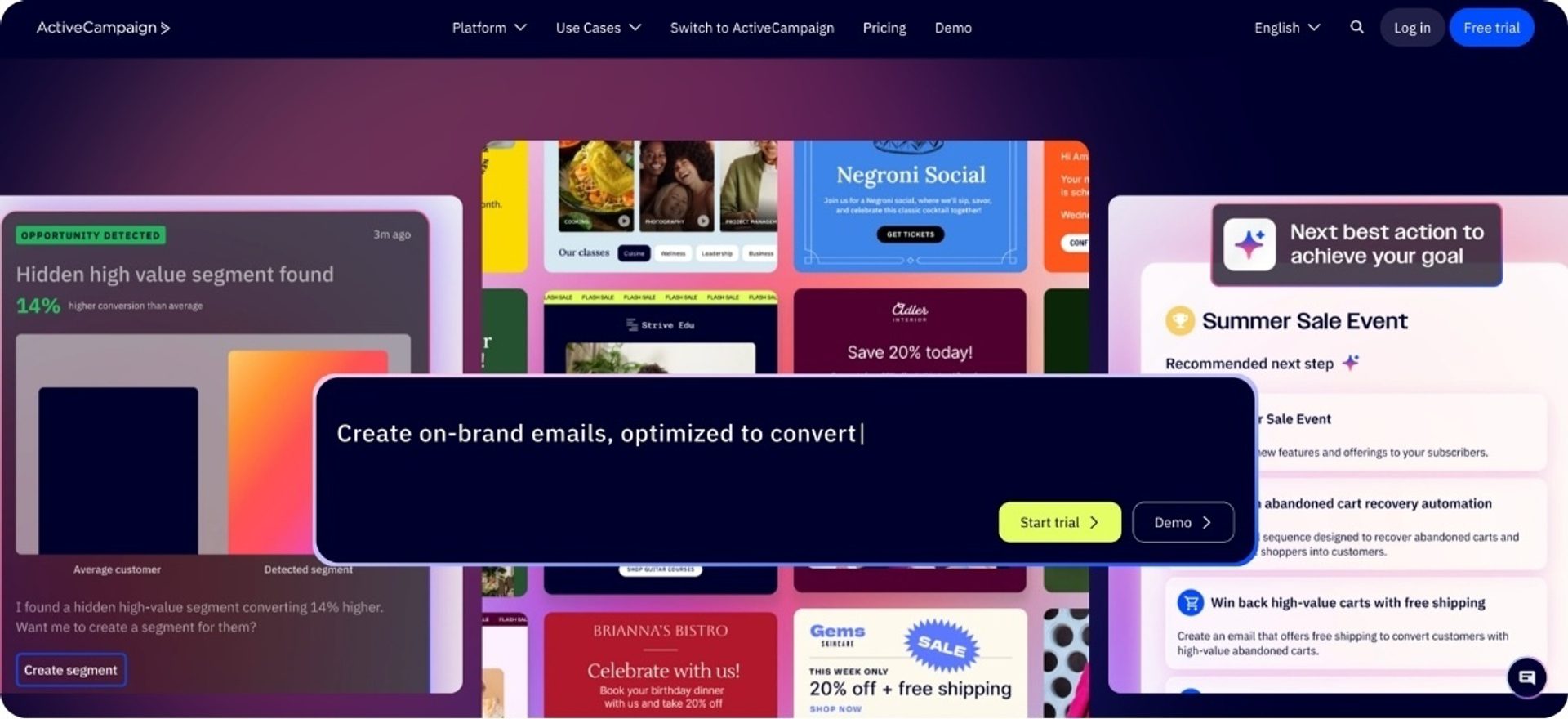
Let’s explore the areas that separate ActiveCampaign most clearly from both Mailchimp and Constant Contact, so you can see where you’ll feel the biggest impact.
AI that understands your goals
Mailchimp's Intuit Assist and Constant Contact's AI tools help you write faster, but leave everything else firmly with your team.
ActiveCampaign's Active Intelligence is an AI engine that operates across the entire marketing lifecycle. Describe an objective in plain language, and it builds a full, goal-aware campaign: copy, subject lines, layout, and the multi-step automation sequence that runs it, all ready to deploy. After launch, it proactively surfaces Autonomous Insights and continues optimizing based on real contact behavior without waiting to be told what to do next.
Hands on the product: Try out the AI Campaign Builder
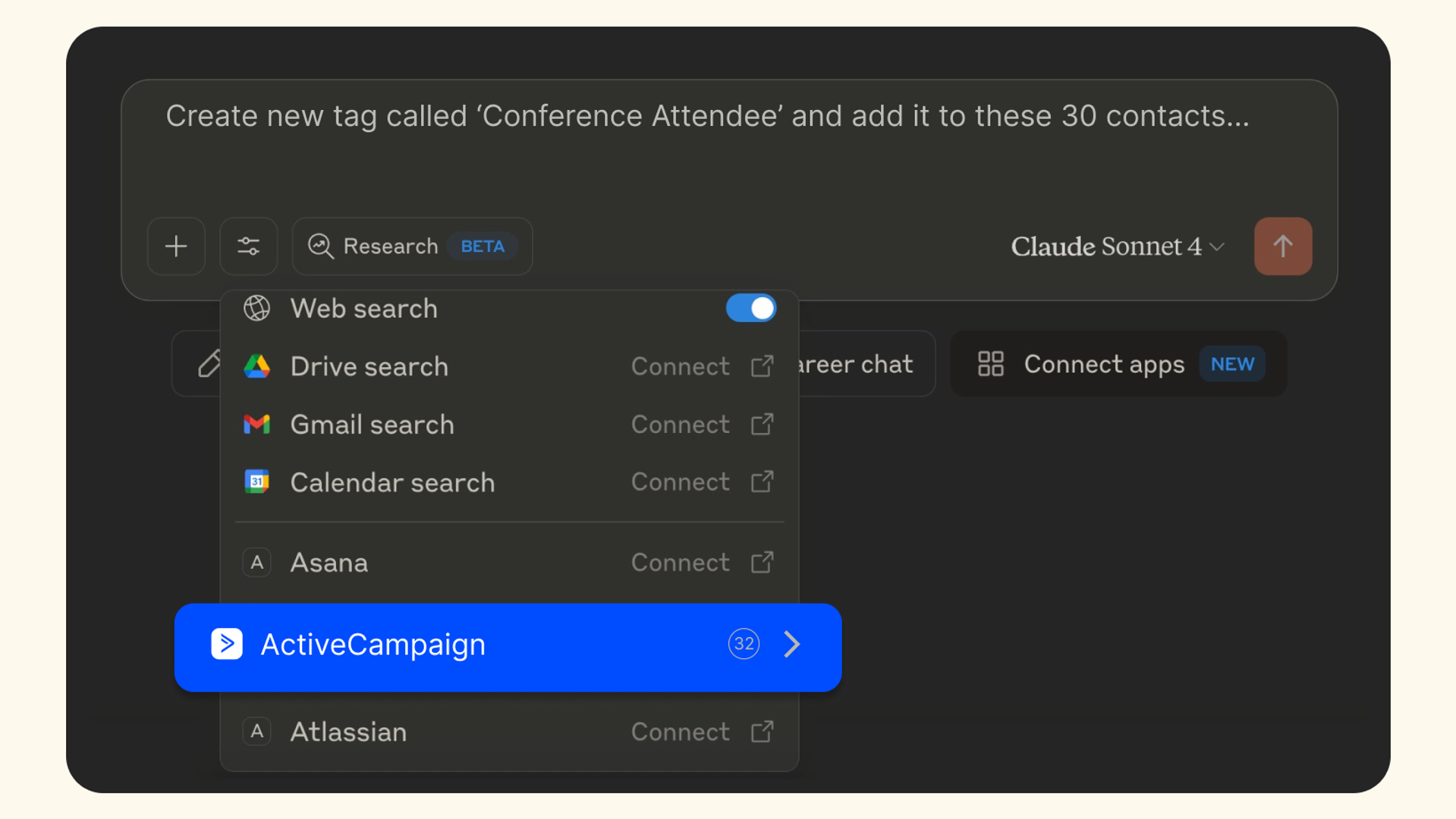
ActiveCampaign's much broader library of 1,000+ native integrations feeds a unified data layer that AI agents draw from across the full customer lifecycle. Every additional connection makes the system meaningfully smarter. MCP Connectors extend intelligence outward, allowing teams to query and act on live contact data from external tools like Claude and ChatGPT.
Read more about how Active Intelligence compares to Constant Contact and Mailchimp’s AI offerings:
- AI Marketing Comparison: ActiveCampaign Active Intelligence vs. Constant Contact’s AI Assistant
- AI Marketing Comparison: ActiveCampaign Active Intelligence vs. Mailchimp Intuit Assist
Automation that actually grows with you
Mailchimp and Constant Contact have significant limitations in marketing automation. Most marketing teams require more than a welcome series and an abandoned cart flow.
ActiveCampaign marketing automation works across all key channels: email, SMS, WhatsApp, on-site messaging, and integrations. It supports deep conditional logic, multi-branch workflows, if/else splits, wait conditions, and real-time behavioral triggers.
The conversational AI workspace extends to automation building, too. Workflows that would take hours to map manually can be generated from a plain-language description in seconds. The complexity is still there; your team just doesn't have to build it by hand.
For teams that want some inspiration, a library of 1,000+ pre-built automation recipes helps to launch sophisticated welcome series, re-engagement flows, post-purchase sequences, and lead nurturing journeys in minutes.
Segmentation and personalization without the workarounds
ActiveCampaign’s intelligence extends to how contacts are treated individually. Where both Mailchimp and Constant Contact rely on rule-based segmentation and audience-level recommendations, Active Intelligence works at the contact level.
AI segmentation software automatically surfaces high-impact segments and targets contacts based on extensive conditions, including behavior, engagement, purchase history, and custom fields, simultaneously.
Segmentation becomes more powerful as behavioral data accumulates, so the platform's targeting gets sharper over time without requiring a rebuild of your contact architecture or a plan upgrade to unlock it.
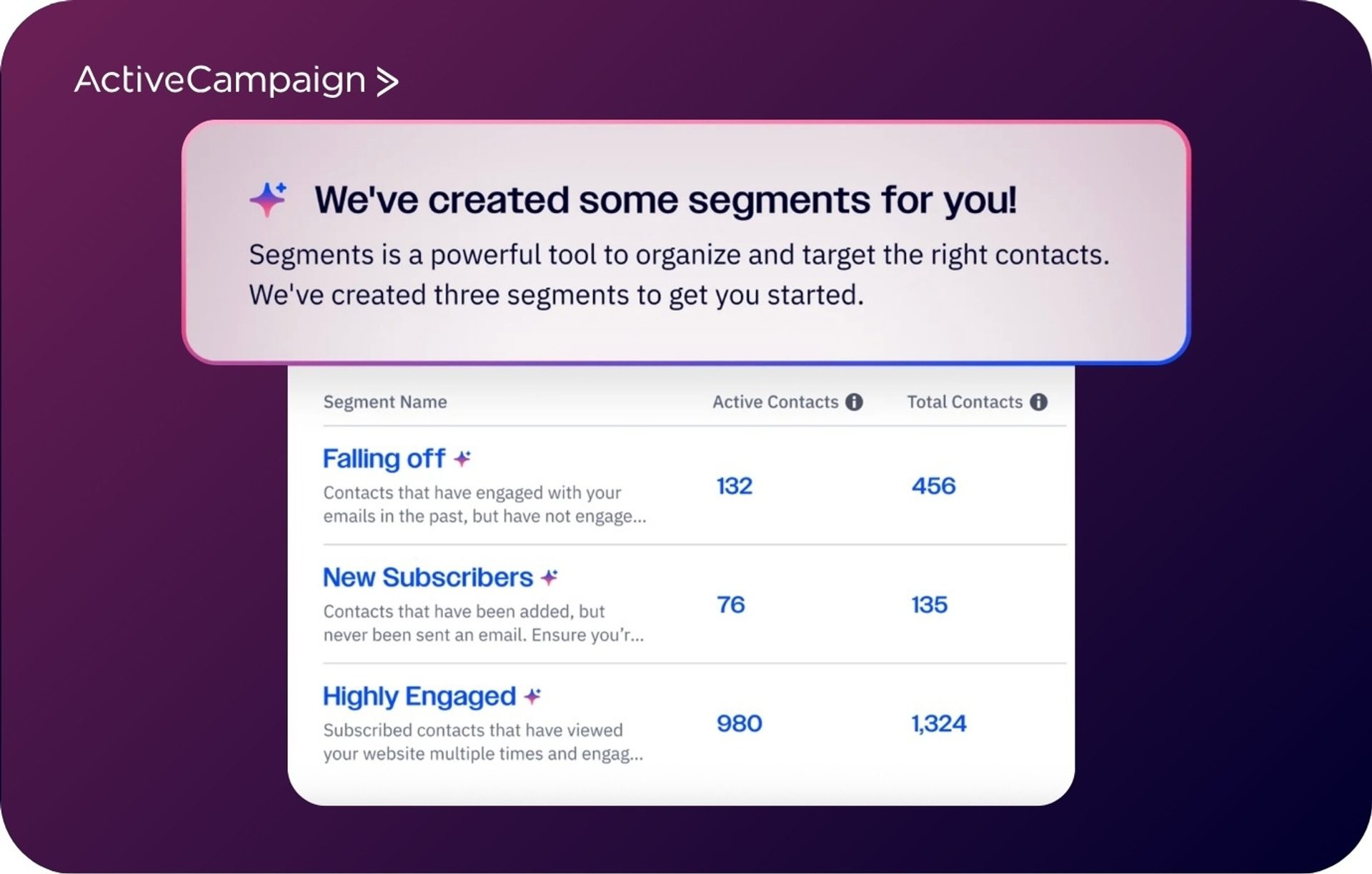
Tagging, site tracking, event tracking, and a dynamic content engine combine to enable real-time marketing personalization that adapts based on what each contact actually does, rather than simply which list they were imported into.
- Predictive Sending calculates the optimal delivery time for each individual contact based on their personal engagement history, not a list average.
- Personalization tools dynamically select content variants inside the same email based on each contact's click behavior.
Hands on the product: See how deeply you can personalize your campaigns
Pricing that scales logically
Both Mailchimp and Constant Contact follow the same pricing pattern: accessible entry points that quietly hide features and T&Cs, so teams end up paying more than they expect.
ActiveCampaign’s pricing delivers more power than both Constant Contact and Mailchimp at a comparable price point. Core capabilities like advanced automation, AI tooling, cross-channel messaging, and segmentation are included across plans rather than held back for the top tier.
The advantage compounds as contact lists grow into the 10,000–50,000+ range, particularly because there is no feature gating or duplicate contact billing. A contact is a contact, regardless of how many workflows or segments they appear in.
ActiveCampaign's pricing looks most different when the total cost of ownership is the measure rather than the monthly subscription fee alone. Teams can significantly reduce manual marketing work with Active Intelligence. They no longer need to build sequences by hand, manage segments manually, or figure out complex optimization.
Marketing teams that use ActiveCampaign save over 10 hours per week by reducing manual work with AI and automations.
I’ve found [ActiveCampaign] to be more powerful, simpler to use, and a more intuitive UX than other email marketing platforms I’ve used (Mailchimp, Constant Contact), and the price point is very reasonable.
Getting started is low-risk. ActiveCampaign offers a free 14-day trial with no credit card required, free agentic migration for teams switching from either platform, and a money-back guarantee if you don't see results within 30 days.
Find out more about:
Mailchimp and Constant Contact were built for the way marketing used to work. ActiveCampaign is built for the way it works now and where it's heading in the future.
FAQs
Is Mailchimp or Constant Contact better for small businesses?
Which marketing platform is better for your small business depends on your priorities. Mailchimp is better if you want a free starting point, stronger ecommerce integrations, and more design flexibility. Constant Contact is better if you value phone support, a simpler interface, and built-in event marketing tools. If you need advanced automation or a built-in CRM, ActiveCampaign is worth considering as an accessible and reasonably priced third option.
Does Mailchimp or Constant Contact have a free plan?
Mailchimp offers a free plan for up to 250 contacts and 500 emails per month. Constant Contact does not offer a permanent free plan, but it does provide a free trial. ActiveCampaign similarly offers a 14-day free trial rather than a permanent free tier.
Which platform has better AI marketing features, Mailchimp or Constant Contact?
Mailchimp has slightly more advanced AI marketing features than Constant Contact. While both platforms have AI content tools, Mailchimp’s AI (Intuit Assist) goes further with predictive analytics to find your best customers and send-time optimization to increase open rates.
That said, both platforms limit AI primarily to content generation. ActiveCampaign’s Active Intelligence extends AI into automation building, segmentation, reporting, and ongoing optimization across the full marketing lifecycle.
How can I switch from Mailchimp or Constant Contact to ActiveCampaign?
ActiveCampaign offers free agentic migration and onboarding to help teams transition from Mailchimp or Constant Contact. You can import contacts, recreate automations using the visual builder or AI Automation Builder, and connect your existing integrations through the platform’s library of 1,000+ native connections. The 14-day free trial lets you test the full platform before committing, and there is a 30-day money-back guarantee if you don’t see results.