HubSpot and Mailchimp consistently appear at the top of every platform shortlist and they’ll both tell you they’re the right choice for your business.
The problem is they’re built for completely different jobs, and most teams comparing the two are somewhere in between. Depending on where your business is right now, one of them might be serious overkill while the other could already be holding you back.
In this comparison guide, we’ll break down the feature lists and pricing pages to help you understand exactly what each platform actually delivers in practice, as well as why a growing number of scaling teams are choosing neither. We’ll also look at why the rise of AI-driven marketing automation is making the cost of picking the wrong tool higher than it's ever been.
HubSpot and Mailchimp: Two different starting points
HubSpot and Mailchimp have competed for the same marketing budgets for nearly two decades. But one is built for teams that have outgrown emails while the other is built for teams that haven’t needed to yet.
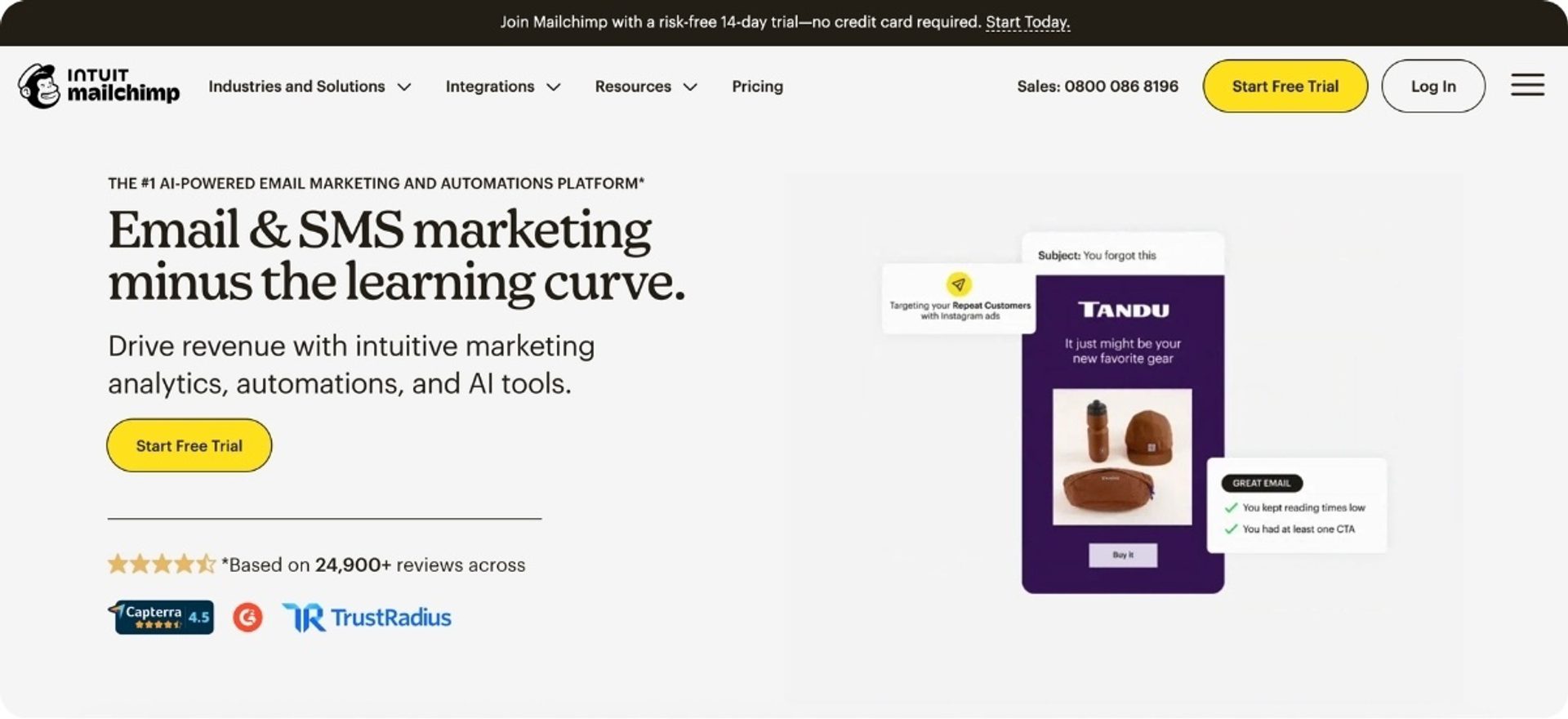
HubSpot is a CRM-first growth platform. Marketing, sales, service, and content are all connected by a shared data layer, making breadth a strength. When everything talks to everything, full-funnel visibility is much easier. The catch? That breadth comes with real complexity and a price tag that climbs fast once you start unlocking the features that make it worthwhile.
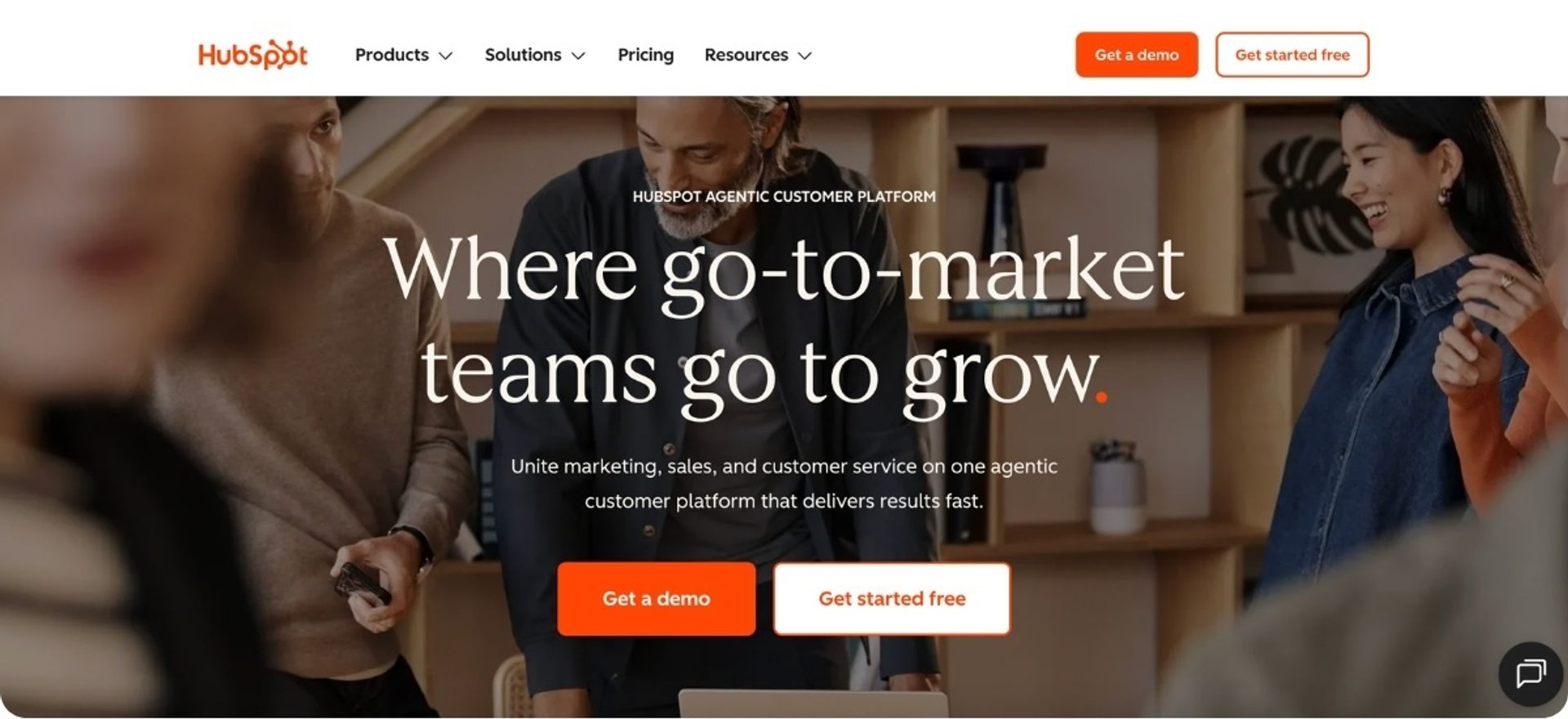
Mailchimp is an email-first tool built for accessibility. With a clean interface, fast onboarding, and solid templates, it’s hard to beat for teams that need to get campaigns out the door without a steep learning curve. But simplicity has a ceiling. Once you need complex automation, deep personalization, or lifecycle marketing that actually responds to customer behavior, Mailchimp starts to show its limits.
There’s also a timing question worth naming. Both HubSpot and Mailchimp are investing in AI, but teams that want intelligence embedded across their workflows today either have to pay to unlock a new tier or find themselves in a beta version. Which tool you select today will determine if you’re ahead of the curve or need to go back to square one.
HubSpot vs. Mailchimp: Core feature comparison
The following sections break down each platform at a high-level across the categories that growth-focused marketing teams care about most when evaluating Mailchimp vs HubSpot side by side:
| Feature | HubSpot | Mailchimp |
| AI tools | Breeze AI operates across the full funnel, covering agents and predictive intelligence. | Intuit Assist (beta) offers useful generative AI, but is limited to campaign-level assistance rather than cross-channel intelligence. |
| Email automation | Multi-step workflows built for complex lifecycle sequences, but gated behind an expensive Professional tier. | Pre-built journey templates with basic entry triggers work well for straightforward nurture flows, but conditional logic and sequencing is limited. |
| CRM | Fully-featured native CRM with pipeline management, deal tracking, and contact history requires additional budget to purchase a separate Hub. | An audience dashboard with tags and purchase history, but no true CRM makes it hard to connect marketing activity to sales outcomes. |
| Segmentation | Active and static lists with behavioral, property, and event-based filters that update in real time. | Tag-based segmentation works well for ecommerce, but lacks the depth needed for behavioral or lifecycle targeting. |
| Reporting | Custom report builder that can tie marketing spend to closed revenue, available on Professional+. | Dashboards show how campaigns perform, but can't connect activity to pipeline or deal impact. |
| Integrations | 2,000+ integrations with deep connections to suit complex tech stacks. | 300+ integrations that cover the essentials, but limited for teams with broader tooling needs. |
| Starting price | Free version available. Marketing Hub plans start at $20/month for 1,000 contacts. Modular pricing across hubs like CRM, Marketing, Data, Commerce. | Free tier available. Plans start at $13/month for 500 contacts. Limited access to essentials on lower-tier plans. |
AI tools and capabilities
HubSpot's Breeze AI operates across three layers:
- Breeze Assistant for day-to-day task support
- Breeze Agents for autonomous workflows
- Breeze Intelligence for data enrichment and predictive scoring
HubSpot Breeze offers an expansive ecosystem, including AI Forecasting, Predictive Lead Scoring, and content generation across blogs, emails, and social. The ecosystem is broad but access is uneven depending on which plan you have.
Mailchimp's AI is built on Intuit Assist, a practical toolkit for making email creation faster. It generates copy and subject lines, recommends send times, and surfaces predictive demographics to help you understand your audience. It’s useful, but limited in scope. It simply accelerates email execution, rather than driving broader marketing decisions. Intuit Assist is also still in beta and currently geo-restricted to US, UK, Canada, and Australia.
Mailchimp’s Intuit Assist is still in beta and geo-restricted to four markets, white HubSpot’s Breeze is more expansive. HubSpot’s impactful features like AI Forecasting and Predictive Lead Scoring sit behind the Professional plan at $800/month, making costs more unpredictable at scale.
Email marketing and automation
HubSpot's automation engine offers branching logic, enrollment triggers, if/then paths, and lead scoring across marketing, sales, and service. The depth is genuinely impressive. The catch is that almost none of it is accessible below the Professional tier at $800/month. The more accessible Starter plan at $20/month is closer to a placeholder than a real automation tool.
Mailchimp's automation centers on Marketing Automation Flows: pre-built journeys triggered by sign-ups, purchases, and date-based events. For straightforward email sequences, it does the job. The limits emerge fast once you need multi-branch logic or behavior-driven workflows. And to access multi-step automation at all, you'll need the Standard plan, starting at $90/month for 5,000 contacts.
Mailchimp's flows lack the conditional depth needed for sophisticated lifecycle nurturing. HubSpot's full workflow engine sits behind a price point that feels like an enterprise commitment. For many teams, the automation question alone drives the entire platform decision and the jump between these two options is sharp. For teams in the middle—past Mailchimp's ceiling but not ready to commit to HubSpot's price tag—neither platform scales gracefully with you.
CRM and customer data
HubSpot's CRM is its foundational strength and the main reason teams choose it. For teams where sales and marketing alignment is the primary driver, that shared data layer is a genuine differentiator. To take advantage, teams need to purchase the HubSpot CRM at additional cost, though there is a free version available for very basic tracking of contacts, companies, deals, tasks, and activities.
Mailchimp offers an audience dashboard with tags, purchase history, and behavioral data. It’s useful for contact organization, but isn’t a CRM in any meaningful sense. Pipeline tracking and deal management aren't in scope. Growing teams inevitably find themselves bolting on a separate CRM tool, adding both cost and fragmentation.
HubSpot gives you real CRM power, but getting full value from it means buying into its broader ecosystem. Mailchimp keeps things simple, but that simplicity has a hard limit once your sales motion requires more than a contact list.
Segmentation and personalization
HubSpot offers active and static lists with property-based, behavioral, and event-based filtering for flexible segmentation. The trade-off is complexity: getting full value requires understanding HubSpot's data model and often building custom properties before the segmentation logic does what you need. Personalization is strong too, with smart content modules and programmable tokens, but again it’s available primarily on Professional-tier plans.
Mailchimp's segmentation is tag-based, with segments built from purchase behavior, engagement levels, and demographics. It covers the basics effectively. The limits show up when you need to combine multiple behavioral conditions or build dynamic segments that update as contacts move through a lifecycle.
For teams whose growth depends on increasingly granular targeting, the pattern continues: Mailchimp's ceiling arrives earlier than expected, and HubSpot's learning curve is steeper than the feature list implies.
Reporting and analytics
HubSpot's reporting is among its strongest assets, particularly for teams already invested across multiple hubs. The custom report builder, multi-touch attribution, and revenue analytics can span marketing, sales, and service data simultaneously. However, the caveat is familiar: custom reports and attribution sit behind Professional and Enterprise tiers.
Mailchimp's reporting covers campaign performance, audience growth, and ecommerce revenue tracking. It's sufficient for optimizing individual emails but doesn't extend far beyond that. Cross-channel visibility, funnel analysis, and journey attribution are largely out of scope.
Mailchimp gives you enough to optimize what you've already sent, while HubSpot gives you the full picture only after you've paid for the plan that unlocks it.
Integrations and tech stack fit
Both platforms have solid integration ecosystems for the audiences they serve:
HubSpot's App Marketplace covers 2,000+ integrations across CRM, ERP, customer support, and beyond.
Mailchimp connects with 300+ tools focused on ecommerce and content.
The more revealing difference is philosophy. HubSpot positions itself as the center of your stack, designed to consolidate or replace multiple tools through its hub structure, while Mailchimp is designed to complement your existing setup as the dedicated email and marketing layer.
Consider the commitment, dependency, and cost implications of each when evaluating fit. Mailchimp can slot into your existing workflows with some light bridging work, but HubSpot wants to be the operating system for your entire go-to-market motion.
HubSpot vs. Mailchimp pricing: What do you really pay?
While both platforms offer a relatively low cost entry point, a more useful comparison is seeing how much they cost when a team with 5,000+ contacts needs automation, reporting, and CRM working together.
HubSpot's $20/month Starter plan is accessible, but it excludes almost every feature (no workflows, no lead scoring, no smart content) that makes HubSpot worth choosing. The Professional plan starts at $800/month for 2,000 contacts, with a mandatory, one-time onboarding fee of $3,000. Contact tier incrementally climb from there.
Mailchimp appears affordable at early stages. The Essentials plan starts at $13/month, and Standard (where multi-step automation unlocks) begins at $90/month for 5,000 contacts. Costs scale with audience size, but Mailchimp bills per list appearance, so one contact on multiple lists is billed multiple times. You’ll also need to pay for higher tiers to unlock features like advanced segmentation and comparative reporting.
The frustration that surfaces in almost every HubSpot vs. Mailchimp pricing conversation is the same: Mailchimp feels affordable until you hit its feature ceiling, and HubSpot feels powerful until you see the invoice.
Most growing teams don't outgrow Mailchimp and land neatly at HubSpot. They outgrow one and overpay for the other.
Does HubSpot or Mailchimp fit your business needs best?
Both HubSpot and Mailchimp have a clear ideal customer, and a lot of businesses comparing them don't fit either profile perfectly.
Mailchimp is the stronger choice if you're an early-stage team or small business running email newsletters, basic ecommerce automations, and straightforward audience management.
If your list is manageable, your workflows are simple, your budget is lean, and you have no immediate need for a CRM or lifecycle marketing sophistication, Mailchimp does exactly what it promises at a price that makes sense.
HubSpot is the stronger choice if you're a sales-driven organization with the budget to access the Professional tier and above.
Teams that need a central CRM with a tight marketing-to-sales handoff and a unified platform spanning multiple departments get genuine value from HubSpot's breadth, provided they're ready to commit to it fully.
The problem is the space between those two profiles. Most scaling businesses need more automation and personalization than Mailchimp can deliver, but find HubSpot's cost, complexity, and hub-based structure to be more platform than they actually need right now.
That difficulty is compounded by a shift that's already underway. As AI raises expectations for what marketing automation can do, the limitations in both platforms are becoming more visible. Mailchimp's AI is useful but scoped tightly to email. HubSpot's is more expansive but locked behind tiers most scaling teams can't yet justify. For a business trying to grow into AI-driven marketing, neither platform offers a clean on-ramp.
So if Mailchimp is too limited and HubSpot is too expensive to unlock, what's the right platform for a team that needs intelligent marketing automation now?
ActiveCampaign: The best platform for teams between HubSpot and Mailchimp
Between Mailchimp's feature ceiling and HubSpot's pricing floor, there's a gap that a number of growing teams fall into. ActiveCampaign is purpose-built for scaling teams that need:
- Serious marketing automation
- AI that goes beyond a subject line suggestion
- Pricing that doesn't punish growth
It’s not a compromise between HubSpot and Mailchimp. It’s what the category looks like when AI is built into execution rather than bolted on as a feature.

AI that actually knows your customer journey
ActiveCampaign is built on Active Intelligence, a unified AI engine that runs through the platform’s core workflows instead of sitting alongside them.
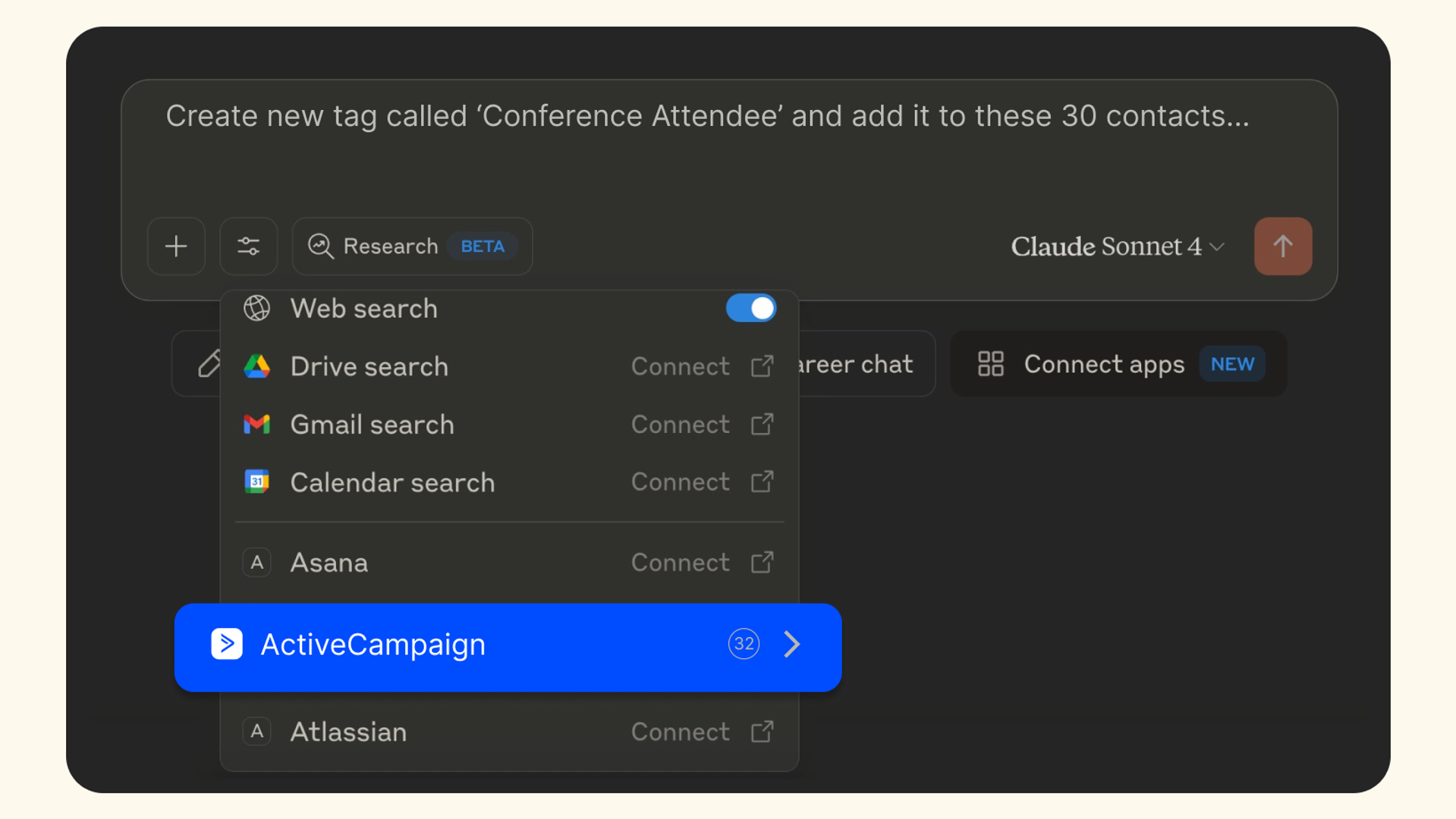
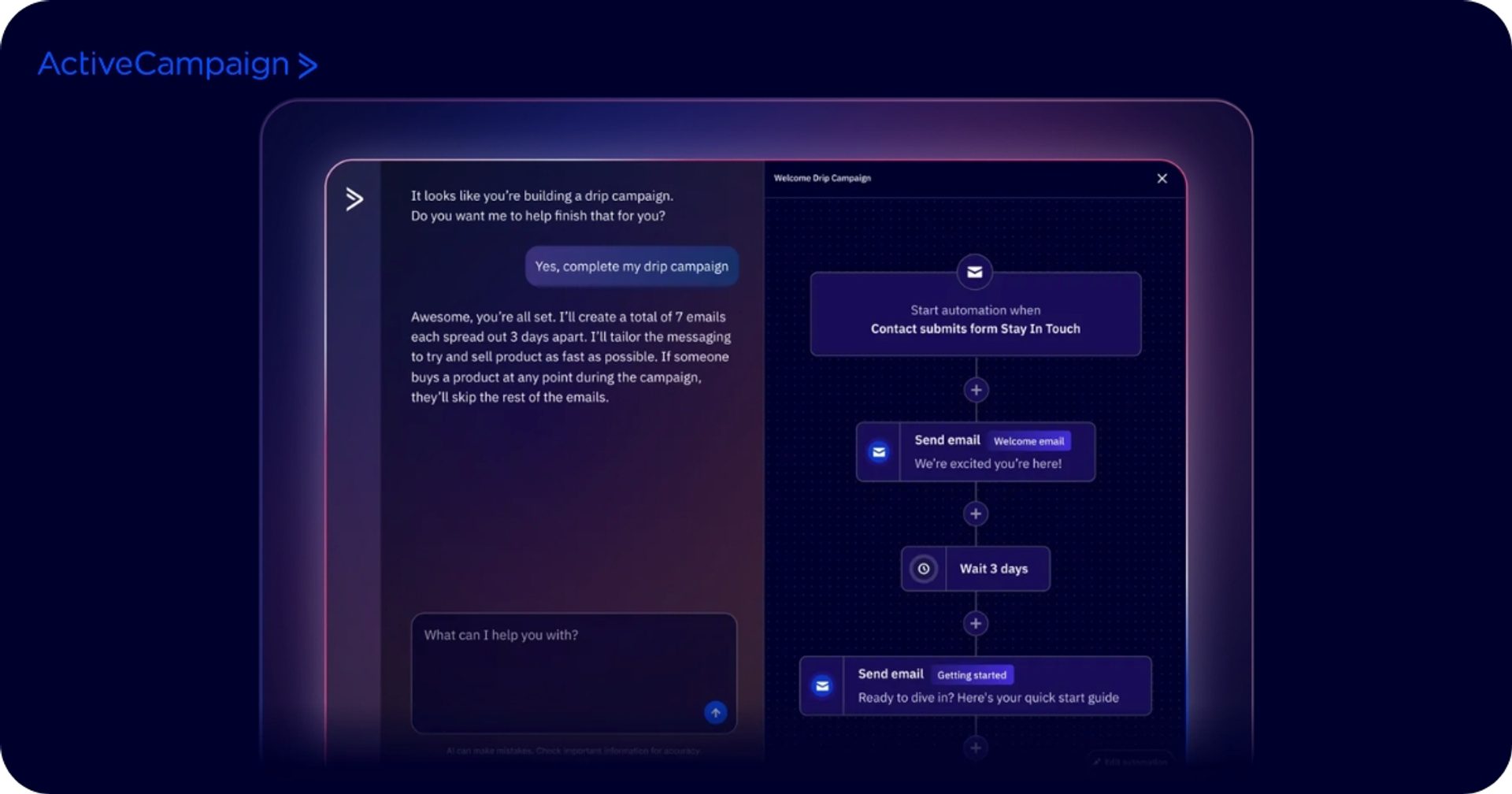
From a single natural-language prompt in a conversational workspace, it can build a complete multi-step campaign, generate the automation sequence, create audience segments, and surface optimization recommendations—without requiring separate tools, manual handoffs, or a tier upgrade to unlock each capability. If execution speed is a constraint for your team, it offers an entirely different way of working.

Take a tour of ActiveCampaign’s custom campaign generator by clicking on the image above.
The segmentation layer reflects the same logic. ActiveCampaign combines behavioral tracking, conditional logic, and AI-Suggested Segments that proactively surface high-value audiences like at-risk customers approaching churn or hidden VIPs buried in an untagged list, re-engagement opportunities your team would never find through manual list-building.
Read more about how Active Intelligence compares to HubSpot and Mailchimp’s AI offerings:
Advanced automation without the enterprise learning curve
ActiveCampaign's automation software is comparable in depth to HubSpot's Professional-tier workflows, with conditional branching, split actions, goal tracking, wait conditions, lead scoring, and predictive sending, but available at a fraction of the cost. The features that HubSpot gates are accessible on ActiveCampaign plans that start significantly lower, with AI baked into the builder rather than added on top.
The time-to-value gap is also meaningfully different. Where HubSpot's onboarding and configuration timeline is a known friction point—often delaying real marketing work by weeks—ActiveCampaign's visual automation builder and library of 1,000+ pre-built automation recipes let teams launch sophisticated lifecycle workflows in minutes. You're not building from scratch or mapping a process before you can send a single email.
Crucially, those automations aren't email-only. ActiveCampaign orchestrates cross-channel marketing for email, SMS, WhatsApp, and on-site messaging, and connects 1,000+ integrations within a single automation layer. It has broader channel reach than Mailchimp's email-first structure and a more unified experience than HubSpot's modular, multi-hub approach where cross-channel coordination requires multiple subscriptions.
Pricing that scales with you
ActiveCampaign's pricing is built around a principle neither Mailchimp nor HubSpot fully delivers: the features that make the platform worth choosing shouldn't require a steep tier jump to access.
Advanced automation, AI, CRM, and cross-channel capabilities are available at entry and mid-tier price points, not held back for Professional or Enterprise plans.
- There is no double charging for contacts on multiple lists.
- There are no mandatory onboarding fees.
- There's no consumption-based credit model running in the background as your team starts relying on AI.
- There is no moment where the platform suddenly becomes three times more expensive because you needed one more feature.
ActiveCampaign delivers more capability than Mailchimp at comparable price points, and automation parity and AI superiority over HubSpot Professional at significantly lower cost. The advantage compounds as contact lists grow into the 10,000–50,000+ range.
Getting started is low-risk by design. ActiveCampaign offers a free 14-day trial with no credit card required, free agentic migration and onboarding assistance for teams switching from Mailchimp or HubSpot, and a money-back guarantee if you don’t see results in 30 days.
I had looked into more expensive tools like HubSpot and had been using MailChimp for a while. I switched to ActiveCampaign because it offers really robust automated email funnels at a fraction of the price of HubSpot and has features MailChimp doesn’t even offer.
Ready to make the switch? Read on to learn about what you'll need to migrate to ActiveCampaign today:
Mailchimp helped businesses get started while HubSpot gave enterprise companies the infrastructure they needed at the time. But the teams scaling the fastest right now are already on a platform that’s built for where they’re going, not where they are today.
ActiveCampaign is ready to scale with your business every step of the way. No ceiling like Mailchimp. No floor like HubSpot. Just room to grow.
FAQs
Is HubSpot or Mailchimp better for small businesses?
For small businesses focused on email newsletters and basic campaigns, Mailchimp is typically the better starting point thanks to its simple interface and lower entry price. HubSpot’s free CRM is strong if sales pipeline management is a priority.
For small businesses that need real automation without paying enterprise prices, ActiveCampaign often provides the best fit between simplicity and depth.
Why is HubSpot more expensive than Mailchimp?
HubSpot is a more expensive platform because it offers more sophisticated hubs for sales, marketing, and customer service teams. However, you won’t actually have access to its full collection of features unless you pay for higher tiers.
HubSpot’s pricing reflects the scope of a full CRM platform with sales tools, service features, and content management, not just email marketing. The cost jumps are most noticeable between Starter and Professional, where most useful automation and reporting features live.
Which platform has the best AI features for email marketing?
HubSpot, Mailchimp, and ActiveCampaign are all investing in AI, but their approaches differ. Mailchimp concentrates AI on email content creation. HubSpot spreads AI across its ecosystem through Breeze, but gates the most useful agent features behind expensive tiers.
ActiveCampaign’s Active Intelligence powers a unified AI experience that can build entire campaigns, automations, and segments from a single prompt. That makes it the strongest option for teams that want AI to drive execution, not just copywriting.
How do I switch from Mailchimp or HubSpot to ActiveCampaign?
ActiveCampaign provides free agentic migration assistance on all paid plans, handling the transfer of contacts, tags, and data from your current platform. The 14-day free trial lets you test the platform before committing.
ActiveCampaign also backs new accounts with a 30-day money-back guarantee if you don’t see results.