Nearly every marketing platform now claims to offer AI. "AI-powered" is an easy checkbox that platforms add to feature lists, but the capabilities on each platform are worlds apart.
Some tools use AI to help you create faster, generating copy, suggesting subject lines, and accelerating the blank-canvas problem. Others are built to help you execute and optimize entire campaigns, automating decisions, personalizing at the contact level, and continuously learning from behavioral data across the full customer lifecycle.
Both ActiveCampaign and Constant Contact feature AI tools on their platforms, but the AI architecture in each platform is very different. For busy teams whose goal is to reduce manual workload, not just move faster through the same tasks, this has operational consequences.
In this guide, we’ll break down how each platform's AI performs across real stages of marketing work, then help you match the right tool to your specific team and goals.
| ActiveCampaign Active Intelligence | Constant Contact AI Assistant | |
| AI capabilities | 25+ Specialized AI Agents AI Campaign Builder AI Automation Builder AI Brand Kit Predictive Sending AI-Suggested Segments Predictive Content Autonomous Insights AI Translations Predictive Lead Scoring Win Probability | AI content generation AI Campaign Builder Basic AI-assisted reporting recommendations AI tech support |
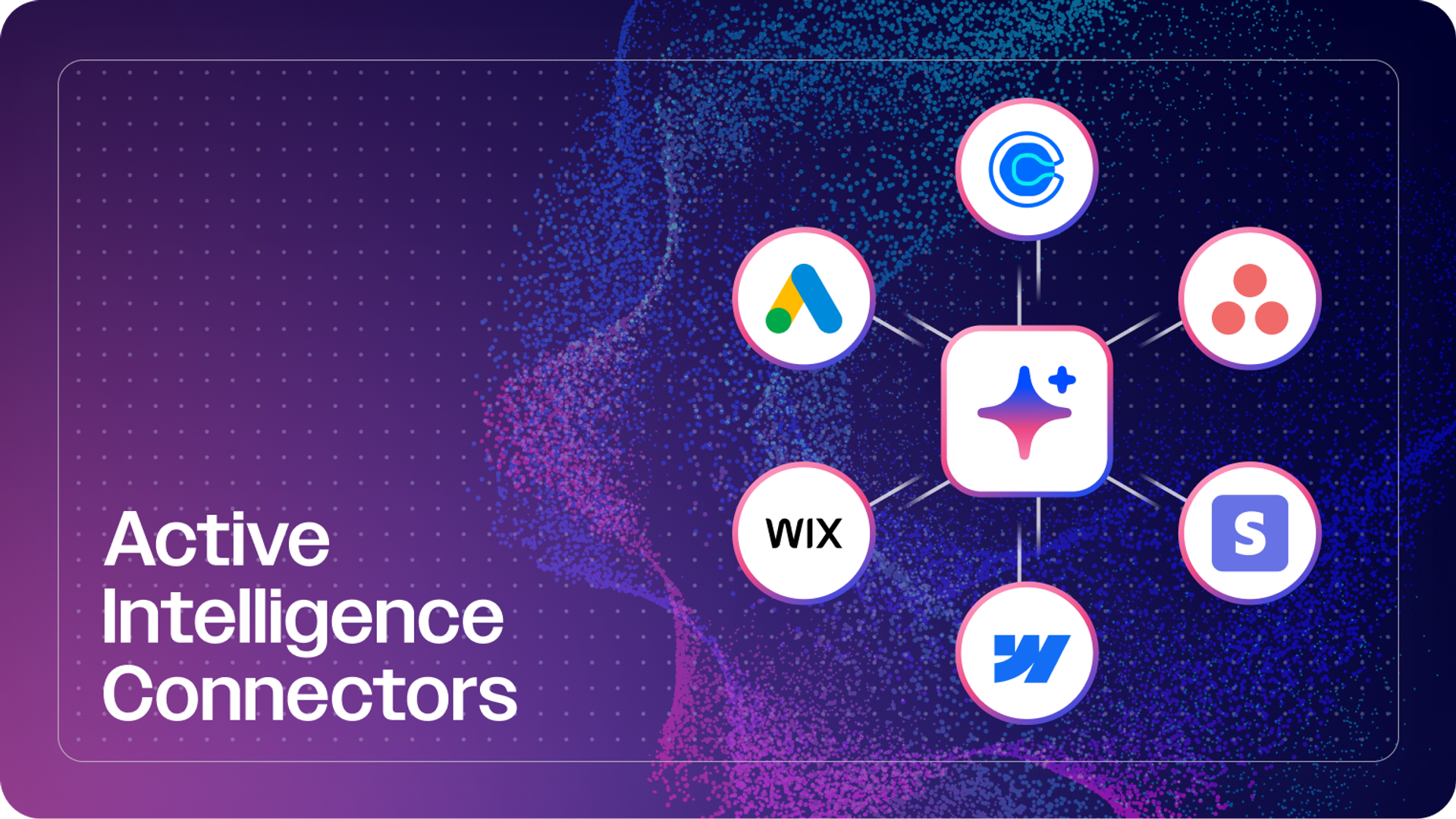
| Integrations | 1,000+ native integrations for CRM, ecommerce, advertising, and support tools unified into a single data layer. MCP Connectors extend the AI layer to external tools including Claude and ChatGPT, enabling external AI systems to query and act on live contact and behavioral data. | 300+ native integrations support core email marketing functionality but do not meaningfully extend the AI layer and do not translate into smarter execution. No MCP Connectors available. |
| Pricing | Core AI capabilities included in Pro plan (from $79/month for 1,000 contacts). No separate AI usage fees. Predictable scaling. | Core AI capabilities available on Standard plan (from $55/month for 1,000 contacts). Advanced features require higher tiers. Lower entry price reflects a narrower AI capability set. |
AI assistance vs. AI execution
Not all AI is built the same. There is a meaningful and measurable difference between generative AI that helps you create faster and autonomous, agentic AI that helps you execute, optimize, and learn across your entire marketing operation. The first saves you time on a single task. The second compounds productivity across every stage of the customer lifecycle, from first touch to retention.
ActiveCampaign's Active Intelligence is a platform-wide AI engine embedded across the full marketing workflow that continuously works in the background while your campaigns run. Describe a goal in plain language and Active Intelligence builds the complete workflow. The system generates the campaign architecture, populates it with content, and keeps optimizing after launch based on real behavioral signals—without waiting to be told what to do next.

Active Intelligence aggregates behavioral data across billions of interactions—opens, clicks, purchases, site visits, CRM signals—and operationalizes that data at the individual contact level. The system learns from every send, adapts to every contact, and orchestrates across channels in a way that no manually-managed workflow can replicate. It makes the entire operation smarter over time.
Constant Contact's AI Assistant is primarily a content acceleration tool. It helps marketers move faster through campaign production: generating email copy, suggesting subject lines, drafting social posts, and walking users through simplified campaign setup workflows. For teams who find the blank page the biggest obstacle to getting campaigns out the door, this is useful. Constant Contact also surfaces basic performance summaries within its reporting interface, offering lightweight AI-assisted observations on how campaigns have performed.

But the AI's role largely ends there. Once content is created and a campaign is scheduled, the majority of what happens after send falls back to the marketer.
Constant Contact's AI will save time at the point of creation. ActiveCampaign's AI removes manual work from the entire lifecycle.
Where Constant Contact AI Assistant works well (and where it doesn’t)
Marketers who need to move quickly through content production, without the complexity of a full automation platform, will find Constant Contact’s AI Assistant a capable and practical tool. It is best when used as a content and campaign assistance layer: purposefully focused on accelerating the tasks that slow small teams down most.
But it does have some limits in scope compared to more sophisticated AI marketing platforms. Let’s take a look at where it can make the biggest impact on your workflows.
AI is primarily a content creation assistant
The core of Constant Contact's AI capability is content generation. The AI Assistant can generate email copy, social posts, and SMS content from a chat prompt, helping marketers move quickly through the blank-page stage of campaign production. Because it spans a fairly broad set of formats, teams can produce multi-channel content variations without starting from scratch each time.

The AI Assistant can also help brainstorm ideas and strategize marketing campaigns, set up a brand profile, and provide colors based on your website. For small teams with limited marketing bandwidth, the guided setup removes early friction and accelerates the creation stage.
Campaign strategy remains a manual marketer responsibility
The AI Campaign Builder takes your goals and turns them into a full-blown marketing strategy in minutes, generating a suite of tactical assets across email, social, and SMS. It uses predefined industry best practices to help reach your audience where they live, without starting from scratch. But the system still relies on marketer input for structure, audience selection, business context, and configuration.
Campaign Builder accelerates planning, not system design. Audience definitions, automation rules and triggers, delivery schedules, and template customization all remain the marketer's responsibility. AI reduces content production time significantly. It does not reduce the need for manual campaign architecture. The marketer is still the system designer, while AI fills in the content layer.
Basic reporting and optimization support, not autonomous decisioning
The AI Assistant leverages GPT-driven insights and user-specific data to provide personalized marketing strategies and tailored guidance.You can also prompt it conversationally to ask for snapshot answers about open and click rates for past campaigns, surfacing basic performance data on request.
This is supportive and advisory. The AI can reflect on what has already happened and offer directional guidance on individual campaign elements. It does not perform behavioral optimization or dynamically adjust journeys to user preferences. Optimization is reactive and surface-level; useful context for a marketer making a decision, but not a system making decisions on its own.
Constant Contact’s AI Assistant is still in beta, and features may change as the platform continues to develop and expand its capabilities. Based on Constant Contact’s current functionality, the AI's role is to support marketers in creating and improving campaigns. The marketer remains responsible for designing, operating, and optimizing the system as a whole.
Beyond AI assistance: Active Intelligence for AI execution and more
ActiveCampaign is built differently from the ground up. Active Intelligence is not a feature added to an existing platform, but an operating layer that runs beneath every workflow. From the moment a marketer sets a goal to the point a contact converts, AI is embedded in creation, execution, optimization, and reporting.
Let’s look at some of these AI workflows in detail.
Build full campaigns in seconds
ActiveCampaign's AI Campaign Builder works from a plain-language goal entered into a Conversational Workspace, something like "launch a win-back campaign for inactive customers". It then produces a complete campaign: email copy, subject lines, CTAs, layout suggestions, and the multi-step automation sequences that run it, ready to deploy.

An AI Brand Kit is embedded into every output, automatically importing brand colors, fonts, logos, and imagery from your own site, so AI-generated campaigns arrive production-ready. Custom Instructions allow admins to define guardrails that are automatically applied to every AI asset and action, without re-specifying them prompt by prompt. No manual brand review cycle, no back-and-forth with design. The output is on-brand by default, removing one of the most consistent points of friction between marketing execution and brand approval.
A suite of 25+ specialized AI Agents handle distinct marketing tasks like campaign creation, optimization, execution support, with awareness of your defined Business Goals and broader marketing context.

Take a tour of the AI Campaign Builder by clicking on the image above.
Find audiences automatically
Most segmentation is rules-driven: a marketer defines the criteria, builds the list, and applies it. Active Intelligence analyzes engagement behavior, purchase history, and lifecycle stage signals to surface high-value audiences as AI-Suggested Segments.
Segments like dormant repeat buyers, high-LTV customers not recently engaged, at-risk contacts showing early churn signals, or emerging high-intent groups that no existing rule would have captured are surfaced automatically. Segmentation becomes discovery-driven rather than definition-driven, and the audiences it surfaces are ready to use, not drafts that need further configuration.

Explore AI-Suggested Segmentation by taking a product tour.
Run automations that adapt in real time
ActiveCampaign's AI doesn't just help build automations, it operates inside them. The AI Actions Library lets marketers describe a workflow goal in plain language and receive a complete multi-step automation in return. This includes extensive triggers, conditions, branching logic, and messaging across email, SMS, WhatsApp, CRM, and other channels connected via 1,000+ integration options.
The AI monitors in-life automation performance, tracking opens, clicks, engagement signals, and purchase behavior, and adjusts journeys accordingly. Rather than following a static path, contacts follow a path that responds to what they actually do. The automation is a living workflow, not a fixed sequence.
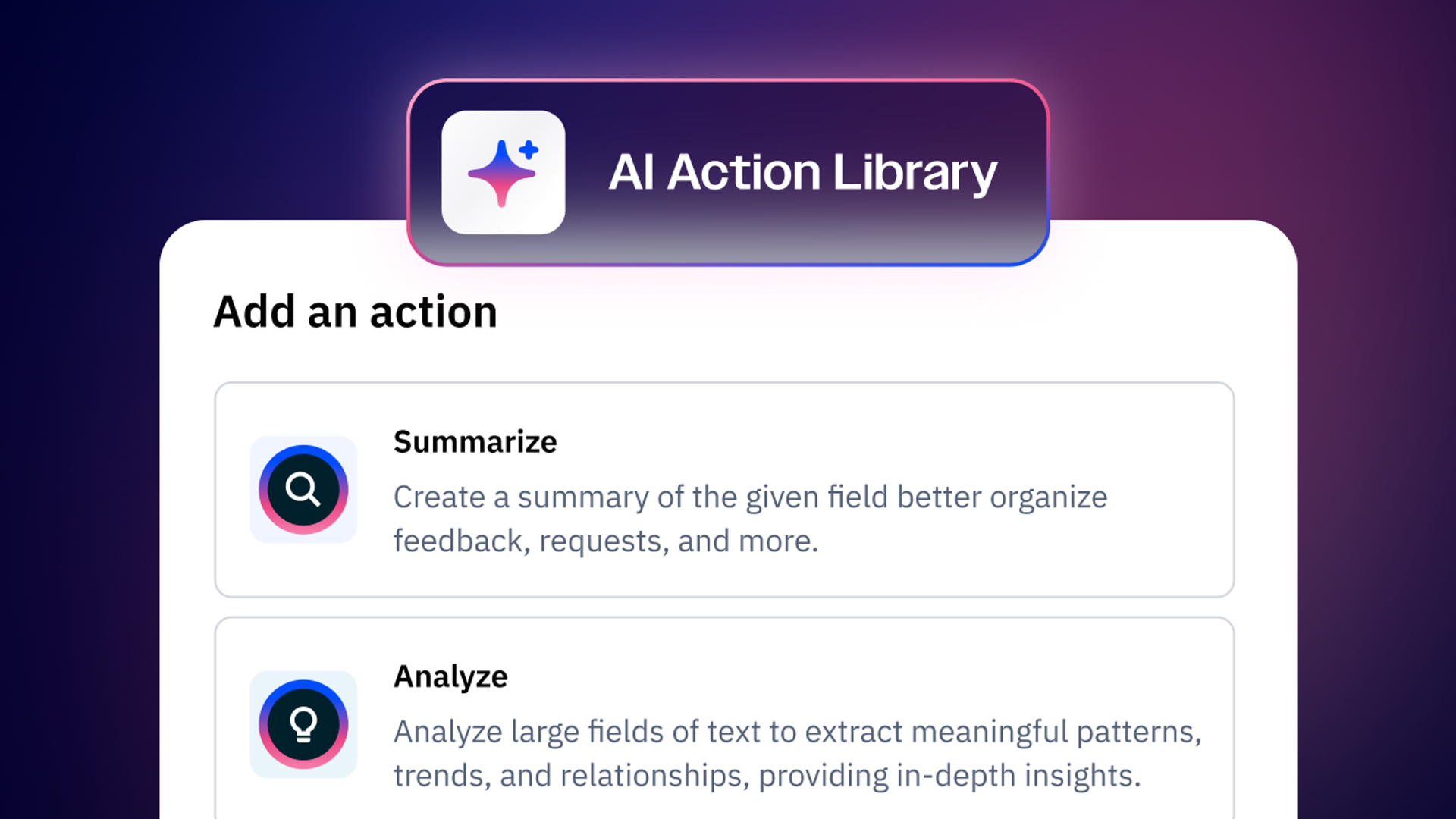
Take a tour of the AI Actions Library by clicking the image above.
Personalize and optimize for each individual contact
ActiveCampaign's optimization layer works at the contact level, not the campaign level.
Predictive Sending determines the optimal delivery time for each individual contact based on their personal engagement history—not a list-level average or a general best-practice window. Every contact receives the message at the moment they are most likely to open it.

Personalization operates inside the message itself, not just around it. Inside those messages, Predictive Content dynamically selects between multiple content variants within a single email based on each contact's past click behavior. Different contacts can receive different versions of the same campaign without additional segmentation or duplicate sends.
Both layers run continuously and automatically. Once activated, there is no per-campaign configuration required. The system improves its predictions as behavioral data accumulates.
Understand and act on performance instantly
Autonomous Insights surface trends, anomalies, and recommendations directly in the dashboard, without a marketer having to go looking. Performance analysis acts as a continuous feed.
Conversational reporting adds a second layer: answers to the questions you’re already asking. A marketer can ask a plain-language question like "which segment converted best last month?" and receive instant answers, visual breakdowns, and actionable recommendations. Reporting shifts from analysis work to something closer to a standing brief that updates itself.
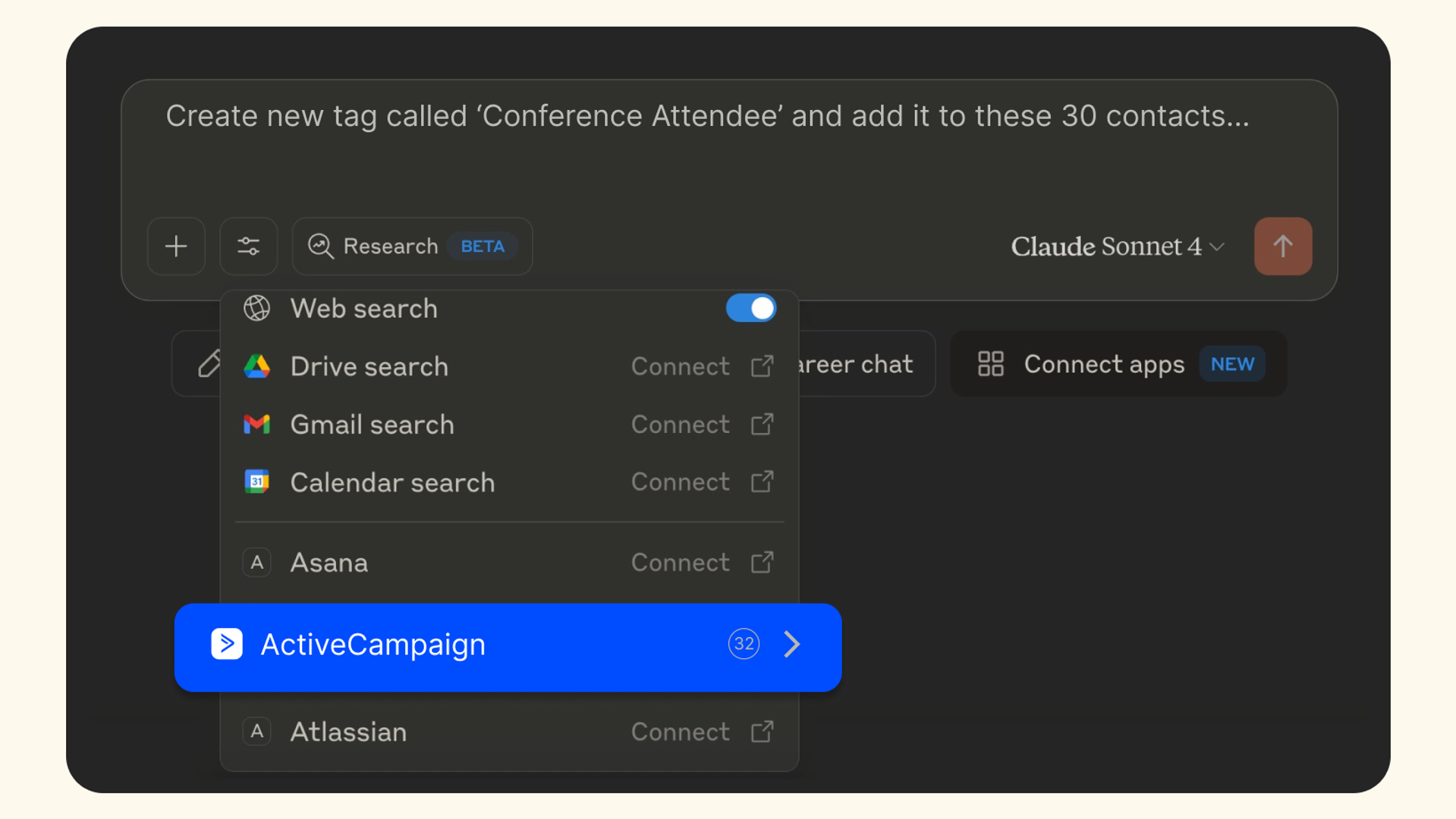
MCP Connectors further close marketing data siloes between teams. Users can query, interpret, and act on live CRM and behavioral data directly within the external AI tools they already use, including Claude and ChatGPT. Insight generation and execution no longer operate in separate systems.
Compounding intelligence over time
The cumulative effect of all of these tools is a system that gets more effective the longer it runs. Active Intelligence continuously analyzes billions of data points to learn from engagement patterns, refine segmentation suggestions, improve send-time predictions, and enhance automation performance recommendations as data accumulates. Manual optimization burden decreases over time rather than growing with list size or campaign volume.
This is the most valuable difference between an AI execution platform and an AI assistance tool. Active Intelligence doesn't just support the work; it runs and improves it.
Which AI marketing platform is right for your team?
A longer feature list doesn't necessarily lead to better marketing. What matters is whether the AI embedded in your platform can handle the work you’re trying to do, not just the work you’re doing today.
Any evaluation of AI marketing tooling should start with honest answers to a few practical questions:
- How much of my current marketing workload is content creation versus campaign operations and optimization?
- Do I need AI to help me work faster, or to help me do things my team couldn't do manually at all?
- How important is personalization and segmentation to my marketing strategy right now—and in the next 12 months?
- How connected are my email, CRM, and automation workflows, and does AI need to work across all of them?
- What's the realistic ceiling of the AI features I need?
- What AI features are available at the pricing tier I can commit to today?
Constant Contact may be the right fit for…
Teams whose primary channel is email, whose automation needs are straightforward, and whose biggest friction point is content production. If your workflow follows a straightforward build-send-review cycle and you want AI to move through it faster, the AI Assistant will serve that need well. It's accessible, simple to adopt, and doesn't require significant onboarding investment to start generating value.
Core AI capabilities are available on the Standard plan from $55/month for 1,000 contacts, making it an approachable entry point for small teams and growing businesses with focused requirements.
ActiveCampaign is the better choice for…
Teams that see precise, behavior-driven marketing as a growth driver rather than a problem to be simplified. If your operation involves lifecycle automation, contact-level personalization, multi-channel orchestration, or a CRM that needs to inform how campaigns behave—Active Intelligence operates natively across all of it.
This applies whether you're a lean team that wants AI to carry the operational burden that headcount can't, or a scaling organization that needs a system capable of running increasingly sophisticated customer journeys without proportional increases in manual work.
All core AI capabilities are included in the Pro plan from $79/month for 1,000 contacts, with no separate AI usage fees. Pricing scales predictably with contact volume, not with how heavily you use the AI layer.
Teams using Active Intelligence build campaigns 3x faster.
SparkJoy New York reported 85% faster campaign creation using ActiveCampaign's AI agents.
Soundsnap reported 20% higher open rates after enabling AI Predictive Sending.
If ambition extends beyond faster content production to genuinely smarter, more automated marketing, it’s time to try Active Intelligence.
Ready to see Active Intelligence working with your own data? Start a free trial or book a demo to explore how Active Intelligence can power precise, strategic campaigns, workflows, and insights from day one.
FAQs
How is ActiveCampaign’s AI different from Constant Contact’s AI?
Constant Contact’s AI is primarily focused on content generation, helping marketers draft emails, social posts, and SMS messages faster. ActiveCampaign’s Active Intelligence operates across the entire platform, embedding AI into automation building, audience segmentation, predictive send-time optimization, real-time reporting, and cross-channel campaign execution. The difference is between AI that accelerates individual tasks and AI that runs and continuously improves the marketing operation as a whole.
Which platform is more cost effective for AI: ActiveCampaign or Constant Contact?
Cost effectiveness depends on which AI capabilities your team will actually use. Constant Contact’s Standard plan starts at a lower entry price, but its AI feature set is narrower in scope. ActiveCampaign’s Pro plan includes the full Active Intelligence suite with no separate usage fees, making it more cost effective for teams that need AI working across multiple workflows rather than a single stage of campaign production.
Can I connect my existing tools to ActiveCampaign’s AI engine?
Yes. ActiveCampaign offers 1,000+ native integrations spanning CRM, ecommerce, advertising, and customer support tools, all feeding into a unified data layer that the AI draws on. MCP Connectors allow external AI tools including Claude and ChatGPT to query and act on live contact and behavioral data directly. This means the intelligence built up inside ActiveCampaign can inform decisions across the wider tools your team already works in.
Which platform is better for a small team starting with AI: ActiveCampaign or Constant Contact?
For small teams whose primary need is email marketing with AI-assisted content creation, Constant Contact can offer a straightforward and accessible starting point. For small teams who want AI to reduce operational workload beyond content creation, ActiveCampaign is an accessible tool designed to scale handling segmentation, automation, and optimization from day one without requiring additional headcount.