In healthcare, trust is everything. HIPAA (Health Insurance Portability and Accountability Act) sets national standards for protecting patients’ sensitive health information. For healthcare marketers, HIPAA compliance is a legal and ethical responsibility that shapes every interaction with patients.
At the same time, modern healthcare marketing is expected to be digital-first. Along with every other industry, healthcare organizations are under pressure to deliver personalized, automated communications, without ever compromising privacy. This creates a common tension: how can you engage patients effectively while adhering to strict regulatory requirements?
This guide will help you navigate that complexity. We’ll cover HIPAA marketing essentials, highlight common pitfalls to avoid, and provide a lifecycle-based framework for compliant healthcare marketing, so you can build a strategy that supports patients, while keeping their data safe.
Understanding HIPAA compliance in a marketing context
Legal disclaimer: The information in this guide does not constitute legal advice. This is for informational purposes only, and we strongly encourage you to seek independent legal counsel to understand how your organization needs to comply with HIPAA.
HIPAA establishes strict rules for marketing activities that involve Protected Health Information (PHI).
What is PHI?
Protected Health Information (PHI) is any individually identifiable health information that relates to a patient’s past, present, or future physical or mental health, provision of care, or payment for healthcare services.
This includes:
- Names
- Contact details
- Medical records
- Lab results
- Appointment information
- Any other data that could identify a patient
Under HIPAA, PHI must be handled with strict confidentiality and appropriate safeguards throughout all marketing, communication, and operational activities.
In HIPAA terms, “marketing” differs from activities related to treatment, payment, or healthcare operations (TPO).
Marketing is defined as communications that promote a product or service, often using patient information to target or personalize messages.
Treatment, Payment, and Healthcare Operations (TPO) activities are necessary for providing care, processing payments, or managing healthcare operations. PHI use in these contexts generally does not require marketing authorization.
In general, any communication that promotes a product or service and uses a patient’s PHI requires explicit patient authorization. This ensures patients remain in control of how their sensitive health information is used.
There are some exceptions where HIPAA allows certain communications without patient authorization. Exceptions include:
- Treatment and care coordination (e.g. scheduling follow-ups, test results)
- Refill reminders or medication adherence notifications
- Communications about the covered entity’s own services
- Face-to-face communications
- Promotional gifts of nominal value
- General, non-personalized health promotion (e.g. flu shot reminders)
It’s important to understand these distinctions to avoid accidental violations and focus on compliant outreach.
Practical compliance for healthcare marketers
To run HIPAA-compliant campaigns, healthcare marketers must address several critical areas:
- PHI handling and confidentiality: Ensuring all patient data is protected during collection, storage, and communication, and limiting exposure to only essential, authorized personnel.
- Covered entities: Recognizing if your organization is a covered entity under HIPAA (e.g., healthcare providers, health plans) and understanding the rules that apply.
- Business Associates: Vendors or partners handling PHI on your behalf must be HIPAA-compliant and have a signed Business Associate Agreement (BAA).
- Minimum necessary use: Only accessing or sharing the amount of PHI needed for a specific task, reducing risk of unnecessary exposure.
- Patient consent: Obtain explicit authorization when required for marketing communications involving PHI.
- Data storage and retention policies: Secure storage of PHI, adherence to retention schedules, and providing systems that allow patients to revoke consent or request data deletion where applicable.
Overlooking any of these can lead to PHI exposure, regulatory penalties, or patient distrust.
Common marketing activities that trigger HIPAA violations
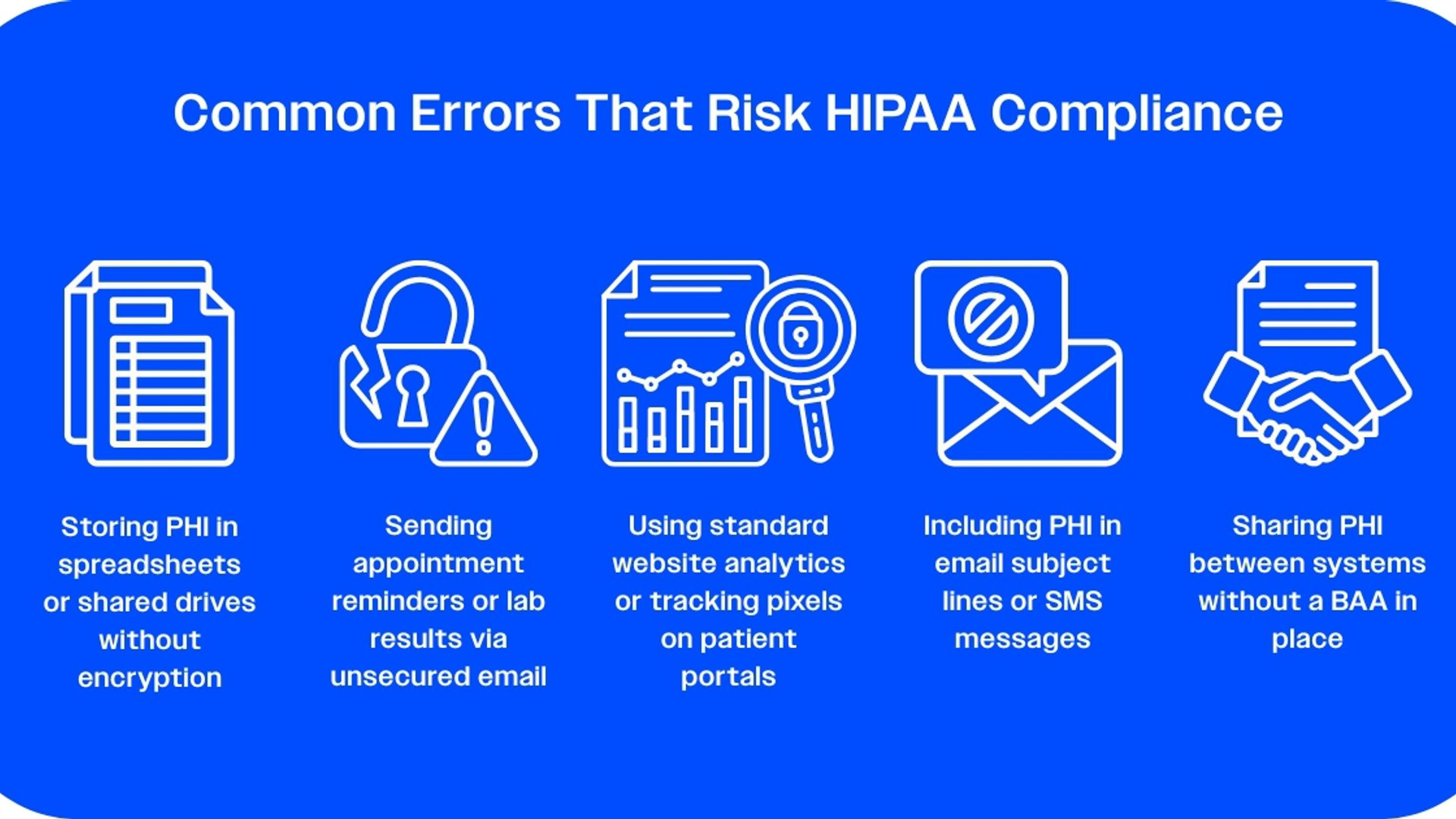
Even small missteps can lead to serious HIPAA violations. Many healthcare marketers unintentionally expose patient data because seemingly simple tasks aren’t handled securely.
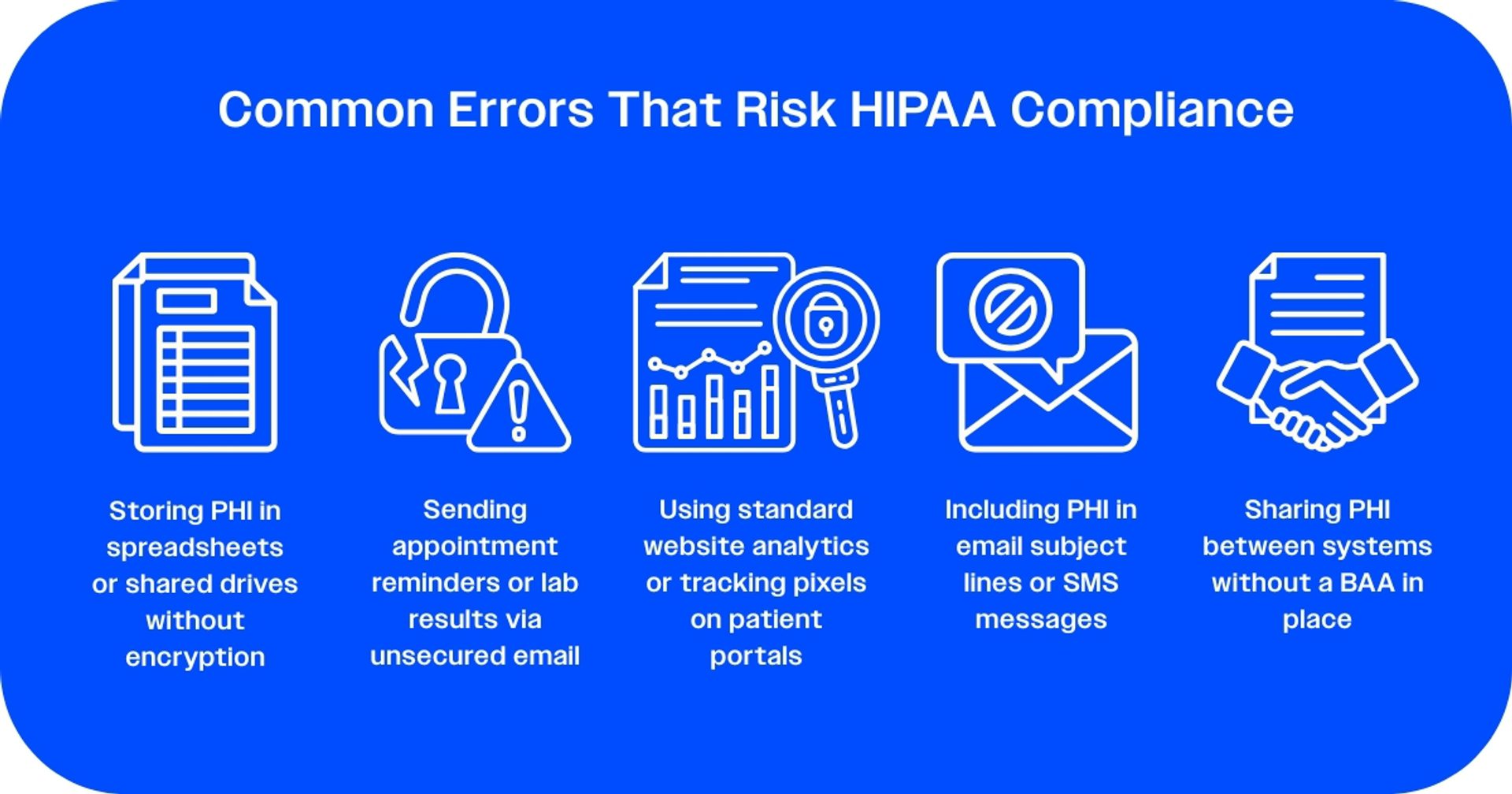
The table below outlines mitigation strategies for common risk scenarios:
| Common mistake | Risks | Mitigation strategies |
| Storing PHI in spreadsheets or shared drives without encryption | Unauthorized access Data breaches Regulatory penalties | Use secure, HIPAA-compliant CRM storage Restrict access via Role-Based Access Control (RBAC) |
| Sending appointment reminders or lab results via unsecured email | PHI interception Violation of confidentiality | Send reminders through HIPAA-compliant messaging platforms with encryption Avoid PHI in email subject lines |
| Using standard website analytics or tracking pixels on patient portals | Accidental sharing of PHI with third parties | Implement exclusion zones for sensitive pages Use privacy-first analytics tools |
| Including PHI in email subject lines or SMS messages | Data exposure during transmission | Keep PHI out of subject lines and SMS Trigger secure portal links instead |
| Sharing PHI between systems without a BAA in place | Legal liability for unprotected PHI | Ensure all vendors have signed BAAs Integrate systems via HIPAA-compliant connections |
According to IBM’s X-Force 2025 Threat Intelligence Index, more than 70% of healthcare breaches are linked to internal activity—either intentional misuse or unintentional errors that enabled access to sensitive data. Penalty fines range from $100 to $50,000 per violation for even unintentional breaches, so building secure, compliant workflows should be a priority.
A lifecycle-based framework for HIPAA-compliant marketing
Navigating HIPAA compliance can feel complex, especially when you want to make sure your patients are engaged and supported. But with the right tools and processes, compliance can be built seamlessly into every stage of the patient journey.
In the following framework, we’ll break down the customer patient lifecycle and map HIPAA-first marketing strategies to each stage. We’ll show you exactly how to implement ActiveCampaign’s compliance tools to communicate responsibly while keeping patient data protected.
Acquisition: Compliant lead generation and website tracking
Collecting patient information safely at the first touchpoint is foundational to HIPAA compliance. Early blunders in data collection or tracking can create PHI exposures that ripple through your marketing stack.
Design acquisition processes with privacy in mind from the start by using these strategies:
- Use secure web forms & landing pages to collect contact inquiries or consultation requests. ActiveCampaign’s forms are hosted with SSL/TLS encryption, so data is protected both in transit and at rest, reducing the risk of interception or unauthorized access. This eliminates common vulnerabilities associated with unsecured or third‑party form tools.
As a rule, intake forms should include the option for patients to state their communications preferences, so you have their consent to send marketing communications (or not) from the start.
- Host data in regions that meet local compliance needs. Healthcare organizations with regional compliance requirements benefit from being able to choose their data residency. ActiveCampaign’s data hosting options help practices meet local data sovereignty mandates and align with regional privacy laws that may layer on additional requirements beyond HIPAA.
- Implement safe tracking practices. ActiveCampaign uses first-party site tracking to monitor engagement without sending data to third-party analytics platforms. This keeps information within your HIPAA-covered environment.
Analytics or tracking pixels can inadvertently collect or expose PHI if they run on sensitive pages. ActiveCampaign’s tracking code is implemented per-page, so organizations can implement exclusion zones (areas where tracking scripts are disabled) for pages like patient portals to keep PHI out of analytics tools and avoid accidental data sharing with third parties.
Southern Orthodontic Partners uses ActiveCampaign’s HIPAA-compliant forms and workflows to collect patient inquiries. PHI flowed directly into the secure CRM, without passing through unsecured spreadsheets, email, or third-party tools. With their data instantly protected, SOP could ensure no lead was left unattended, and set up an automation sequence that achieved an 87% response rate within 24 hours.
Conversion: Secure intake and consultation scheduling
Once a lead has been captured, PHI handling becomes critical. Patient intake and consultation scheduling often involve sensitive information like medical history, appointment details, or insurance data. Without proper safeguards, this information can be exposed, creating compliance risks and eroding patient trust.
Design your conversion workflows with privacy and efficiency in mind using these strategies:
- Secure CRM integration: Captured leads should flow directly into a HIPAA-compliant CRM like ActiveCampaign, eliminating the need for spreadsheets, unsecured email, or manual data transfers. This keeps PHI protected while allowing staff to manage intake efficiently.
- Limit PHI visibility to only authorized staff members. ActiveCampaign’s Role-Based Access Controls (RBAC) ensure that team members can only access the data necessary for their role, while reports and contact activity streams track all changes, supporting compliance audits and incident investigations.
- Automate confirmations, reminders, and intake routing without exposing PHI. Online intake forms can trigger automated workflows that route information to the appropriate staff member, maintaining data security.
For example, a patient might submit a consultation request via a secure online form so PHI flows directly into a secure CRM. This could trigger an automated workflow that schedules and confirms the appointment, and requests relevant appointment information. Sensitive information is routed only to the appropriate department and staff members, based on automation rules, and follow-up messages—like patient portal invitations are timely and personal, but don’t expose data to unnecessary team members.
Onboarding & care communication: Communicating with new patients
Early patient engagement is one of the most sensitive phases of the healthcare journey. At this stage, individuals may be anxious, seeking guidance, or processing important health information. Crucially, they’re also deciding whether they trust a provider. Consistent, compliant communication builds trust, showing patients that your practice values both privacy and care quality.
Design your onboarding and care communication strategy to balance personalization with privacy safeguards:
- Automate structured, privacy-first sequences for welcome messages, appointment reminders, and educational content. ActiveCampaign’s rich automations run within a HIPAA-covered account, reducing manual handling of PHI while ensuring patients receive timely, consistent communication.
- Use segmentation and conditional content to personalize messages based on non‑sensitive attributes—such as form submissions or engagement history—or patient preferences. This lets you tailor messaging without exposing PHI in email bodies or subject lines.
Most importantly, remember that any content based on sensitive information, like medical conditions, should have explicit permission from the patient. Lists and preference centers make it easy to keep track of preferences and ensure they only receive communication types they have agreed to.
Men’s Health Clinic Optimale uses ActiveCampaign to automate patient onboarding and follow-up communications across email and SMS. Workflows are triggered based on very specific patient interactions and preferences, allowing Optimale to automate highly-relevant education and reminders without risking data exposure.
Retention & reactivation: Prompting engagement without overstepping
Retention and reactivation are especially important in healthcare. Regular, appropriate communication supports preventive care, helps patients stay on track with treatment plans, and reduces missed appointments or gaps in care that can directly impact health outcomes.
When done well, ongoing engagement also reinforces the message that a practice truly cares about the patient’s well-being, not just revenue.
Design retention and reactivation campaigns that keep patients engaged while respecting privacy boundaries using these strategies:
- Deliver ongoing education, post-visit follow-ups, and recall campaigns at the right time using automations. These workflows can run automatically within a HIPAA-covered environment like ActiveCampaign to reduce manual handling of sensitive data while maintaining consistent patient outreach.
- Personalize messaging flows based on non-sensitive behaviors. Use tags based on appointment history, engagement with past messages, or time since last visit, rather than including PHI directly in message content. This enables relevance without unnecessary data exposure.
- Trigger behavior-based reactivation workflows based on patient actions or inaction, such as missed appointments or prolonged inactivity, and keep sensitive details out of messages. ActiveCampaign’s automation logic ensures outreach is timely and respectful, without crossing privacy boundaries.
For example, if a dental patient hasn’t visited in several months, an automation could trigger a recall email reminding them it’s time to schedule their 6-month cleaning. The message is personalized based on timing and engagement history—not medical details. This helps practices encourage preventive care while keeping patient information protected.
ActiveCampaign offers HIPAA-compliant marketing tools without the “healthcare tax”
Healthcare organizations shouldn’t have to choose between growth and compliance. ActiveCampaign embeds HIPAA safeguards directly into everyday marketing workflows, so compliance becomes part of how teams operate—not an added burden.
ActiveCampaign is built for peace of mind at scale, with:
- Global data residency: U.S., EU, and Australia hosting options.
- Proactive safeguards: Automatic PHI detection, Role-Based Access Control (RBAC), and audit logs.
- Secure intake: SSL/TLS-encrypted forms and landing pages.
- Superior deliverability: 98%+ delivery rate and dedicated IPs, DMARC, DKIM, and SPF to ensure critical messages reach the inbox.
- Business Associate Agreement (BAA): Available on eligible plans to cover the use and disclosure of PHI.
Many healthcare practices rely on vertical-specific Patient Management Systems (PMS) for scheduling or record-keeping. These platforms are valuable for operations, but they aren’t built for complex patient communication flows.
PMS also typically come with high costs tied to healthcare-specific pricing models. This “healthcare tax” can make advanced marketing automation inaccessible for smaller or growing practices.
ActiveCampaign provides accessible, HIPAA-compliant automation across the entire patient journey and the lowest cost for a BAA across comparable tools. Take a look at HIPAA compliance pricing, based on 10,000 contacts with common marketing software platforms below:
- ActiveCampaign: ~$229/mo for an Enterprise plan with BAA
- Mailchimp: ~$350/mo minimum
- Salesforce Health Cloud: ~$325 per user per month
- HubSpot: ~$3,600+/mo, with an Enterprise plan required
Ready to grow responsibly? Request a demo to explore how ActiveCampaign supports HIPAA-compliant marketing across the full patient lifecycle—and see how privacy-first automation can work for your healthcare organization.
FAQs
What is HIPAA-compliant marketing?
HIPAA-compliant marketing refers to promoting healthcare services while protecting patients’ Protected Health Information (PHI) in accordance with HIPAA regulations. It requires secure data handling, limited access to PHI, proper patient authorization when required, and the use of compliant tools and vendors under a Business Associate Agreement (BAA).
Can I personalize emails and SMS for patients without violating HIPAA?
Yes, personalization is allowed when it avoids unnecessary PHI in message content. Using segmentation, conditional content, and behavior-based triggers lets you tailor messages safely while keeping sensitive health information out of emails and SMS.
How often should I communicate with patients without overstepping privacy boundaries?
There’s no fixed limit, but communications should be relevant, expected, and tied to care, education, or patient engagement. Consistent, purposeful messaging, such as reminders or educational content, supports trust and better outcomes without feeling intrusive.
Are HIPAA-compliant marketing tools only for large practices?
No, HIPAA-compliant marketing tools are increasingly accessible to practices of all sizes. Platforms like ActiveCampaign offer compliant automation and BAAs on eligible plans, making privacy-first marketing practical for small clinics and growing healthcare organizations alike.
How do I know if my marketing workflows are HIPAA-compliant?
Start by ensuring all tools handling PHI are covered by a BAA and use encryption, access controls, and audit logs. Review workflows to confirm PHI is only used when necessary, access is role-based, and tracking is excluded from sensitive pages—ideally with guidance from legal or compliance professionals.