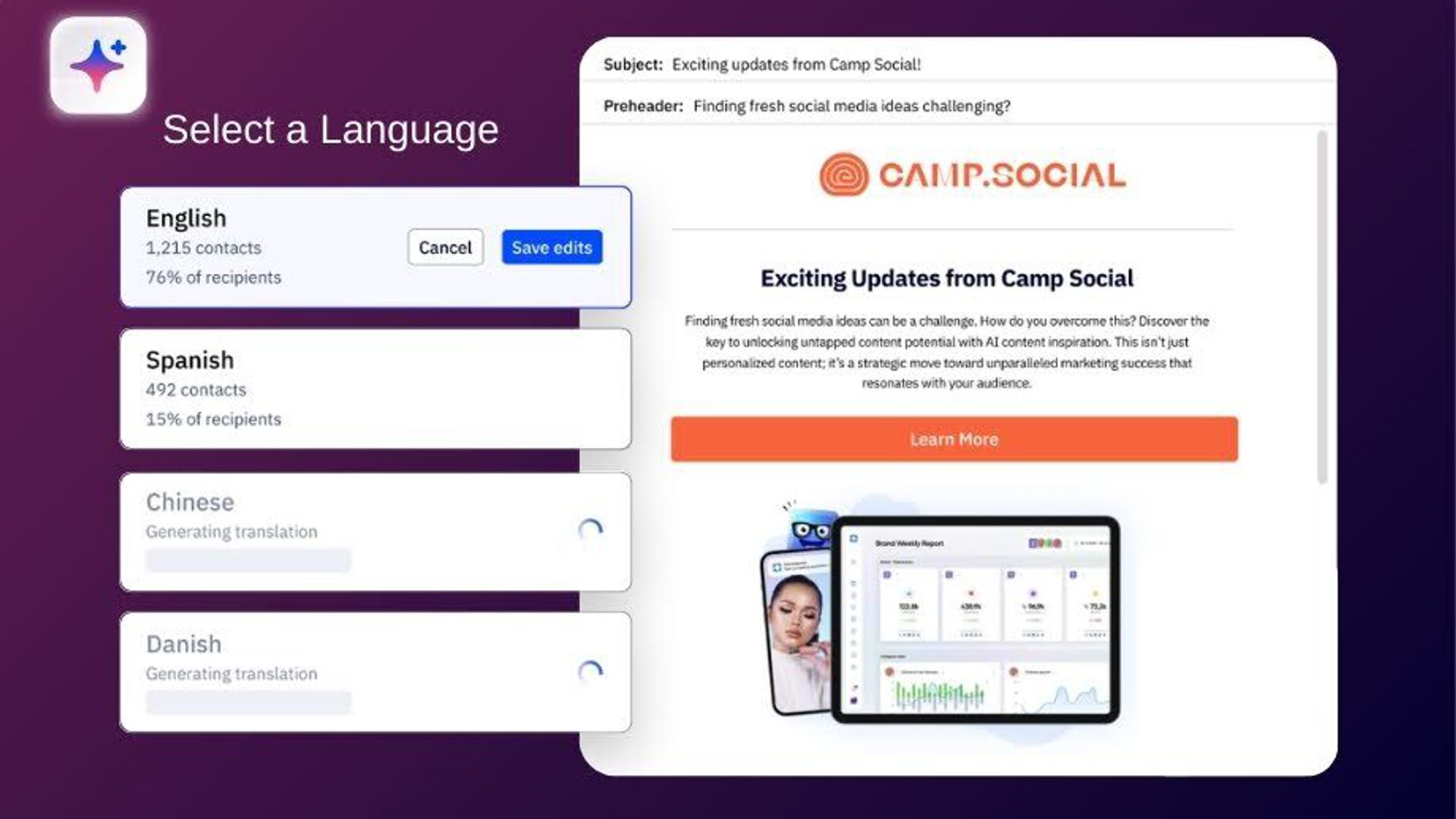
Language plays a critical role in consumer purchasing decisions. It is the most fundamental form of personalization. In fact, 76% of online shoppers prefer to buy products when campaigns are in their native language. If your business is eyeing international growth, multilingual email marketing is non-negotiable.
Imagine launching your next campaign across oceans, time zones, and inboxes—but half your audience can’t read it.
Awkward.
More importantly, effort has been wasted and customers feel excluded or undervalued. Seeing your own language in marketing materials instills a sense of connection and trust. Without it, an email can feel like a tourist in your inbox.
Many teams start with good intentions, only to find themselves buckling under the pressures of translation and campaign duplication. This guide will show you how to build multilingual email marketing that scales sustainably.
What is multilingual email marketing?
Multilingual email marketing is the practice of delivering email campaigns and automations in different languages based on each subscriber's language preference. Rather than blasting the same message to a global list, teams tailor the language of their emails so every recipient reads content that feels native.
Technology is shrinking the world, and brands can reach customers anywhere. More and more businesses are looking beyond borders to grow. The first instinct is usually to approach new markets in a language that’s familiar—usually the one the company speaks itself. It’s simple, convenient, and feels safe.
But as your reach expands, there come critical moments when sticking to a single language is no longer enough. Multilingual email marketing becomes a business necessity at specific inflection points. Consider three common scenarios:
- Operating in a multilingual country: Even within a single national market, customers might not all communicate in the same language.
- Targeting multi-region markets: As businesses expand into nearby regions, language differences often follow geographic boundaries.
- Expanding globally: Once growth extends across continents, language becomes a core operational factor.
Email is especially sensitive to language because it’s a direct, personal channel.
Unlike a website—where visitors can click away or rely on browser translation—an email arrives with an immediate expectation of relevance. If the language doesn’t match the recipient’s preference, it’s often dismissed before it’s even read.
Translation vs. localization in marketing
Translation and localization are related but distinct practices. Both are essential for global marketing that resonates.
Translation is the foundation of multilingual email marketing. It ensures messages are understood by converting text from one language to another while preserving the original meaning.
For most email campaigns—promotional announcements, product updates, automated workflows—accurate translation is a sufficient minimum to reach global audiences.
Localization ensures messages resonate culturally and contextually. It adapts content to reflect local customs, cultural references, currency, date formats, imagery, and tone. Localization takes into account how a message will be received in a specific cultural context.
Localization is essential for high-impact campaigns, regulated content (like financial or healthcare communications), and culturally sensitive messaging where nuance matters.
These practices work best when used together strategically. Translation can be used to kick off multilingual email marketing quickly, but localized marketing should be layered in for cultural resonance.
Why multilingual marketing programs often break as they grow
Multilingual email marketing programs often start simply: build one campaign, duplicate it with translated copy, and hit send. It works—at first. But as you add more languages, campaigns, and automation workflows, the cracks show quickly.
- Campaign duplication multiplies the workload: Every new language means another version to maintain. A simple update—fixing a link, changing a CTA, adjusting timing—suddenly has to be repeated across every copy. What should take minutes turns into hours.
- Manual translation workflows create bottlenecks: Teams export email copy to spreadsheets or translation tools, wait for turnarounds, then manually paste translated text back into templates. Each handoff slows the process and increases the risk of errors.
- Quality control becomes harder to manage: With separate campaigns for every language, consistency is difficult to track. More versions mean more opportunities for mistakes—and more chances for them to slip through during review.
- Reporting becomes fragmented: Performance data ends up scattered across multiple campaigns, making it difficult to see the full picture. Teams spend valuable time aggregating data instead of acting on insights.
The root cause of all these problems is structural. If every language requires its own campaign instance, your team will end up managing a web of duplicated assets. Even small changes trigger hours of repetitive work. Let’s have a look at how to solve that.
It doesn’t have to be this complicated. Let’s look at a better way to scale.
How to build a scalable model for multilingual email marketing
The smartest way to tackle multilingual email marketing is at the system level. A single campaign structure should be able to serve multiple languages without duplicating content, automations, or assets.
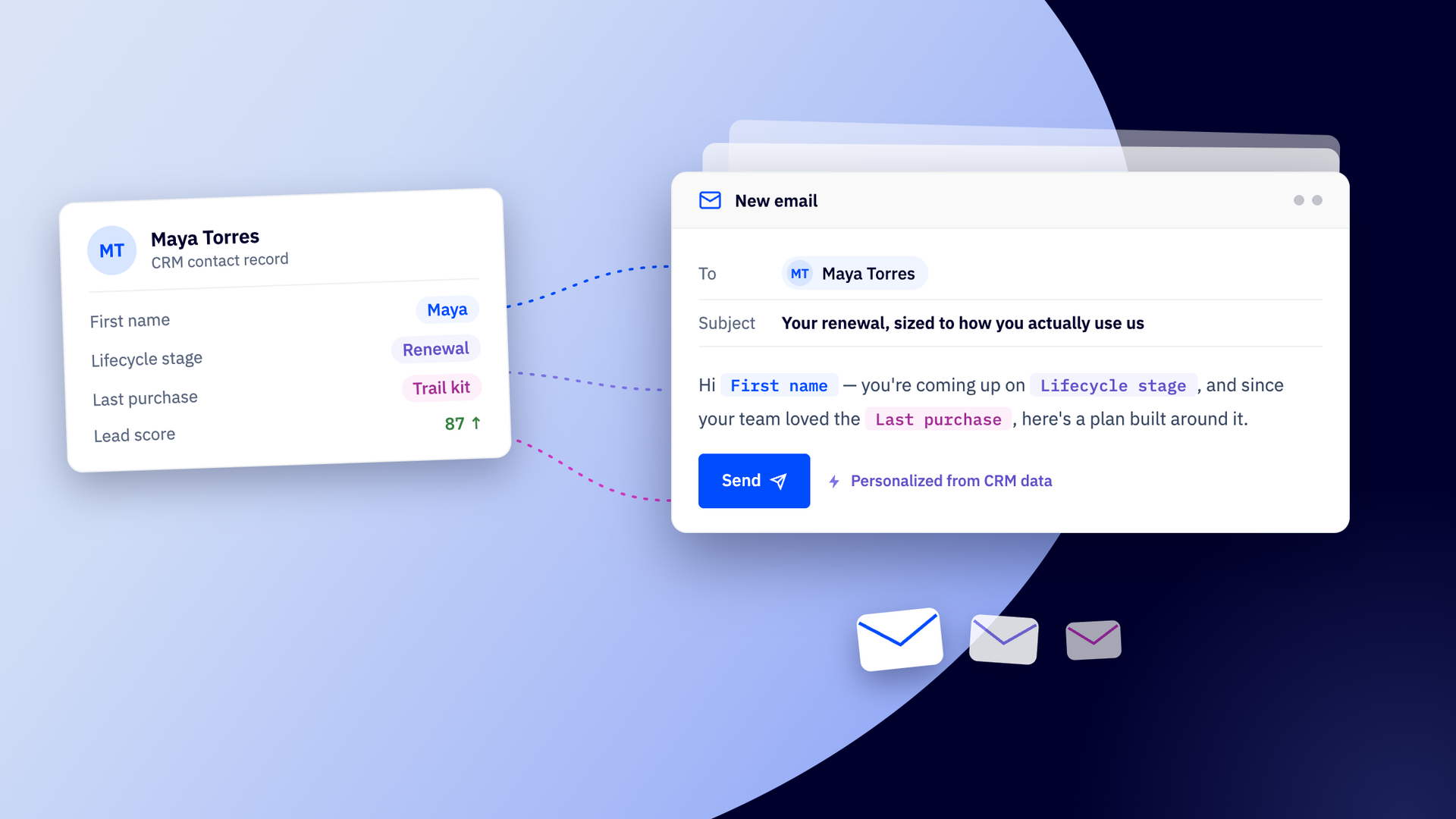
ActiveCampaign’s AI-powered email marketing software can handle the whole process, so your multilingual strategy runs like a well-oiled machine. Smart forms capture preferences in the CRM, AI Translations manage the language, and advanced automations handle complex campaign distribution flawlessly.
1. Capture and respect language preferences
A multilingual program only works if you reliably know what each subscriber actually wants to receive. When people get emails in the wrong language, it doesn’t just hurt engagement—it signals you’re not listening, which can weaken trust faster than almost any copy mistake.
Start by adding a Preferred Language field to sign-up forms, onboarding flows, or your preference center. This gives subscribers an explicit way to choose their language instead of forcing your team to infer it from location, browser settings, or assumptions. In ActiveCampaign’s forms editor, you can simply drag and drop the "Preferred Language" field onto your form to give subscribers the power to select the language they actually want to read.
Once that preference is stored on the contact record, you can use it everywhere: targeting, personalization, and reporting.
From there, your workflow should treat language as a delivery decision, not a separate campaign. With AI Translations enabled, the system reads each contact’s language preference and automatically generates the appropriate version of your email. With support for 75+ languages, you can reach almost every global market without juggling multiple lists.
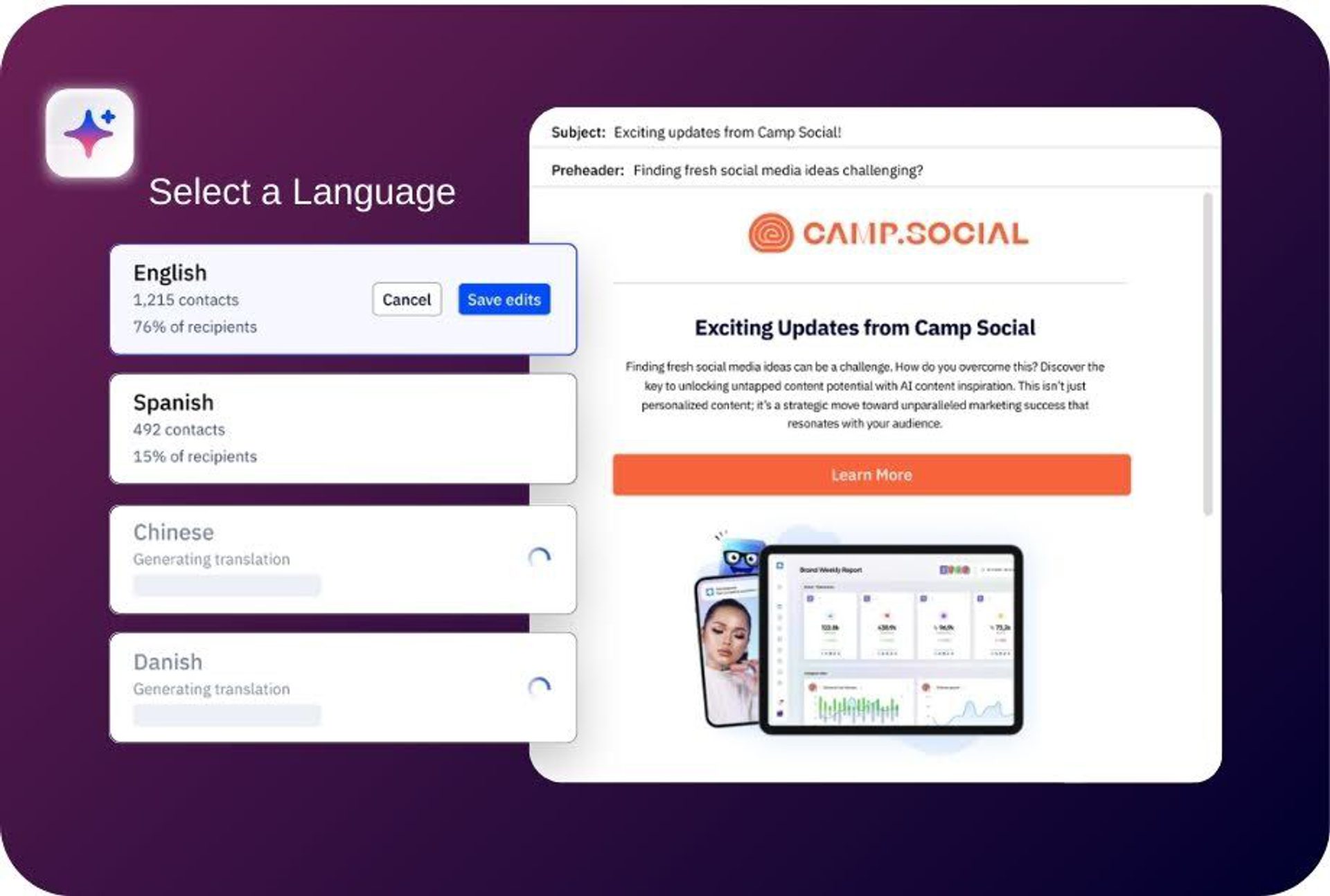
When each send is routed by the subscriber’s stated preference, you can protect the customer experience and avoid messy list splits that make it hard to manage frequency, exclusions, and suppression rules.
2. Design a single source of truth
Creating separate campaigns for each language quickly becomes a logistical nightmare.
Instead, build one canonical campaign: one structure, one automation logic, one set of goals and decision rules. The AI Campaign Builder can design one campaign template for you and generate language variants from that core. It will also layer in dynamic content, and let automations handle everything—from sending the right version to the right contact to adjusting timing based on engagement. This keeps the campaign’s intent consistent across languages.
Segment only when you truly need a different strategy—like market-specific pricing, compliance requirements, or region-exclusive offers. Otherwise, keep segmentation minimal and let the language preference determine which version a person receives.
3. Start small and expand strategically
Trying to support every language from day one usually creates two problems: uneven quality and stalled execution. A phased rollout keeps momentum high while giving your team room to learn what “good” looks like in each market.
Start with languages that best reflect your current audience and growth priorities. If 70% of your non-English subscribers speak Spanish, begin there.
Launch your core lifecycle campaigns first (welcome, onboarding, key promos) and review translated versions for tone, formality, and culturally sensitive phrasing before sending. Then evaluate performance by language.
View reporting for your multilingual emails, including breakdowns of how each translated version performed in the dashboard. Or simply ask Active Intelligence for smart insights about how the campaign performed to identify which markets respond best, which subject lines drive opens in different languages, and where content adjustments might improve results.
Because ActiveCampaign handles translation and reporting in a unified system, teams can iterate and expand without overhauling workflows or managing multiple campaign versions. Adding a new language becomes a configuration change, not a structural redesign.
You can be fluent in every market with ActiveCampaign
Multilingual email is more than a “growth tactic.” It’s a basic expectation once your audience crosses borders. If someone signs up, buys, or engages in one language and you keep showing up in another, the message they receive is simple: this brand isn’t for me.
Translation also does more than improve comprehension. It protects the consistency of your customer experience. The same product benefits, policies, and onboarding steps land the way you intended—so customers aren’t filling in the gaps or relying on assumptions.
Multilingual email marketing helps customers feel like your messages were truly written for them. When they arrive in the language a customer actually uses day-to-day, you’ll see:
- Less friction and faster decisions because customers don’t have to translate mentally or second-guess what you mean.
- Fewer mistakes and fewer support tickets with onboarding steps, shipping updates, account notices, and policy changes that are easier to follow.
- Higher trust at the moments that matter because security notices, renewal reminders, compliance messages, and payment issues carry more weight when they’re unmistakable.
- A more respectful relationship with your contacts. Language signals recognition. It tells customers you expect them to be here—and that they don’t need to adapt to you to get value.
ActiveCampaign helps to serve your customers more clearly, more respectfully, and with fewer points of friction. It handles the language side, so you can focus on the real message.
- Boost performance with minimal lift by matching messages to what customers actually want to read.
- Launch multilingual emails in less time without rebuilding campaigns for every language.
- Scale global campaigns with quality and ease while keeping your workflows clean and consistent.
- Measure results across every translated version so you know which markets are growing and why.
Cross borders, not wires. Sign up now to launch multilingual email marketing in ActiveCampaign.
FAQs
How do I start a multilingual email marketing program?
Start your multilingual email marketing program with a clear strategy: identify your target markets, prioritize the languages that matter most, and plan campaigns that scale without duplication. Use a platform that supports AI-powered translation and automation, like ActiveCampaign, so a single campaign can reach every subscriber in their preferred language.
How do I decide which languages to prioritize for my multilingual email campaigns?
Analyze your subscriber data to identify and prioritize languages relevant to where your customers are located. Start with languages that represent your largest customer segments or highest-growth markets. Review engagement metrics after launching to validate assumptions and expand strategically based on performance rather than trying to support every language at once.
How can I capture language preferences from my subscribers?
Capture language preferences by adding a language preference field to your sign-up forms, onboarding flow, or preference centers where subscribers can explicitly select their preferred language. You can also use browser language detection as a fallback, though explicit opt-in provides more accurate data and ensures subscribers receive content in the language they actually want.