GDPR has set a new standard for data privacy in Europe. It demands transparency, explicit consent, and strong data protection from any business handling EU customer data.
Customers are also paying closer attention to how brands use their data. Many marketers now recognize the opportunity to use what previously felt like a legal hurdle to their advantage. Companies that respect privacy see fewer spam complaints, better engagement, and ultimately higher deliverability.
But collecting the volume of data you need for highly personalized messages without crossing compliance lines is a delicate balancing act. In this guide, we’ll show you how ActiveCampaign makes GDPR compliance straightforward so you can focus on growth without risking user trust.
GDPR essentials for marketers
Legal Disclaimer: The information in this guide does not constitute legal advice. This is for informational purposes only, and we strongly encourage you to seek independent legal counsel to understand how your organization needs to comply with the GDPR.
GDPR (General Data Protection Regulation) is a European law that governs how organizations collect, process, and store personal data. It applies to any business handling data from EU residents, regardless of where the business is based.
There are 7 fundamental privacy principles behind GDPR:
- Lawfulness, fairness, and transparency: Personal data must be collected and processed legally, used in ways people would reasonably expect, and communicated openly to individuals.
- Purpose limitation: Data can only be collected for specific, explicit purposes and cannot be reused for unrelated activities without additional consent.
- Data minimization: Only the minimum amount of personal data necessary to achieve the stated purpose should be collected and processed.
- Accuracy: Personal data must be kept accurate and up-to-date, with incorrect information corrected or deleted promptly.
- Storage limitation: Data should only be retained for as long as it is needed for the original purpose, and securely deleted or anonymized afterward.
- Integrity and confidentiality: Personal data must be protected through appropriate security measures to prevent unauthorized access, loss, or damage.
- Accountability: Organizations must not only follow GDPR principles but also be able to demonstrate compliance through documentation, processes, and oversight.
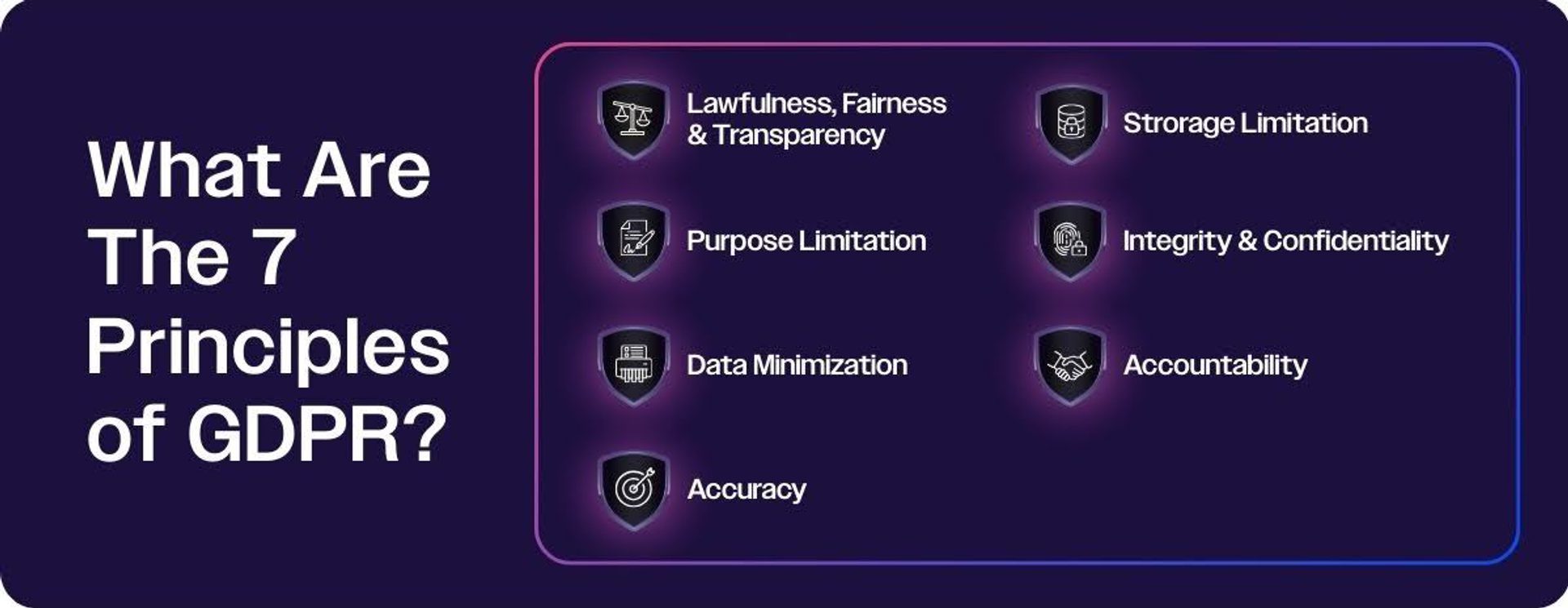
The 7 core principles of GDPR
In practical terms, GDPR affects how you run email campaigns and manage CRM records. For example, you can't send marketing emails to someone who hasn't opted in, and you need to be able to remove or export a contact's data at their request.
Some common GDPR compliance pitfalls that marketers run into include:
- Failing to document consent.
- Failing to offer clear and granular preference options, resulting in overly broad or ambiguous consent.
- Sending promotional content to contacts who have only consented to receive transactional messages.
- Storing unnecessary data (e.g., asking for birthdays when that information is not necessary for the stated purpose).
- Mixing consent types by treating a newsletter opt-in as consent for all updates.
- Failing to refresh outdated consent, especially for long-inactive contacts.
- Using behavioral tracking tools, cookies, or pixels without explicit consent.
- Not honoring data deletion or access requests promptly.
- Allowing too many internal team members access to personal data increasing the risk of unauthorized processing.
These mistakes not only erode trust but can lead to fines or lost customers, especially when repeated errors are made, and when customer concerns are not addressed in a timely manner.
How ActiveCampaign supports GDPR-compliant marketing
GDPR can seem overwhelming, but ActiveCampaign translates those principles into simple features that can be built into your everyday campaigns and automated for convenience. Instead of worrying about legal fine print, marketers can operate confidently while ActiveCampaign quietly handles compliance workflows in the background.
Let’s explore the GDPR-friendly safeguards you can take advantage of with ActiveCampaign.
Consent-driven data practices
Consent is the foundation of compliant marketing. GDPR requires that all personal data be collected lawfully and transparently. ActiveCampaign makes it easy to capture explicit consent and prove that every contact has opted in with full clarity.
The following best practices will help you to capture only the data you need, with full consent, and prove your compliance:
- Use no-code, easily customizable lead forms to offer real choice. Add explicit consent checkboxes that are not pre-checked and clearly separated from other preferences (e.g. “Yes, email me updates” vs. “Yes, email me about offers”).
- Keep double opt-in enabled to demonstrate unambiguous consent. ActiveCampaign enables double opt-in by default. Confirmation emails demonstrate to regulators (and customers) that the person actively verified their intent to subscribe. This also reduces accidental entries, bot sign-ups, or malicious submissions.
- Configure forms to send consent records directly to you. Add an “Email Results” action to your consent form. You’ll receive notifications of all consent form submissions, and can use these as an audit-ready record.
- Obtain consent for site tracking before activating. If you use Site Tracking to capture user behavior, treat page visits and IP addresses as personal data. ActiveCampaign’s tracking code is disabled by default and activates only after consent is given. Add a clear tracking-consent banner and log acceptance via cookies or script to demonstrate compliance.
- Store consent data automatically with custom fields and tags. Set up a simple automation to add a tag when someone opts in, including details on how and when consent was granted (e.g., “Form: Webinar – 12/02/2025”).
GDPR also requires that people must be able to easily adjust or withdraw consent at any time. ActiveCampaign supports the “right to be forgotten” and other data minimization principles at the heart of GDPR.
To keep your consent records up-to-date:
- Create preference centers that support ongoing consent by letting contacts update what they want to receive and how often, whenever they like.
- Automate data minimization with list cleanup tools that identify unengaged contacts and remove inactive or non-consenting contacts automatically.
These tools limit stored data to what is accurate and necessary, keeping your database lean and compliant. As a bonus, strong consent practices naturally improve deliverability and engagement by ensuring you’re only contacting people who clearly want to hear from you.
Advanced segmentation without risk
Segmentation is a powerful tool, but under GDPR, you can only use data for the purposes a contact agreed to. ActiveCampaign’s AI Segmentation engine ensures your outreach always respects those boundaries, protecting you from unlawful processing.
Create compliant segments by filtering based on consent status. This will prevent you from accidentally messaging people who haven’t opted in or who have withdrawn consent.
Granular segments that use AND/OR logic can tie directly to multiple pieces of data, like communication preferences, or location, as well as engagement records. Use these to create outreach that is based on specific information and aligns exactly with what contacts have agreed to see.
You can also combine segmentation with conditional content to stay compliant in more complex consent scenarios. For example, you might send a single product-update email to all of your contacts who have given consent to receive these, but use a conditional content block to display a relevant promotional offer only to contacts who have explicitly opted in to promotions. This way, you can add perks without duplicating campaigns, or crossing consent boundaries.
Automating this logic will reduce human error so every campaign only reaches contacts with a lawful basis for processing their data. Segments are an excellent resource for precision marketing that not only performs well but stays firmly within GDPR boundaries.
Robust security and privacy controls
GDPR raises the bar on how customer data must be handled. ActiveCampaign’s privacy and security infrastructure helps meet that bar, even for companies storing data outside the EU. Platform-level protections align with strict expectations for safeguarding personal data:
- Encryption protects data at rest and in transit.
- Data is securely hosted in world-class data centers.
- DPAs are available to support GDPR processor obligations.
- Role-based permissions restrict sensitive data access to essential stakeholders only.
Even if your customer data is stored in ActiveCampaign’s US servers, ActiveCampaign complies with the EU-US Data Privacy Framework to offer a compliant mechanism for lawful international transfers. This means you can run global operations without compromising GDPR obligations.
How GDPR‑conscious marketing can still deliver strong ROI
At first glance, strict privacy rules might seem like a barrier to growth. But respecting consent and handling data responsibly can actually improve engagement and drive stronger results. When contacts know their information is handled respectfully, they’re more likely to engage, open emails, click links, and convert. Privacy builds trust, and trust drives action.
This is especially evident in data‑sensitive industries like healthcare, financial services, and legal.
Optimale, a UK‑based men’s health clinic, chose ActiveCampaign because privacy and data integrity were non‑negotiable. With extremely sensitive patient data at risk, missteps could put the organization in real trouble. ActiveCampaign made privacy operationally seamless.
How they made it work:
- Integrated ActiveCampaign with Salesforce to sync opt-outs and keep patient contact data up-to-date. This integration was particularly important. It was vital for Optimale to ensure all patients were treated appropriately, and that patient records were accurately synced.
“The Salesforce integration just works. Since I've set it up, I haven't had to do anything. That's really what you want from an integration—zero admin.” - David Kennett, Co-Founder, Optimale - Built segmentation and automation based on patient responses to eligibility questions, ensuring every outreach respected explicit consent.
- Delivered personalized follow-up across email, SMS, web, and phone, giving patients control over exactly how they engaged and ensuring communications were relevant, timely, and consent-aware.
“Nowadays, it's about providing patients with access to information through their preferred channel," says David. "Using ActiveCampaign means we can offer broader options for communicating with us, not just through email but web, phone, and SMS.”
By building marketing programs around clear consent and privacy-first practices, Optimale did more than check a regulatory box. They created communications that were relevant, respectful, and welcomed by their audience.
This led to impressive results:
- 600% ROI on ActiveCampaign.
- 26% average open rate, showing strong engagement with privacy-conscious campaigns.
When privacy and personalization work together, compliance becomes a competitive advantage, not a constraint.
Drive growth with trust and compliance
A privacy-first approach may well keep you out of legal trouble, but it will also build a foundation for better marketing. When customers trust you with their data, they're more likely to engage, respond, and stick around.
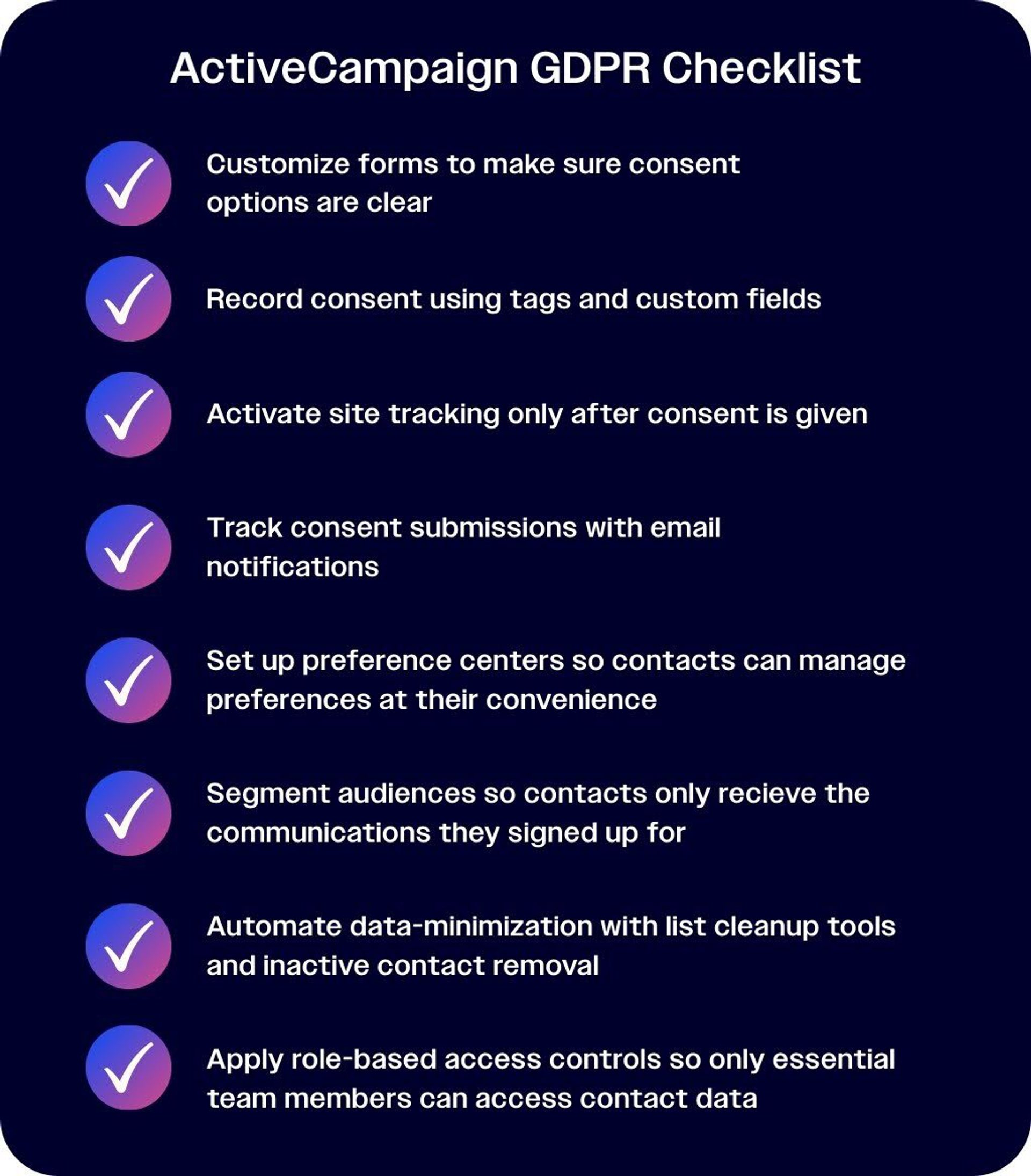
Use an easy checklist to set up your GDPR basics in ActiveCampaign.
Sign up for a free trial with ActiveCampaign to start building GDPR-compliant marketing campaigns that respect consent and convert.
ActiveCampaign is committed to GDPR-compliant support. Take a look at our GDPR updates page to see the latest information.
GDPR FAQs
Does using ActiveCampaign mean my business is automatically GDPR-compliant?
ActiveCampaign provides tools that support compliance, but businesses must implement proper processes and use the features correctly to meet GDPR obligations.
Can I send GDPR-compliant communications to customers in the EU if my customer data is stored in ActiveCampaign’s US data centers?
Yes, ActiveCampaign complies with the EU-US Data Privacy Framework, allowing for secure, compliant data transfers from the EU to the U.S. without needing other complex mechanisms like Standard Contractual Clauses (SCCs).
How does ActiveCampaign store and prove consent for GDPR audits?
ActiveCampaign automatically stores GDPR consent data using custom fields, tags, and automation logs. Each record can show when, how, and why a contact gave consent, creating an audit-ready trail to demonstrate compliance.
Can I migrate GDPR consent history from Mailchimp, HubSpot, or Klaviyo to ActiveCampaign?
Yes, ActiveCampaign allows you to import contacts along with tags or custom fields that capture consent history, ensuring your GDPR records stay accurate and intact during migration.