Don't go asking Bob Pearson for his "perfect prompt" for writing better marketing copy or generating campaign ideas.
"I'm not a huge prompt engineer advocate," Pearson explains. "For a simple reason. I think we're making it too complicated."
Pearson, based in Austin, TX, built Dell's first global social media organization and is a recognized expert in communications, marketing, and digital innovation, currently serving as an adjunct professor at The University of Texas McCombs School of Business, where he teaches courses on new digital media models, persuasive selling, and generative AI.
While most marketers obsess over prompt libraries and debate perfect phrasing, Pearson's focused elsewhere. He's building systems that let autonomous marketing tools amplify creativity instead of replacing it and helping marketers rethink their workflows, or approach to the job.
He's building systems that let autonomous marketing tools amplify creativity instead of replacing it.
Prompt engineering is a tactic. Strategic systems thinking is a competitive advantage. One gives you marginally better outputs. The other transforms how your team competes.
Getting started comes down to three fundamentals: building your own intelligence, asking better questions, and making AI part of regular workflows. But understanding why these matter starts with seeing creativity differently. It’s all part of how not to be average or mediocre using AI.
Prompt engineering is a tactic. Strategic systems thinking is a competitive advantage.
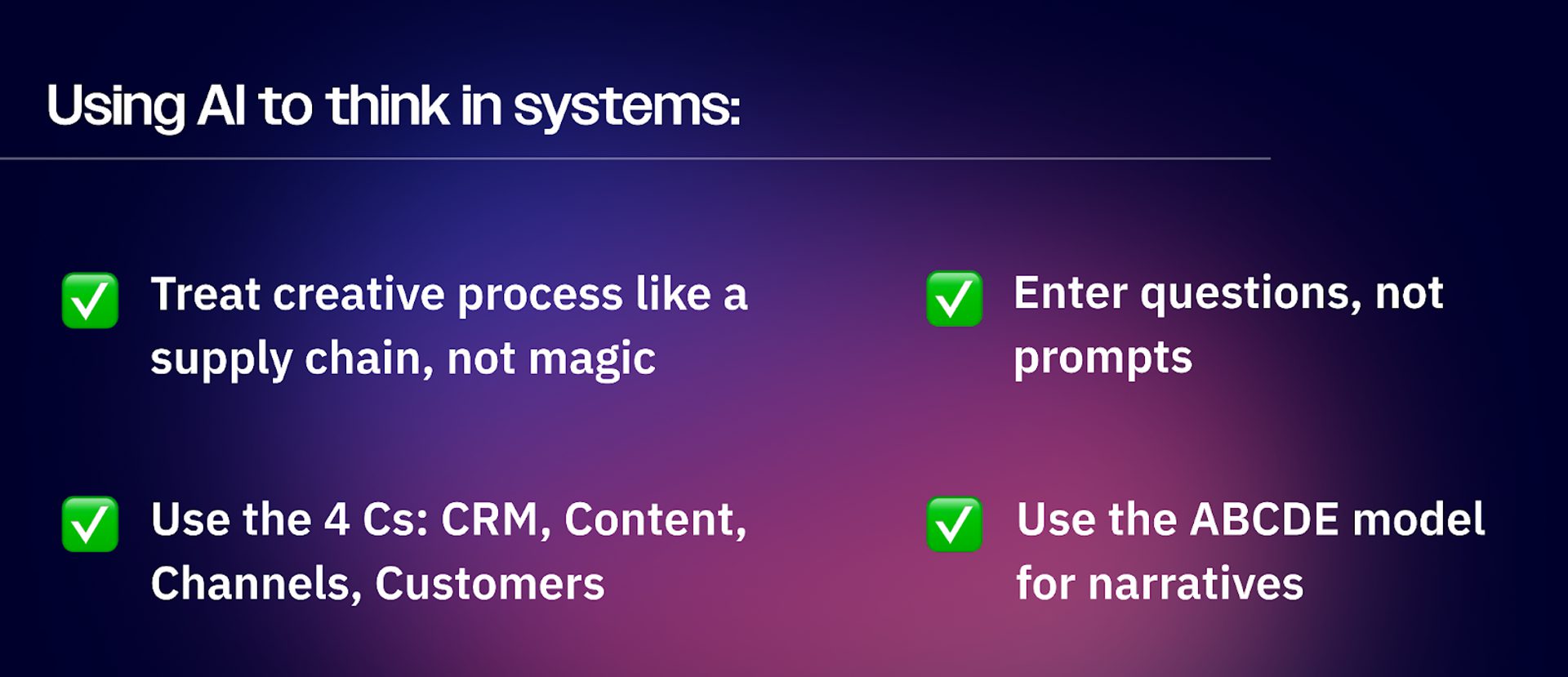
Treat creative process like a supply chain, not magic
Pearson frames creativity the way supply chain experts think about manufacturing. Raw materials (ideas, research, customer insights) move through production (briefs, design, copywriting) to distribution (campaigns, channels, personalization). AI doesn't replace any step. It accelerates every step and expands your options at each stage.
"We may get more ideas up front, more taglines up front, more supporting messages up front," Pearson points out. "Which then becomes fodder for us to do a better brief. As we're doing that brief and thinking of design, we may be fooling around with a much wider range of colors and backgrounds."
You get 50 rough drafts instead of five. Your job isn't to use all 50. Your job is recognizing which three are worth refining, because you understand your audience and what will actually move people.
The human does what only humans can do: make the judgment call that separates signal from noise.
Use questions, not prompts
Pearson distinguishes between prompt engineering and strategic questioning. Typing "write me a blog post about marketing trends" is prompting (albeit way too basic). Asking "What factors are driving recent changes in market share (innovation, pricing, distribution, regulations, new competitors, consumer behaviors? Please list the top three questions in each area, and what would make them care about this topic right now?" is strategic questioning where the questions drive the insights you receive.
Pearson uses two frameworks for building autonomous marketing systems: The "4 Cs" for building an AI-driven marketing stack and the ABCDE model for executing campaigns. Both force you to ask strategic questions before you ever type a prompt.
When building your stack, use the 4 Cs: CRM, Content, Channels, Customers
Most marketers hear "AI-driven marketing stack" and think about software integrations. His “4 Cs framework” is designed for professionals, students, and organizations seeking to develop the core competencies needed to thrive in modern work and educational environments, specifically communications, collaboration, critical thinking, and creativity. Think of them as high-level meta competencies.
- CRM: Can you predict which leads will convert before your sales team wastes time on them? Can you personalize outreach based on behavior patterns you'd never spot manually?
- Content: Can you measure whether your brand voice stays consistent across channels, or are you just hoping it does? Can you see how customers adjust to your messaging in real-time and adapt before the campaign ends?
- Channels: Are you investing in channels based on performance data or based on where you've always invested? Can you kill underperforming channels mid-campaign and redirect budget?
- Customers: Do you know which contact data is accurate before you build campaigns around it? Can you develop outreach that feels personal because it draws from actual intelligence about each prospect?
Pearson gets answers to these questions with his AI tech stack, and he sees each as having a different personality or job title, in essence giving him a “team” to support his work:
- ChatGPT is his smart assistant, and “accelerates how I create or iterate on ideas.”
- Perplexity is his head of market research. He gives it clear direction and it provides citation-rich searches and detailed reports.
- Pi is his social media director. He says it’s “conversational and reflective, like one of my friends commenting on the world.”
- Claude is what he turns to for longer analytical work, and is “best when asked for a document-based analysis.
See how to use Claude with ActiveCampaign with our MCP Claude connector.
Each represents different tools for different jobs, all coordinated by human judgment about which questions matter.
“We want to understand how we become more precise and know if [this process] helps make better decisions/outcomes. That is more important than saving time,” he says. “Then, if we save time, what matters is how we replace that time and if the total value increases. If we save time, then waste what we gained, it is all for naught.”
Use the time you save effectively: Learn how to be a marketing team of one with our guide.
A framework for AI-produced narratives: The ABCDE Model
New technology makes people experiment with every tool. He and Crafting Persuasion co-authors Kip Knight and Ed Tazzia codified the ABCDE model they created for the U.S. State Department as a way to build powerful brand narratives through principles that have worked for decades.
For more on the ABCDE model and other frameworks, see “Crafting Persuasion.”
The ABCDE Model for AI-produced narratives:
Without a process, you are throwing prompts at AI and hoping something useful comes back. With a system built on the 4 Cs and ABCDE model, you are directing autonomous marketing tools to solve specific problems in service of clear goals (e.g., changing behavior, channel adjustment, real-time analysis).
The ABCDE model:
- Audience: Do you have an intelligence platform that reveals exactly who your audience is and which content creators shape their decisions, or are you working from demographic guesses?
- Behavior: Can you measure whether your content actually changes behavior or just generates impressions?
- Content: Are you creating material aligned with the behaviors you want or just producing content because your calendar demands it?
- Delivery: Are you adjusting channels based on performance data or sticking to your original media plan because changing feels hard?
- Evaluation: Can you see what is working in close to real time and shift resources, or are you waiting until the campaign ends to discover you wasted half your budget?
Create your own “Data Ponds” aside from public “Data Lakes”
Everyone has access to the same AI tools. Your competitive advantage comes from what you feed them.
If you’re only using ChatGPT with public training data, you're fishing in the same ocean as your competitors. The insights you get will be similar to theirs.
Build a proprietary data pond by combining internal sales data, customer research, and behavioral patterns. You create insights nobody else can replicate.
"If you actually build an LLM that is specific to your audience," Pearson explains, "using proprietary sales data, proprietary marketing data, all of your research combined with open source, you will build a much more specific LLM that will give you different insights than your competitors."
For example, analysts and AI agents pull from ClinicalTrials.gov, an open-source global database of 450,000 clinical trials combined with proprietary knowledge for each cancer treatment being studied in drug development and used in the marketplace. That intelligence does not exist in any public database. They created their own pond. That is the edge.
Build the infrastructure to handle increased creative capability. Pearson points to Eleven Labs as his favorite example of why AI capability means nothing without systems thinking. The voice localization platform converts English content into any language, cadence, or dialect worldwide with professional quality. You could launch a brand globally in days instead of months.
But then what?
"If you’re only using ChatGPT with public training data, you're fishing in the same ocean as your competitors. The insights you get will be similar to theirs."
What happens next: "What's the pricing by country?" Pearson asks. "How are you going to distribute it by country, package it, produce it, all of that stuff? If the infrastructure can't keep up with the creative, then you can't get there anyway."
This is creativity as a system. You can localize content to 47 markets overnight. But if you haven't built the operational framework to price, distribute, and support those 47 markets, the tool is worthless. Most companies will get AI tools that accelerate creative output. Smart companies build the infrastructure that lets them actually use that output.
What the system looks like in practice
Pearson walks through a healthcare example showing the difference between AI answers and systematic intelligence.
Say you're trying to change how clinical trials work and don’t want to (or can’t) spend the money and time on traditional market research. You need to reach researchers and trial investigators involved in 450,000 clinical trials worldwide. Autonomous marketing tools deliver intelligence in days with the right system.
AI agents pull information from all 450,000 trials and everyone with a research position in specific areas across US health systems. But pulling data isn't intelligence. The system must answer strategic questions: What is the minimal clinical difference that would change practice? What are key biomarkers? Who are the best investigators for this specific treatment? Could we minimize the size of a control arm via a synthetic control? What is the burden on the participant? And much more.
"Basically, do you treat AI like Google, or do you treat AI like you have a PhD student next to you?" Pearson asks.
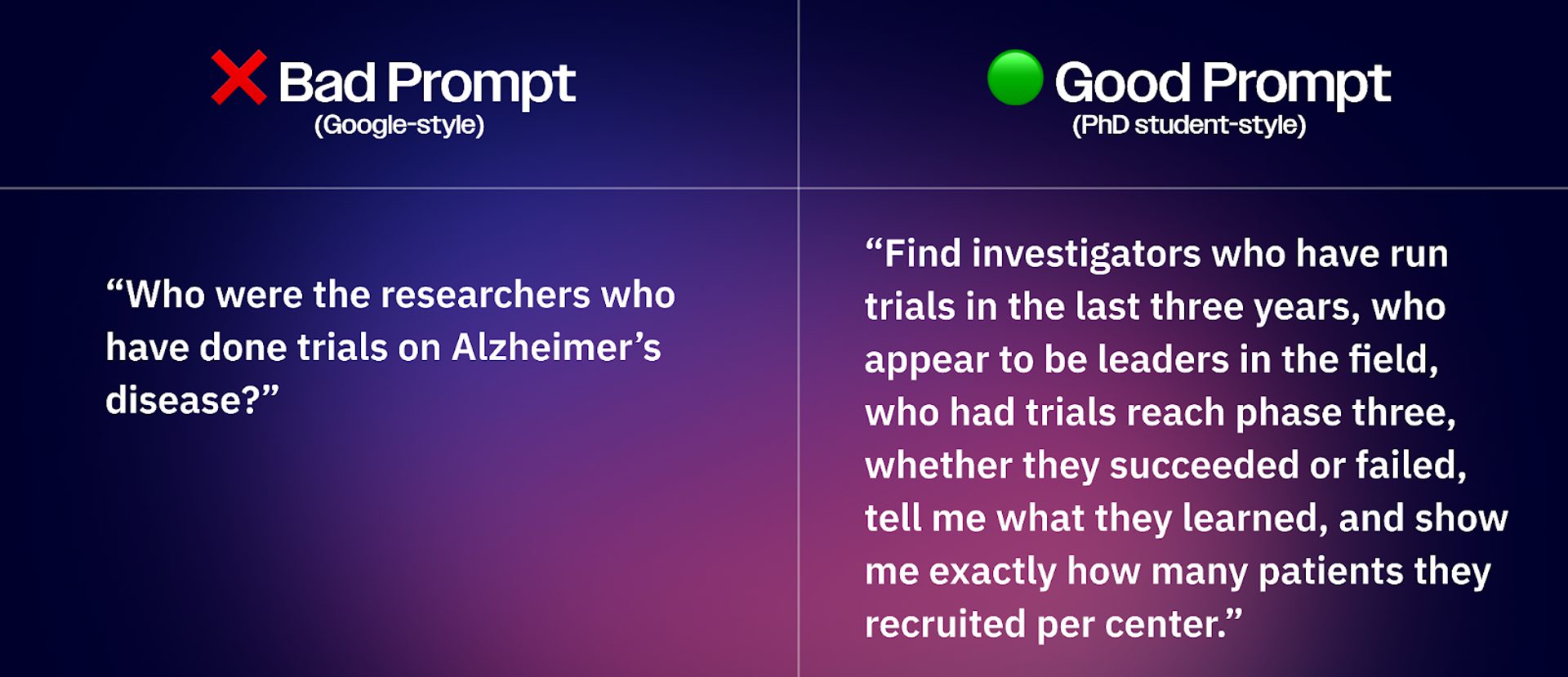
"Do you treat AI like Google, or do you treat AI like you have a PhD student next to you?"
The Google version: Who were the researchers who have done trials on Alzheimer’s disease?
The PhD student version: Find investigators who have run trials in the last three years, who appear to be leaders in the field, who had trials reach phase three, whether they succeeded or failed, tell me what they learned, and show me exactly how many patients they recruited per center.
Check out this episode from The Autonomous Marketer Live: See more prompting best practices for your autonomous marketing workflows.
"With Perplexity, you're going to get a detailed response in like 5-15 minutes," Pearson notes. "You may not have everything you need, but you know what's left. You can now go to your really smart human colleague and say, here's what I got. This is what I need you to fill in to complete our recommendation."
From there, the system keeps building. Which trial investigators should you work with? Which centers are they at? Now you have 25 centers. What content does each center need to market this trial to potential participants? How many languages should the content be in? How do we reach a diverse audience?
"Everyone has an idea and everyone knows," Pearson explains. "But now the system generates content for every investigator with slight tweaks. The health system in Denver versus Cleveland versus Miami, or the one in Spanish or Mandarin."
The breakthrough isn’t speed. It’s making decisions based on intelligence nobody else has because you built a system that asks questions nobody else is asking.
Start here: Three actions that matter
Pearson's advice for getting started avoids the typical "try everything and see what works" approach. Focus on fundamentals that compound.
- Build your intelligence platform. Pick your three most important customer segments. Use AI agents to gather everything publicly available: their challenges, content consumption habits, who influences them, and trends reshaping their industry. When you create content, you're drawing from actual intelligence about how your audience thinks rather than guessing.
- Learn strategic questioning. Stop treating AI like Google. Spend a week forcing yourself to write longer, more specific prompts that include context about your audience, desired outcomes, tone, and constraints. Track which prompts produce useful first drafts versus garbage. Five minutes spent crafting a thoughtful question saves an hour of revision.
- Assign AI workflow roles. Don't create an "AI team" separate from your regular work. Give existing team members AI responsibilities alongside their current roles. Someone becomes the workflow planner. Someone else manages your creative library. When AI work integrates into regular roles, it becomes standard operating procedure.
"The increase in personalization means we need to be more intensely involved to understand if we are aligning. Scaling crappy work has never been easier."
The companies that will win with autonomous marketing are not the ones using AI the most. They are the ones using AI most intentionally, with systems built on principles that have always mattered: understanding your audience, creating with purpose, measuring what matters, and maintaining the judgment that comes from actually caring about the problem you are solving.
Everything else is just faster mediocrity.
Avoid "faster mediocrity": Operationalize your AI strategy
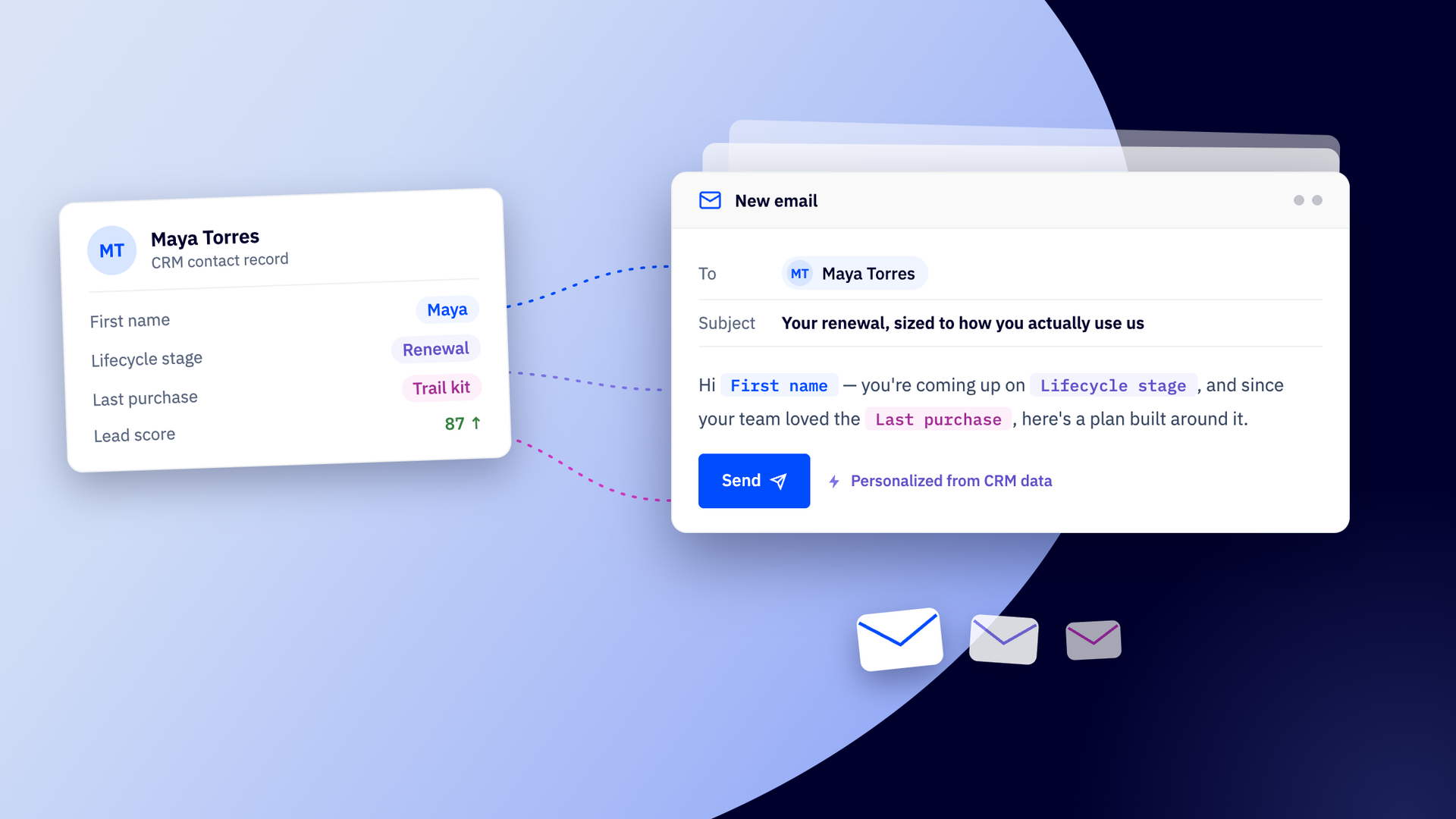
You have the strategic framework (The 4 Cs & ABCDE Model). Now, you need the infrastructure. ActiveCampaign's Active Intelligence connects your proprietary data—your "Data Pond"—to automated customer journeys, ensuring every creative output drives measurable, personalized results.
Start building your system: Try ActiveCampaign free