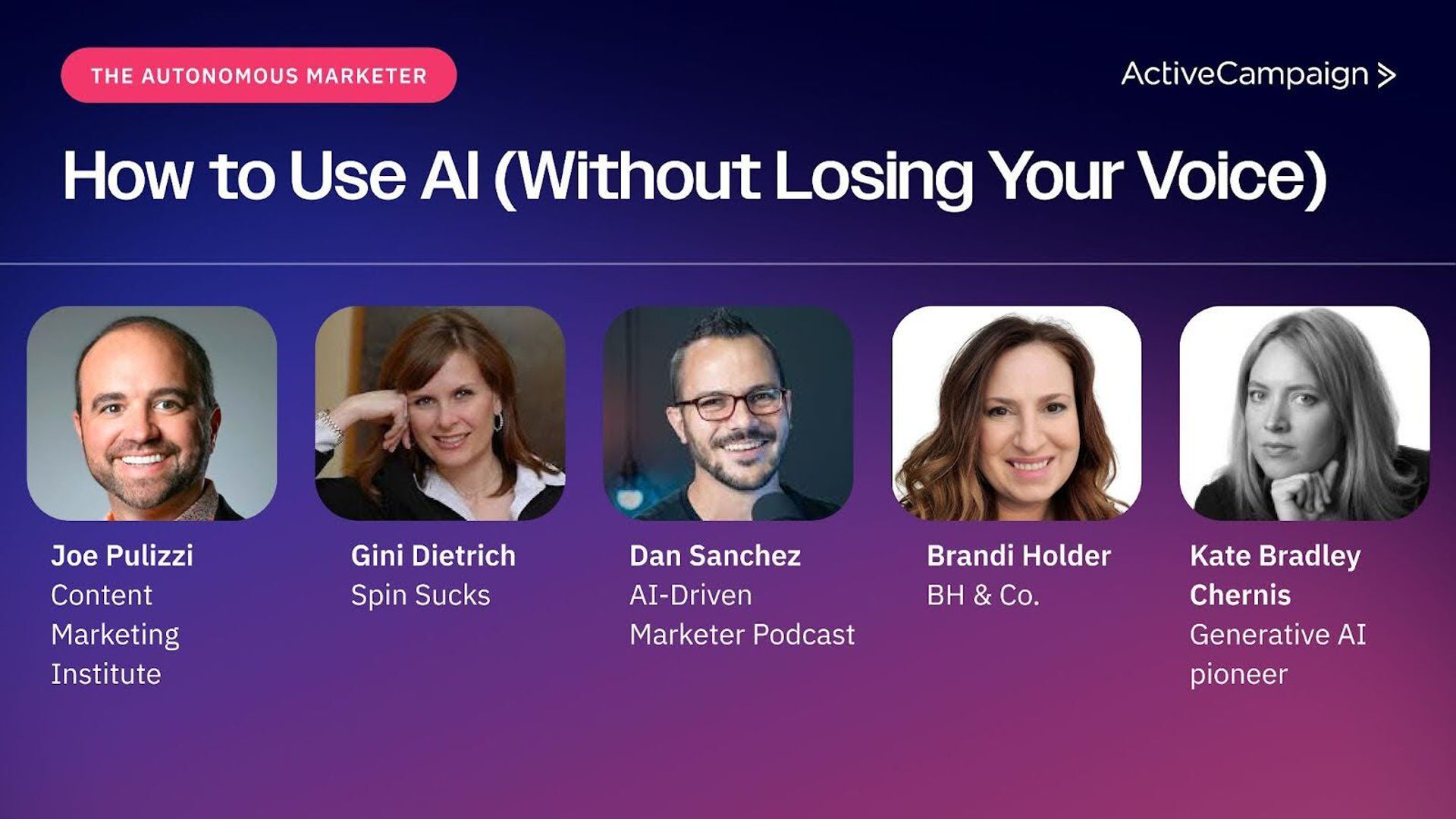
Joe Pulizzi has a confession: He was afraid to use ChatGPT as his editor for his new book, Burn the Playbook, because he was concerned he’d lose his voice.
His solution? He uploaded all his past books into the system, went back and forth with questions about his thinking and style, then let the AI edit.
"It took a bit of back and forth, but the product came out great," says Pulizzi, an entrepreneur, author, and founder of the Content Marketing Institute, best known for his influential books on content marketing and business strategy, including his latest, Burn the Playbook.
The secret wasn't the tool. It was his approach.
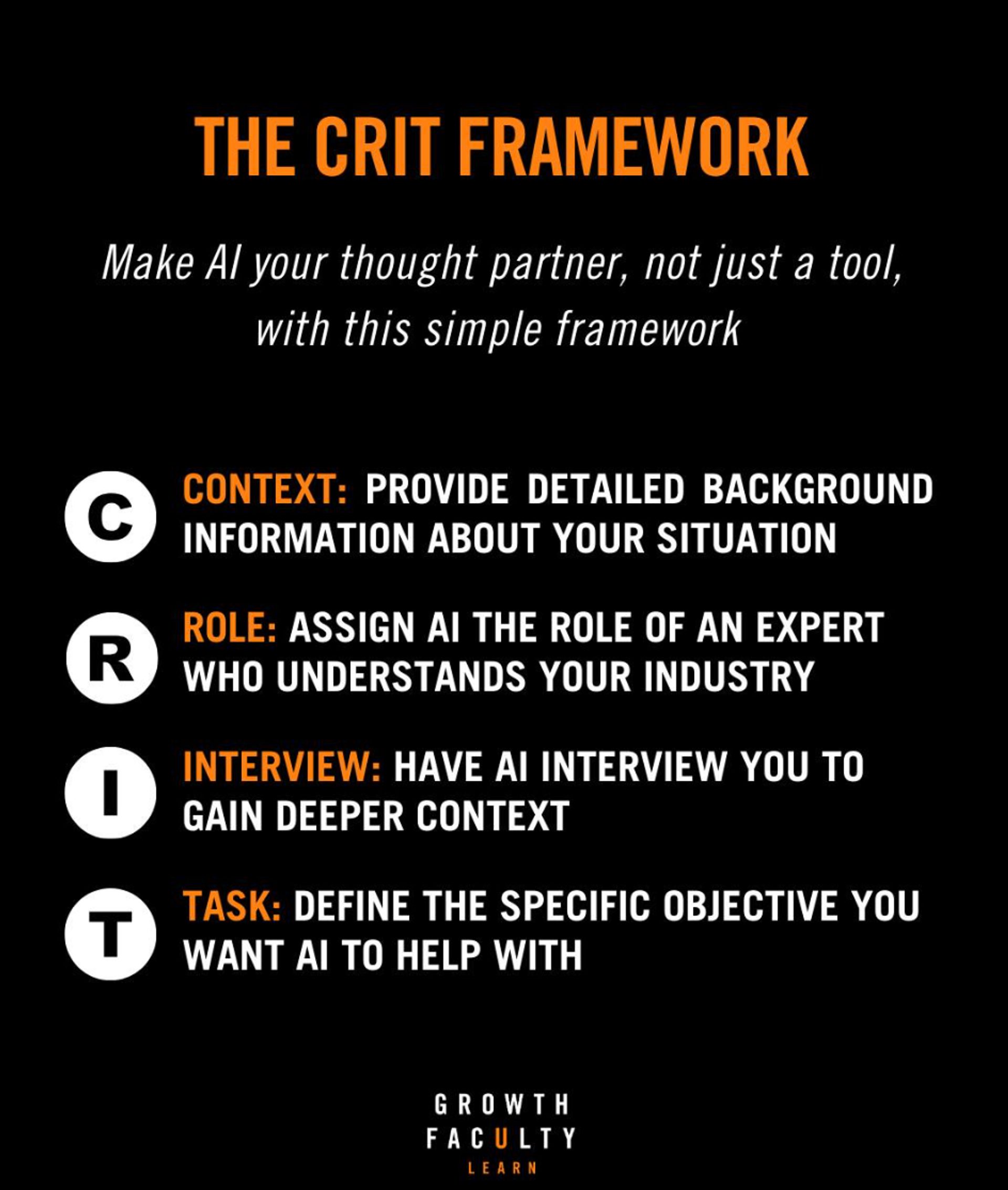
Pulizzi uses what he calls the CRIT Framework: Context, Role, Interview, Task. Instead of barking orders at AI ("Write me 10 ideas"), you…
- Give it your world (Context)
- Tell it who to be (Role)
- Let it ask you clarifying questions (Interview)
- Then issue the assignment (Task)
The Interview step matters most. "Ask me no more than three questions, one at a time, to clarify what I'm trying to achieve," Pulizzi instructs the AI. This forces you to slow down and think while the AI learns what actually matters.
The framework works because it treats AI like a strategic thought partner, not a content machine.
But here's the thing: We talked to five marketing leaders, who it turned out had five very different approaches to ensuring AI is a tool to amplify and not replace their voices.
Pulizzi embraces it as an editor. Dan Sanchez uses it as a creative jam session partner. Kate Bradley Chernis barely touches it unless she built it herself. Gini Dietrich leverages it to kill procrastination. Brandi Holder interrogates her thinking with it, but never lets it generate first.
They all avoid the sameness trap. None of them sounds like they came from the same AI blender. And they're all getting stronger creative results, not weaker ones.
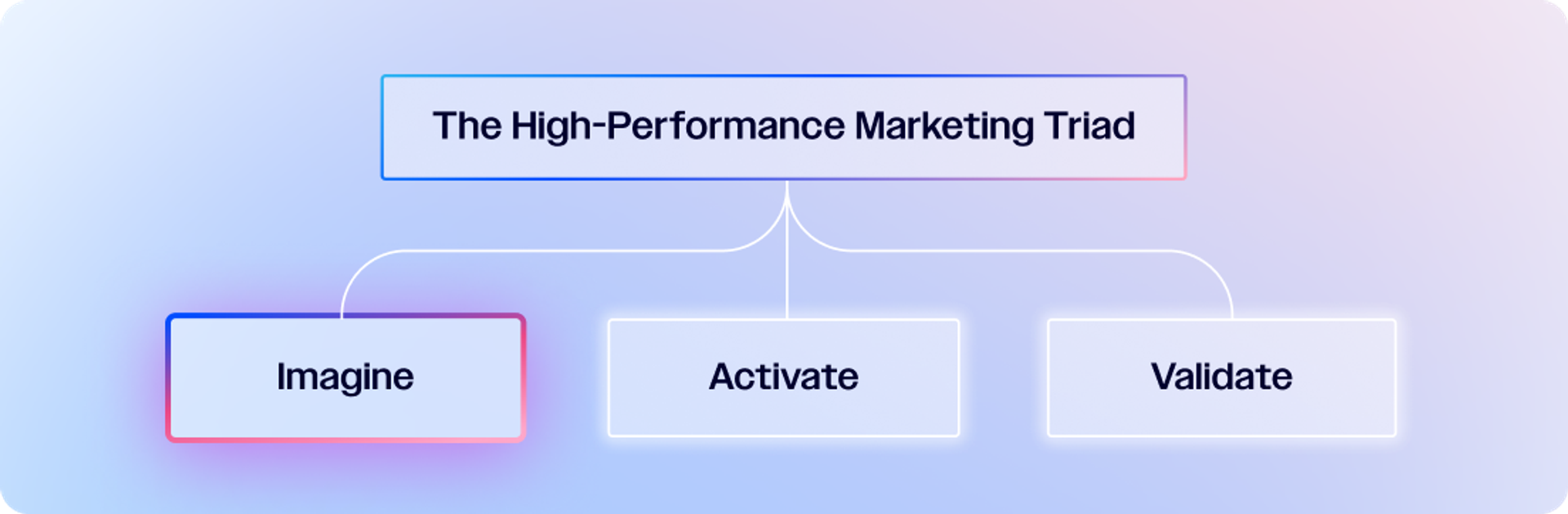
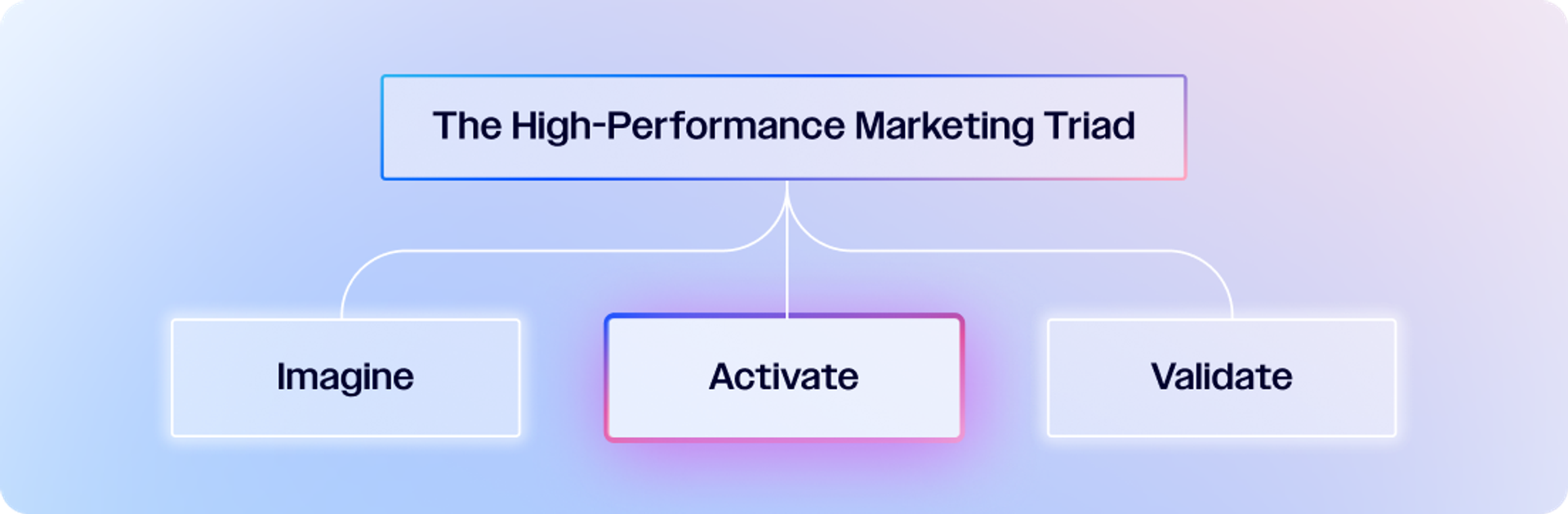
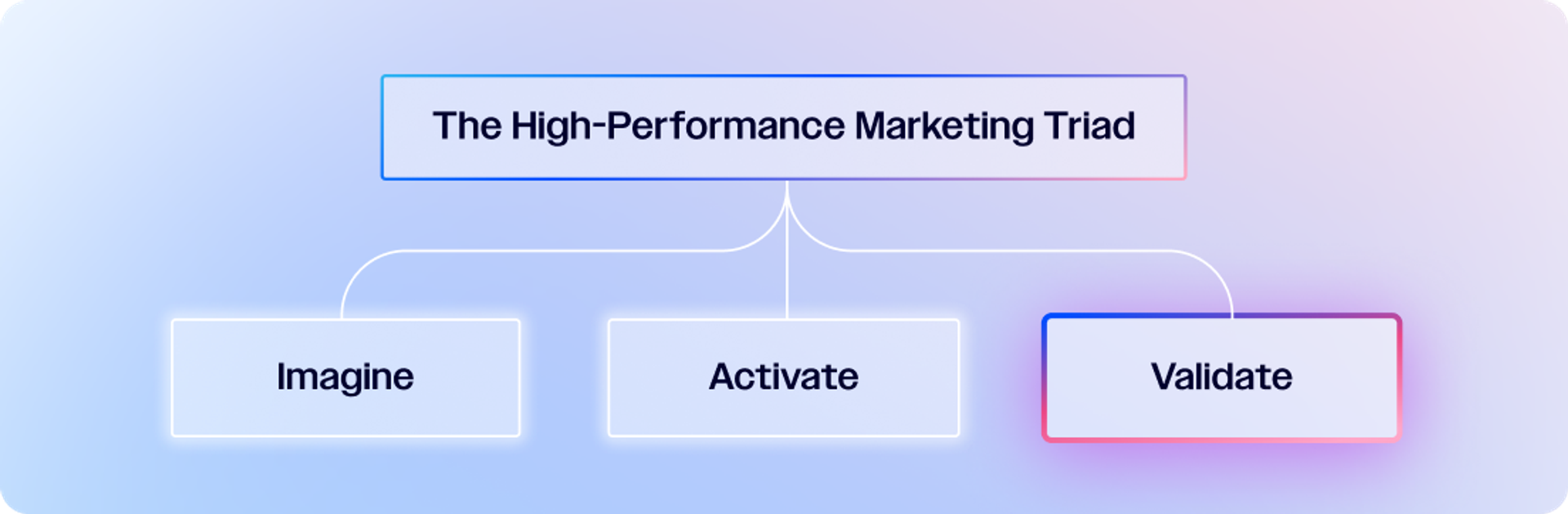
We asked our five marketing experts how they ensure that at each phase of the High-Performance Marketing Triad, they retain their voice.
And, most importantly, to demonstrate that there is no single “right” way to use autonomous marketing.
Get autonomous marketing inspiration and examples like this delivered to your inbox every other week. Sign up for our newsletter.
Imagine: Using AI to generate smarter ideas
How has AI changed the way you brainstorm or develop original campaign ideas?
Dan Sanchez, host of the AI-Driven Marketer podcast, describes it like a creative jam session.
"I give it an initial idea and [the AI is] like, 'oh yeah,' and then we could do this," he explains. The breakthrough? "You don't have to run into blank-page syndrome anymore. You can come up with the initial wave and then just run."
-
Gini Dietrich, CEO of Spin Sucks and creator of the PESO Model, agrees on the blank-page cure. "It has completely gotten rid of my ability to procrastinate because I no longer have to look at a blank screen." Her process: Prompt it with whatever challenge she's facing, explain why she's stuck, and ask for an outline. "That almost always prompts something in my brain and ignites a fire."
-
Kate Bradley Chernis, an early Generative AI software visionary who cofounded the first closed-data, proprietary, machine learning and natural language processing platform on the planet in 2014, takes a more skeptical approach.
"I don't really use it to brainstorm," she says. Instead, she uses AI for elimination and inspiration. "I might say, give me a feminine but quirky twist on a blog title with the words cowboss in it. It spat out a bunch of things. I didn't like any of them, but it gave me another idea." Her real brainstorming fuel? Reading.
"I read this book called Eels for Lollygag: Quirky Words for a Clever Tongue. It just gets me thinking."
-
Brandi Holder, a St. Louis-based executive coach, brand strategist, and entrepreneur, uses AI to stress-test ideas rather than generate them.
"I use it to identify what is missing or what I haven't thought of," she explains. When working on client positioning, she'll write the concept herself, then ask what assumptions she's making. "The AI doesn't come up with the idea, but it acts like a strategic sparring partner."
The pattern: AI accelerates thinking for those who already know how to think. It doesn't replace the creative spark. It removes friction from the process.
Building a career that AI can't replace starts here.
Get the bi-weekly newsletter that helps you master the "High-Performance Marketing Triad" and stay ahead of the curve.
Activate: Building systems that amplify voice
What’s one workflow or system you’ve automated with AI where you initially worried you’d lose your voice, but it actually amplified it?
Dan Sanchez has a system that takes any raw idea and turns it into three LinkedIn posts: a long one, a short and concise one, and a more spicy take. His contrarian view?
"I think brands are way too caught up on writing voice. Nobody even notices. Stop. You're not Emily Dickinson. Sorry. Hot take."
-
Kate Bradley Chernis automated repurposing long-form content into short-form using a closed model she built, trained only on her data.
"I did this by hand for Walmart in 2010," she says, recalling a project to increase the number of site visits to a free tax preparation and filing services. "I got them 130% growth year over year for three years with that model." The key difference from open models like ChatGPT? "It was a closed model based only on my data and my best practices." She's blunt about open models:
"I'm using ChatGPT as my salt shaker. It's not the recipe. It's not the meal."
"I'm using ChatGPT as my salt shaker. It's not the recipe. It's not the meal."
Gini Dietrich automated proposals, RFP responses, and statements of work.
"What used to take hours and hours and hours to do has been reduced to an hour or 90 minutes, tops." The training made the difference. Because so much of that content stays consistent regardless of audience, her team trained AI on their response patterns and let it generate strong first drafts.
-
Joe Pulizzi automated his entire podcast production workflow.
"Recording, then producing it, doing the thumbnail and show notes. Now I can do all of this (added video production) in about 20 percent of the time, and I think the product is actually better."
-
Brandi Holder hasn't automated anything.
"Pattern recognition in my work relies heavily on what's not said: the pauses, the body language, the shift in energy when someone's avoiding something."
Tools like Otter can transcribe and summarize.
"But it can't see or hear the moment when someone's voice changes when talking about money,” says Holder. “Or the 10-second pause before they answer a question about why they attract certain clients."
-
The lesson: Automation works best for repeatable processes with clear inputs and outputs. For work that depends on human nuance and real-time interpretation (such as things that require your unique perspective and voice), AI assists but doesn't replace.
"Automation works best for repeatable processes with clear inputs and outputs."
Validate: Judging whether AI output reflects your voice
How do you judge whether AI-powered work reflects your brand’s voice or creative intent before publishing or launching?
Dan Sanchez judges by helpfulness. "Sometimes AI makes it even more helpful than I originally intended," he says. His standard: "Is this as helpful as I meant it to be?" He's not worried about artistic merit. "We're not making art. We're helping people learn."
-
Kate Bradley Chernis looks for her linguistic quirks.
"I use a lot of onomatopoeia. I'll call myself 'moi' because I think I'm Miss Piggy. I'll make up fake swear words like 'holy hot pickled jalapeño peppers.'" She writes like she talks, with ellipses and em dashes galore, sometimes in all capitals or italics.
"I also believe in mistakes. That's the number one trick I learned in radio, was to make mistakes on purpose." She's found AI can't capture her unpredictability.
"I'm personally unpredictable. And I haven't found any AI to get there with me. Because it's looking for patterns."
"I'm personally unpredictable. And I haven't found any AI to get there with me. Because it's looking for patterns."
Gini Dietrich reads and rereads, then has someone else edit.
"We've also gotten really good at knowing the AI tells, particularly as it relates to our voice and our brand." Red flags include words like "receipts," "idea bursts," and "evidence loops."
"Anytime I see those things in my colleagues' work, I ask them to do another edit."
-
Brandi Holder uses Microsoft's read-aloud feature.
"If it sounds like something I'd actually say in a conversation, it passes. If it sounds like a LinkedIn thought leader, a press release, or a little too fluffy, I rewrite it." The prerequisite: "I am very clear on my distinct voice. The tone, the style, the formality, the words I use and don't use. I think that is the essential starting point."
-
Joe Pulizzi doesn’t see a need for prompting. He uses Wispr Flow, a voice-to-text AI that he gives “minutes-long” prompts to, before it organizes it and inputs it into ChatGPT.
-
The truth: You can't validate voice if you don't know what your voice sounds like in the first place.
Beyond using the Marketing Triad framework to retain their voices, the marketing experts offered their thoughts on other things to keep in mind as they produce content.
Keeping AI useful without flattening your voice
What’s your discipline or practice for keeping AI useful without letting it flatten your voice?
Dan Sanchez says stop romanticizing craft.
"People get way too romantic about the craft. Stop being so romantic." His focus? Idea strength over tone purity.
"If it doesn't hit the tone you want, why did that tone matter? I'm not worried about flattening voice. I'm worried about how strong the idea is."
-
Kate Bradley Chernis relies on granular rules. One key rule: Eliminate weak words.
"Like 'I think' versus 'I know,' or 'I just wanted to say,' or 'probably,' or the word 'need.' Weak words undercut your authority. And your authority is your trust. And trust is why people buy and share and click." Another rule: Ban the call to action "check out."
"It's the laziest vapid call to action on the planet. Tell me. Give me something. Why is this worth my time?"
-
Gini Dietrich harkens back to an earlier answer when describing her editing process: Draft it yourself, get AI feedback on what's missing, finish the piece with that feedback, then let AI edit it with AP style applied.
-
Brandi Holder has a simple rule: AI second, never first.
"The core thinking, perspective, and examples all originate from me. Then I use AI to refine, tighten, or reorganize." Her test: "If I can't explain the concept without AI, I don't understand it well enough to write about it."
-
The discipline separates those who use AI from those who let AI use them.
You are the expert, not AI
What’s one thing you wish more marketers would try when working with AI beyond just building custom GPTs?
Dan Sanchez wishes they'd define their process first.
"Everybody wants to learn AI automation, but you can't automate anything unless you define the process." His deeper point: "AI has no core values. It can only mimic them. Trust comes from values and real stories, not consistency in creativity."
-
Kate Bradley Chernis delivers the hardest truth: "I just wish they would do the work themselves. Take pride in ownership in what they're doing instead of trying to always bump it off on automation."
She's blunt about the skills gap: "All marketers need to know how to be really excellent writers. And they're not. They're mostly very bad." Her advice: Use AI before Google for research, and push back when AI gives you wrong answers.
"I still see marketers also not pushing back on the answers it's giving them. And it's wrong a lot."
"Take pride in ownership in what they're doing instead of trying to always bump it off on automation."
Gini Dietrich wishes more marketers would just play with AI.
"Some of it will be terrible, and some of it will be great. But the more you play with it, the more you can recognize its improper use, which makes you better at your job." She's experimenting with a Gini avatar for recorded coursework.
"This will enable us to make quick changes without my having to re-record every time we need to evolve the curriculum."
-
Joe Pulizzi points back to the CRIT framework.
"Putting limits on AI generates better results." Specifically: Limit the number of questions AI asks you during the Interview phase. Three questions, one at a time, force clarity.
-
Brandi Holder wants marketers to use AI to interrogate their thinking, not replace it.
“For my prompt, I usually ask something open-ended like: Is this clear and compelling? What is missing in my argument? Or if it has produced a piece of research or a stat, I'll ask, Is this true? I also still do my own fact-checking.
-
Creativity thrives when AI clears space for deeper thinking. But the clearing only happens if you know what belongs in that space.
The marketers who win with AI share one trait: They did the hard work of understanding their craft before they automated any part of it. They know their voice. They know their values. They know what makes an idea strong versus merely executable.
AI doesn't flatten your voice. Lazy thinking flattens your voice. The tool just makes the problem visible faster.
Stop guessing. Start automating.
Get the exact strategies, prompts, and workflows veteran marketers use to scale their impact without burning out. Every other week, we send you a masterclass in modern marketing efficiency. Subscribe to The Autonomous Marketer.