How can you drive awareness for a mission-led franchise brand while supporting lead generation for over 200 franchise owners across North America? Julia Moody, Director of Marketing at British Swim School, and her team balance hyper-local, targeted campaigns and national-level visibility to drive growth.
We spoke about the brand’s strategy, including how her team facilitates franchisees’ grassroots success in local markets (think pediatrician partnerships, water safety presentations, and daycare events). Meanwhile, a partnership with the iconic Peppa Pig supports national-level growth, with one campaign generating over 8,000 leads and an 82% uptick in Instagram followers.
Julia pairs her background in agency marketing with a deep understanding of franchisee realities. Plus, as a millennial mom of two, she’s right within British Swim School’s target demographic.
In this interview, she shares how it’s done, from meeting cadences and touchpoints with franchisees, to balancing local and HQ campaign ownership, and how to step in effectively when things go awry.
Working on marketing from the HQ side of things and guiding your franchisees at the local level, what are the sorts of outcomes or metrics that your marketing team is focused on?
The top priorities are definitely system-wide, and those are revenue growth and brand awareness. When we think about the national campaigns we’re running or the work we’re doing in collaboration with our franchisees, we really see our role as filling the top of the funnel. We want to drive national visibility and brand interest, which then supports lead generation down the funnel at the local level.
A lot of our paid digital channels (social, search, display) are “always on” throughout the year. Then we generally have two or three big national pushes annually, mostly aligned with seasonal dips in the summer when kids are off school.
For example, May is water safety month, which is huge for water safety presentations at schools, daycares, and paediatrician offices. And then we have our “Back to Pool” push at the end of the summer to improve retention rates and get kids back to swim classes in line with school starting back up. Our franchisees develop these partnerships and events, while we at HQ support them with things like printed materials, swag to distribute, and QR codes for on-site lead generation.
"We really see our role as filling the top of the funnel. We want to drive national visibility and brand interest, which then supports lead generation down the funnel at the local level."
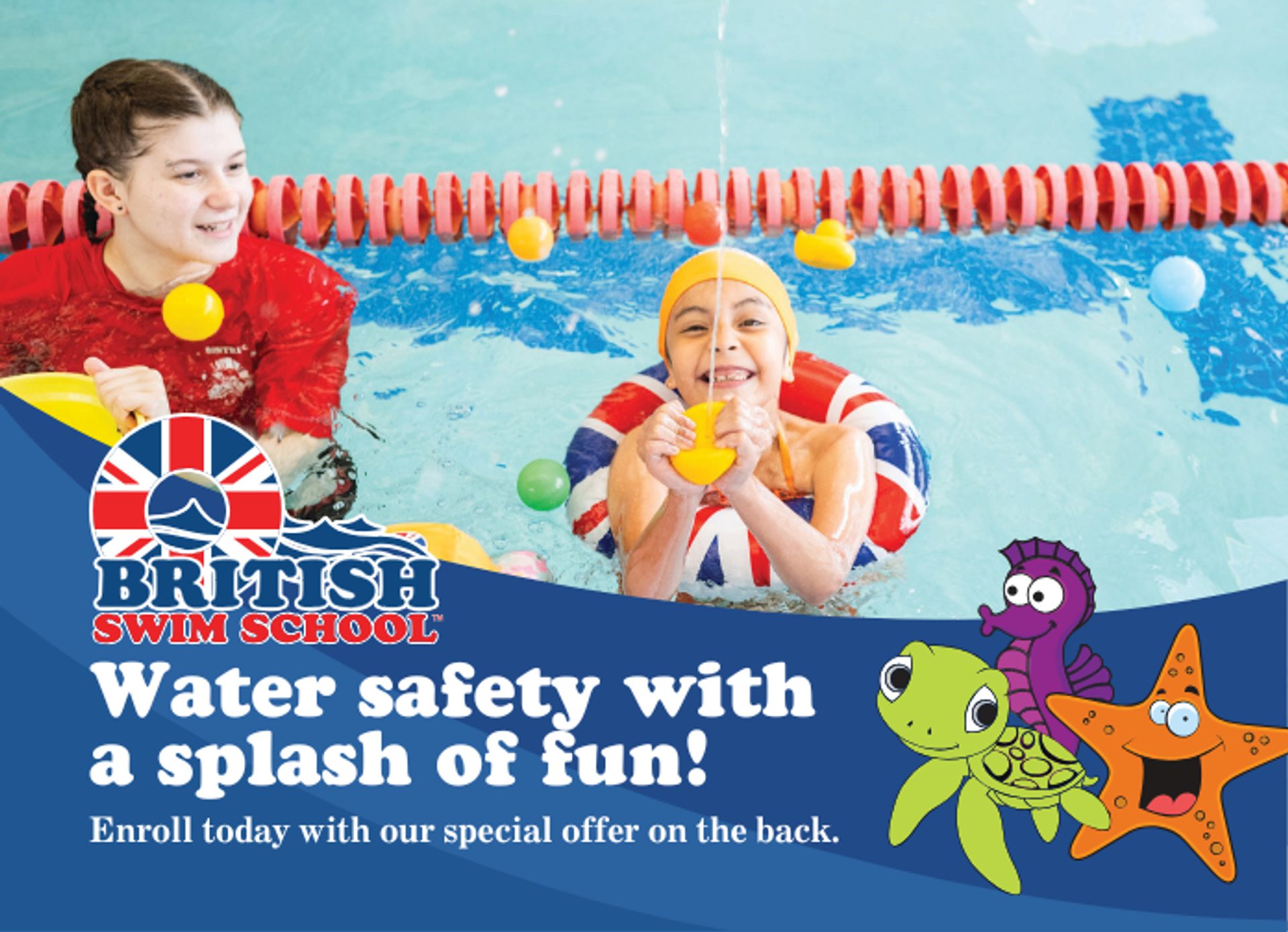
Front side of a local flyer template, an example of the printed materials that HQ uses to support its locations.
What channels do you focus on most? Are you looking at social media, traffic, mentions?
Probably everything you can think of. As something of a niche brand, targeting plays a really big role in everything we do.
[Customer] convenience is also a major factor for us, and it’s not necessarily something people would immediately think of. We never want to run campaigns that are so widespread that, yes, people hear about us, but they live hours away from a British Swim School location. That’s just not an effective use of spend.
When it comes to targeting, we stick to people who live within a 15-20 minute drive away from one of our pool locations. We’re also targeting people more likely to have young kids from 0-9 in terms of age range, along with a pretty specific household income bracket. That targeting applies across all our paid channels, including social, display, and YouTube, and any direct mail campaigns. We’ve gathered that information by speaking directly to existing customers and gathering data from digital surveys sent out by email.
So that’s the balance we have to walk: wanting to become a widely known brand, but also being smart with our time, energy, and budget by not targeting people who can’t realistically take swim lessons with us.
How does that balance out between different locations? Obviously there’s territory to consider. Are you still small enough in terms of the number of locations that territory conflict is not a big concern? Or does it even come up?
It definitely comes up! We have some areas with a really dense number of owners, not just [individual] locations. Cities like Toronto, Boston, Atlanta, and even the Bay Area are markets where we might have five or six owners, each with five to ten territories that all border each other.
As we've grown, especially over the last couple of years, we’ve had to become more stringent about what we allow. Owners can only market into the zip codes they own.
For some brands, it's a bit simpler: the franchisee owns a set of zip codes, and their customers live within them. But for us, convenience is a bigger factor. Just because I own the zip code where a family lives, doesn’t necessarily mean I’m their most convenient location.
So, we have to be strict: owners only market in the zip codes they own. But even if your pool is in one zip code, your swimmers could live in another, so there’s always going to be some overlap. That’s where we encourage and help to facilitate collaboration between franchisees.
For example, franchisees in our Southern California region are super collaborative. They wanted to test advertising on Hulu together and worked with us to build a regional landing page. The page contained all the individual locations in the region, so they all got the same exposure. The user could then select the location most convenient to them and be taken to that location’s microsite. This type of collaboration is up to the owners, but it’s heavily encouraged and facilitated by our regional business coaches in the field.
You have to function as a collaborative unit, knowing that some of your marketing might benefit a neighboring owner and vice versa.
And what’s the split like between what you handle at HQ versus the marketing that’s handed off to your franchisees? I imagine the more you hand off, the harder it is to manage territory governance.
100%. We manage the national campaigns. From there, we also handle direct mail and paid digital in collaboration with the franchisees. We run the strategy and execution, and then have very geographic, localized conversations with them to confirm targeting.
But we’re the ones ultimately owning execution, so we can ensure no one is marketing where they shouldn't be. At the local level, I’m sure there could be overlap, but ideally, everyone is aware and working together, especially where there might be an opportunity in a neighboring territory. Some owners might attend regional industry events together, for example, and use a shared landing page containing all their locations similar to the Hulu campaign.
At the local level, what types of activities are your franchisees engaging in?
Our brand is perfect for organic social. Everyone’s obsessed with their kids, and parents love to take photos and videos of them doing activities like swimming or learning a new skill in the water. So we get a lot of user-generated content on social media that we try to leverage. We’ve created branded stickers and gifs for Instagram stories, for example.
That’s something we’re definitely training our franchisees on too. Every month, they get a copy of our upcoming social media calendar so they can participate in trends or get some ideas for their own location’s channels. And we’ll take that opportunity to remind them about getting parents to tag the brand when they post their own content, but also to take their own quick photos and videos in class. There’s a social media waiver in our registration forms, but we also tell owners to explicitly ask each parent if they’re ok with it when their kid first joins up for lessons.
Also things like flyers, yard signs, feather flags, anything that builds awareness of where our swim lessons are and reinforces our brand presence is encouraged. We also focus on really targeted activities based on their specific pool locations.
For example, if they’re in a gym that has a kids club, owners can bring in coloring pages, bookmarks, things that are British Swim School-branded, and fun for kids to take home. It builds familiarity and interest.

A British Swim School coloring book page
Free water safety presentations are also huge for us, whether that’s in daycares, elementary schools, or through partnerships with pediatricians’ offices. The list goes on, but it all comes back to finding ways to let people know that swim lessons are available, they’re important, and they can help promote water safety in general.
With all these local opportunities, when it comes to things like social media posts or materials for events, how do you manage brand consistency?
Consistency versus flexibility is one of those tightropes we’re constantly walking.
We don’t see flexibility as a threat to the brand. We recognize that every market is a little bit different, and every owner is different, too. We are British Swim School, but they’re individualized owners, and we want them to feel empowered to make decisions for their swim school as long as those decisions align with our core brand and visual identity.
To keep that flexibility from going off course, we’ve put some guardrails in place. We have clearly defined brand guidelines that everyone has access to. We offer a ton of templated assets, both generic and customizable, so they can plug and play for their location.
We share these through a Google Drive folder and also use FranConnect, which has a massive library of both generic and customizable marketing materials. And we also have Vista Print Pro Shop, so owners can connect with print and apparel partners that already have a lot of our templates.
We also have a design team available to work with owners if they want to swap a photo, add a QR code, or create something entirely new. That gives them individualized support while still maintaining brand consistency.
And we do allow owners to create things outside of our templates. We just ask that they send it to us for final approval.
What kind of communication do you use with franchisees when doing a national campaign?
We try to over-communicate. It’s that same delicate balance.
We have a content calendar, and we also send out a monthly marketing newsletter to all of our owners. It’s kind of a “look ahead” that outlines what their messaging should be, what email templates to use, new promotional materials, new collateral, and PR wins from across the system. So it's really a nice playbook of what they can focus on over the next couple of months.
Anytime we launch a larger initiative, we’ll send out a campaign brief. That outlines the goals, what’s happening at the national level, how they can take advantage at the local level, and what collateral is available. We usually host a webinar as well, to give people the opportunity to ask questions.
We’re also very high-touch with new owners. We meet with them monthly throughout their first year of business, so anything we’re pushing out to the broader system gets reinforced in those one-on-one conversations too.
Alongside all that, we have a marketing chat space in Gmail. It’s a great way for our team, the owners, and those field-level staff working for franchisees to collaborate, share ideas, and stay connected.
It sounds like you’ve got a really well-thought-out ecosystem for keeping everyone aligned. That being said, have there been any moments where something went wrong?
Right when TikTok started gaining traction a few years ago, we didn’t yet have a corporate account. But we would occasionally search for our name or hashtag, just to keep an eye on how we were being represented, if at all.
A couple of legacy owners had TikTok accounts. That’s how we discovered some videos had been posted—a few filmed on the pool deck, others created off-duty. But they featured instructors wearing British Swim School apparel.
Unfortunately, some of that off-duty content included dance trends that, while popular on TikTok, didn’t really align with the image we want to project.
Thankfully, it was easy to address. We were able to quickly identify the employee, have the owner speak to them, and get the content taken down.
So, not a crisis, but definitely a wake-up call. It made us stop and ask: we’re communicating with our owners, but is that info making it all the way to their teams? Do staff understand how something like that could impact the brand? It was a good opportunity to take a step back. In this digital age, so much happens outside of our direct oversight. So we had to consider how we keep an eye on that, how we communicate expectations to owners, and how they, in turn, create a culture where their teams are aligned on protecting the brand.
We updated our social media guidelines, emphasized the importance of staff training on social media best practices, and started paying more attention to situations like that. We’re not in the business of policing personal accounts, but the second someone’s wearing our sweatshirt, it matters.
"It made us stop and ask: we’re communicating with our owners, but is that info making it all the way to their teams? Do staff understand how something like that could impact the brand?"
And, especially on the national campaign front, is there any campaign or initiative that you’re particularly proud of? Something that went really well?
For sure. The campaign or partnership I’m most proud of is definitely our relationship with Peppa Pig.
In 2024, we were able to partner with Hasbro. We did some cold outreach to brands based on a wishlist of our “ideal” partners, and their European product team responded. Our brand started in the UK before our founder moved to the US, so we had to explain we’re no longer operational in the UK. From there, we were able to get an intro to the US team instead. That led to a co-branded effort that introduced a whole new audience to British Swim School and to the importance of water safety.
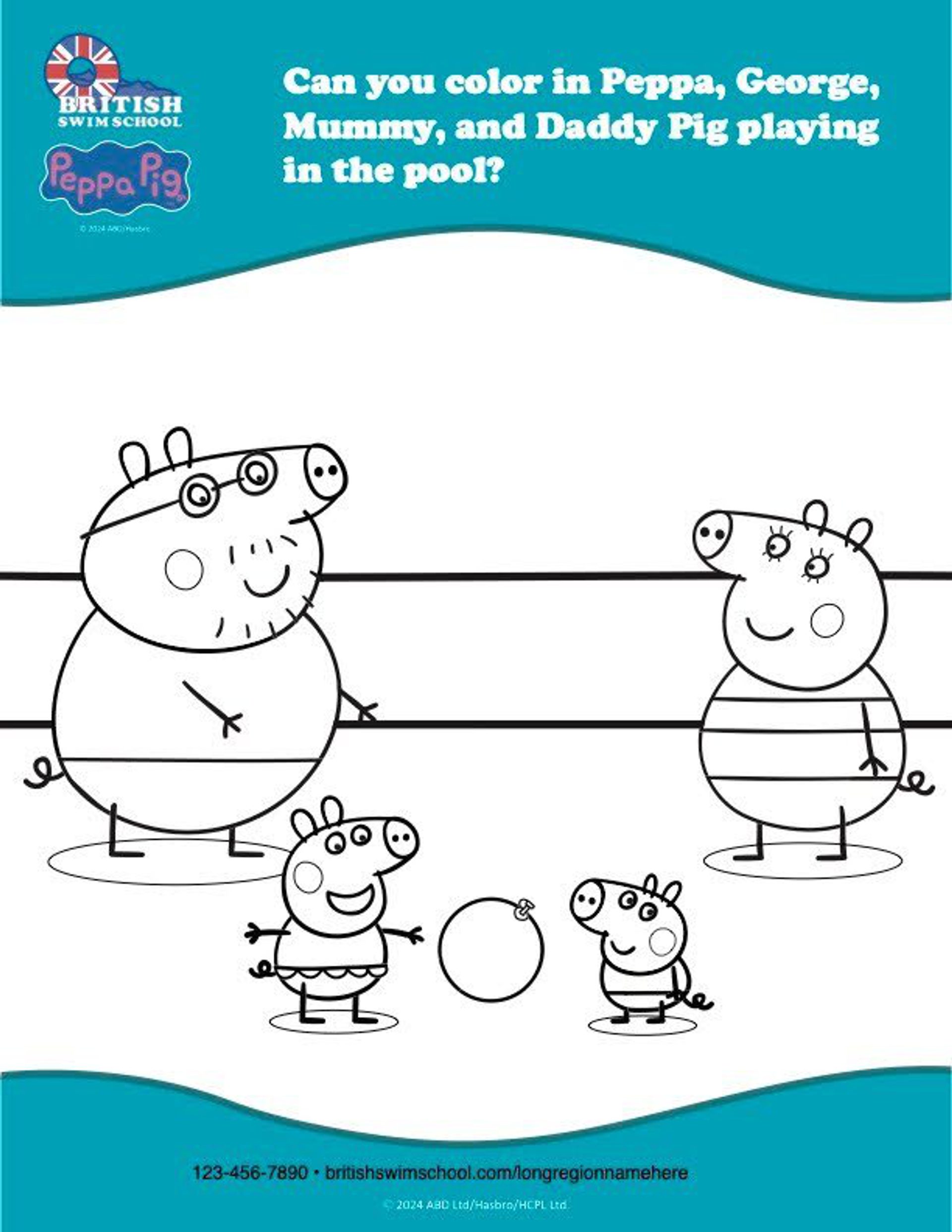
Peppa Pig coloring books that franchise owners can give to students.
Peppa Pig has been around for over 20 years and is beloved internationally. We both have strong UK roots, so it felt like the perfect fit. It allowed us to introduce a lot of young families and children who love Peppa to our water safety mission.
The campaign included national paid media, email, and social to our core target audience. Every quarter, we host something called Survival Week. It’s themed, and kids come to lessons wearing clothes like pajamas, Halloween costumes, or superhero outfits.
The idea is to simulate what it would feel like to fall into water in everyday clothes, since most water accidents don’t happen when kids are wearing swimsuits. We want them to understand how floating, movement, and safety skills feel in that situation.
For Peppa Pig Safety Week in May, we themed the entire Survival Week around Peppa Pig. We also ran a sweepstakes and gave away a trip to the Peppa Pig Theme Park in Florida.
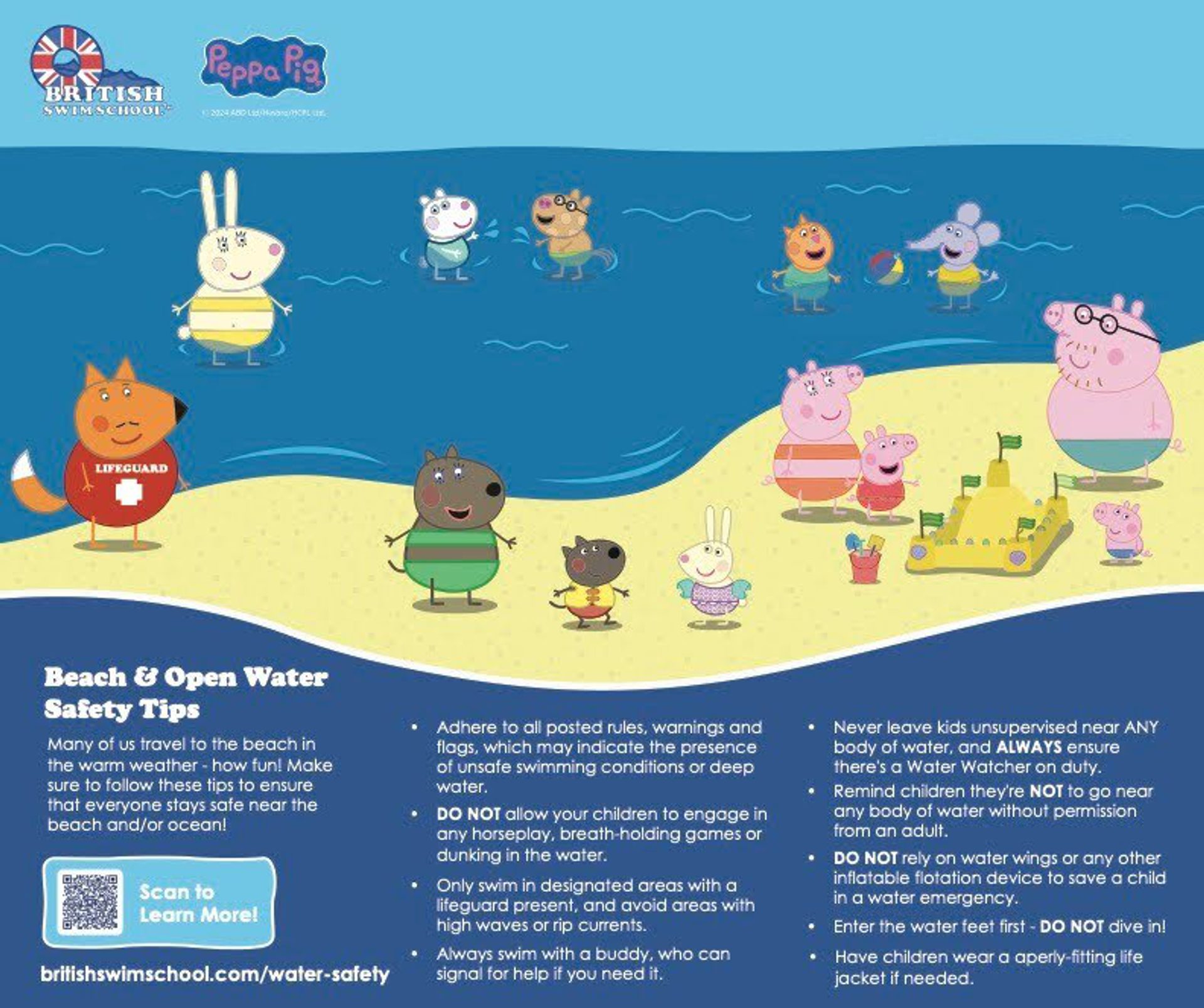
An example of Peppa Pig branded materials with a traceable QR code.
Are you able to share any specific numbers or outcomes?
Sure! The sweepstakes component was very focused on lead generation, and we brought in over 8,000 leads from that alone, which was fantastic. We also saw a 10% lift in website traffic and an 82% increase in Instagram followers.
So, it was a really nice mix of lead generation efforts and retention—keeping our current customers excited about Safety Week and engaged through social media content. It was a great dual-purpose campaign.
Wow, congratulations. What does that process look like when leads come in?
Obviously, they’re coming through regional pages and landing pages, so it’s probably fairly easy to track locally. But how do you separate what’s coming from HQ-driven marketing versus what might have come from local owner efforts?
With our current setup, leads aren’t really coming through the corporate website. We’re driving traffic directly to the microsites of each franchise owner, so that helps with attribution and makes it a bit easier to distinguish.
We’re also in the process of onboarding a new CRM, which we’re really excited about. The goal is to take a lot of the lead management out of the franchise owners’ hands, or at least make it far less manual. That way, they can focus more on things like customer retention, while we handle more of the lead flow and communication. It’ll be a huge step up from what we’re doing now. There’s not much automation in place currently, so having a centralized system for all communication will be a big win for everyone.
Are there any common errors or hiccups you see franchise brands making?
I think, across the board, we tend to overestimate the local execution and underestimate how easy we think we’re making it [from HQ].
We’ve all created these fantastic campaigns, and we expect owners to be really excited and just adopt them, no matter what. But without providing them with the tools, the context, or the support, those campaigns hit a wall right where you need local activation to take over. So we’re working really hard to close that gap on our side, but I think it’s a really common blind spot.
I’m always thinking about marketing, but these owners are thinking about marketing, their staff, the pool going down, chlorine levels… there’s just so much more in their world.
You really have to keep that operator mindset: What’s going to keep them up at night? What resources do they actually have time to use?
"I think, across the board, we tend to overestimate the local execution and underestimate how easy we think we’re making it [from HQ]."
Yes, you really do have to have quite an empathetic approach. How do you keep that going?
For franchise marketing, this is their livelihood. When they’re concerned about a budget or how many leads they’re getting, it’s easy to take it personally.
But in reality, they just want to be successful. And we just want them to be successful. I think the more we understand that, and really try to sit on the same side of the table as them, the more effective we’ll be.