For Sara Whiteleather, franchise marketing is more than just a job — it’s personal. Growing up, she watched her dad run his own small business, giving her an early appreciation for the grit, heart, and community impact of local ownership. That experience now fuels her work as Senior Director of Marketing at Batteries Plus, where she’s leading 700+ stores through a chapter of growth and transformation.
During her two years with the company, Batteries Plus has launched a bold brand refresh and heightened brand awareness, doubled down on data-driven measurement, helped franchise owners get more bang for their buck with marketing — specifically, a 40% cost reduction in media while improving ad inventory, quality and hyper-local targeting — and expanded its e-commerce presence, all while keeping franchisees’ needs and voices at the center.
A video ad from the Experts in Charge campaign
Although this is Sara’s first role in franchising, she’s found deep purpose in supporting franchise owners — the entrepreneurs who embody the brand’s promise in their local markets every day.
In this conversation, Sara shares how her team thinks about measuring marketing impact at both the national and local level, how the brand’s unique co-op model of marketing has helped all of their stores see more success, how e-commerce growth ties directly back to supporting store owners, and more.
What’s changed about your approach to consumer marketing when moving into the franchise space?
When I started two and a half years ago, the lines between local and corporate were very blurred. Owners didn’t always understand: What do I get a say in? What should I lean on the experts at corporate to do on my behalf? We focus on offering tools and support to our owners while enabling them to be their biggest brand ambassadors and lean into their communities in a way that we at corporate will never be able to do as impactfully.
At corporate, we oversee brand identity — we build the voice and tone, create playbooks, and help owners apply them. For example, our new branding is centered on being “The Experts in Charge,” and we’re making toolkits that help owners understand what that means for them, their associates, and how they train their stores.
So we're really focused now on creating more of those toolkits so that owners can easily apply them and really see the benefits of being part of a franchise — they don’t have to do all of this on their own.
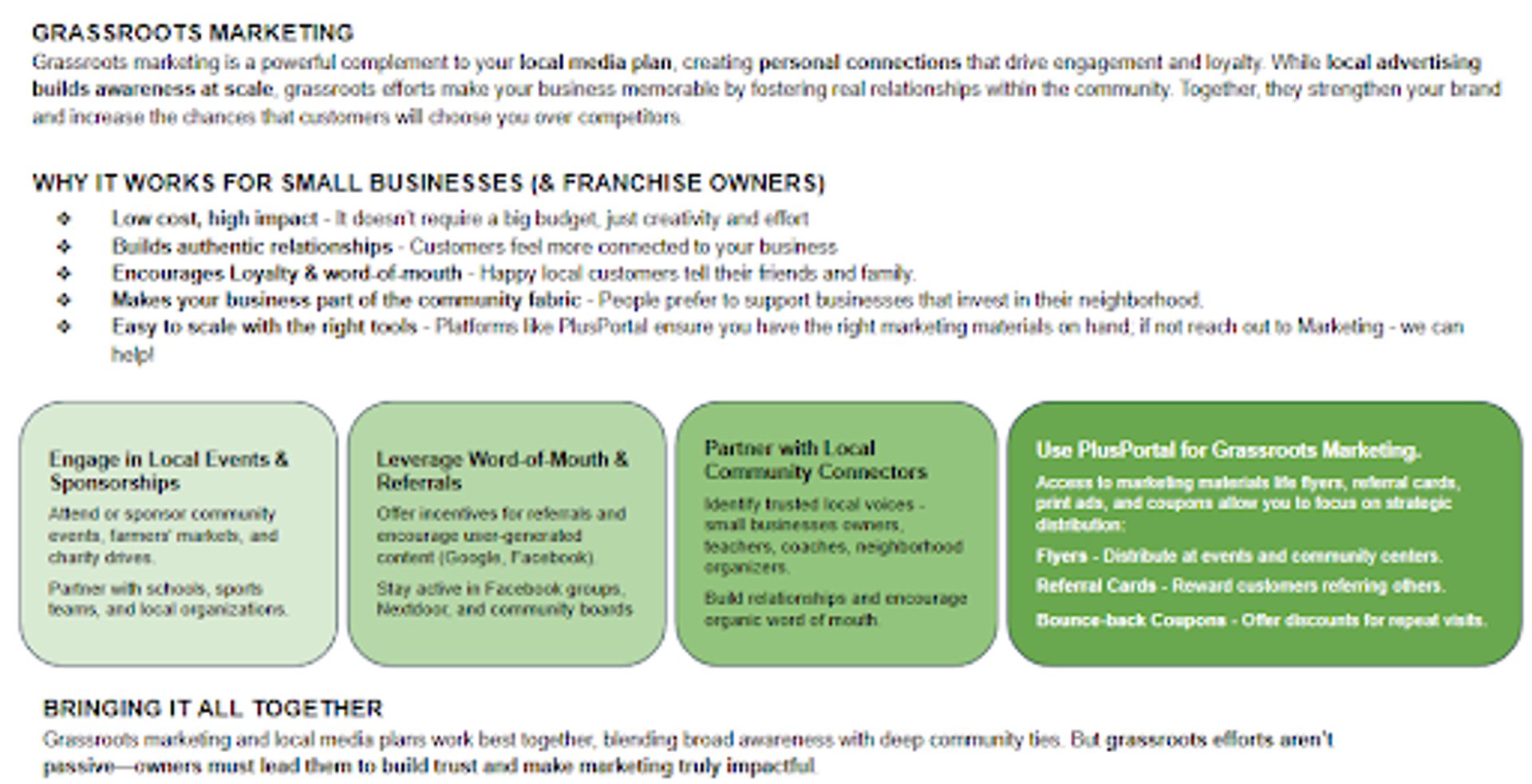
Toolkit on grassroots marketing
We also manage broader advertising efforts — things like paid placement that deliver more bang for our buck than individual owners could get locally. We run paid social, manage local listings, and maintain relationships with companies like Meta and Google to keep our franchisees visible and on trend.
On the flip side, there are things corporate can’t do, like grassroots community involvement: being activists and participants in their communities, having strong relationships with Chamber of Commerce types of organizations. So we create playbooks for that, too. We also give owners a credit back from their marketing contribution to invest in hyper-local sponsorships, like Little League teams or banners in local stadiums. That local piece is what really sets us apart.
"On the flip side, there are things corporate can’t do, like grassroots community involvement."
And did you decide where those lines of responsibility should fall?
We’ve done a lot of analysis to understand where we see pain points and friction in our franchisees’ world, and how we can step in to support that — and it continues to evolve over time.
Advertising and brand media are good examples. Historically, owners had direct relationships with television and radio stations. Some liked that because they could hand-select a network, but it was a lot of work — maintaining contracts, paying invoices, managing another vendor.
That was an area where we quickly decided, not only can we negotiate better rates by packaging everything together, but we can also remove a huge operational lift from owners. We don’t want them working with TV networks; we want them training associates, running stores, and being local ambassadors.
So we’re always running cost-benefit analyses: Where are owners spending a lot of time without seeing enough return? And, can we put tools, systems, or processes in place to alleviate that burden and give them more for less?
What does the collaboration and training process look like between corporate and local owners?
We use a combination of methods. It starts with an annual planning playbook that outlines our overall marketing strategy for the year and where we’re focusing. We host webinars as needed to bring franchisees up to speed on big changes. We publish monthly newsletters highlighting initiatives and explaining what owners can do to support them.

Sample newsletter section with a video explaining the Batteries Plus OOH strategy
For example, if we’re revamping local listings in Google, that requires owners to provide updated photos of their stores or adjust attributes. So we make sure our communication is a two-way dialogue — explaining what we’re doing, but also what we need their support for in order to make the program successful.
Getting franchisees to engage can definitely require some nudging. I’m always reminding myself and the team how much communication franchisees get from corporate. So we focus on distilling information, getting straight to the point, and linking out to full documentation instead of dumping everything in an email.
We also have very active conversations with our owners. I don’t think there’s anyone on our corporate marketing team who hasn’t picked up the phone to talk directly with an owner. They know they can get a hold of us if they have questions or need extra support. That dialogue is so important, and while it adds more to our workload, the team sees the value in having those one-on-one relationships.
"I don’t think there’s anyone on our corporate marketing team who hasn’t picked up the phone to talk directly with an owner."
Finally, we recognize that owners aren’t always the only decision-makers. Sometimes it’s a manager or an associate who needs the information. So, before communicating, we think carefully about who is the right person to get this within a franchisee’s business and how they might best receive the message. We join system-wide store manager meetings. We're also conducting market meetings where we go meet with owners and their store managers in a given market. That helps us get better engagement and support from the right people in each business.
You’ve led a marketing transformation that achieved a 40% increase in impressions for the same cost. Can you talk me through the specific strategies that helped you do that?
This has been a two-year transformation, rooted in our dedication to growing ROI over time. It ties back to that earlier example — historically, owners did all of their own brand media at the hyper-local level. A few years ago, we defined a co-op model that allowed stores to pool their dollars together by market, based on DMA (designated market areas) and MSA (metropolitan statistical area) so we can negotiate better rates for TV and radio. By doing that, we can afford a lot more than what each store could do alone.
It’s also allowed us to diversify channel mix. Before, an owner might have invested only in TV or only in radio. With the co-op, we can bundle resources for TV, radio, streaming, and out-of-home billboards. We’re now building multi-channel plans that reach both retail and commercial audiences more effectively, and we’re getting about 40% more impressions than stores got on their own. This is all managed at the corporate level — we create the plans, coordinate with owners, and run the programs.
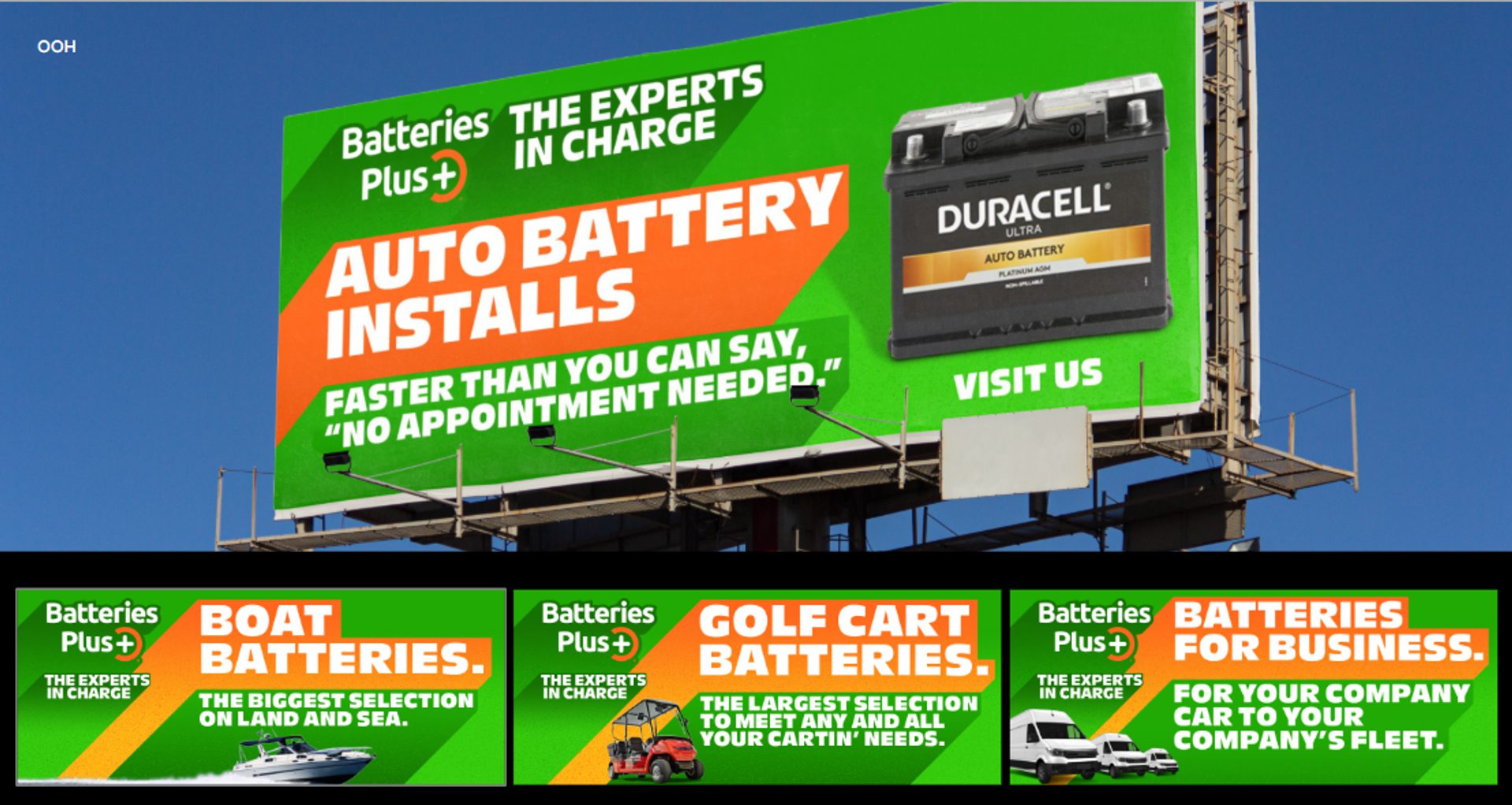
Billboards as part of the new branding rollout.
It comes down to unifying as a brand. Customers don’t see us as “Store 1” and “Store 2” down the road. To them, we’re all Batteries Plus. So we asked: How do we create more impact in communities at large by thinking about markets more holistically? It was about bringing our owners together to say, “All boats can rise together here.”
I’m assuming you got some pushback from franchisees around that. How did you navigate those conversations — especially when someone might worry about driving traffic to other local Batteries Plus stores instead of their own?
Absolutely — I’m not going to sugarcoat that we’ve had tough conversations through this process. It’s really been about building trust and sharing our recommendations rooted in data: Showing what we can get, showing how we're going to measure the impact, and then saying, “Do we have enough trust built to let us prove it to you?”
Year one was hard because we didn’t have results yet. All we could say was, “Hey, you can spend $5 and get X or you can spend $5 and get Y, it’s 40% more, and here’s how we’re going to measure that benefit to you.” We could estimate this improved reach based on new rate cards we got across key channels that allowed us to understand how much more our pooled dollars could go.
Now, in year two, we have that proof. We can show that awareness levels, which had been stagnant for years, are now up 10 percentage points in some markets after just one year. More eyeballs, more diversification in our channels, more brand visibility. So, we're really using data and measurement to stand behind all of the recommendations we make.
That said, some owners still prefer to choose their own radio station or do things their own way. That’s why we created programs like the hyper-local fund. If they want to do additional local marketing on top of the co-op, they can qualify for credits back or use our agency partners at great rates.
So our goal isn’t to say “no” — it’s to say “yes, and here’s how we can make it work without sacrificing progress for the greater whole.”
"I’m not going to sugarcoat that we’ve had tough conversations through this process."
You’ve talked a lot about data, and I know some of those things can be hard to measure, like awareness in a market. What are some of the ways you approach measuring the impact of your marketing work for franchises?
We have a very broad measurement plan in place. At the macro level, we’re looking at brand health: Are we moving the needle on awareness? Are we driving stronger consideration?
We also measure brand health at the market level. We have a phenomenal partner — Morning Consult — who provides an AI-based measurement solution. It lets us look at awareness, consideration, trust, and favorability at both a national and local market level, in real time.
That’s been phenomenal for us, because we have over 300 custom plans — launching radio in one market, TV in another market, working with seasonal variation at different stores — and we can really measure the impacts of that from a brand perspective at a very local level. It’s been really cool to see these numbers grow, especially as we’ve rebranded and focused on our new tagline, “The Experts in Charge.” We’ve seen +100 bps in awareness, +140 bps in trust, +100 bps in favorability, and +70 bps in consideration.
Of course, the number one thing we care about is store performance. We do a lot of media mix modeling, both nationally and at the market level, to understand ROI on every marketing dollar we spend. Growing ROI over time is a key KPI for us, which is why that 40% growth in impressions for the same cost has been huge.
One of the hardest parts of being primarily retail-focused is that closed-loop measurement — from advertising exposure all the way to an in-store transaction — is tricky. So we also use store traffic analysis with partners like Foursquare, Precisely (formerly PlaceIQ), and InMarket to connect advertising exposure to store visits.
On top of that, we’re piloting ways to measure in-store conversion, comparing store walk-ins to actual transactions. That helps us diagnose where breakdowns happen: Are we not driving enough foot traffic, or are we not converting it once they’re in? Ultimately, we’re trying to measure every step of the customer journey to create a more frictionless experience.