Brevo and Mailchimp are two of the most widely compared email marketing platforms on the market. Both are accessible, affordable, and easy to stand up. For businesses with simple needs, either might get the job done.
But “getting the job done” is a low bar when AI has transformed what marketing automation can do.
The real question isn’t whether Brevo or Mailchimp can handle your email marketing needs today. It’s whether either can handle where you’re going tomorrow. Here’s what that comparison looks like and what you should look for when evaluating AI-driven marketing automation platforms.
Mailchimp vs. Brevo: Built for email, stretched in different directions
Mailchimp and Brevo both started as email marketing tools. Over time, each platform expanded, but in different directions.
Mailchimp went deep on ecommerce. Its 2021 acquisition by Intuit pushed it further toward small business commerce, landing pages, social ads, and creative tools. For design-forward email campaigns and online stores, Mailchimp covers all the basics.
Brevo (formerly Sendinblue) went wide on channels. It added SMS, WhatsApp, live chat, and a built-in CRM, positioning itself as the single platform for all customer communications. Pricing is structured around email volume instead of contact count.
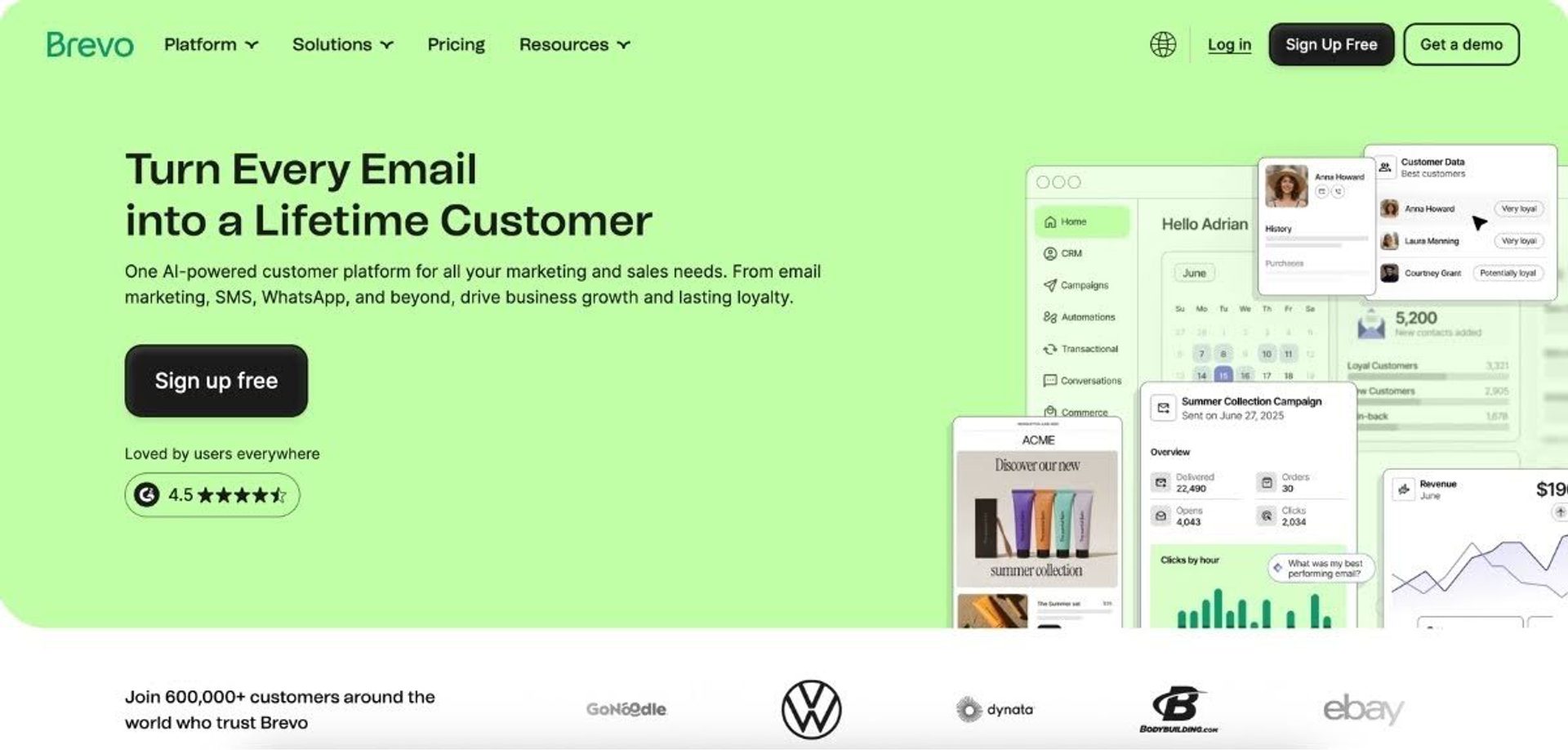
The end result is two platforms that look more capable than they are. Both have added landing pages, CRM tools, SMS, and AI features over the years, but the underlying architecture hasn’t fundamentally changed. New capabilities sit on top of an email core, and the seams show the moment you try to run behavior-driven campaigns that require your tools to actually talk to each other.
That’s the real limitation at play. Not any single missing feature, but the compounding cost of a platform that wasn’t built for intelligence from the ground up. You can layer AI onto bolted-together infrastructure, but you can’t make it coherent.
Brevo vs. Mailchimp: Core feature comparison
Here’s how each platform stacks up across the categories growth-focused teams care about the most.
| Feature | Brevo | Mailchimp |
| AI capabilities | Aura provides four agents that operate on tasks like copy generation and send-time optimization independently. | Intuit Assist handles copy, send-time optimization, and predicted segments. |
| Email design | 40+ templates with a functional drag-and-drop editor. | 130+ templates with a polished editor. |
| Marketing automation | Multi-step workflows available on lower tiers, making it accessible earlier. | Multi-step flows with branching logic, but teams must upgrade to higher tiers before building more meaningful sequences. |
| Segmentation | List-based segmentation is straightforward to manage but limits behavioral targeting. | Tag-based segmentation with predicted segments offers more targeting precision. |
| CRM | Built-in CRM with deal pipelines keeps sales and marketing connected. Available on free plans. | No built-in CRM, but audience management handles contact data well within campaigns. |
| Transactional email | Native SMTP and API support across all plans. | Transactional email requires Mandrill as a paid add-on. |
| Reporting | Standard campaign metrics cover the basics. Limited ecommerce analytics make it harder to connect email activity to revenue outcomes. | Ecommerce revenue attribution and audience analytics give clearer visibility into what’s driving results. Deeper analysis requires exporting data. |
| Integrations | 300+ native integrations | 300+ native integrations |
| Pricing model | Limited free tier available. Paid plans start at $9/month for 5,000 emails (send-based rather than contact-based). Sudden pricing jump to $449+/month to access advanced features. | Limited free tier available. Paid plans from $26.50/month for 1,000 contacts. Restricted access to automation on lower-tier subscriptions. Pricing jumps as features expand. |
AI capabilities
Brevo’s Aura is organized into four independent agents: marketing, sales, conversations, and data management. Each agent handles individual tasks like content generation, deal creation, and chat summaries. AI-powered segmentation lets users build contact segments simply by describing an audience in plain language. That last feature is genuinely useful, but is only available on Enterprise plans.
Mailchimp’s AI lives in Intuit Assist and covers similar ground: email copy generation, subject line suggestions, and send-time optimization. For teams whose main bottleneck is content production, Mailchimp can speed up drafting. Predicted segments and purchase likelihood scores add some audience intelligence for ecommerce-connected accounts. It’s worth noting that Intuit Assist is still in beta and limited to users in the US, UK, Canada, and Australia.
The pattern across both platforms is the same. AI assists with individual tasks, but doesn’t connect to automation logic or inform cross-channel decisions. It sits alongside the workflow rather than inside it. Teams looking to use AI for behavior-driven campaigns, dynamic personalization, or more sophisticated automation won’t find either platform built for that.
Email design and campaign builder
Brevo’s email builder covers the fundamentals: 40+ templates, a functional drag-and-drop editor, and reliable delivery. A/B testing is available on standard plans but limited to subject lines, with content testing available on higher tiers.
Mailchimp’s template library is larger (260+) and its editor offers more design flexibility, giving it an edge over Brevo for teams where visual consistency is a core requirement. A/B testing covers subject lines, content, send times, and from-name variations across plans. If design output is the primary evaluation criterion, Mailchimp is the stronger platform of the two.
Neither platform connects design or testing outputs to broader automation logic. What performs well in a campaign doesn’t automatically inform how contacts are segmented or sequenced next.
Marketing automation
Brevo’s clearest advantage is access. Multi-step automation workflows are available on lower-tier plans, making it accessible for teams building automation infrastructure before they’ve hit the scale to justify enterprise pricing. The automation editor supports branching logic, conditional splits, percentage-based A/B testing across entire workflows, and lead scoring. SMS, WhatsApp, and live chat are available as channels within those workflows.
Mailchimp’s automation is more restricted at entry tiers. There’s no automation on the free plan and more sophisticated flows require the Standard plan or above. The visual builder handles common sequences (welcome series, abandoned cart, re-engagement, pot-purchase) with little friction. Branching depth and trigger variety are more limited than Brevo’s, and SMS is available but sits outside the core workflow logic instead of being integrated.
Brevo and Mailchimp have 300+ native connections covering ecommerce platforms to CRMs, and help plug data into automation triggers without custom workarounds. Both platforms handle standard lifecycle sequences but they fall short in automation that adapts in real time to behavior across multiple touchpoints. Having multichannel features is different from running unified customer journeys on shared contact data. That distinction becomes more costly to work around the more sophisticated your program gets.
Segmentation and personalization
Brevo’s segmentation is good enough for most straightforward programs, covering demographics, engagement history, purchase behavior, and custom attributes. Dynamic contact lists update automatically based on conditions, reducing manual list management. AI-assisted segmentation helps create audiences from simple prompts, but is restricted to Enterprise plans.
Mailchimp’s segmentation is stronger at higher plan levels. Tag-based audience management is flexible for standard use cases, and predicted segments provide useful forward-looking signals for ecommerce-connected accounts like purchase likelihood, lifetime value, and churn risk. Engagement-based targeting and behavioral conditions are available, though the most powerful segmentation features are restricted to more expensive plans.
Personalization in both platforms is covered by dynamic content and merge tags, which handle the most common use cases. But adaptive, real-time personalization is harder to implement and requires a data layer and automation engine that isn’t available out-of-the-box.
CRM and customer data management
Brevo includes a built-in CRM with deal pipeline tracking at no additional cost, giving smaller teams visibility into their sales and marketing efforts. Contacts, deals, and marketing activity are consolidated in one platform, removing a layer of integration complexity. Compared to other dedicated solutions, Brevo’s lightweight CRM lacks the automation engine connection that powers sophisticated lead routing and lifecycle workflows. This makes it ideal for teams managing simple sales pipelines alongside email marketing.
Mailchimp’s audience management handles contact data well within the context of campaigns, but lacks a true, built-in CRM. Teams will need to integrate Mailchimp with an external tool like Salesforce if they want more sophisticated CRM features. Mailchimp’s integration library makes the connection easy for teams already running a CRM they’re happy with, but Brevo provides an edge for those that want a unified tool without connecting separate tools.
Transactional email
Brevo holds a clear advantage here. Transactional email for order confirmations, password resets, and system notifications is built natively into the platform with dedicated SMTP and API support available across all plans. Marketing and transactional email run from the same account, simplifying setup and keeping deliverability management in one place. It eliminates the cost of a separate sending infrastructure.
Mailchimp routes transactional email through Mandrill, a separate add-on that costs $20 per 25,000 emails. It also split operational and marketing email, adding friction in the form of separate billing, configuration, and a divided view of how contacts are engaged.
Reporting and analytics
Brevo’s reporting covers standard campaign metrics like opens, clicks, deliverability, and unsubscribes. However, it falls short in revenue-focused analysis and cross-channel performance visibility. Teams that need to connect email activity to downstream commercial outcomes will find Brevo’s reporting less equipped for that work.
Mailchimp is the stronger platform for focused reporting. Revenue attribution, ecommerce analytics, and audience growth tracking give connected stores a clearer picture of what campaigns are actually driving in terms of revenue. Benchmark comparisons add useful industry context for performance evaluation. The reporting is solid for understanding what happened after a campaign, though deeper analysis typically requires exporting data.
Brevo vs. Mailchimp pricing: What you’ll actually pay as you grow
The two platforms are built on fundamentally different pricing logic, and that difference compounds as a business scales.
Brevo charges by email volume, not contact count; that means unlimited contacts on all plans and a free tier that offers 300 emails per day. Paid plans start at $9/month for 5,000 monthly emails. SMS credits are billed separately, which is worth factoring in for multichannel programs, but the base pricing model is transparent and scales with how much you send.
Mailchimp’s free plan caps at 250 contacts and 500 sends a month, a limit that most active teams hit quickly. Mailchimp has previously reduced these allowances over the years, so current restrictions are worth verifying before committing. Paid plans start at $13/month for 500 contacts on Essentials, but the features that make Mailchimp powerful (like multi-step automation, branching journeys, predicted segments, comparative reporting) all require Standard or above, starting at $45/month for 1,000 contacts.
Mailchimp’s billing structure can add up. Contacts appearing across multiple lists are charged multiple times and transactional email requires the Mandrill add-on at $20 per 25,000 emails on top of plan fees.
Does Brevo or Mailchimp fit your business needs best?
The right choice between Brevo and Mailchimp comes down to what your company’s individual marketing operation actually looks like.
Brevo fits teams with large or fast-growing contact lists where volume-based pricing keeps costs predictable. It’s ideal for businesses running transactional and marketing email from a single platform, or those that need SMS and WhatsApp without a separate tool. Brevo offers a breadth of services at an accessible price.
Mailchimp fits teams needing email design and brand consistency, as its template library and creative tooling are stronger. Ecommerce brands in particular get more from Mailchimp’s revenue attribution and reporting compared to other businesses. The tradeoff is a pricing model that increases as you scale and a feature set that requires higher tiers to unlock.
Both platforms have a defined target audience. Both were also built on an email-first architecture that predates the behavioral, AI-driven automation that modern marketing programs call for. Adding AI features to that foundation doesn’t change what the foundation was built to do. And the gaps between what these platforms can deliver and what sophisticated marketing automation actually looks like is getting harder to paper over.
ActiveCampaign: The marketing platform that’s a step ahead
ActiveCampaign is an autonomous marketing platform built for a more mature and responsive marketing strategy. The platform handles more of the execution and optimization work, so teams can focus on strategy and impact.
AI built for execution, not just assistance
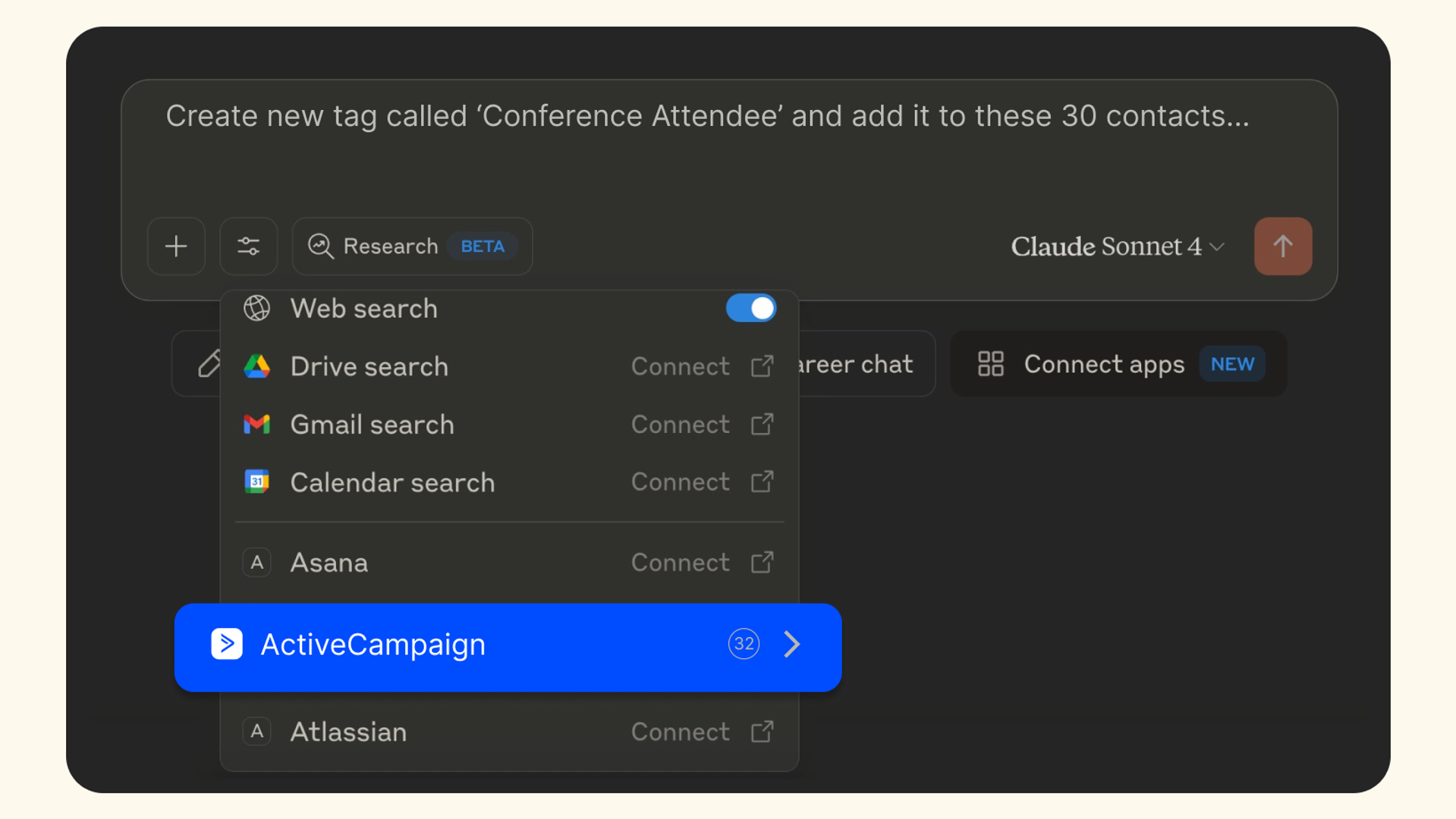
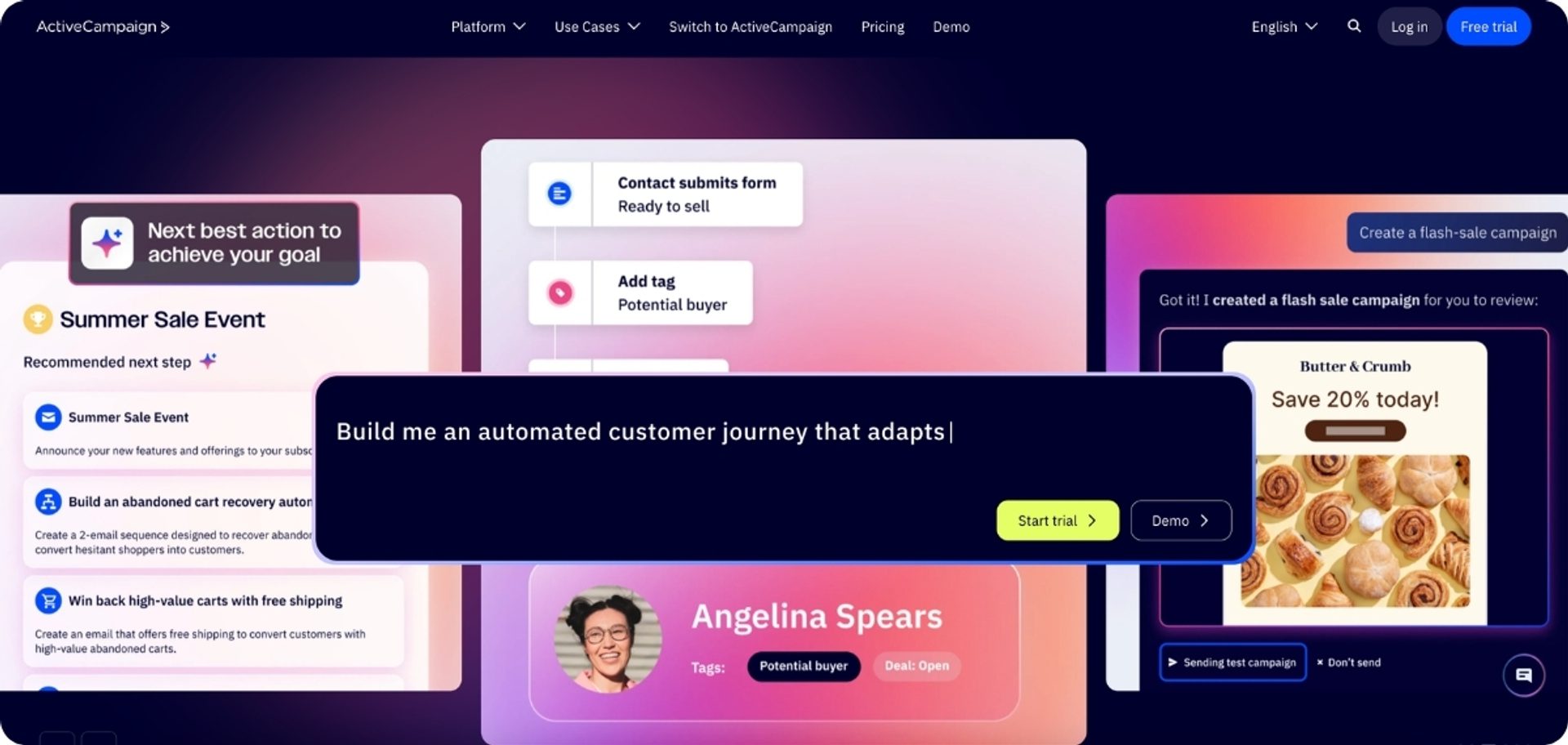
The difference between ActiveCampaign’s AI and what Brevo and Mailchimp offer is a matter of architecture. Active Intelligence is a single AI engine that operates across the entire platform, drawing on billions of behavioral data points to power a suite of AI agents that work across ideation, creation, automation, optimization, and reporting in one continuous flow.
A marketer can describe a campaign goal in plain language and Active Intelligence builds it: the audience, the content, the automation sequence, the brand-consistent design, and the goal-tracking layer behind it—all from a single prompt.

Beyond campaign creation, Active Intelligence optimizes send times per individual contact based on personal engagement history, generates in-depth reports and visualizations from simple queries, and proactively surfaces Autonomous Insights and automation improvements as performance data comes in. The AI isn’t waiting to be asked. It’s operating across the platform continuously, finding opportunities and closing gaps without manual prompting.
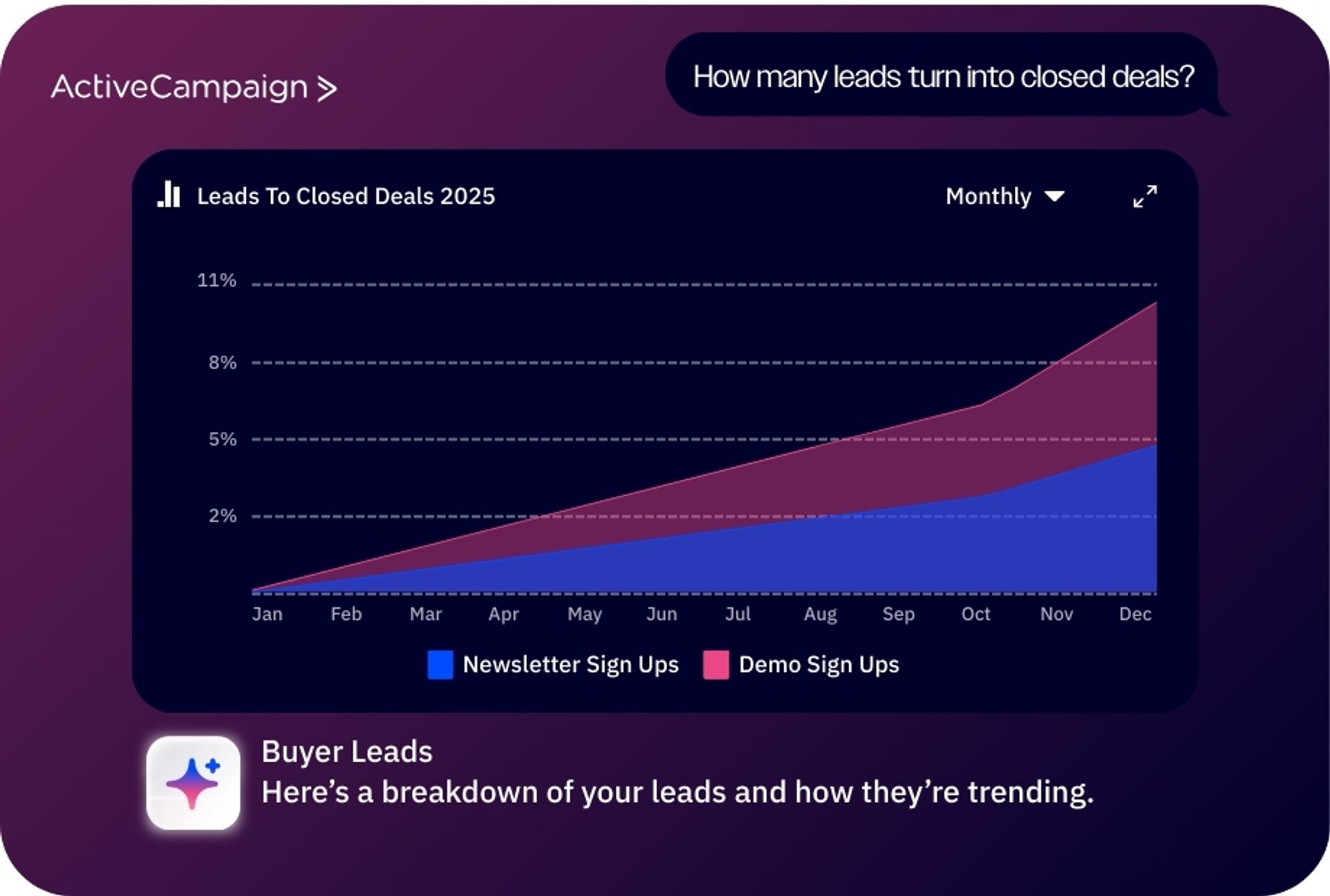
Where Brevo and Mailchimp use AI to speed up individual tasks, ActiveCampaign uses it as an execution layer that unifies strategy across the full marketing workflow.
Read more about how Active Intelligence compares to Brevo and Mailchimp’s AI offerings:
- AI Marketing Comparison: ActiveCampaign Active Intelligence vs. Brevo Aura
- AI Marketing Comparison: ActiveCampaign Active Intelligence vs. Mailchimp Intuit Assist
Automation that orchestrates entire customer journeys
ActiveCampaign’s automation engine is built specifically for advanced flows with granular targeting. Behavior-driven workflows with deep conditional logic, goal tracking, and automation-level A/B testing allow teams to build adaptive journeys that respond to what contacts actually do—not just the paths a marketer pre-mapped.
1,000+ pre-built automation recipes, organized by industry and use case, give teams a practical starting point for common workflows without building from scratch. The visual builder coordinates campaigns across all channels, covering email, SMS, WhatsApp, CRM actions, transactional email via Postmark, and on-site messaging within a single automation. It eliminates the need to manage separate workflows per channel and the data fragmentation that comes with it. For teams that have run into Brevo’s multichannel limitations or Mailchimp’s restricted automation tiers, the contrast is impressive.
Advanced segmentation that scales with growth
Segmentation is only as useful as a team’s ability to build it. On most platforms, constructing a genuinely precise segment requires enough technical familiarity to translate a marketing instinct into a set of platform rules—and that gap is where segmentation ambitions tend to shrink.
ActiveCampaign removes that barrier. AI-Suggested Segments proactively surface high-value audiences from behavioral data that a marketer wouldn’t have known to query, like repeat buyers going quiet, high-intent contacts who haven’t converted, or engagement clusters sitting outside existing segments. The conversation workspace means audiences can also be built from a plain-language description—no manual rule configuration required.

The simple process is supported by powerful segmentation software. 80+ conditions span behavioral signals, purchase history, engagement patterns, custom events, and CRM data simultaneously. Dynamic segments update automatically as contacts move through the lifecycle, so the work of keeping lists accurate doesn’t fall back on the team.
Critically, none of this requires a connected ecommerce store to function. Unlike Mailchimp’s predictive segmentation, which depends on store data to generate audience intelligence, ActiveCampaign’s segmentation works with whatever data the platform holds—making it viable for SaaS, services, and B2B teams as much as ecommerce.
Choose enterprise-level capabilities without enterprise complexity or pricing
ActiveCampaign stands out from Brevo and Mailchimp. It’s sophisticated enough for teams that have outgrown simple email tools, but without the operational overhead and implementation burden of more enterprise platforms.
The automation depth, CRM integration, and AI capabilities are unbeatable—but Active Intelligence handles much of the complexity that would otherwise require a specialist to configure. Generating a multi-step behavioral workflow from a plain-language prompt feels less like learning a new platform and more like describing what you want.
Teams switching from Brevo or Mailchimp typically don’t experience the learning curve they expect. ActiveCampaign users save an average of more than 10 hours per week on manual processes.
If your marketing has grown beyond what either platform was built to support, getting started with ActiveCampaign is low-risk. A free 14-day trial with no credit card required, free agentic migration and onboarding, and a money-back guarantee if you don’t see results within 30 days all help you kick off with confidence.
Find out more about:
Start a free 14-day trial or book a demo to see how ActiveCampaign can take you further.
FAQs
Can I use Brevo or Mailchimp for transactional email?
Yes, both Brevo and Mailchimp offer transactional email, but with an important difference. Brevo supports transactional email natively across all plans via SMTP and API, making it straightforward to send order confirmations, password resets, and system notifications alongside marketing email from the same platform. Mailchimp handles transactional email through Mandrill, a paid add-on that requires separate setup. For businesses that need both marketing and transactional messaging in one place, Brevo is the more practical and cost-effective option.
If you are looking for a more powerful platform that offers a strong transactional email integration, ActiveCampaign handles transactional email natively via Postmark. It has an added advantage of transactional email sitting inside the same automation engine as the rest of your marketing.
Is Brevo or Mailchimp better for small businesses?
Both Brevo and Mailchimp work well for small businesses, but with different strengths. Brevo charges based on email volume rather than subscriber count, which can make it more cost-effective for businesses with large contact lists. Mailchimp offers stronger design tools and a more polished editor, making it better for teams that prioritize visual branding.
For businesses that are looking to scale, it’s worth considering the best long-term platform fit. ActiveCampaign is worth evaluating early if more sophisticated automation and AI-driven marketing are on the roadmap.
Is Brevo or Mailchimp better for ecommerce businesses?
Mailchimp offers social and ecommerce reporting capabilities that Brevo lacks, which is a major difference for online stores. Mailchimp’s Shopify and WooCommerce integrations provide revenue attribution and product recommendations that tie directly to campaign performance. Brevo can serve ecommerce workflows, but Mailchimp is the stronger option for store-centric marketing.
Ecommerce brands with more complex lifecycle marketing needs, such as behavior-driven post-purchase sequences or cross-sell automation at scale, may find that both platforms have limitations worth weighing carefully. ActiveCampaign’s ecommerce integrations, revenue reporting, and behavior-driven automation are worth considering for brands that have outgrown simpler tools.
Which platform has the best AI features for email marketing: Brevo or Mailchimp?
Mailchimp offers AI marketing tools powered by Intuit Assist for content generation, send-time optimization, and predicted customer attributes. Brevo offers Aura, its AI marketing agent, with content generation and predictive send-time features.
Both platforms treat AI as an assistive layer. For marketers that want AI to actively drive campaign creation, optimization, and journey orchestration, ActiveCampaign’s Active Intelligence offers a more deeply integrated approach, where AI is embedded across the entire platform to create, execute, and optimize campaigns.
How can I switch from Mailchimp or Brevo to ActiveCampaign?
ActiveCampaign offers free agentic migration onboarding for teams moving from other platforms. Contact lists, templates, and automation logic can be imported. The platform’s AI tools can also help you rebuild campaigns quickly using natural-language prompts. The transition is designed to be straightforward so teams can be operational without extended downtime. The process is backed by a results-in-30-days-or-money-back guarantee, which reduces the risk of switching.