Brevo is a popular choice for businesses getting started with email and multichannel marketing. The send-based pricing model makes it appealing for teams with large contact lists, and built-in support for SMS, WhatsApp, and email gives it a broader toolkit than many entry-level platforms. For small teams looking to do more than just newsletters—without committing to a more complex system—it checks a lot of boxes.
But as your marketing evolves, those early advantages can start to feel limiting.
Teams often find themselves running into constraints when they try to move beyond basic campaigns. What works well at the start can become harder to scale as marketing grows more sophisticated, especially when the goal is to create more personalized, automated, and measurable customer journeys. At that point, businesses often start looking for a platform with more depth, more flexibility, and a stronger long-term fit.
There are plenty of Brevo alternatives that can work better for your business. If you’ve reached the point where “good enough” is holding your marketing back—or you’re looking for a platform that can support more advanced automation, stronger deliverability, and scalable customer journeys—this guide can help.
It will help you choose the platform that fits not just where your marketing is today, but where it needs to go next.
What to look for in a Brevo alternative
As you evaluate the best Brevo alternative for your business, it’s important to look beyond surface-level features and focus on the limitations that typically drive teams to switch.
Brevo is widely appreciated for its affordability, multichannel capabilities, and ease of getting started—especially for SMBs running email and SMS from one place. But across review platforms, a consistent pattern emerges: as marketing becomes more advanced, users find themselves needing to build workarounds or use external connections to navigate limited automation flexibility, basic segmentation, and less robust reporting and optimization tools.
ome of the more advanced automation and segmentation capabilities can feel a bit basic compared to higher-end tools. If you’re trying to build highly complex multistep flows or deeply dynamic segments, it can sometimes feel restrictive.
Here are some key areas to evaluate when choosing a Brevo alternative that can support your next stage of growth:
- Automation that supports real customer journeys (not just linear workflows): Brevo’s automation is well suited to simple sequences like welcome sequences or abandoned cart reminders. But it can feel restrictive and “cluttered” when building more complex journeys. Look for platforms with intuitive branching logic, goal tracking, and workflow testing—so campaigns can adapt dynamically based on customer behavior.
- Deliverability and inbox placement you can rely on: Your platform directly impacts whether your emails are seen. Brevo performs adequately, with a score of 88.3% deliverability in EmailToolTester’s latest data. But that score is lower than most ambitious marketing teams expect. Look for tools with strong sender reputation infrastructure, proactive monitoring, and consistently high inbox placement rates.
- Segmentation and personalization that evolve with your data: Brevo relies on relatively simple filters and conditions based on email behavior and purchase history. As your audience grows, look for platforms that support behavioral, predictive, and real-time segmentation—so targeting becomes more precise as your data grows, and without constant manual updates.
- A clear path to CRM and lifecycle marketing: Brevo's CRM covers the basics, but it doesn't tightly integrate marketing workflows with sales pipelines. If sales and marketing alignment is a priority, you need a platform where CRM and automation share the same data layer.
- Analytics that show what actually drives results: Brevo’s reporting focuses mainly on campaign-level metrics, and some users report limited granular data and advanced attribution, especially on lower-tier plans. More advanced platforms provide journey-level analytics, attribution, and customizable dashboards—helping you understand not just what happened, but why.
- AI that optimizes campaigns, not just creates content: AI tools are the new hot offering on every platform, and a great way to tell how invested your provider is in future enablement. Brevo's AI assists with basic copy generation and has begun to expand into areas like smart segmentation and timing. Look for platforms that go further by working closely and responsively with your data.
- Scalability without another platform switch: Brevo works well early on, but can become limiting as campaigns, channels, and data grow more complex. There’s also a very steep jump in price to access more advanced features for ecommerce, lead scoring or AI-supported segmentation. The right alternative should scale with your strategy—supporting more advanced use cases without requiring another migration later.
Brevo users often start with a need for affordable, multichannel communication, then begin to feel constraints as their marketing becomes more sophisticated. It’s important to choose an alternative that doesn’t just improve on what you have today, but can support where you’re going next.
The right platform should align with your growth strategy. Different business types will weigh factors differently:
- Ecommerce brands may prioritize advanced segmentation and predictive sending to improve conversion rates across lifecycle campaigns.
- B2B SaaS teams often care more about CRM integration, lead scoring, and tying marketing directly to pipeline.
- Growing SMBs may focus on balancing automation depth with ease of use and cost efficiency.
- Lean teams or solo marketers may prioritize tools that reduce manual work while still offering room to grow.
The goal isn’t to replace Brevo with a like-for-like tool. It’s to choose a platform that supports the kind of marketing you want to run next—and gives you the flexibility to grow into it without hitting the same limitations again.
ActiveCampaign
ActiveCampaign is a leading Brevo alternative for businesses that have outgrown basic email workflows and need deeper automation across channels from one platform. It offers best-in-class deliverability, and has built its reputation on AI-powered autonomous marketing that is unmatched by competitors. As EmailToolTester puts it, "nobody does better marketing automation than ActiveCampaign."
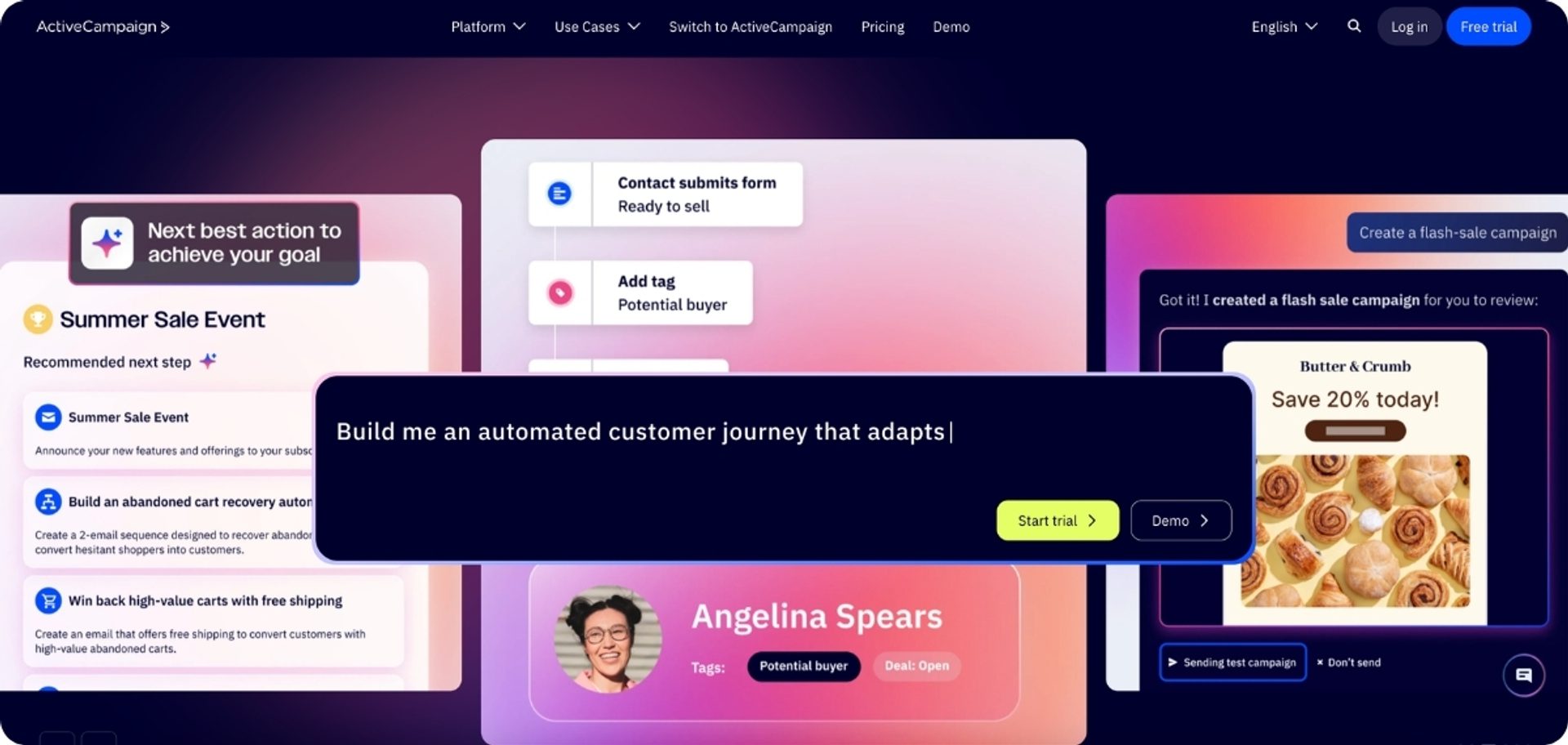
For businesses that have hit the limits of Brevo, ActiveCampaign offers significantly more power and flexibility without requiring an enterprise setup.
- AI optimization across the full marketing lifecycle: ActiveCampaign is an AI-native marketing platform, built on the Active Intelligence engine. As well as end-to-end campaign and automation creation, it powers a number of proactive, strategic recommendations based on customer behavior, continuously executing on optimization in the background. This level of extensibility is very difficult to find elsewhere.
- Advanced automation that adapts in real time: ActiveCampaign’s visual automation builder supports branching logic, goals, split testing, and multi-path journeys, so campaigns respond dynamically as customers move through the funnel. AI also helps lower the setup burden by creating intelligent, goal-aware, cross-channel automations from simple prompts.
- Higher deliverability that improves ROI on every send: ActiveCampaign offers an impressive suite of features to secure your sending reputation. Native domain verification tools, dedicated IPs, bounce management, and list hygiene automations all help ensure emails reach the inbox and drive engagement.
ActiveCampaign is ranked as the top sending provider in third-party tests, with a 94.2% deliverability score from EmailToolTester.
- Fully integrated CRM and pipeline automation: ActiveCampaign combines marketing automation with a native CRM, pipeline management, and lead scoring in one system, so marketing and sales operate from shared logic and shared data. That becomes even more powerful when AI-driven signals and segmentation help surface high-intent contacts earlier.
- Deeper segmentation built for more sophisticated personalization: Dynamic, behavior-based segmentation and AI-suggested segments make it easier to find high-value groups and personalize campaigns as data grows more complex. Brevo supports segmentation too, but ActiveCampaign gives teams more flexibility when they need targeting to evolve automatically rather than rely on simpler filtering.
- Analytics and reporting that answer the big questions, fast: ActiveCampaign goes beyond campaign-level metrics with full journey reporting, attribution insights, and performance tracking across automations, channels, and lifecycle stages. Proactive, AI-driven insights and recommendations are layered in to help improve what happens next. ActiveCampaign is a very strong option for teams that want reporting to guide decisions, not just describe past performance.
- Scalability and value that improve as you grow: ActiveCampaign is built to scale with your strategy, not just your contact list. As your marketing becomes more sophisticated, your data unlocks deeper automation, segmentation, CRM, and AI capabilities—without needing to layer in additional tools. Compared to Brevo’s send-based model, which stays relatively flat in capability, ActiveCampaign delivers increasing value as your needs evolve.
While ActiveCampaign offers significantly more capability than Brevo, it’s still built to stay approachable. With AI-assisted workflows across the platform, visual builders, and a library of 1,000+ automation recipes and 250+ customizable templates, teams can launch sophisticated campaigns quickly without needing deep technical expertise.
ActiveCampaign is particularly well-suited to growing SMBs, SaaS companies, ecommerce brands, and B2B lifecycle marketing teams that need a platform they won’t outgrow.
Across review platforms, ActiveCampaign is consistently praised for its automation depth, flexibility, and ability to support more advanced marketing strategies. Compared to Brevo, users frequently highlight stronger automation capabilities and better alignment between marketing and sales.
What I like most is how powerful and flexible the automation system is. I can build highly personalized email sequences based on user behavior, which makes my marketing feel much more relevant and effective. It’s not just email marketing – it’s a complete system to guide leads through a structured journey. The tagging and segmentation options are especially useful and give me full control over my audience.
| ActiveCampaign | Brevo | |
| Deliverability | 94.2% | 88.3% |
| Which businesses choose this platform? | Growing teams that need advanced automation, CRM alignment, and scalable lifecycle marketing that doesn’t increase manual work. | SMBs looking for affordable email + SMS with simple workflows and multichannel basics. |
| Pricing & value | Free trial available. Paid plans start at $15/month for 1,000 contacts. Core features available early and scale gradually with capabilities and contacts. | Limited free tier available. Paid plans start at $9/month for 5,000 emails (send-based rather than contact-based). Sudden pricing jump to $449+/month to access advanced features. |
| Templates | 250+ email templates and 1,000+ automation recipes. | 40+ email templates. |
| Integrations | 1,000+ native integrations. | 150+ native integrations. |
To dive deeper into the differences between Brevo and ActiveCampaign, read our full ActiveCampaign vs. Brevo comparison.
MailerLite
MailerLite is a Brevo alternative for simplicity-first teams that want a clean, intuitive platform for email marketing. It has better deliverability and design flexibility at its core.
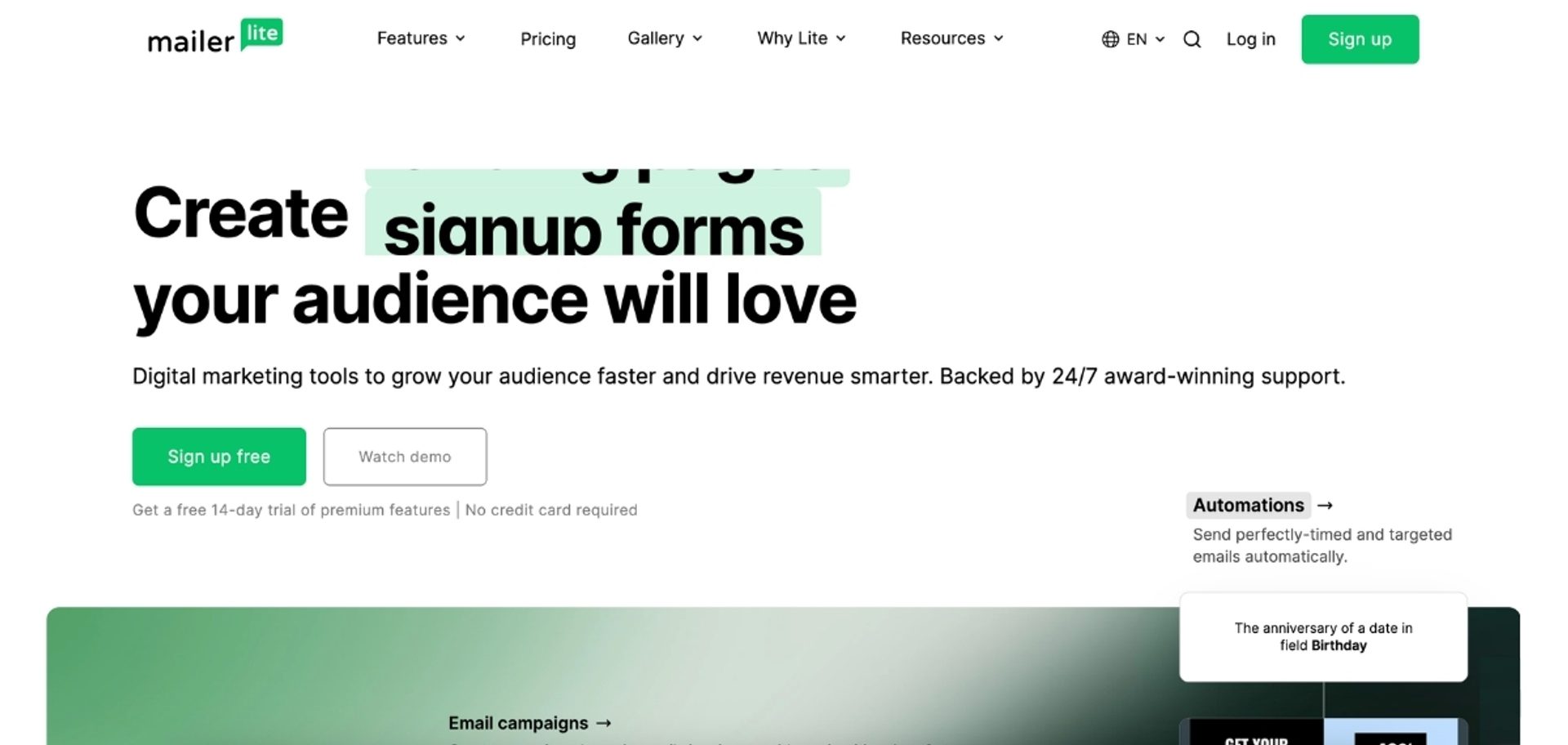
For businesses that find Brevo’s interface cluttered or its workflows harder to navigate, MailerLite offers a more focused experience.
- Cleaner, more intuitive interface: MailerLite is built around simplicity, with a streamlined UI that keeps core tools easy to find and use. Compared to Brevo’s broader, sometimes more cluttered dashboard, it offers a focused experience that’s easier to navigate day-to-day.
- Stronger landing page and design tools: MailerLite includes a flexible drag-and-drop landing page builder available even on lower-tier plans. It gives teams more control over layout and design compared to Brevo, where landing pages are more limited and often gated behind higher plans.
- Automation that’s easier to set up and manage: MailerLite’s visual automation builder is designed for speed and clarity, making it easier for beginners to create workflows without a steep learning curve. While Brevo supports similar use cases, MailerLite’s approach is more intuitive for teams that want to get campaigns live quickly.
- Reliable deliverability for core email programs: MailerLite has built a strong reputation for consistent inbox placement, making it a dependable choice for teams focused on newsletters and core campaigns. While Brevo performs well, MailerLite is often favored by users who prioritize straightforward, reliable email delivery.
- More generous free plan for small senders: MailerLite’s free plan includes up to 500 subscribers and 12,000 monthly emails, along with landing pages and basic automation. Brevo’s free plan is more restrictive, with daily send limits and branding on emails, making MailerLite more appealing for early-stage teams.
MailerLite is intentionally focused. It delivers a solid experience for email marketing, but it doesn’t aim to be a full lifecycle platform. Automation is more limited than other tools on this list, and CRM functionality is minimal. Teams that need deeper segmentation, sales alignment, or cross-channel orchestration are likely to outgrow it quickly.
Across review platforms, MailerLite is consistently praised for its ease of use, affordability, and clean design. Many users see it as a simpler, more enjoyable alternative to tools like Brevo, particularly for core email marketing. At the same time, reviewers note that it’s best suited to smaller-scale programs rather than complex automation or lifecycle marketing.
MailerLite is easy to use and straightforward to implement, even for small teams. The interface is clean, and creating email campaigns, forms, and basic automations is simple. More advanced automation and segmentation options are limited compared to larger enterprise platforms. Some design and reporting features are fairly basic, which may be restrictive for teams with more complex requirements.
| MailerLite | Brevo | |
| Deliverability | 89.8% | 88.3% |
| Which businesses choose this platform? | Smaller teams and creators who want a clean, easy-to-use email platform with strong core features. | Businesses that want multichannel messaging (email, SMS, WhatsApp) in one platform. |
| Pricing & value | Free plan covers 500 subscribers and 12,000 emails per month. Paid plans start at $13.50/month for 1,000 contacts. Advanced tools like enhanced automations and AI tools limited to upper subscription tiers. | Free plan covers 300 emails/day. Paid plans start at $9/month for 5,000 emails. AI writing assistant available to users at lower pricing brackets. |
| Templates | 50+ email templates. | 40+ email templates. |
| Integrations | 150+ native integrations. | 150+ native integrations. |
GetResponse
GetResponse is a Brevo alternative for businesses that rely on funnels and lead generation to drive growth. It combines marketing features and webinar hosting to move prospects from first touch to conversion without stitching together multiple tools.

GetResponse offers a more complete system for building, managing, and optimizing lead funnels.
- Stronger funnel builder for end-to-end conversion flows: GetResponse includes a drag-and-drop landing page builder, forms, and conversion funnels that connect campaigns from opt-in through to purchase. This provides a clearer structure than Brevo for building and optimizing full customer journeys.
- More advanced automation with deeper workflow logic: GetResponse’s automations support more complex conditions, tagging, and multi-step flows, including webinar-triggered sequences and lead scoring paths. Brevo handles simpler workflows well, but GetResponse gives teams more flexibility as their automation needs grow.
- Better lead nurturing and lifecycle management: With built-in lead scoring, tagging, and behavioral segmentation, GetResponse makes it easier to track where contacts are in the funnel and tailor follow-up accordingly.
- More robust reporting tied to funnel performance: GetResponse goes beyond standard campaign metrics with funnel analytics and revenue tracking. This helps teams understand how campaigns contribute to conversions better than Brevo’s campaign-level reporting tools.
- Built-in webinars for lead generation and conversion: One of GetResponse’s standout features is its native webinar functionality, allowing businesses to manage registration, reminders, live sessions, and follow-up in one place.
GetResponse offers more depth than Brevo, but that comes with a tradeoff. The platform can feel heavier and has a slightly steeper learning curve, especially for teams that only need simple campaigns. It’s best suited to businesses that will be very invested in its funnel and lead generation capabilities.
Across review platforms, GetResponse is often praised for its all-in-one approach, particularly for landing pages, webinars, and automation. Users appreciate the ability to manage lead generation and nurturing in one place, though some note that setup can take more time compared to simpler tools like Brevo.
GR helps manage email marketing and lead generation in one place. Instead of using many different tools, everything such as emails, landing pages, and contact lists can be handled in one dashboard. Some advanced automation features may take time to learn for beginners.
| GetResponse | Brevo | |
| Deliverability | 90.09% | 88.3% |
| Which businesses choose this platform? | Lead-gen teams, educators, and marketers building funnels, webinars, and conversion-driven flows | Businesses that want affordable multichannel messaging (email, SMS, WhatsApp) |
| Pricing & value | Free trial available. Paid plans start at $19/month for 1,000 contacts. Higher tier plans unlock stronger features, including webinars, but prices raise incrementally. | Free plan covers 300 emails/day. Paid plans start at $9/month for 5,000 emails. Significant pricing jump to unlock stronger features. |
| Templates | 150+ email templates. | 40+ email templates. |
| Integrations | 180+ native integrations. | 150+ native integrations. |
Want to see how GetResponse compares to ActiveCampaign? Read our deep dive comparison of ActiveCampaign vs. GetResponse.
Mailchimp
Mailchimp is a Brevo alternative for teams that prioritize ease of use, polished design, and a well-established ecosystem. It’s a well-recognized platform in email marketing, making it a popular choice for beginners and small teams.
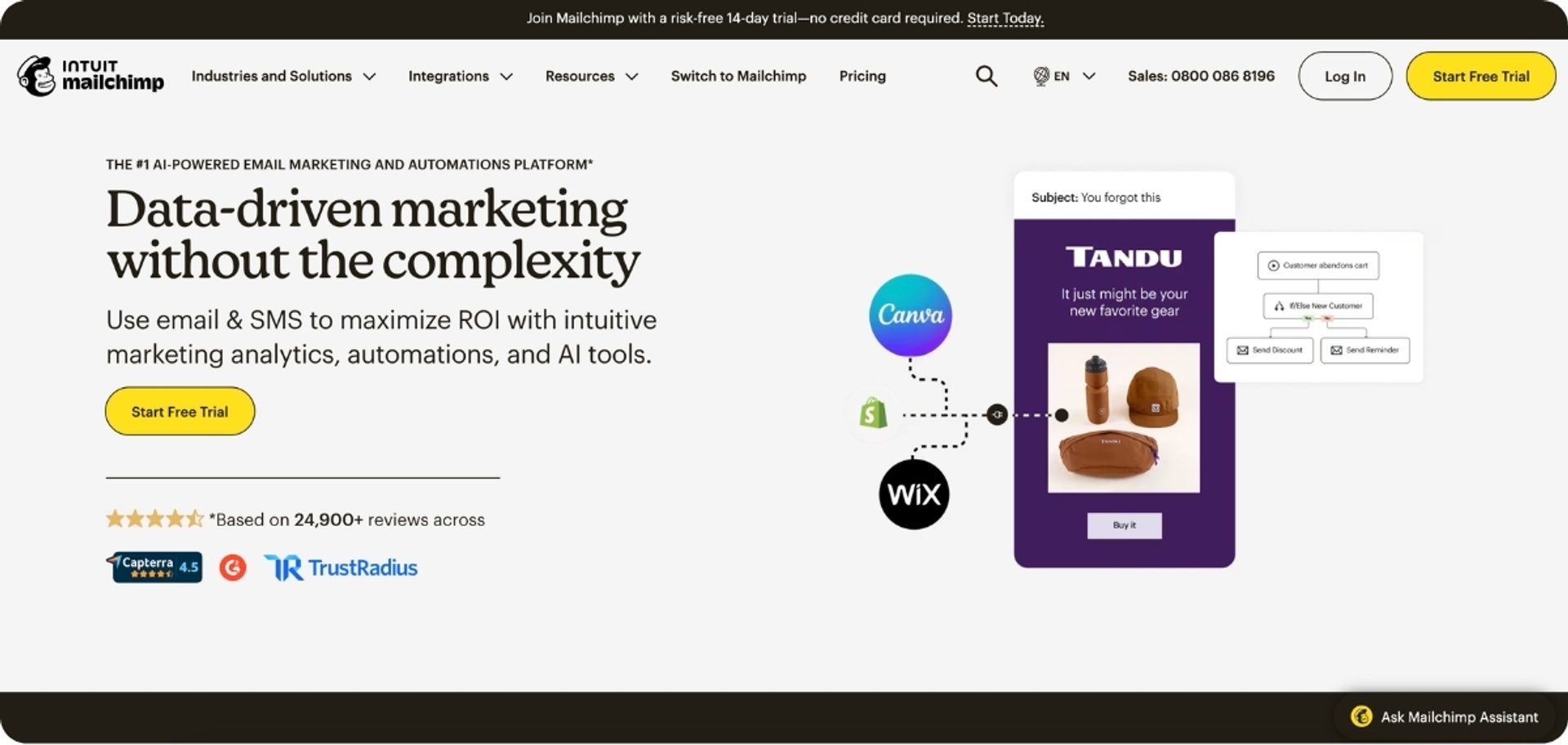
For businesses that want a more refined email-building experience and better onboarding than Brevo, Mailchimp offers a more design-forward and accessible starting point.
- More polished email builder and design experience: Mailchimp’s drag-and-drop editor is widely regarded as one of the most intuitive and visually refined on the market. Compared to Brevo’s more functional editor, it gives teams more control over layout and branding with less effort.
- Larger, more flexible template library: Mailchimp offers a broader range of pre-designed templates, with stronger categorization and customization options. This makes it easier to create high-quality campaigns quickly, while Brevo’s template library is more limited.
- Better analytics dashboards for campaign insights: Mailchimp provides more developed reporting, including engagement trends, click maps, and audience insights. With this, teams get a clearer view of campaign performance and audience response.
- Easier onboarding and faster time-to-value: Mailchimp is designed to get users from signup to first campaign quickly, with guided setup, templates, and a highly intuitive interface. For teams new to email marketing, it often feels easier to learn and operate than Brevo.
Mailchimp improves on Brevo in areas like design, usability, and ecosystem support, but it shares a few of the same limitations. Automation is relatively basic and pricing can increase quickly as contact lists grow or more advanced features are needed. It’s not the strongest option for complex lifecycle marketing or long-term scalability.
Across review platforms, Mailchimp is consistently praised for its ease of use, strong design tools, and accessibility for beginners. Many users see it as a more polished alternative to Brevo for email-first marketing. However, reviewers also mention rising costs and limited automation depth as their needs become more sophisticated.
Mailchimp is a solid email marketing tool with an intuitive interface and a wide range of templates that make it easy to get started quickly. The segmentation and automation features cover the basics well. For teams that have outgrown simple newsletters and need advanced segmentation, behavioral triggers, or tight CRM connectivity, Mailchimp can quickly feel like a limitation rather than an enabler.
| Mailchimp | Brevo | |
| Deliverability | 89.5% | 88.3% |
| Which businesses choose this platform? | Beginners and small teams that want polished design, easy setup, and strong ecosystem support | Businesses that want affordable send-based pricing for multichannel messaging. |
| Pricing & value | Free tier available but limited to 500 sends/ month and a 250 contact list. Paid plans from $26.50/month for 1,000 contacts. Restricted access to automation on lower-tier subscriptions. Low-cost entry point for very small lists with pricing jumps as features expand. | More generous free plan available, with 300 daily sends and unlimited contacts. Paid plans start at $9/month for 5,000 emails. Similar low-cost entry point and significant pricing jump to unlock stronger features. |
| Templates | 250+ email templates. | 40+ email templates. |
| Integrations | 300+ native integrations. | 150+ native integrations. |
Want to see how Mailchimp compares to ActiveCampaign? Read our deep dive comparison of ActiveCampaign vs Mailchimp.
HubSpot
HubSpot is a Brevo alternative for teams that prioritize CRM-centric marketing and deep alignment between marketing, sales, and customer success. It’s designed as a modular platform and offers businesses a broad system to manage the entire lifecycle.
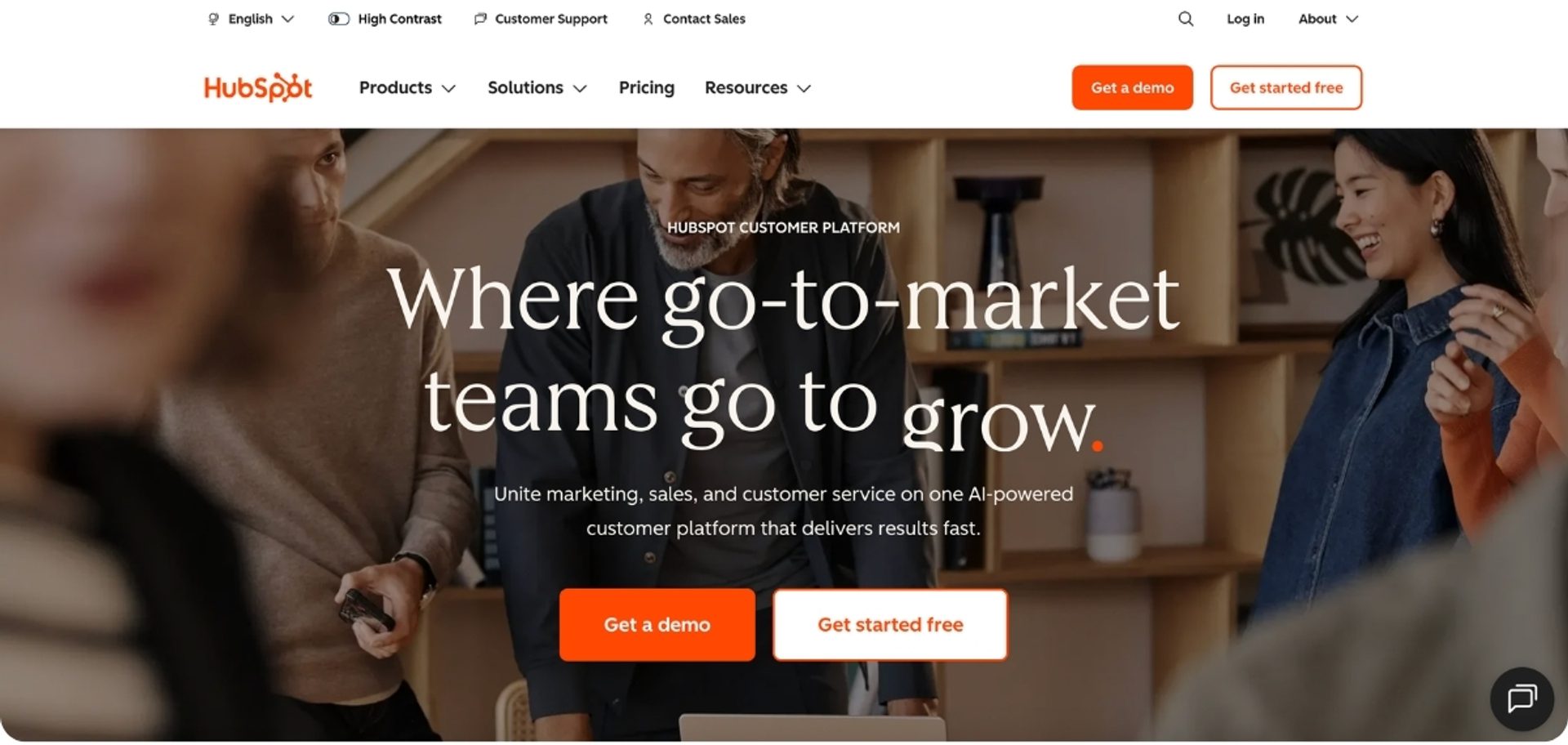
For sales-first teams that find Brevo’s CRM too lightweight or disconnected from broader business processes, HubSpot offers a comprehensive and integrated approach.
- Enterprise-grade CRM at the core of the platform: HubSpot’s CRM is the foundation of its ecosystem, supporting advanced contact management, deal tracking, and customer data modeling across teams. Compared to Brevo’s basic CRM functionality, it provides significantly more power for managing complex customer relationships.
- Advanced sales pipeline automation: HubSpot allows teams to automate deal stages, assign tasks, trigger follow-ups, and manage pipelines dynamically based on customer behavior. This creates a much more structured and scalable sales process than Brevo’s more manual approach.
- Full customer lifecycle tracking across touchpoints: HubSpot connects marketing, sales, and service interactions into a single timeline, giving teams complete visibility into how leads become customers. This level of lifecycle tracking isn’t possible to achieve in Brevo without complex integrations.
- More advanced reporting and attribution: HubSpot provides detailed analytics that tie campaigns directly to pipeline and revenue, including multi-touch attribution and custom reporting. Brevo’s reporting is more campaign-focused, making it harder to measure full-funnel performance.
- Stronger marketing-sales alignment in one system: HubSpot’s biggest advantage is how tightly it connects teams. Marketing automation, CRM data, sales workflows, and customer support tools all operate on the same data layer, eliminating the silos that often exist when using Brevo alongside separate systems.
HubSpot solves some of the limitations that push teams beyond Brevo—but it’s an expensive choice. Combining marketing, sales, and service typically requires adopting multiple platform “hubs” and the associated costs. It’s fundamentally built as a sales-forward, CRM-first platform, which can create friction for marketing-led teams. Deliverability performance is less of a core focus compared to more email-centric platforms, and the UX can feel heavier as you scale.
Across review platforms, HubSpot is widely praised for its powerful feature set, polished experience, and ability to unify teams around a single system. Many users see it as a major step up from Brevo for managing growth. However, reviewers frequently point to pricing and complexity as their biggest challenges as usage expands.
As someone running growth systems and AI-driven outbound programs, what stands out is how flexible the platform is for orchestrating workflows, signals, and integrations. The workflow engine, while powerful, can become difficult to manage at scale. When you have many automation flows running across different teams, debugging and maintaining them can get complex.
| HubSpot | Brevo | |
| Deliverability | 77.7% | 88.3% |
| Which businesses choose this platform? | B2B sales-first teams that need CRM-driven marketing, sales automation, and full lifecycle tracking in one platform. | Businesses that want affordable multichannel messaging for marketing teams. |
| Pricing & value | Limited free plan available. Paid plans start at $9/seat/month to access basic email marketing features for 1,000 contacts. Core marketing features like automation and advanced reporting are only available for Professional users at a steep jump to $800/month. This plan also requires a $3,000 one-time onboarding fee. | More generous free plan available. Paid plans from $9/month for 5,000 emails with pricing based on sends. More basic marketing features are available to lower tiers. |
| Templates | Text-only email templates available, mostly with a sales and follow-up focus. | 40+ email templates. |
| Integrations | 2,000+ native integrations. | 150+ native integrations. |
Want to see how HubSpot compares to ActiveCampaign? Read our deep dive comparison of ActiveCampaign vs. HubSpot.
How to pick the best Brevo alternative for your team
Choosing a Brevo alternative—especially if you’re migrating contacts, automations, and campaign data—should focus on long-term value, not just short-term feature upgrades.
Many platforms will seem similar on the surface. But as your marketing evolves, differences in automation depth, deliverability, and scalability become much more important. Look for a platform that won’t just solve today’s limitations, but will continue to support your strategy as it grows.
When comparing alternatives, focus on the areas where Brevo typically starts to fall short:
- Automation depth: Brevo’s workflows are effective for simple campaigns, but can feel limiting as you move into lifecycle marketing. Look for platforms that support branching logic, goals, and full customer journey orchestration.
ActiveCampaign is built for automation. AI-assisted workflows include dynamic paths, split testing, reusable logic, and 1,000+ pre-built recipes help you build once and scale without constantly rebuilding.
- Deliverability and performance: Inbox placement directly impacts revenue. Even small differences in deliverability can significantly affect campaign results.
ActiveCampaign consistently ranks at the top of third-party tests, with a 94.2% deliverability rate, helping ensure more of your campaigns reach your audience compared to platforms with weaker infrastructure.
- Sales and marketing integration: Brevo includes a basic CRM, but it doesn’t fully connect marketing engagement with sales actions. As teams grow, this often leads to disconnected systems.
ActiveCampaign combines automation with a native CRM, including pipeline automation, lead scoring, and task management—so marketing and sales operate from the same data and workflows.
- Pricing over time: Entry pricing rarely reflects real cost. As your contact list grows, it’s important to choose a platform that will scale at a reasonable rate alongside your strategy.
ActiveCampaign’s pricing scales with contacts, giving teams access to automation, segmentation, CRM, and AI from early plans. It’s also easy to invest in specific features that suit your team’s needs, but only when the ROI makes sense.
- AI capabilities that reduce manual work: Many platforms focus AI on content generation. But the bigger opportunity is reducing the manual effort of building, optimizing, and scaling campaigns.
ActiveCampaign’s AI-native approach goes further, with predictive sending, AI-suggested segments, automation building from natural language, and proactive performance insights—helping teams execute and improve campaigns continuously.
Migration is another factor that’s easy to underestimate. The success of your switch depends on how quickly you can get up and running without rebuilding everything from scratch.
Here’s how the platforms in this list compare:
- ActiveCampaign: Offers free agentic migration and onboarding, including migration of data, contacts, automations, and templates on qualifying plans. Backed by extensive self-serve resources, AI-assisted onboarding, and a large support ecosystem.
- MailerLite: Provides simple, self-serve import tools that make it easy to get started, but with limited hands-on support for more complex migrations.
- GetResponse: Offers guided migration resources and onboarding support, with more structured assistance available on higher-tier plans.
- Mailchimp: Supports basic import tools, but migration is largely self-serve and more advanced workflows typically need to be rebuilt manually.
- HubSpot: Provides onboarding support, but this is often tied to higher-cost plans and can require a more involved setup across multiple hubs. Compulsory onboarding also comes at a high cost for plans that enable real marketing features, starting at $3,000.
The best Brevo alternative is the one that aligns with how your business expects to grow—not just the one with the most features.
If you want a simple, email-first platform with clean UX, tools like MailerLite or Mailchimp are strong options.
If your focus is lead generation or sales-driven workflows, GetResponse or HubSpot may be a better fit.
If you’re looking for a high-deliverability platform that can support advanced automation and cross-channel journeys now and in the future, ActiveCampaign can’t be beaten.
ActiveCampaign consistently performs well for teams making the switch from simpler platforms:
- 3x faster campaign creation
- 88% of customers say it delivers value faster than competitors
- 77% report improved lead generation and conversion
- 68% reduce the cost to acquire, convert, and support customers
Ultimately, switching platforms should be a step forward—not just a lateral move. If you’ve outgrown Brevo, the right choice is the one that helps you scale your marketing without hitting the same limits again.
Start your free ActiveCampaign trial and see how much more your marketing can do.
FAQs
Why do businesses look for Brevo alternatives?
Businesses often start with Brevo for its affordability and multichannel basics, but look elsewhere as their marketing becomes more complex. Common reasons include limited automation depth, simpler segmentation, and difficulty scaling into full lifecycle marketing and revenue attribution.
What is the best Brevo alternative for long-term growth?
The best Brevo alternative depends on your goals, but for long-term growth, most teams need a platform that supports advanced automation, deeper personalization, and scalable reporting. ActiveCampaign stands out here by combining automation, CRM, and AI in one system that can grow with your strategy. It supports the transition from basic email campaigns to full lifecycle marketing without requiring another platform migration down the road.