When we decided to stand up our Autonomous Marketer Live webinar series, we set out with a simple premise: find marketers who are actually doing autonomous marketing well, put them in a room (virtual, but still), and let them show their work.
Six webinars later, we've heard from:
- A B2B consultant who automated her entire sales pipeline
- A solo university enrollment director who rebuilt his email system from scratch
- A law firm marketer who went from spreadsheet marathons to 30-second reports
- And many more to come
Across all of it, a few things have become clear. The gap between marketers who are frustrated with AI and those who aren't isn't about which tools they use. It's about how they think about their existing workflows and how AI changes them.
Here's what we've learned.
Most marketers are using AI, but almost none are using it effectively
We opened the series with a stat that's become something of a throughline: 82% of marketers are using AI, but only 23% are using it effectively.
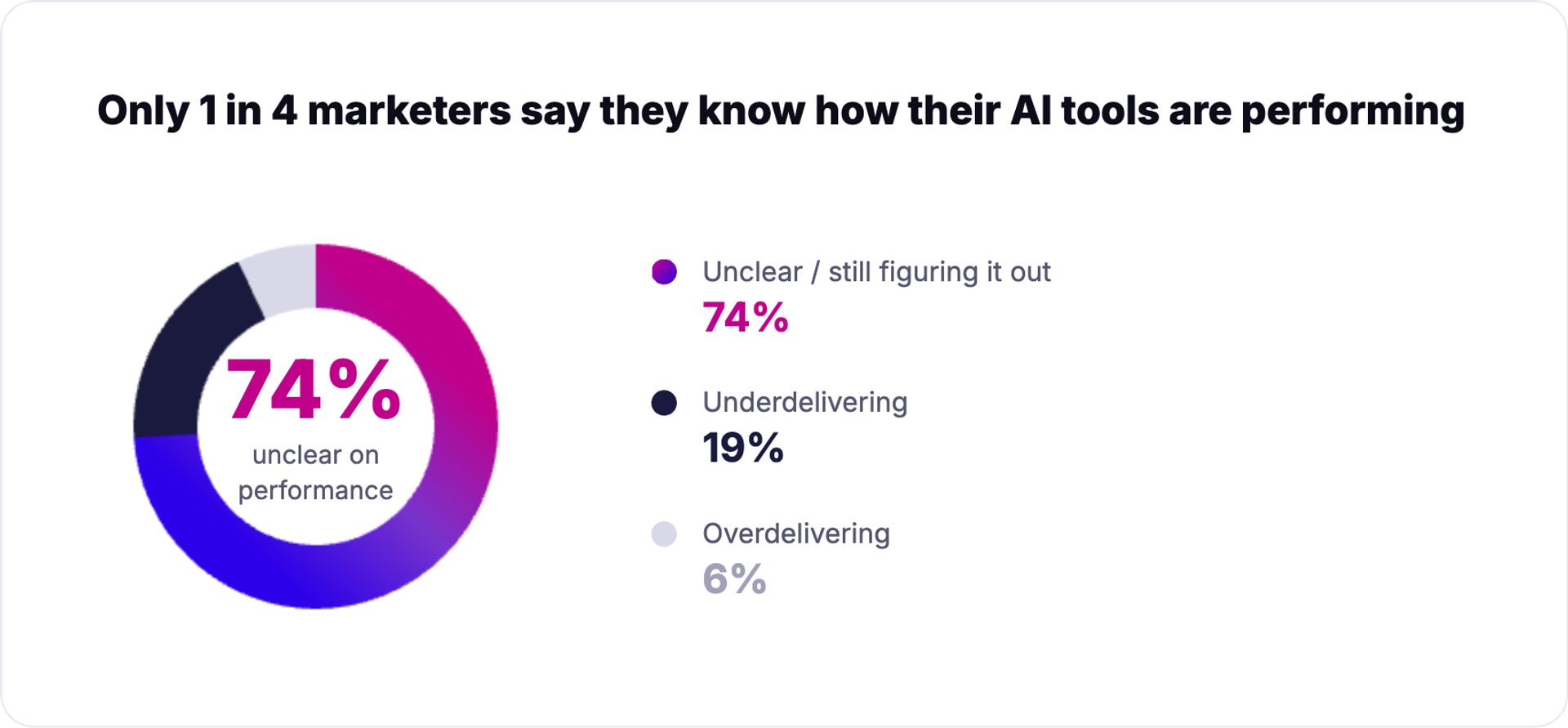
And building on this, when we asked our first webinar audience whether AI had overdelivered or underdelivered on its promises, the "underdelivered" camp was not shy about raising their hands.
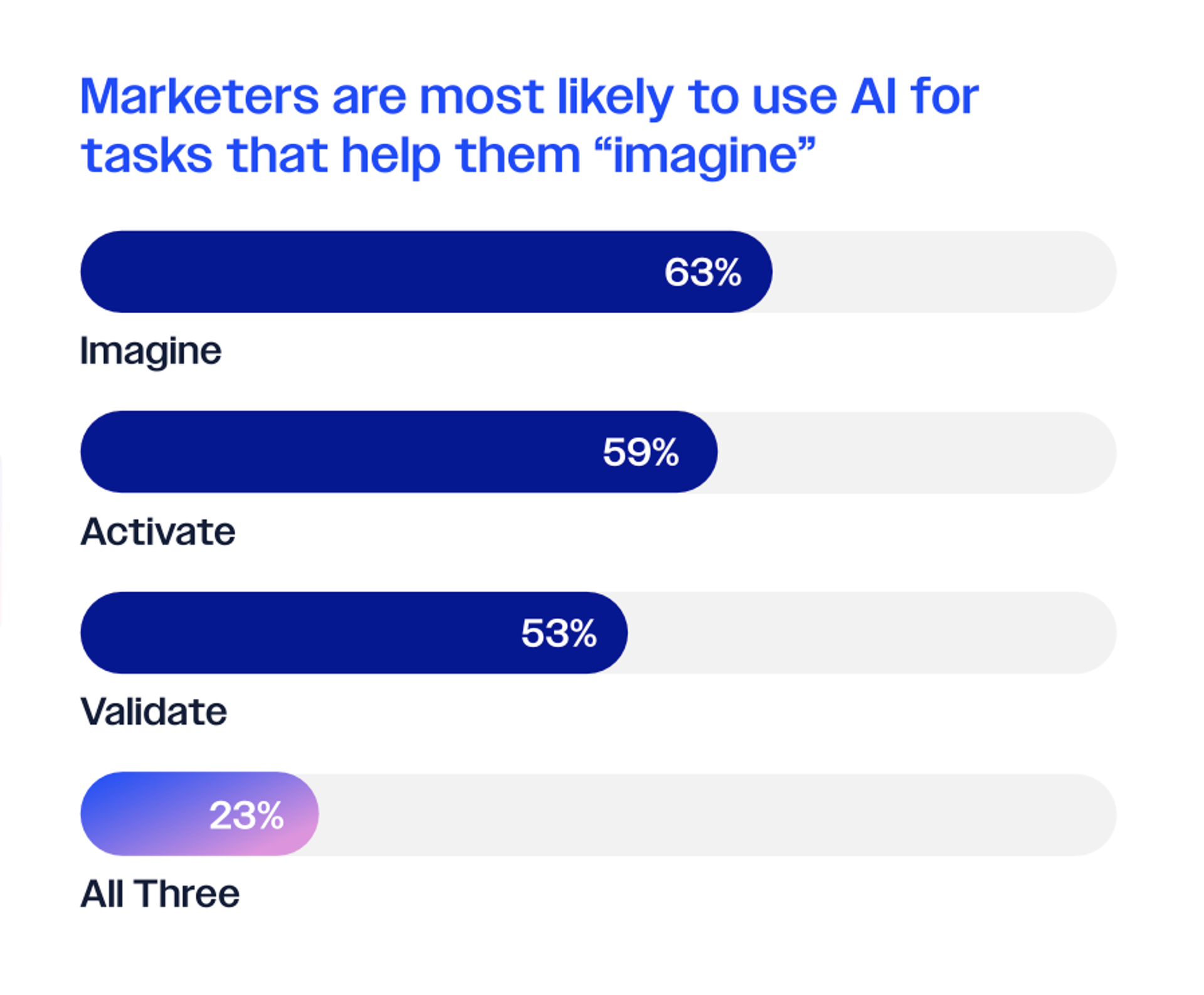
That reaction makes sense when you look at what the majority of marketers are using AI for. Most are using it to speed up individual tasks—drafting a social post, generating a subject line, summarizing a report. Useful, but not transformational.
The 23% are doing something different: they're using AI across the full marketing motion, what we've been calling the Imagine, Activate, Validate loop. They're not just creating faster. They're executing smarter and learning continuously.
The difference isn't effort. It's architecture.
→ Watch in full: The Case for Autonomous Marketing
The best workflows to build are the ones you’re most tired of doing manually
One of the most useful reframes we heard came from Amanda Pressner Kreuser in our third webinar. She'd been spending 20-plus hours a week on business development, prospect research, outreach drafting, follow-up emails, pipeline tracking, when she had the realization that changed how she works:
My tasks were time-consuming but they followed clear logic. It was a system. It worked and was repeatable, it was just tedious—and it left me with zero percent brain space to do anything strategically to grow my business.
That's the test. Not "can AI do this?" but "does this task follow predictable logic, repeat often, and drain cognitive resources I'd rather spend elsewhere?" If yes, it's a candidate for automation.
Maddy Osman had the same realization about content curation. Every morning, she'd spend an hour or two scanning industry news, deciding what was relevant for her CMO audience, drafting platform-specific posts, and scheduling them. On busy days, she'd skip it entirely and miss the visibility window. The work wasn't novel. It was pattern recognition at scale, which is exactly what AI agents are built for.
We wanted systems that could think, not just execute.
Together, Amanda and Maddy were burning through 20-plus hours a week on tasks that, once they mapped the logic, turned out to be automatable without sacrificing quality.
- Amanda's five-GPT system now handles referral research, email drafting, scheduling, follow-ups, and pipeline tracking.
- Maddy's Zapier agents surface relevant news, assess audience fit, draft social posts, and send everything to Slack for her final review before anything goes live.
The time savings: four to five hours a week for Amanda, adding up to more than 200 hours a year.
Before automating anything, ask three questions:
- Does this task follow clear, repeatable logic?
- Does it happen often enough to be worth systematizing?
Is it draining cognitive resources you'd rather spend on strategy? If you answered yes to all three, you have a workflow worth building.
→ Watch in full: Autonomous Marketing in Action: Real Success Stories
→ Read: Amanda's 5-GPT biz dev system
→ Read: Maddy’s process to build a news-scanning AI agent
Autonomous doesn’t mean unsupervised
Something that came up in almost every webinar: none of these marketers are hitting send on their emails, social posts, or campaigns without looking first. Amanda reviews every AI-drafted follow-up before it goes out. Maddy approves every social post before it's published. Don Purdy at UAlbany, who we’ll talk about a little later on, still steers the strategy even as Active Intelligence handles the analysis and campaign builds.
Setting the standard in our new AI-centric world, Maddy talked about the human-in-the-loop concept directly in our third webinar:
AI does the heavy lifting, but I have the final approval. You want to trust the output, but you also want to maintain quality control before it becomes public-facing.
This isn't a sign of not trusting the tools. It's a sign of mature AI adoption. The goal isn't to remove yourself from the work. It's to remove yourself from the parts of the work that don't require you.
The quality of your output is a direct result of how well you prompt
Our second webinar with Pam Didner and our fifth with Bob Pearson both revolved around the same insight from different angles. The quality of your AI output is a direct function of how well you frame your input.
Pam walked through the evolution of a single prompt from beginner to advanced, showing how adding specificity (tone, audience, word count, competitor context, uploaded brand files) produces dramatically different results. The intermediate move alone, uploading brand guidelines, keyword data, buyer personas, and competitor posts before asking for a blog draft, is something most marketers aren't doing.
Pam's prompting progression:
- Beginner: "Write a blog post about email marketing benefits."
- Developing: Add word count, tone, target audience, CTA.
- Intermediate: Upload brand guidelines, keyword analysis, buyer personas, competitor posts. Ask AI to scan competitor sites for differentiation.
- Advanced: After drafting, ask AI to score the piece for GEO optimization (1–10), suggest keyword gaps, strengthen the CTA, and generate headline variations.
Bob's take was more philosophical but equally practical. He pushes back on the concept of "prompt engineering" entirely:
We should be looking at AI as a way to mirror our own intelligence. That’s not a prompt—that’s a series of strategic questions, depending on the decision point.
His framework: treat AI like the smartest person you've ever worked with sitting next to you. You wouldn't hand them one vague sentence and walk away. You'd have a conversation, ask follow-up questions, push back on their answers, and refine until you got what you needed.
One tactical extension of this is volume. When naming a client project, Sean Blanda, owner of Gate Check Studios, asked AI for hundreds of examples across different themes. The right answer clicked while he was typing the next prompt.
We get so entranced with AI that we forget that we’re actually pretty smart, collectively. Our brains are really good at pattern recognition.
Ask for 50 headlines, not five. Your brain will do the rest.
“What am I not seeing?” is the most underused prompt
Pam made a point that we keep coming back to. She argued that marketers are underpowered not in creation or execution, but in validation—using AI to pressure-test decisions, surface inconsistencies, and find what you're not seeing.
Some of her suggested uses: entering your marketing strategy and asking, "What am I missing?" Running completed work through an AI check for on-brand consistency. Asking AI what other KPIs might reflect success beyond the ones you're already tracking. And her favorite—the decision validation:
You already made a decision. You’re allocating budget from paid ads to email. You can say: what if I did X instead of Y? What are the unintended consequences I need to be aware of?
This isn't outsourcing judgment. It's using AI as a constructive critic before you commit, which is exactly when you want one.
The AI maturity ladder is not linear
One of the more memorable moments of the series was when Pam pushed back on the idea that AI maturity is a single dimension you move up uniformly. She was responding to a question about where she'd place herself on the five-level framework (Beginner → Developing → Intermediate → Advanced → Expert):
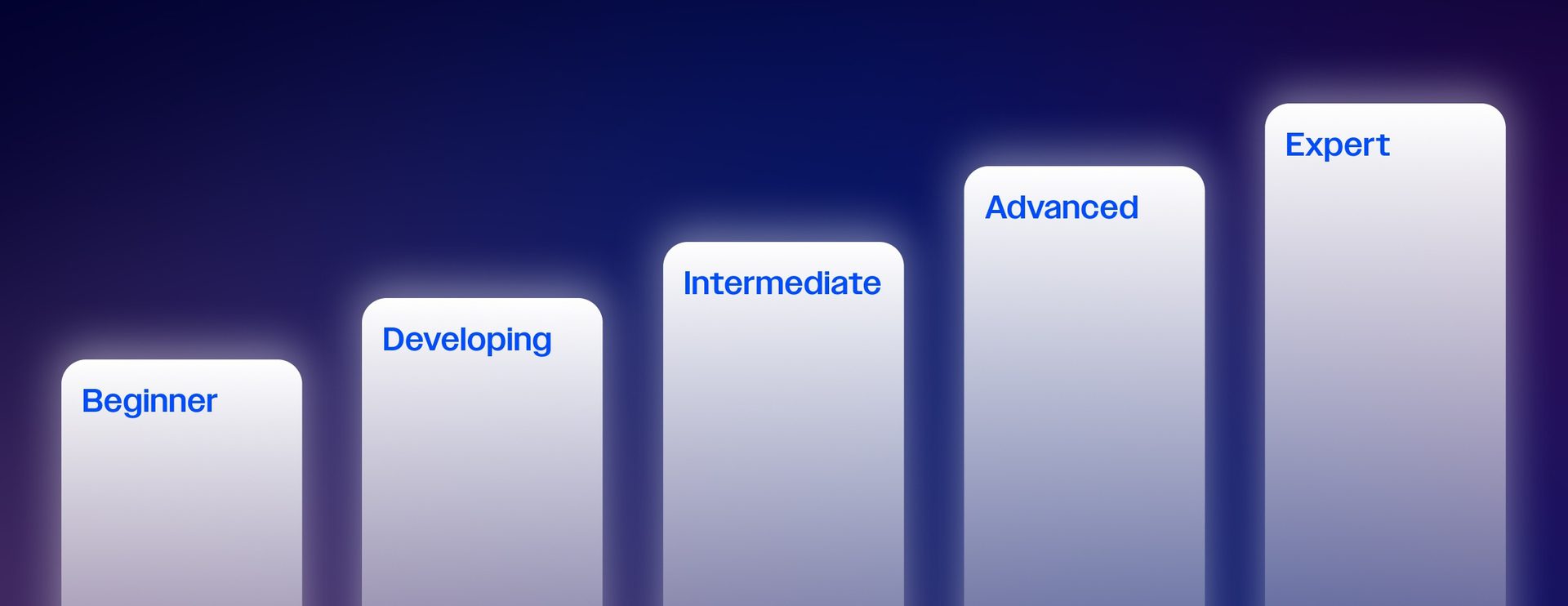
I’m everywhere on the maturity scale. On prompting, I’m pretty good. On AI agent creation? I’m still probably at the beginner stage. So, depending on what you do or your interaction with AI, you may be at different stages.
This reframe matters because it takes the pressure off. You're not behind just because you haven't built a multi-agent workflow yet. You might be advanced at content prompting and a beginner at analytics prompting, which is actually most marketers' reality. The useful exercise is assessing your maturity by dimension, not overall.
Take our quiz and see where you land on the AI maturity ladder!
Real results don’t require complex starting points
It would be easy to look at the workflows in this series and feel like you need to build something complex before you can see real results. Luis Fernando Castillon's story at Parrish Law is a useful corrective.
When Luis joined the Virginia personal injury firm in 2024, email marketing was running on Mailchimp with no segmentation, no personalization, and no real reporting. Open rates sat between 17 and 19%, sometimes dipping below 10%. Monthly reports took him more than 10 hours to build manually, and by the time they were done, the data was already stale.
I was reporting on the past instead of planning for the future.
The switch to ActiveCampaign started with one fundamental move: segmentation. Car accident prospects and dog bite prospects have different questions, different timelines, and different emotional states. Sending them the same email wasn't just ineffective, it was actively training email providers to treat Parrish Law as irrelevant.
Once the segmentation was in place, Active Intelligence became significantly more powerful. Luis now asks questions in plain language and gets instant visualizations, performance breakdowns, and recommendations in under a minute. Campaign planning that used to mean hours in spreadsheets now starts with a prompt.
It takes me 30 to 40 seconds instead of the three hours I was spending to understand how we’re performing and what we can do better.
The results? Open rates jumped from under 20% to 35 to 40%. He saves 12 to 15 hours a month on reporting alone. The firm's contact list grew from a few hundred to 5,000 in a matter of months. And Luis's role changed.
I shifted from being an executor to a strategic advisor.
→ Watch in full: Building Autonomous Marketing
→ Read: How Parrish Law Boosted Open Rates from 17% to 40% using ActiveCampaign
The paradox: a bigger list can mean fewer people actually hear from you
Let’s get back to Don! Don Purdy's story at the University of Albany made this point more clearly than any feature description could. He manages recruiting and enrollment for UAlbany's executive MBA program solo, working with roughly 1,000 carefully curated contacts.
Before he found ActiveCampaign, he was batch-blasting the same emails to alumni from 20 years ago, recent graduates, and mid-career professionals. All were getting the same application deadline reminders. All were increasingly tuning him out.
The breaking point for me was realizing we weren’t being ignored. We weren’t even being seen.
The fix wasn't complicated in concept: segment by behavior, send relevant content, track what works. But executing that across 1,000 contacts as a one-person operation required infrastructure that could scale. That's what pushed him to ActiveCampaign.
Deliverability jumped from around 50% to over 99%. Open rates climbed to 40%. The prospect feedback changed completely.
Instead of ‘I’ve never heard from you,’ I started getting ‘thanks for the reminder’ and ‘that article was exactly what I needed.’
Active Intelligence now surfaces what's working across his campaigns, benchmarks his results against higher education peers, and generates new campaigns built from the successful elements of past ones. He's not starting from scratch each time. He's building on what already worked.
The AB tests run themselves. Active Intelligence surfaces the insights. I just need to apply the learning and keep the cycle going. I’m steering strategy. I’m not pulling reports. I’m not guessing what to test next. The system does the heavy lifting.
Don's three steps to get started this week:
- Audit your deliverability. Check where your emails are actually landing, then ask whether your segments are based on who people are or what they do.
- Build one behavioral segment. Pick one interest area, set up a tag that applies automatically based on actions (clicks, opens, conversions), and build one simple automation around it.
- Ask Active Intelligence five questions. Stop pulling reports and start having conversations. Which segments engage the most? What subject line patterns work? Who engaged but didn't convert?
More stories are coming. Yours could be one of them.
We're six webinars in, and we have no shortage of stories left to tell. Autonomous marketing isn't a destination—it's a practice, and the marketers figuring it out are doing it iteratively, one workflow at a time.
If you've been building something and want to share it, we want to hear from you. We're actively looking for marketers to feature in the AI Lab and in future webinars—people who are experimenting, seeing results (or learning from what didn't work), and willing to show their work.
The Autonomous Marketer newsletter goes out every other week with new stories, workflows, and research from marketers who are building in real time. It's free, and it's the fastest way to stay connected to this community as it grows.
→ Subscribe to our newsletter and get in touch to share your story on the AI Lab