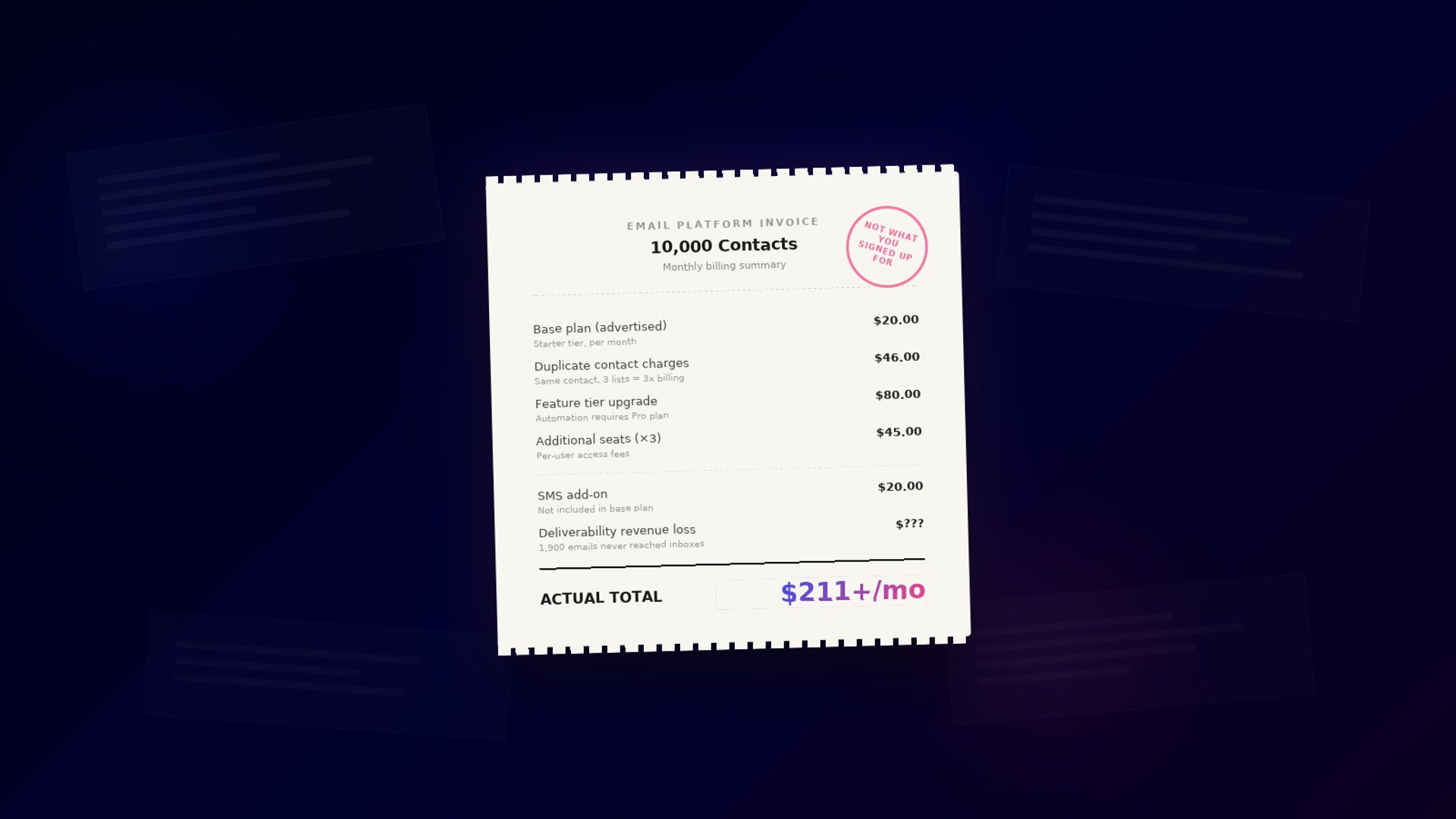
Here’s a number worth sitting with: 1,900 emails. That’s the number of emails that never reach an inbox if you send 10,000 emails and have a deliverability rate of 75%, instead of a deliverability rate of 94%. Same list, same campaign, and the same cost to build and send. But 1,900 of them never reached a single inbox.
That gap never shows up on a pricing page. Neither do per-list contact charges, feature paywalls, or seat fees. Platform pricing is engineered to look reasonable at the starting line, and the full cost structure only reveals itself at scale — precisely when you can least afford surprises.
This guide breaks down how to calculate the true total cost of ownership (TCO) for your email marketing stack, what to look for before you commit to a platform, and what affordable actually means when you run the math at your real contact volume.
6 costs that don’t appear on the pricing page
Most email marketing platforms advertise their entry-level pricing prominently. $15 per month. $20 per month. Sometimes free. These numbers are real, but they are misleading and reflect just a fraction of what you’ll actually pay.
The full cost of an email marketing platform includes:
- Base subscription fees: The number you see on the pricing page (often with the line “plans starting at…”)
- Contact count methodology: How the platform counts the same subscriber across lists. (Note: Some email marketing platforms define contacts in a way that means you could be paying for inactive contacts, or paying twice for the same contact if they’re on more than one list.)
- Feature tier requirements: What plan level you need to access the capabilities you’ll actually use
- Channel add-ons: SMS, WhatsApp, transactional email, etc., are often priced separately
- Seat costs: Per-user fees for team access
- Deliverability impact: The revenue cost of emails that never reach the inbox.
Each variable can meaningfully increase your actual cost. Together, they can make a nominally affordable platform substantially more expensive than one with higher base pricing and a more transparent cost structure.
The numbers on pricing pages are real, but they can be misleading and reflect just a fraction of what you’ll actually pay.
The per-list contact penalty
One of the most consequential (and least discussed) pricing variables in email marketing is how a platform counts contacts.
The standard for most modern platforms is to charge once per unique contact, regardless of how many lists, tags, or segments that contact appears in. You can build multiple audience segments, run parallel campaign tracks, and organize contacts into fine-grained cohorts without any pricing penalty.
Some platforms charge per list appearance. A contact on your newsletter list, your onboarding sequence, and your re-engagement campaign is billed as three contacts—despite being one subscriber.
For small lists, this is minor. For a growing business running multiple campaign tracks, the math compounds fast. At 5,000 unique contacts organized across five audience segments, per-list pricing means up to 25,000 billable contacts. Per-contact pricing means 5,000.
This count methodology is tied directly to your financial risk: exceeding your contact limit on many platforms triggers an automatic upgrade to the next pricing tier, or an immediate overage fee that can increase your monthly bill.
“If the same email address appears in three different lists, how many contacts does that count as for billing?”
That answer alone can dramatically change your cost calculation.
Why the features you need are always one plan away
The second major hidden cost is feature gating – locking advanced capabilities behind higher tiers – which forces an upgrade before you’ve fully tested or outgrown the platform.
Marketing automation depth is the most commonly gated category. Multi-step behavioral workflows, conditional logic, predictive send time, and lead scoring are frequently reserved for mid-tier or enterprise plans. On a starter tier, you get broadcast campaigns and simple sequences. The automation that makes email marketing genuinely powerful is one plan level – and often one significant price jump – away.
This creates a predictable upgrade cycle: you start on the affordable plan, build momentum, and hit the automation ceiling precisely when your business is scaling and you can least afford friction. The upgrade happens under pressure, not by choice.
To break this cycle, evaluate platforms not at the plan you’d start on, but at the tier that covers your full requirements for the next 12 to 18 months. Then verify, feature by feature, that your requirements are actually available there.
Features worth checking explicitly:
- Multi-step automation with behavioral triggers
- Advanced segmentation with multiple condition types
- A/B testing beyond subject lines: body copy, send time, audience
- CRM integration or built-in deal tracking
- Predictive sending: note whether the tool optimizes a single best send time across all contacts, or does true 1:1 optimization based on each contact’s individual history
- AI features, like Active Intelligence, which is embedded throughout the platform
- Custom reporting beyond standard open and click dashboards
If the features you need live two tiers above your starting point, the “affordable” entry price is a trial rate, not a sustainable cost.
The deliverability revenue gap
Back to those 1,900 emails. Deliverability — the percentage of your email sends that land in the inbox — should be one of the first things you evaluate.
Independent testing by EmailTooltester shows significant variation across major platforms: nearly 20 percentage points separate the top-ranked platform (94.2%) from lower-ranked alternatives (as low as 74.7%). That deliverability gap is not a vanity metric; it’s a direct revenue gap.
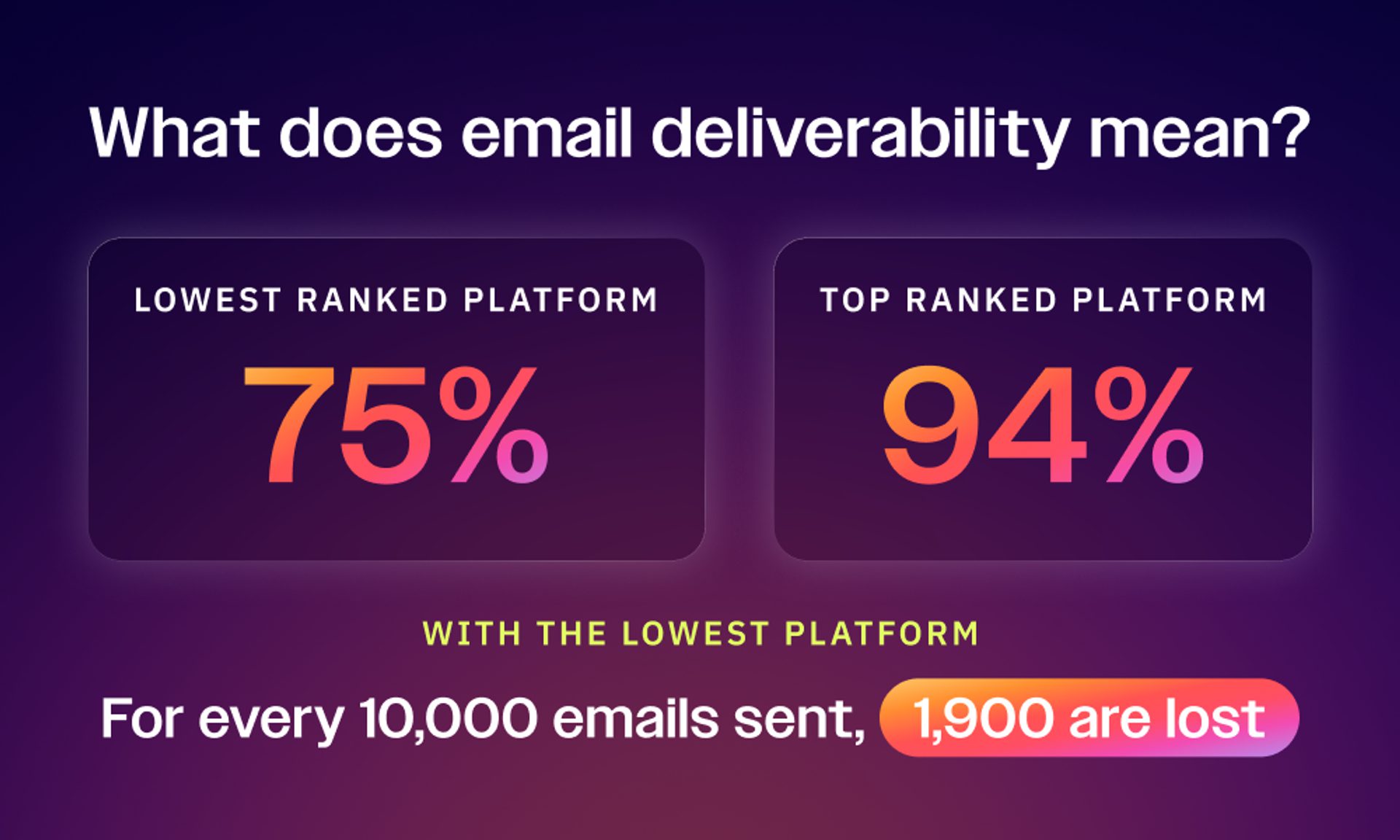
Based on the latest deliverability data from EmailTooltester
For 10,000 emails sent, a 19 percentage point difference in deliverability rate means 1,900 fewer emails that get to their destination. Same campaign, same cost to send, but that gap means vastly different revenue opportunity.
Over the course of a year, the lost customer conversions and missed sales from poor inbox placement can easily exceed the difference in subscription cost, compounding your revenue loss with every campaign you run.
When evaluating platforms, ask for third-party deliverability benchmarks, not self-reported numbers. Look for organizations that run real-world inbox placement tests across major email providers.
What 10,000 contacts actually costs: A side-by-side example
Let’s say you’re doing a comparison of Mailchimp and ActiveCampaign. On paper, Mailchimp wins by price (Mailchimp’s Essentials plan is $135/month, and ActiveCampaign’s Starter plan is $149/month). If that were the whole story, this would be a short section.
It isn’t.
The Essentials ceiling. Mailchimp Essentials caps customer journeys at four steps. And there’s more you’re not able to do: no conditional branching, no behavioral triggers beyond basic entry conditions, and no multi-step logic. For a business running a welcome sequence, re-engagement flow, and a post-purchase track simultaneously, Essentials isn’t likely to be a fully functional marketing automation platform. It’s a broadcast tool with a low entry price.
ActiveCampaign Starter, at $149/month, includes multi-step automation, behavioral triggers, and site tracking. The $14 price difference buys you a platform you can actually grow on.
Then the duplication penalty hits. Mailchimp bills per list appearance, not per unique contact. A subscriber who appears in your newsletter list, your onboarding sequence, and your re-engagement track counts as three contacts. Four to five audiences (typical for businesses running parallel campaign tracks) means your 10,000 unique contacts may be more like 40,000-50,000 billable contacts with Mailchimp.
Mailchimp Essentials at 45,000 contacts (the midpoint of the potential billable contacts) runs approximately $325-350/month. The $135 entry point didn’t change. Your list did exactly what a growing list is supposed to do, but your bill more than doubled.
ActiveCampaign charges once per unique contact, regardless of how many automations, tags, or segments that contact appears in. At 10,000 contacts, Starter stays at $149/month.
Advertised vs. actual costs: Mailchimp and ActiveCampaign
| Mailchimp Essentials (advertised) | Mailchimp Essentials (actual) | ActiveCampaign Starter | |
| Contacts | 10k | ~45k billable contacts | 10k contacts |
| Monthly total platform cost | $135/mo | ~$340/mo | $149/mo |
| Annual total platform cost | $1,620/yr | ~$4,080/yr | $1,788/yr |
The platform that looked cheaper by $14 a month costs approximately $2,292 more per year once you account for how Mailchimp actually counts contacts.
Then factor in deliverability. Independent inbox placement testing by EmailTooltester puts ActiveCampaign at 94.2% and Mailchimp at 92.7%—both good. At 10,000 contacts sending weekly, that’s 40,000 emails per month, which means that 1.5-point gap translates to roughly 600 emails per month that reach the inbox with ActiveCampaign that don’t on Mailchimp. At a 1% conversion rate and $150 average customer value, that’s an estimated $900 per month, or $10,800 per year, in revenue that was lost.
Combined, the platform cost difference and the estimated deliverability gap add up to ~$13,000 per year from the platform that, at first glance, appeared cheaper by $14 a month. $14 is the pricing of starting, but $13,000 is the cost of staying.
How to calculate what you’ll actually pay
Use this framework to apply the TCO analysis to your own business.
- Define your 12-month contact growth. Where will your list be in 12 months? If you’re at 5,000 contacts and growing 20% per quarter, price for 10,000 to 15,000 by the end of the year assuming strong growth.
- Map required features to plan tiers. List every automation type, segmentation capability, and reporting feature you’ll actively use. Identify which tier each platform requires for those features.
- Apply the contact counting model. If you run multiple audience segments, confirm how the platform bills contacts that appear in multiple lists.
- Add channels and seats. SMS, WhatsApp, transactional email, number of team members — price these explicitly.
- Factor in deliverability. Estimate the revenue impact of the deliverability difference between platforms at your send volume, conversion rate, and customer value.
- Compare fully-loaded monthly cost. Only now compare total cost across platforms at your actual use case, not the entry-level plan.
This exercise consistently reveals that the platform with the lowest advertised price is not the most affordable at real-world scale. And the platform with higher base pricing often delivers better value meaningfully when deliverability, feature depth, and contact counting are factored in honestly.
Want to see your own email revenue gap?
Calculate your potential revenue loss with our free Email Performance Calculator.
One more cost: Getting it wrong the first time
Switching platforms after you’ve built significant automation infrastructure carries its own price. Migrating contacts, rebuilding workflows, re-warming your sending reputation, and retraining your team is real investment. Getting the selection right the first time is materially cheaper than switching under pressure once you’ve hit a ceiling, which is exactly when most businesses discover they made the wrong call.
This is why the TCO analysis matters before you commit, not after. The cost of switching isn’t just the migration project. It’s the months of suboptimal campaigns, manual workarounds, and missed opportunities you accumulate while still on the wrong platform, plus the switching costs you pay to get off it.
The cost structure that doesn’t punish growth
A platform built for scaling businesses has a recognizable cost structure:
- Single-count billing. One contact, one price, regardless of list membership.
- Robust automation at accessible tiers. Behavioral triggers, multi-step workflows, and conditional branching available at plans that match SMB budgets, not gated behind enterprise pricing.
- Verified deliverability. Third-party validation, not self-reported metrics.
- Predictable scaling. No surprise penalties as your list grows or your campaign architecture becomes more sophisticated.
- Bundled channels. Email, SMS, and WhatsApp in unified journeys, not separate vendor contracts.
- No hidden setup costs. Some providers include guided onboarding and migration services in every plan, eliminating surprise fees for setup, training, or rebuilding from scratch.
The goal isn’t the lowest starting price. It’s the lowest fully-loaded cost at the scale you’re actually heading toward.
The pricing page shows you the cost of starting. It doesn’t show you the cost of staying.
Every platform looks affordable before your list grows, before you need the automation features that live one tier up, before the per-list billing compounds, before you’re running real sends at real volume and watching emails disappear into spam folders. By the time those costs are visible, you’ve already built campaigns, trained a team, and created switching costs of your own.
The marketers who avoid this trap don’t find a cheaper platform. They find the right platform the first time, by pricing for the business they’re building, not the one they have today. That means running the TCO analysis now, before the ceiling appears, and asking the uncomfortable questions about contact counting and feature gating before they become budget emergencies.
An option may be cheap at 500 contacts but expensive at 10,000. Make sure you run the TCO math first.
ActiveCampaign charges once per contact regardless of list membership, includes advanced automation starting at the Starter plan, and is independently ranked #1 for email deliverability at 94.2% by EmailTooltester. See how ActiveCampaign pricing compares at your actual contact volume.