See results in 30 days or get your money back
We're so confident you'll grow with us, we'll give you a full refund if you're not satisfied after 30 days.
No matter the size or maturity of your business, you'll eventually run into the question of which email marketing platform will be the most beneficial to invest in to help you market and sell your product or service.
Both ActiveCampaign and Klaviyo put ecommerce at the center of their platform and are great options to help you drive online store revenue with advanced email marketing.
Klaviyo is a powerful choice for ecommerce brands that want fast setup and revenue-focused email and SMS flows.
ActiveCampaign is an AI-native platform that uses autonomous marketing to enable more complex lifecycle automations, with CRM and omnichannel campaigns under one roof.
If you’re weighing your options between different email marketing tools that’ll not only uphold your current strategy but transform it in the coming years, you’ve landed on the right page. Let's take a look at the features of both ActiveCampaign and Klaviyo and break down where each platform shines. By the time you reach the end, you’ll have an idea of which tool is going to work for you and your business.
ActiveCampaign vs. Klaviyo at a glance
Both platforms are serious in the email marketing space, especially for managing ecommerce campaigns and growing relationships with customers.
ActiveCampaign combines email, SMS, WhatsApp, CRM, sales automation, and AI-powered campaign building.
Klaviyo is an ecommerce-focused email and SMS marketing platform designed primarily for DTC and online retail brands.
Here's a high-level look at how the two platforms compare across key categories:
| Feature | ActiveCampaign | Klaviyo |
|---|---|---|
| Platform focus | Full-lifecycle autonomous marketing across channels. | Ecommerce-focused marketing for customer engagement. |
| Core strengths | AI engine Automation depth Built-in CRM Cross-channel orchestration | Shopify integration Ecommerce revenue attribution |
| AI capabilities | AI Campaign Builder AI Automations Predictive Sending AI-Suggested Segments Conversational reporting 75+ language translations Proactive insights & optimizations | Predictive analytics for purchase behavior AI content generation |
| Automation depth | Multi-step, cross-channel automations with dozens of triggers, actions, and goals. Complex branching and A/B testing available. | Limited triggers for common ecommerce flows. |
| Reporting intelligence | Marketing, sales, and lifecycle analytics with AI-driven insights. | Ecommerce revenue analytics. |
| Ease of use | Visual builder designed for complex workflows without technical skills. | Quick setup for standard ecommerce sequences. |
| Integrations | 1,000+ native integrations | 350+ integrations |
| Pricing model | Free trial available Plans start at $15/month for 1,000 contacts Core features included in all plans. Pay for specialist features only when you need them. | Limited free plan available Starts at $30/month for 1,000 contacts Modular pricing for Composer marketing agent, analytics, and more. |
Core feature comparison
Both platforms meet the core expectations for an email marketing platform, but that baseline has moved. Feature lists have expanded across the category, and surface-level comparisons are less useful than they used to be. Let’s examine how ActiveCampaign and Klaviyo compare in depth, flexibility, and strategic impact across the full customer lifecycle.
Ecommerce marketing
Ecommerce marketing platforms should be measured by how much customer data each platform makes usable, and where it can go.
ActiveCampaign treats ecommerce as one part of a broader marketing and sales engine.
Klaviyo builds its entire platform around online retail.
ActiveCampaign's approach gives every automation a memory of the customer's shopping history. Once Deep Data integrations automatically sync product, order, cart, and SKU-level information from Shopify, WooCommerce, and other platforms. That data feeds personalization directly into ecommerce campaigns, so a cart-recovery email or a product recommendation reflects what someone actually browsed and bought, not just that they visited the site.
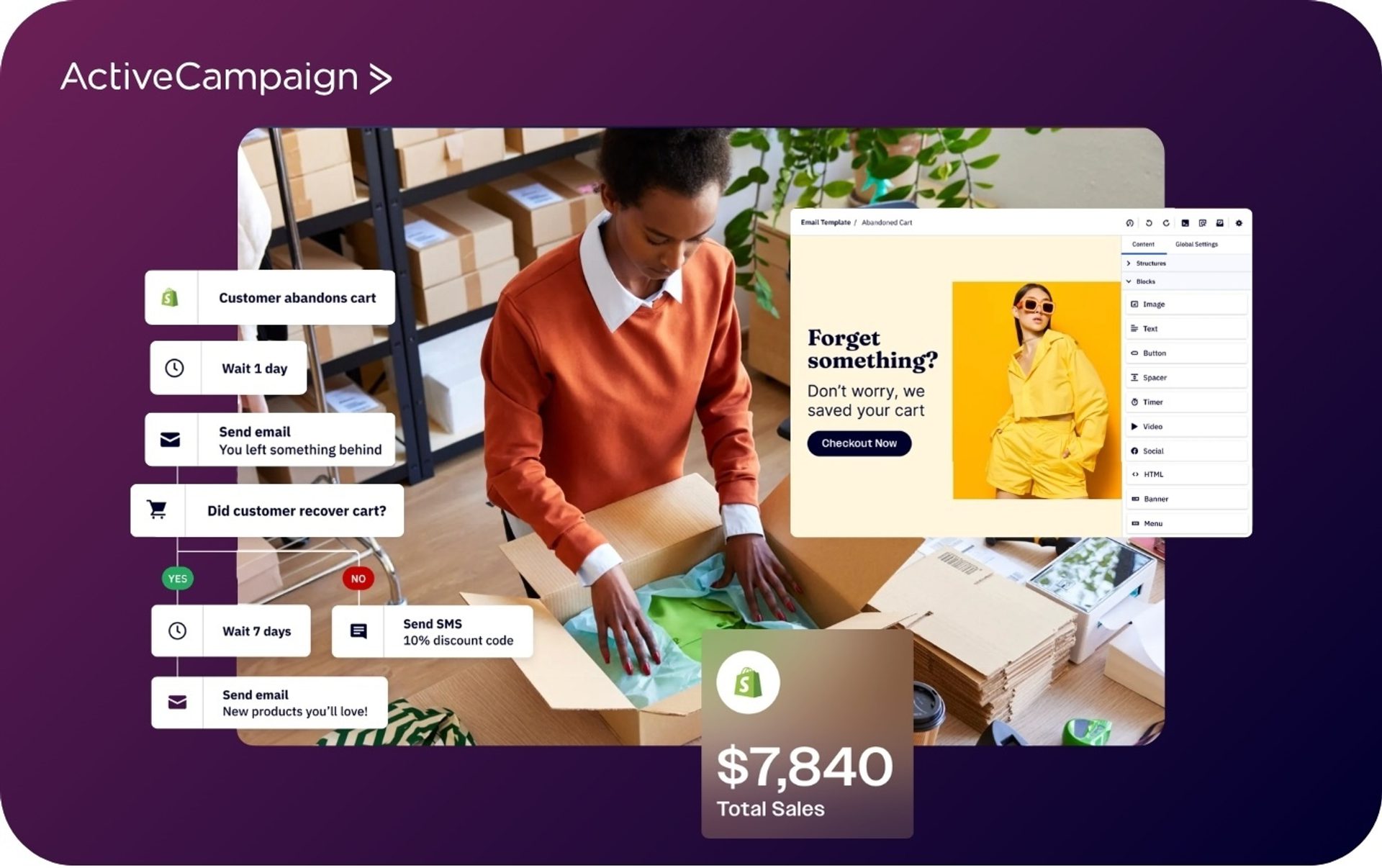
Native triggers cover abandoned carts, order status changes, subscriptions, and returns, so post-purchase sequences run without a third-party tool bridging the gap. Cart recovery, in particular, can reach customers over email, SMS, WhatsApp, or landing pages within the same automation, rather than defaulting to email alone.
It’s worth noting that the same purchase data that powers ActiveCampaign's ecommerce flows doesn't stay siloed there. It's available to sales automations, lifecycle campaigns, and CRM workflows outside the storefront, so a customer's order history can inform a sales follow-up or a retention sequence, not just their next cart-recovery email.
Klaviyo covers the same ground with a tighter, Shopify-native focus. The platform is purpose-built for ecommerce rather than adapted to it. Its flows handle abandoned cart recovery, browse abandonment, post-purchase follow-up, and product recommendations over email, SMS, and WhatsApp, and the segmentation behind them draws on granular purchase and browsing data that rivals platforms built for a broader use case.
Because it's built around Shopify and WooCommerce data from the ground up, setup is fast and ecommerce tooling works well straight out of the box, which suits a business that wants strong ecommerce automation without building it from scratch.

Ecommerce campaigns depend on inbox placement more than most email types, since a cart-recovery message sitting in spam has zero chance of recovering the cart. ActiveCampaign scored 94.2% in the most recent third-party deliverability testing by EmailToolTester, winning over all other platforms tested. There’s little concrete data available for Klaviyo’s deliverability.
If your business plans to stay ecommerce only, Klaviyo’s solution may be sufficient. If you want to expand across the customer lifecycle, ActiveCampaign extends further into cross-channel orchestration and connects ecommerce data to CRM, sales, and lifecycle automations.
Marketing automation
Both platforms handle automations that react to customer behavior, but there is significant difference in the scope and flexibility of those automations.
ActiveCampaign is built as a full automation engine for any customer journey, even the ones you haven’t thought of yet.
Klaviyo focuses on ecommerce-specific email and SMS sequences.
ActiveCampaign's marketing automations can react to almost anything a contact does. Dozens of triggers, actions, and goals respond to a subscription event, an engagement signal, an ecommerce action, a site visit, a CRM update, a change to their contact data, and much more. Once triggered, an automation can branch with if/else logic, split-test up to five variations against each other, and let contacts skip ahead entirely when they've already hit a goal. The automation adapts to the contact instead of pushing everyone through the same steps.
The flexibility makes very complex, multi-step, cross-channel journeys possible with little manual work from marketers. A contact can be routed down entirely different paths based on what they've bought, how valuable they are as a customer, where they're located, or how engaged they've been, with hundreds of pre-built automation recipes available as a starting point for welcome series, lead nurturing, cart recovery, post-purchase follow-up, and win-back campaigns.

Building that kind of complex journey used to mean mapping out every branch by hand and being able to anticipate the potential moves customers would make. ActiveCampaign’s AI tools suggest next steps and generate automation logic from a plain-language goal, making that complexity far faster and easier to set up. We’ll explore this more later.
Klaviyo's automated flows are designed primarily for ecommerce sequences like abandoned carts, post-purchase follow-ups, browse abandonment, and product recommendations. Each flow uses a single trigger tied to a specific ecommerce event. Klaviyo does not include sales automation or CRM deal management within its platform.

Klaviyo's flows handle standard ecommerce sequences effectively. ActiveCampaign's automation engine is built for more complex, multi-step customer journeys that span marketing, sales, and customer experience.
Campaign design
Both platforms offer user-friendly email builders.
ActiveCampaign's builder generates a starting campaign for you; Klaviyo's builder assumes you already know what you want to build.
ActiveCampaign’s AI-powered campaign builder can generate what you need from scratch.
Klaviyo’s builder provides a quick start if you already know what you want to build.
ActiveCampaign's drag-and-drop designer includes 250+ responsive templates, full HTML editing for teams that want to get under the hood. Conditional content blocks let a single email show different content to different segments, so one campaign build serves several audiences instead of requiring a separate version for each. AI tools go a step further and generate a complete campaign — subject line, copy, layout, images, and CTAs — from a single prompt.
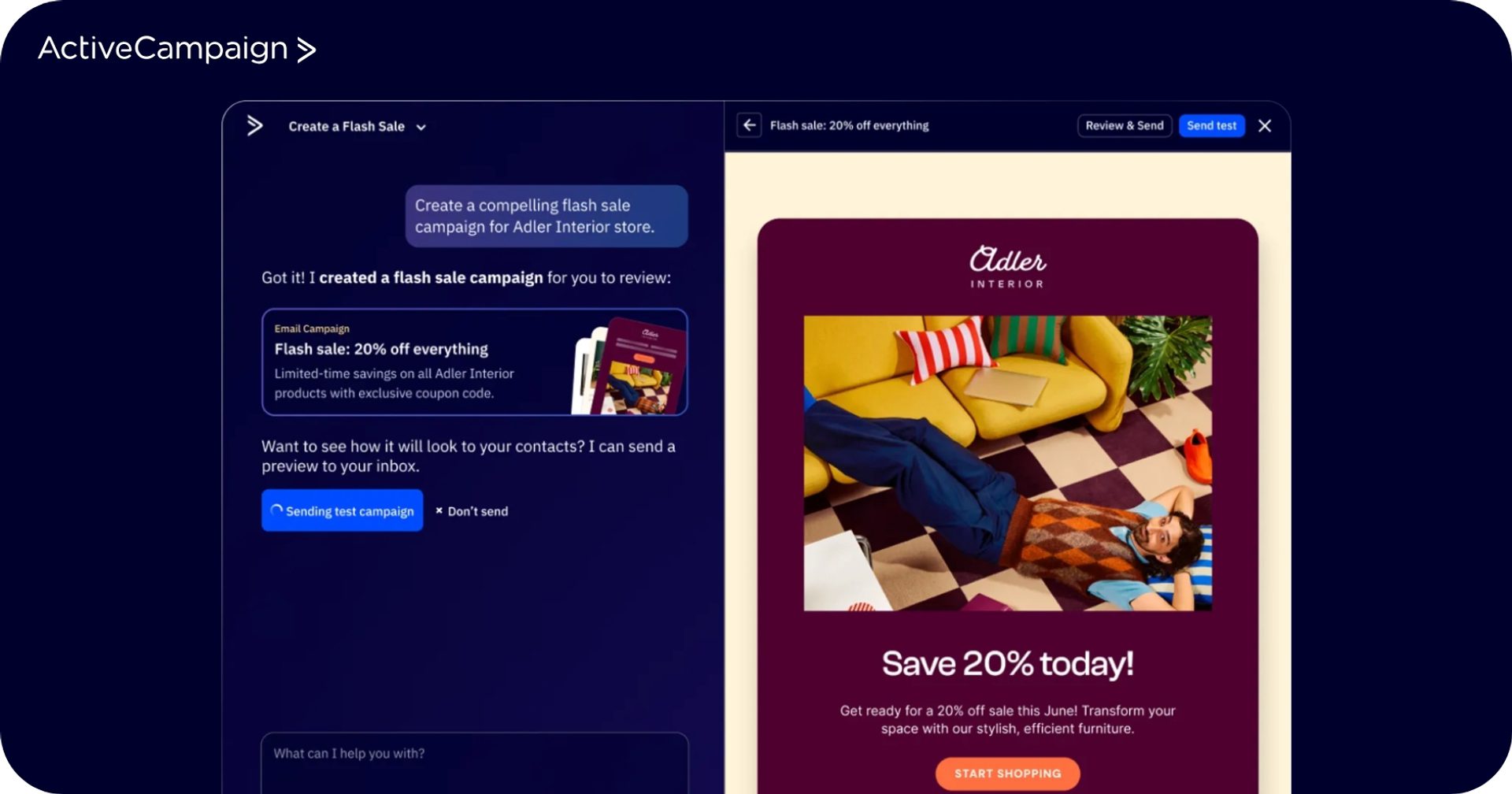
Along with the visual builder, ActiveCampaign’s AI tools make it easy to kick off campaigns. They can generate complete campaigns from a single conversational prompt, covering subject lines, copy, layout, images, and CTAs. The AI Brand Kit keeps that AI generation from producing off-brand results: it pulls logos, fonts, and colors from a URL automatically, so AI-generated campaigns already look like they came from the brand rather than needing a cleanup pass.

Lead Forms extend the same builder logic to lead capture, with inline forms, floating bars, and floating boxes that can trigger automations the moment someone submits.
Klaviyo's campaign builder is smaller in scope but well-suited to its purpose. Its 160+ email templates are built around common ecommerce sends, so teams aren't sorting through generic templates to find one that fits a retail use case. The drag-and-drop interface is clean and fast to learn, which matters for ecommerce teams that need to launch campaigns frequently without a steep design learning curve.
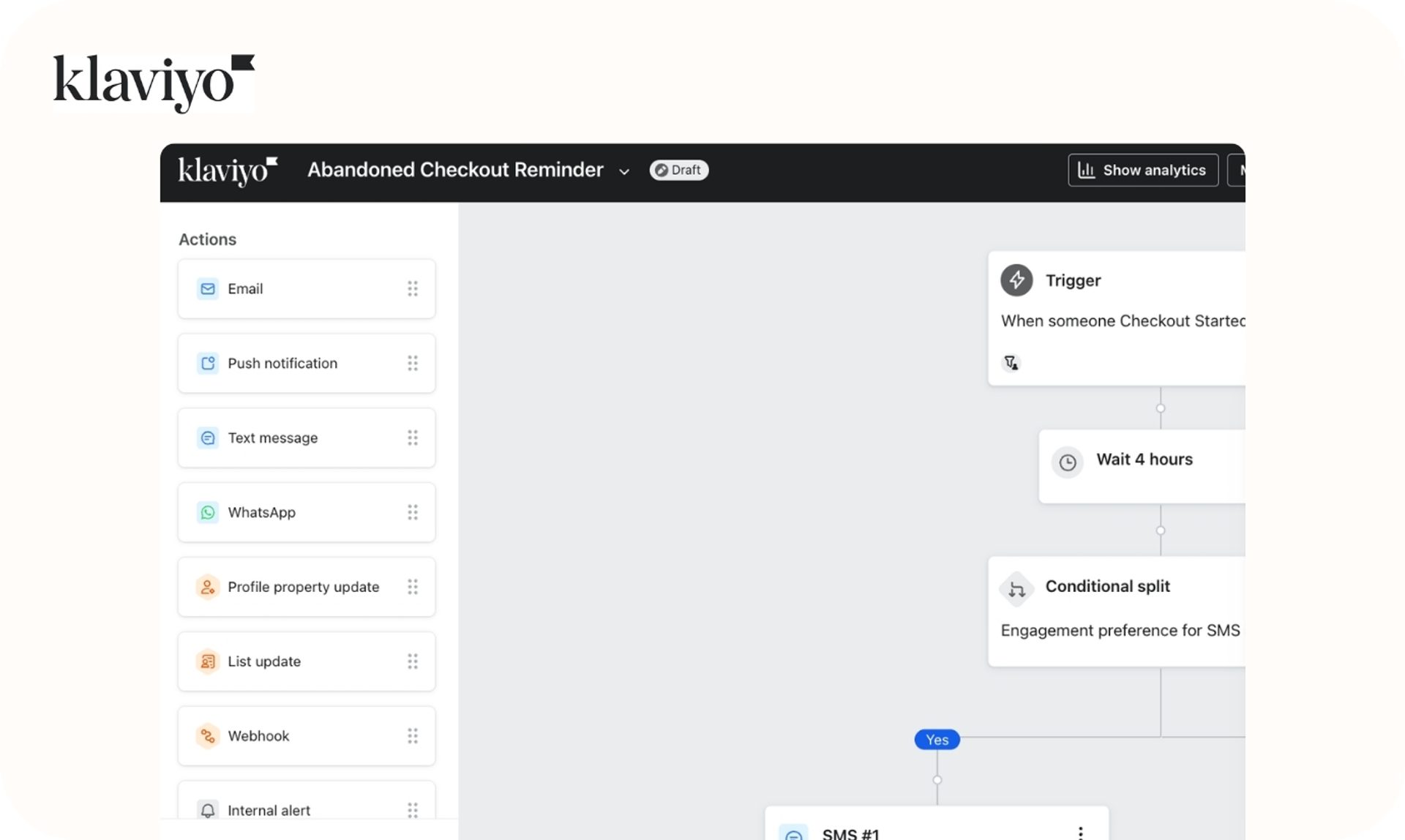
Klaviyo's forms are a particular strength: embed, popup, full page, and flyout options all support split testing, letting teams optimize list growth with rigor.
Klaviyo's design experience is purpose-built for ecommerce sends and strong form-testing capabilities. ActiveCampaign's edge is more flexibility, made accessible by AI tools so that extra depth doesn't come with extra setup time.
Segmentation and personalization
Both platforms help marketers target precisely within large audiences, but the difference is what data that slice is built from.
ActiveCampaign segments across contacts, organizations, and deals, connecting purchase data with engagement, CRM, and lifecycle signals.
Klaviyo segments primarily based on ecommerce behavior.
ActiveCampaign’s segmentation software uses lists, tags, custom fields, event tracking, site tracking, and lead scoring, with support for up to 20 conditions per segment. Segments update in real time as a contact's behavior changes. Someone who abandons a cart moves into a different segment the moment it happens, not on the next sync. AI helps to take that further by surfacing micro-audiences the marketer never explicitly built, based on behavioral patterns the platform detects on its own.
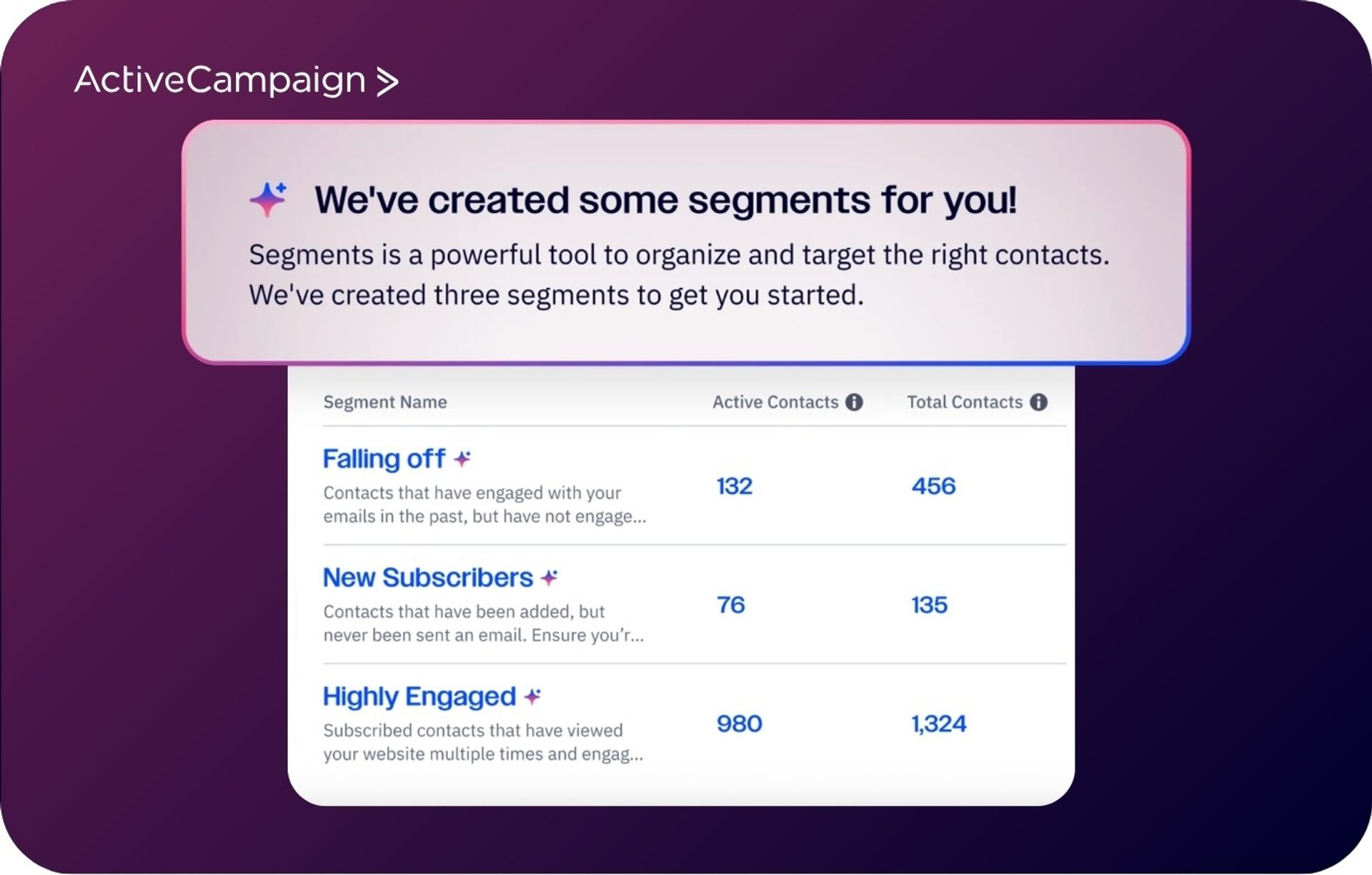
That same real-time data powers granular personalization: customer journeys can shift based on what someone is browsing right now and their level of priority in your customer database, not just their previous interests. Meanwhile, Predictive Sending calculates the best send time for each contact individually rather than applying one send time to an entire list.
Klaviyo keeps segmentation centered on the shopping relationship. Segments draw on purchase history, browsing activity, engagement levels, and predicted customer value, which is exactly the data a DTC brand needs to catch a lapsing customer or target a high-value shopper before a competitor does. Segments support up to 13 conditions, fewer than ActiveCampaign's.
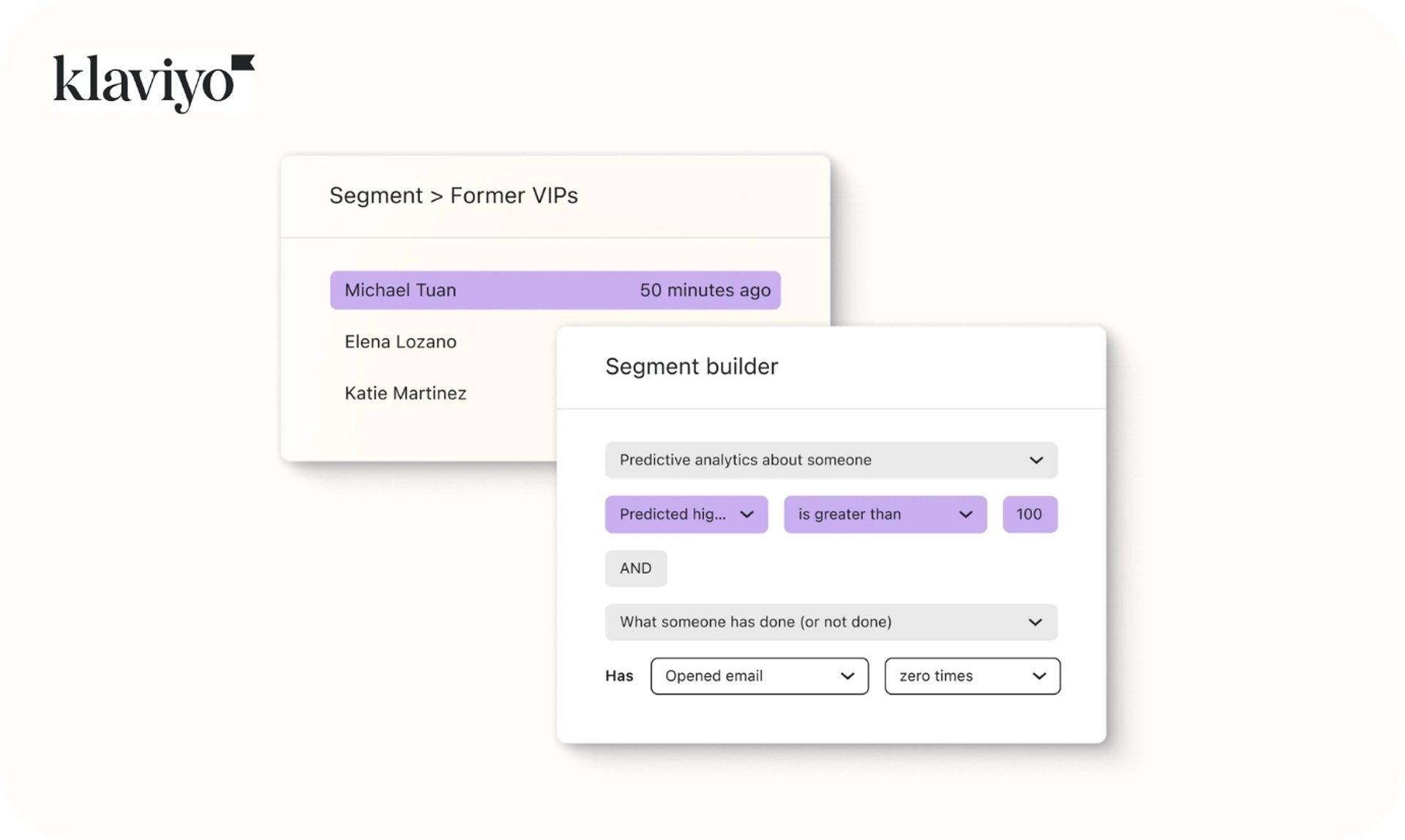
Klaviyo's segmentation is precise for a retail business: purchase behavior, browsing intent, and predicted value. ActiveCampaign's segmentation is broader, pulling in CRM and site activity alongside purchase data, which matters more once a business tracks customers through a sales process rather than a single checkout.
CRM and sales alignment
CRMs can be designed for vastly different use cases because "the customer relationship" means something different depending on whether a business is closing deals or fulfilling orders.
ActiveCampaign's CRM connects marketing automation directly to sales pipelines, deal management, and lead scoring.
Klaviyo recently launched a B2C CRM built around marketing, customer service, and ecommerce data.
ActiveCampaign's Sales CRM works like a shared nervous system between marketing and sales: a deal moving to a new stage can trigger an email campaign, and an email open can raise a lead's score, so the two teams are reacting to the same signals instead of working from separate views of the customer.

Visual sales pipelines, Win Probability, sales routing, and task management round out the sales side, helping sales teams prioritize the deals most likely to close and stay on top of follow-ups instead of letting them slip between the cracks. It's built natively into the ActiveCampaign platform, so marketing channels and integrations feed the CRM, while CRM data feeds segmentation directly. There’s no export, no sync delay, and no separate sales tool costing more in budget and overhead.
Klaviyo's B2C CRM is built to keep every touchpoint with a customer (purchases, support tickets, marketing emails) visible in one profile. Unified customer profiles draw from integrations and marketing campaigns so a service agent can see the same history a marketer does. Adding the Customer Hub means your shoppers can manage their own orders, and the built-in helpdesk gives service teams a home without bolting on a separate tool.
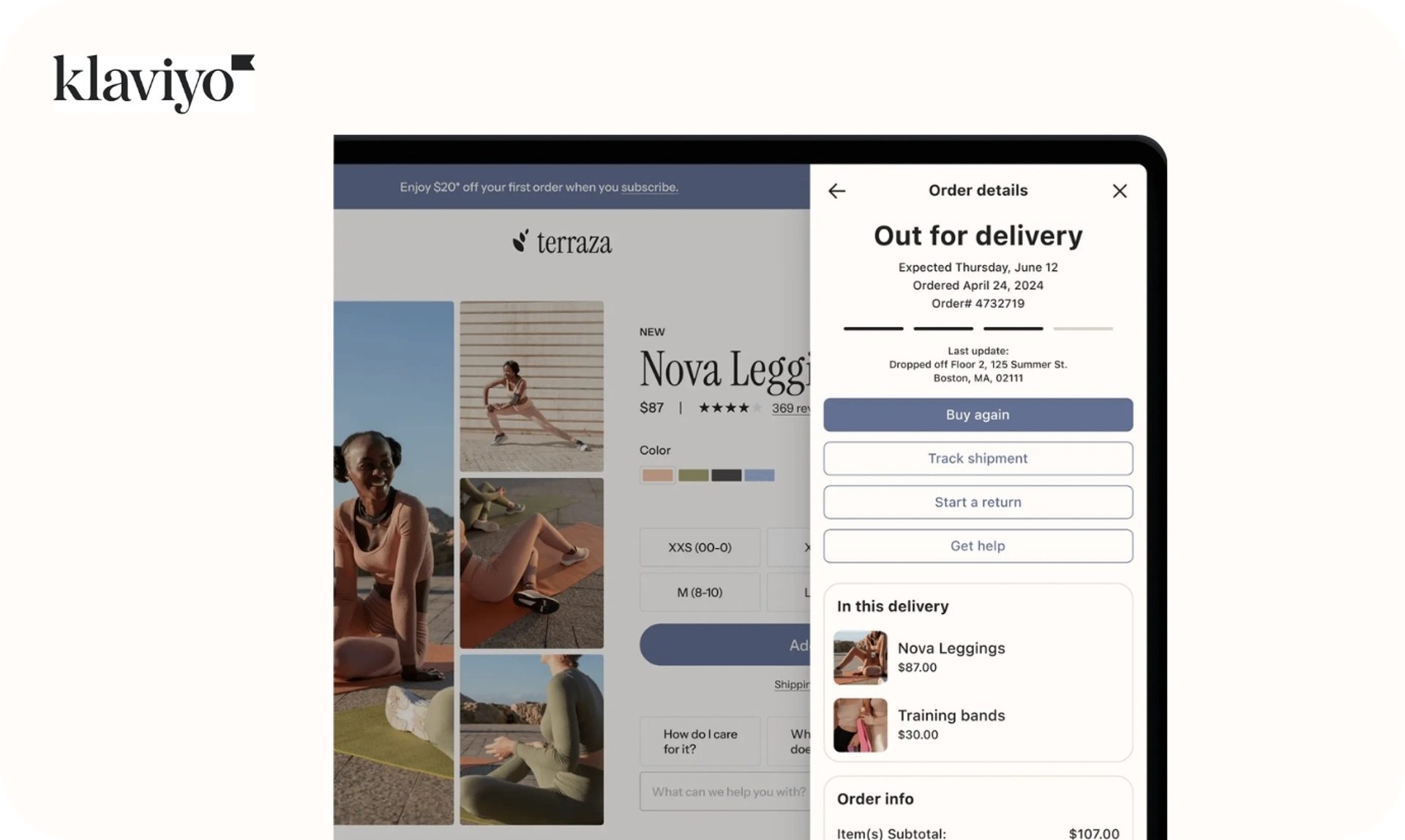
What Klaviyo's CRM isn't built for is a sales process: there are no deal pipelines, sales automation, lead scoring, or task management for a sales team, because that's not the relationship it's tracking. Businesses with a sales team, B2B buying processes, or lead-to-deal workflows still need a separate sales CRM alongside Klaviyo.
For ecommerce brands whose "sales process" ends at checkout, Klaviyo's CRM covers the basics. For businesses with a sales team standing between a lead and a closed deal, ActiveCampaign's CRM removes the extra tool instead of requiring one.
Reporting and analytics
Both platforms report on what's working, but they make the information available in very different ways.
ActiveCampaign's reporting spans marketing, sales, and lifecycle analytics with AI-powered insights.
Klaviyo's reporting excels at ecommerce revenue attribution.
ActiveCampaign's reporting suite covers campaign performance, automation results, sales pipeline metrics, contact performance, attribution, and marketing revenue, with custom reports for anything that doesn't fit a standard view.

AI turns that data conversational: a marketer can ask "Which campaigns drove the most revenue this quarter?" and get an answer without building a report first. Autonomous Insights proactively push up to six recommendations a week to the homepage including benchmarks, trends, and specific next steps, like which segment to re-engage or which automation to adjust.
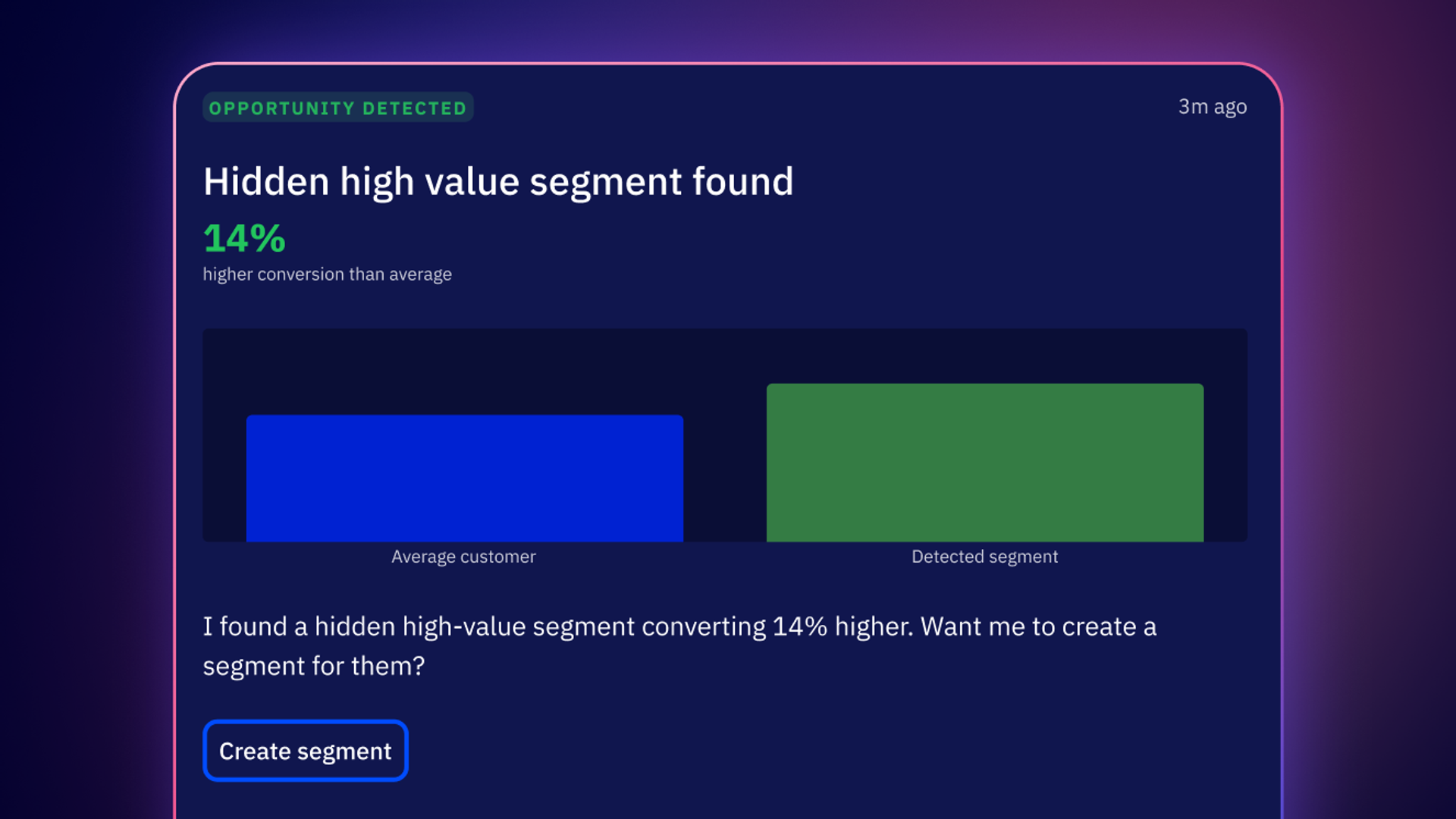
Business Goals track real-time progress against outcomes the business actually stated, rather than generic engagement metrics. Underneath all of it, ActiveCampaign ties individual actions to individual contacts, so a marketer can trace one person's path from an email click to a landing page visit to a purchase.
Klaviyo's reporting is built to answer a narrower question well: which products, campaigns, and flows are actually driving revenue. Product-level performance and purchase attribution are detailed enough that an ecommerce team can see not just that a campaign worked, but which products it sold and at what margin. This level of retail-specific detail is usually unmatched by general-purpose reporting suites. That depth is concentrated on ecommerce though, so the analytics become thinner once a business needs to measure something outside online retail, like a sales pipeline or a service interaction.

Klaviyo's analytics give an ecommerce team a sharper view of revenue than most platforms offer. ActiveCampaign's analytics trade some of that retail-specific depth for the reasoning and recommendations to act, which matters once a business needs to know not just what happened, but what to do next.
AI capabilities
AI is no longer a bolt-on feature for marketing platforms. It's a design decision, and where a platform chooses to apply it says as much as how well it works.
ActiveCampaign builds AI into every stage of the marketing workflow, from strategy through execution to reporting. Its Active Intelligence engine powers an end-to-end AI marketing suite:
- The Conversational Workspace lets marketers build campaigns, create automations, and analyze performance through a single chat interface that holds context across tasks.
- AI Campaign Builder generates a complete campaign — subject line, copy, images, and automation flow, from a single natural language prompt.
- AI Automation Builder translates a plain-language description into a multi-step workflow with triggers, conditions, and actions already configured.
- AI-Suggested Segments analyze behavior and purchase history to surface high-value audiences a marketer might not build manually.
- Predictive Sending calculates the optimal send time for each individual contact using machine learning.
- AI Brand Kit imports brand colors, fonts, and logos from a URL and applies them automatically across AI-generated content.
- AI Content Generation & AI Image Generation produce copy and visuals on demand.
- Autonomous Insights proactively surface up to six performance recommendations a week without being asked.
- AI Reporting answers plain-language questions about performance and benchmarks results against billions of platform-wide signals.
- AI Translations auto-translate email campaigns into 75+ languages per contact.
- Sentiment analysis reads incoming deal emails to flag changing customer sentiment and trigger automations accordingly.
These capabilities sit on top of the native CRM, cross-channel orchestration engine, and 1,000+ integrations, so the AI has context from the full customer relationship (not just email engagement) when it makes a recommendation.
Klaviyo’s AI is aimed almost entirely at the shopping relationship:
- Predictive analytics calculate customer lifetime value, churn risk, next-order-date, spending potential, and time between orders, feeding those predictions directly into segmentation.
- Flows AI builds automation flows like cart abandonments or post-purchase sequences from a goal description rather than manual configuration.
- AI-generated content produces subject lines and email body copy through Klaviyo's Email AI.
- AI-driven segmentation groups contacts by ecommerce-specific behavior like browse abandonment, purchase frequency, and average order value.
- Smart send-time optimization adjusts delivery timing per contact based on past engagement patterns.
What Klaviyo's AI does, it does with real depth: the predictive analytics in particular go further into purchase forecasting than most general-purpose platforms attempt, which is exactly the data an ecommerce team needs to catch a high-value customer before they churn. That depth doesn't extend past ecommerce, though — there's no AI applied to sales pipelines, lead scoring, or sales CRM data.
For ecommerce-only businesses, Klaviyo's AI is purpose-built for the job: predicting what a customer will buy next, when, and how to time the message that gets them there.
For businesses managing marketing, sales, and customer lifecycle in one system, ActiveCampaign's Active Intelligence layer applies AI across all of it, from campaign generation to deal sentiment, so the same intelligence that writes a campaign also prioritizes a sales lead.
Ease of use and support
Ease of use used to mean a simple interface. Now it increasingly means how much of the manual work marketing software takes off your plate.
ActiveCampaign's feature set is broader, which normally comes with a tradeoff: more capability usually means more complexity to manage. AI is what breaks that tradeoff. Instead of a marketer building a workflow step by step, Active Intelligence turns a plain-language description into a working multi-step automation. Instead of writing a campaign from scratch, it generates one from a single prompt. The platform's depth is still there, but AI absorbs the setup work that depth would normally require, so ActiveCampaign's learning curve reflects its feature set far less than it used to.
AI enablement extends into support and onboarding too. ActiveCampaign offers multiple paths to get unstuck or get better at the platform:
- AI chatbot for instant answers without waiting on a queue
- Email support for direct help with specific issues
- Dedicated support on Enterprise plans for higher-touch account management
- Certified consultants for businesses that want strategic guidance beyond day-to-day troubleshooting
- Complimentary agentic migration and onboarding within defined limits, so switching platforms doesn't mean rebuilding lists, templates, and automations from scratch
- In-person training events for teams that want hands-on learning
- Self-serve resources, including a Help Center, an active Community, and webinars for teams that prefer to learn at their own pace
Klaviyo is often considered easier to set up for straightforward ecommerce email flows. Its interface is clean, and getting a first abandoned cart sequence running takes minutes. That simplicity is a real advantage for a small, ecommerce-only team that wants to launch fast without a learning curve, but it also reflects limitations in what the platform can do.
Klaviyo's support and enablement offerings are also slightly more contained:
- Email and chat support during business hours
- Onboarding calls, limited to one hour on Essential and Standard plans and four hours on Premium
- No community forum, so troubleshooting relies on direct support rather than peer knowledge-sharing
Ease of use isn't just about the first week, either. The platform you choose should keep pace as your business adds automations, segments, and team members.
Klaviyo's simpler structure holds up well at a small scale, but with fewer AI tools to absorb growing complexity, that simplicity has more of a ceiling as the business scales or expands past ecommerce. ActiveCampaign's AI layer is built to keep the platform easy to run even as what's running on it gets more sophisticated.
Pricing and value over time
Both platforms offer a free option to test the platform before committing fully:
- ActiveCampaign’s 14-day free trial requires no credit card to test the platform first.
- Klaviyo offers a free plan with 500 monthly email sends for businesses that want to start with a limited feature set at no cost.
There is a notable difference between ActiveCampaign and Klaviyo at the entry level of paid plans.
ActiveCampaign Starter begins at $15/month for 1,000 contacts. It includes multi-step marketing automation, AI Campaign Builder, AI-Suggested Segments, and 10x contact email sends. Costs then scale gradually based on contact list size.
Migration and onboarding come at no extra cost with ActiveCampaign. There are no setup fees and the surrounding education and support resources are built to get teams up and running fast. Getting started isn't treated as a separate implementation project.
Klaviyo is generally thought of as having a high price for its core offering. The Email plan starts at $30/month for 1,000 contacts. Paid plans include email campaigns, flows, segmentation, and ecommerce reporting. As contact lists grow, Klaviyo's costs increase significantly.
The full cost picture extends beyond the monthly plan price. Klaviyo users often need additional tools for important capabilities such as:
- Landing pages: third-party builders like Unbounce cost $72 to $300+ per month
- CRM: standalone sales tools run $25 or more per user per month
- Site messaging and web personalization: additional tools add further monthly costs
- Integration gaps: Zapier subscriptions fill the gap where Klaviyo's 350+ integrations fall short of ActiveCampaign's 1,000+
ActiveCampaign includes landing pages, CRM, site messages, and web personalization within the platform. That can eliminate $100 to $400+ per month in additional tool costs. When comparing ActiveCampaign vs. Klaviyo for small businesses, total cost of ownership often favors ActiveCampaign even when the plan prices look similar at first glance.
Klaviyo's pricing may work for a business that's ecommerce-only and wants a single, purpose-built tool without extra configuration. ActiveCampaign's pricing folds in a broader platform, so the total cost of running a full marketing stack often comes out lower for businesses that need more than email and SMS.
Customer feedback and market sentiment
Both platforms perform well on independent review sites, though the reasons behind those scores point in different directions.
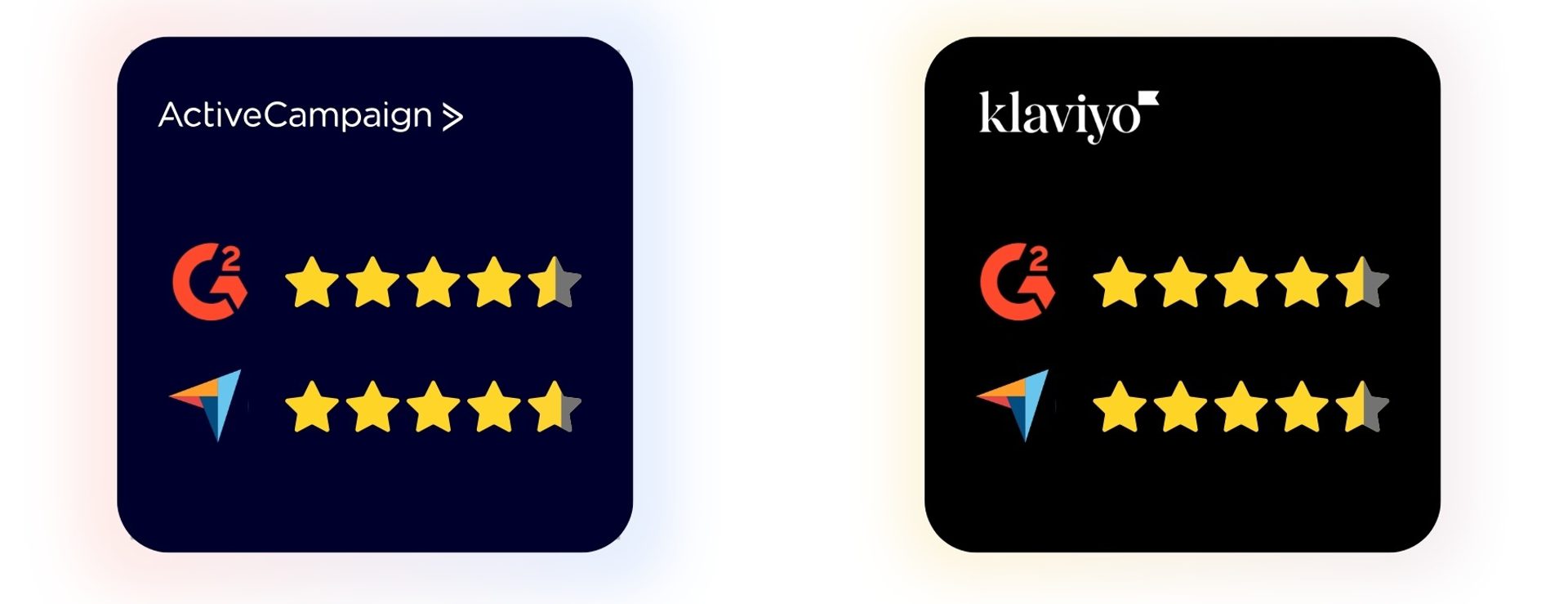
ActiveCampaign scores 4.4 out of 5 stars on G2 and 4.6 out of 5 stars on Capterra across a total of over 17,000 reviews.
Klaviyo scores 4.6 out of 5 stars on G2 and 4.6 out of 5 stars on Capterra across a total of over 1,000 reviews.
What reviewers say about ActiveCampaign clusters tightly around one idea: the platform rewards businesses that want automation to do real work, not just send scheduled emails.
Recurring points in reviews include:
- Praise for the drag-and-drop automation builder's ability to handle branching logic tied to actual contact behavior, not just static rules.
- Appreciation for how tightly the built-in CRM ties into marketing data, so sales and marketing aren't working from separate systems.
- Strong marks for segmentation depth, letting teams target audiences that update themselves as behavior changes.
- Frequent mentions of cost efficiency, especially from teams who consolidated several tools into one platform.
- Growing praise for Active Intelligence and other AI features that cut down the manual work of building and refining campaigns.
The most common criticism is the ramp-up time: several reviewers describe a slight learning curve before the platform's depth starts paying off. Reviewers who push through that ramp-up tend to describe the automation as something that keeps working in the background long after it's built.
“What I like best about ActiveCampaign is its powerful automation capabilities. It makes it easy to create personalized customer journeys, automate follow ups, and manage email campaigns efficiently. The visual automation builder is intuitive and allows complex workflows to be created without much effort. The platform offers a lot of functionality, which is great, but the learning curve can feel a bit steep initially.” - Dharamveer P. G2
“ActiveCampaign is an all-in-one ecosystem that has allowed us to effectively manage lead data, customise email marketing and potential clients in our pipeline. The extensive automation triggers and custom fields are easy to use and do a good job.” - Sophia G. G2
Klaviyo's reviews tell an equally consistent story: it's a tool built for ecommerce, and it earns its reputation by doing that job well.
Recurring points in reviews include:
- The native Shopify connection, which reviewers describe as syncing purchase and behavioral data almost instantly
- Segmentation built specifically around shopping behavior — purchase history, predicted value, browsing activity — that ecommerce teams find sharper than general-purpose alternatives
- Ready-made flows for abandoned carts, post-purchase sequences, and win-backs that reviewers say perform well without much tuning
- Reporting that connects campaigns and flows directly to revenue generated, rather than stopping at open and click metrics
Where sentiment turns more mixed is around pricing and scope. Reviewers frequently mention that costs climb quickly as a contact list grows, since billing is tied to total active profiles rather than how often a business actually sends. A number of reviewers also note that once a business's needs extend past ecommerce, the platform's advanced segmentation and design tools get harder to navigate, and the toolset starts to feel narrower than what broader platforms offer.
“What I like most about Klaviyo is how well it connects with the rest of an e-commerce stack, especially Shopify. The integration is seamless, and it pulls in customer behavior, purchase history, and engagement data automatically. That consolidated data makes it much easier to build meaningful segments and customer journeys.” - Dorothy N. G2
“The biggest drawback is the pricing, which can get quite expensive as your contact list grows. Some areas of the interface can also feel a bit complicated when you’re managing lots of flows or segments, especially if you’re new to the platform. I’d also like to see more advanced built-in reporting, or at least easier ways to analyze performance across multiple campaigns without having to export the data.” - Adrien P. G2
Which platform fits your business?
If you're deciding between Klaviyo and ActiveCampaign, the clearest path is to look at what kind of business you're running today, and how far you expect it to grow past its current shape.
Both platforms are strong at what they're built for:
ActiveCampaign optimizes for the full customer lifecycle.
Klaviyo optimizes for the ecommerce purchase funnel.
Before you decide, pressure-test three things:
- Your business model. Is your revenue purely transactional through an online store, or does it involve leads, sales conversations, subscriptions, or service delivery alongside (or instead of) ecommerce?
- Your team structure. Does marketing operate independently, or does it need to hand contacts off to a sales team, track deals, or coordinate with account management?
- Where you're headed. If your business succeeds over the next year, does it stay ecommerce-only, or does it start layering in new revenue streams, sales motions, or customer types that a purely ecommerce tool wasn't built to handle?
Choose Klaviyo if…
- Your business is purely ecommerce or DTC, with no sales team managing individual relationships
- You want a quick-to-setup email and SMS platform built specifically around driving online store revenue
- You don't need a CRM, sales automation, or multi-channel journeys that extend beyond email and SMS
Choose ActiveCampaign if…
- You need marketing automation that goes beyond standard ecommerce flows, including nurture sequences, lifecycle campaigns, or journeys triggered by non-purchase behavior
- You manage lead nurture or longer sales cycles that require tracking a contact through multiple touchpoints before a deal closes
- Your business spans multiple models — ecommerce, services, and B2B — rather than fitting neatly into one
- You need to connect a broader tech stack beyond your storefront
- You want to consolidate several point solutions (CRM, landing pages, sales tools) into one platform instead of paying for and maintaining each separately
Klaviyo isn't built to follow a contract past the purchase. ActiveCampaign is built to follow them through whatever comes next, which is what prevents a business from having to bolt on a separate CRM or sales tool once ecommerce alone stops telling the whole story.
That point is where most businesses migrate. Thousands of customers have made the switch from Klaviyo to ActiveCampaign when their marketing grew in scale and depth.
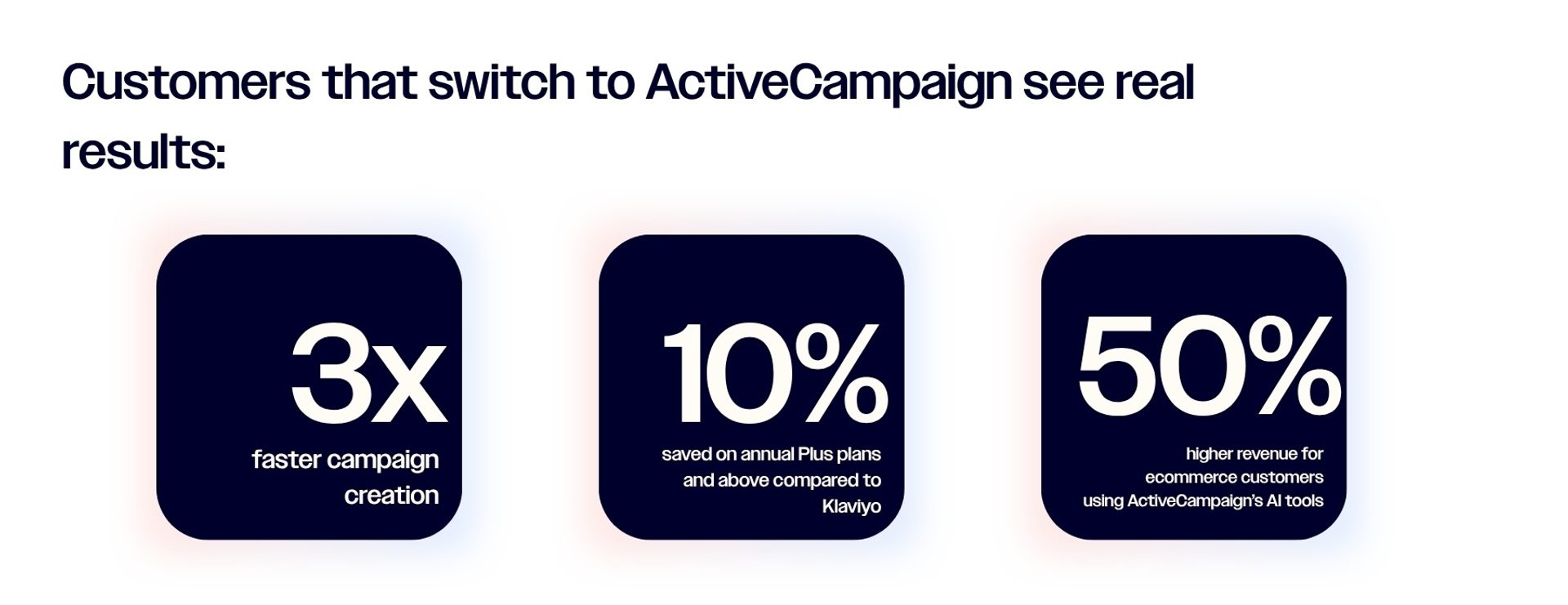
- If you're running an ecommerce business today but expect to add a sales team, a subscription model, or a B2B arm down the line, migrating later means rebuilding your automations from scratch. Starting with a platform built to grow across all of that avoids the replatform entirely.
- Try ActiveCampaign free for 14 days, or book a demo to see how it handles your own contact data and automations before you switch.
FAQs
What is the main difference between ActiveCampaign and Klaviyo?
ActiveCampaign is a full-lifecycle autonomous marketing platform with built-in CRM, sales automation, and AI-powered campaign building. Klaviyo is an ecommerce-focused email and SMS marketing platform designed primarily for DTC and online retail brands. The main difference between the two platforms is scope: ActiveCampaign covers marketing, sales, and customer experience in one platform, while Klaviyo focuses on the ecommerce purchase funnel.
Is ActiveCampaign or Klaviyo better for ecommerce?
Both ActiveCampaign and Klaviyo handle core ecommerce marketing well, including abandoned cart recovery, product recommendations, and post-purchase follow-ups. Klaviyo is strong for Shopify-centric businesses that need fast setup for email and SMS flows. ActiveCampaign is the better choice for ecommerce brands that also need cross-channel orchestration, CRM, sales automation, or marketing beyond standard retail sequences.
Is ActiveCampaign or Klaviyo better for small businesses?
ActiveCampaign is typically a stronger choice for small businesses than Klaviyo because it starts at $15/month for 1,000 contacts and includes automation, CRM, and AI features in a single platform. Klaviyo starts at $30/month for the same contact count and often requires separate tools or add-ons for CRM, landing pages, and advanced automation. For small businesses watching their budget, ActiveCampaign’s total cost of ownership tends to be lower.
Can I migrate from Klaviyo to ActiveCampaign?
Yes, it’s easy to migrate from Klaviyo to ActiveCampaign. ActiveCampaign offers free agentic migration that handles the transfer of email lists, templates, automations, and landing pages at no additional cost. Most migrations complete within a few business days.