Few channels can brag about the immediate, almost guaranteed engagement SMS enjoys. Studies show that as much as 82% of recipients open text messages within five minutes of receiving them. Others point to its superior CTR when stacked against email: 7.6% vs. just 1.5%.
With a channel like this, it's tempting to blast your entire list and hope it sticks. But attention without intention won't get you far. If texts aren't triggered by behavior or personalized to where someone is in the customer journey, all of SMS’ potential goes to waste.
The automation platform you choose determines whether SMS becomes a high-performing channel or stays a glorified broadcast tool. Let's walk through the four capabilities that separate real SMS marketing automation platforms from basic texting tools and what cross-channel SMS looks like in practice.
SMS automation vs. broadcast texting
SMS automation is text messaging triggered by customer behavior, data conditions, or workflow logic. A platform that reacts to customer actions by sending is a different product category from one that waits for you to press “send.”
There are two types of automated SMS. SMS marketing covers promotions, flash sales, and re-engagement messages. Transactional SMS covers order confirmations, shipping updates, and appointment reminders. Both can be automated, but they serve different purposes and carry different compliance requirements.
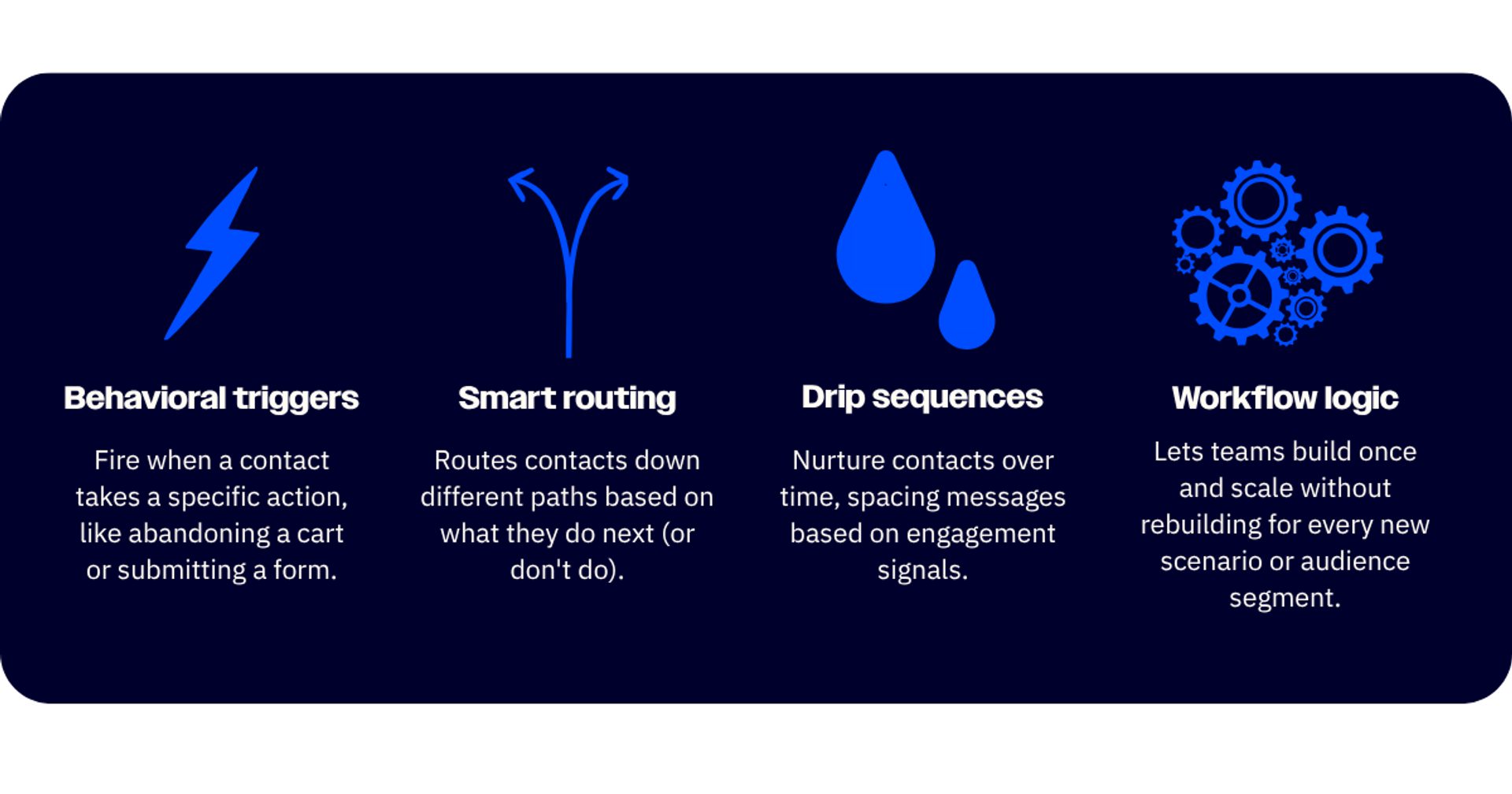
Broadly, there are four mechanics that manage SMS automation:
- Behavioral triggers that fire when a contact takes a specific action, like abandoning a cart or submitting a form.
- Smart routing that sends contacts down different paths based on what they do next (or don't do).
- Drip sequences that nurture contacts over time without manual sends, spacing messages based on engagement signals.
- Workflow logic that lets teams build once and scale without rebuilding for every new scenario or audience segment.
Broadcast-only tools skip all of the above. Every subscriber receives the same message at the same time, regardless of behavior, purchase history, or lifecycle stage. There's no branching, no response-based routing, and no way to treat a first-time buyer differently from a VIP customer.
This is the first filter you should apply when evaluating SMS marketing automation tools: does the platform automate based on what contacts do, or only what I, the marketer, manually schedule?
The four capabilities that define a great SMS marketing automation platform
The difference between a texting add-on and an SMS marketing platform built for growth shows up in four areas. You should pressure-test all of them during any evaluation, because each directly affects whether you can prove ROI and keep customers engaged without burning them out.
Segmented broadcast campaigns with performance tracking
Broadcast campaigns still earn their place in SMS marketing. Product launches, seasonal promotions and other specific dates all benefit from sending to a larger audience at a specific time. However, the ability to segment is still non-negotiable.
A strong SMS marketing automation platform should let you slice your audience by:
- Contact properties like location, age, or job title.
- Tags applied based on past behavior.
- Purchase history and order value.
- Engagement level such as active, lapsed, or never-opened.
- List membership across your various audiences.
- Custom fields unique to your business.
Using customer data to segment your audience leads to higher engagement and lower opt-out rates. If you can target a segment of repeat buyers with a VIP early-access text instead of blasting the whole list, you protect deliverability and increase conversions.
There's also the matter of metrics. Without granular tracking, you can't prove SMS ROI or optimize sends over time. You should expect any platform to offer insight into the following performance metrics:
| Metric | Why It Matters |
| Delivery rate | Confirms messages are actually reaching recipients |
| Click-through rate | Measures how many contacts tapped a link |
| Reply rate | Shows two-way engagement and purchase intent |
| Opt-out rate | Signals message fatigue or audience mismatch |
| Per-campaign revenue attribution | Ties SMS directly to revenue, the metric that justifies budget |
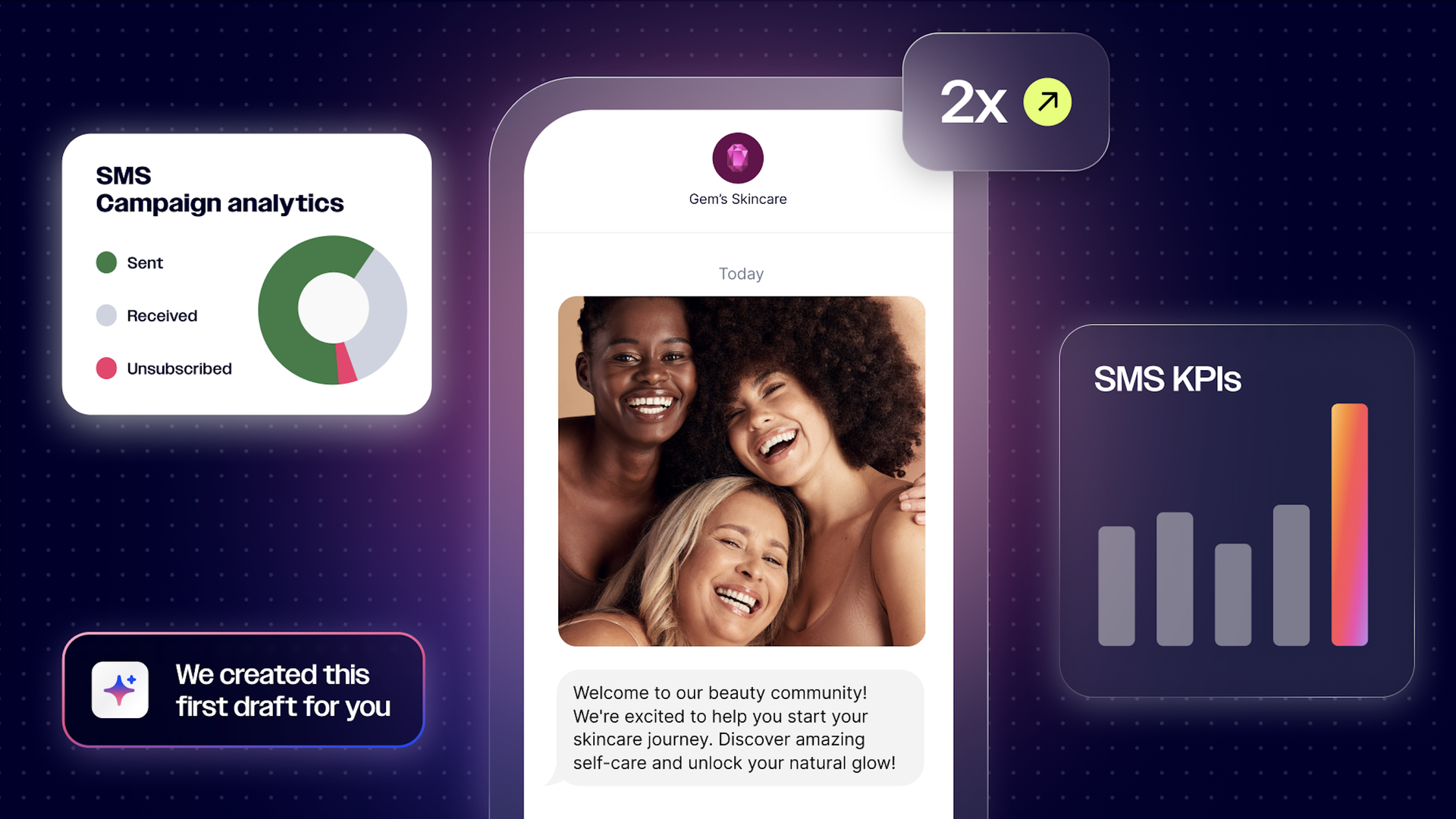
ActiveCampaign's Aggregate Campaign Performance dashboard gives teams a centralized view of broadcast SMS metrics, with drill-down reporting per campaign covering delivery, clicks, replies, and opt-outs.
For teams that don't want to build segments from scratch, AI Suggested Segments automatically analyze customer data and behavior to surface high-impact audience groups, like repeat buyers or at-risk subscribers.
Behavior-triggered workflows with branching logic
SMS automation is at its most valuable when a message reaches someone immediately after they’ve done something relevant. This is how the channel can drive consistent revenue—by reacting to behavior in real-time.
In order to perform, a capable workflow engine needs:
- Behavioral triggers spanning purchases, cart abandonment, page visits, form submissions, and CRM deal stage changes.
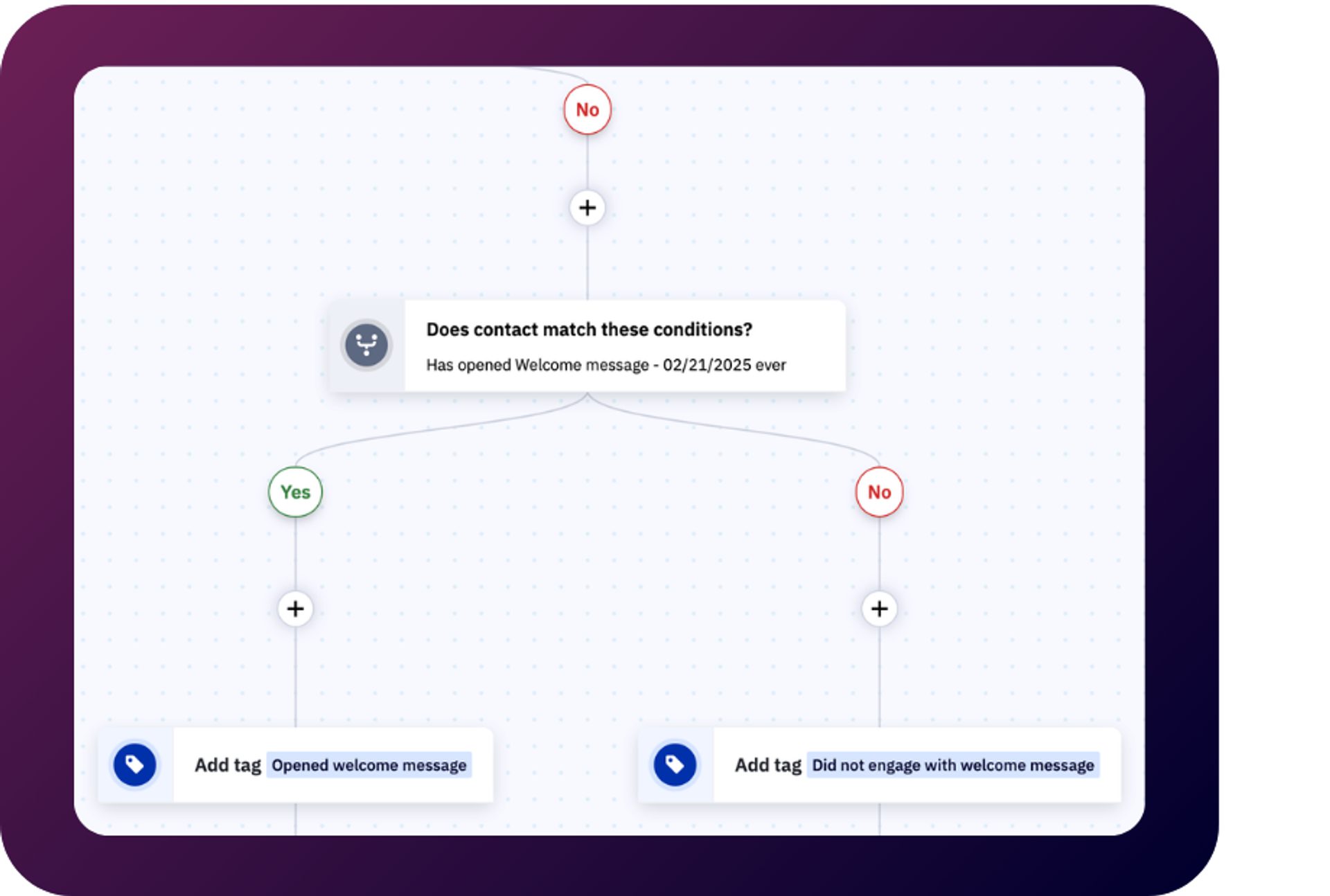
- If/Else branching and wait steps that adapt the path based on each contact's next action.
- Goal conditions that let the automation measure success and exit contacts who convert.
- Multiple entry points so the same automation can serve different scenarios without duplicating the entire workflow.
For example, say an ecommerce brand sets up an abandoned cart automation: 30 minutes after exit, a text fires with a link back to the cart. If the customer clicks but doesn't purchase within 24 hours, an If/Else branch sends a follow-up with a small incentive.
ActiveCampaign's AI Automation Builder supports all of these capabilities. Behavioral triggers spanning site visits, form submissions, purchases, and CRM deal stage changes, with If/Else branching and conditional waits that adapt based on each contact’s behavior.
If getting started fast is a priority, pre-built SMS automation recipes cover common scenarios like cart recovery, welcome sequences, and appointment reminders. And if you want to skip the blank canvas altogether, Active Intelligence lets you describe a campaign goal in plain language to the AI engine and generate a full, goal-aware, cross-channel workflow.
Two-way messaging with a centralized inbox
SMS automation doesn't end when the message is delivered. The more important question is what happens when a contact replies.
Platforms without two-way inbox functionality force you to manage replies outside the system. That breaks attribution and creates holes in the customer record, turning every inbound text into a potential mess, or even a dead end, instead of a potential sales conversation.
A centralized SMS inbox aggregates every inbound reply from campaigns and automations into one view. When a promotional text sparks a question, the conversation flows into a live sales or support thread instead of disappearing into the void. Customers can now use SMS to browse products, ask questions, and complete purchases without leaving the thread—that behavior requires infrastructure, and your automation platform needs to deliver.
Inbound responses should also feed back into the platform by:
- Updating contact records with new data from the conversation.
- Applying tags based on reply content or sentiment.
- Triggering follow-up automations where a reply starts a sales sequence.
- Routing conversations to the right team member based on topic or deal stage.
ActiveCampaign's SMS Inbox captures all replies in a centralized view with filtering, search, and conversation threading. Each conversation displays the contact's profile alongside the thread, so reps keep context when handling multiple conversations.
AI-drafted replies, informed by your Brand Kit and the contact’s conversation history, speed up response time. Plus, AI conversation summaries keep handoffs clean when conversations move between team members.
Compliance and consent management at scale
Compliance is a scaling problem. When you have 500 subscribers, you can manage opt-outs manually. When you have 50,000, one missed STOP request can trigger regulatory action.
The TCPA's overarching requirement is to obtain explicit consent before sending messages, and it gives consumers the right to seek compensation ranging from $500 to $1,500 for each unsolicited message they receive.
In order to keep up with growing businesses, a platform must handle these compliance requirements natively and include:
- Explicit opt-in consent capture with timestamps. This gives you an auditable record of every subscriber's permission.
- Automatic processing of mandatory opt-out keywords. When someone texts STOP, END, CANCEL, QUIT, or UNSUBSCRIBE, they should be removed immediately without manual intervention.
- Quiet hours enforcement by recipient timezone. There are laws restricting the sending of SMS from 8 PM to 8 AM in your contacts' local time zone, known as "quiet hours." Violating them can result in fines and reputation damage.
- Carrier registration (A2P 10DLC). A2P 10DLC is the standard that U.S. telecom carriers have put in place to ensure that SMS traffic through long code phone numbers is verified and consensual. Unregistered senders get blocked.
This infrastructure should be built into the platform by default. Bolting it on through workarounds or third-party add-ons means it can easily break when volume increases.
ActiveCampaign handles each of the requirements. Consent-ready forms capture opt-in with proper disclosures, while the platform automatically processes opt-out keywords (STOP, END, CANCEL, QUIT, UNSUBSCRIBE) without any manual configuration. Built-in quiet hours enforcement includes default windows by country for the US, UK, and Australia, with the ability to configure custom hours by recipient timezone. A2P 10DLC registration support is also available directly within the platform for US sending.
Why SMS marketing automation works best inside a cross-channel strategy
Running SMS in a standalone tool creates several problems. Fragmented customer experiences and reporting blind spots are the most glaring, as teams that manage separate platforms struggle to coordinate messaging and analyze performance across channels. There's also the operational cost to consider—separate tools mean duplicated campaign creation, separate list management, and no shared view of what’s really working.
But if SMS, email, and WhatsApp run inside the same automation, a single workflow can route each contact to the right channel based on behavior or engagement history. A contact who opens every email but never clicks? Hit them with an SMS. A subscriber who converts from texts but ignores email? Prioritize the channel that drives engagement.
To prevent channel overlap and over-messaging, look for marketing automation platforms that include:
- Frequency caps that limit how many messages a contact receives across all channels in a given window.
- Suppression rules that pause SMS after a recent email conversion (or vice versa).
- Branch logic that checks recent sends before adding another touchpoint.
- Channel prioritization based on individual engagement signals, so each contact gets the message where they're most likely to act.
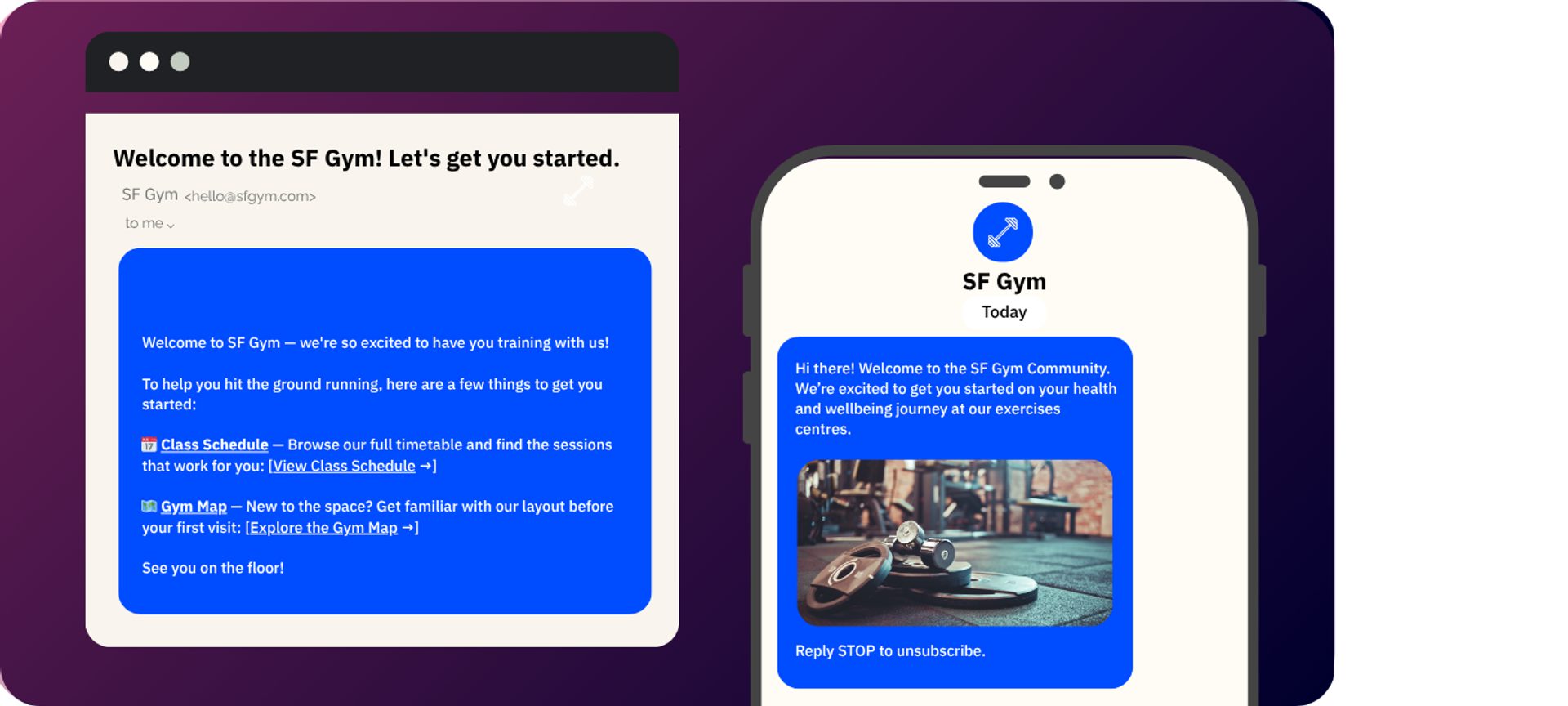
ActiveCampaign manages SMS, email, and WhatsApp from one platform using shared contact data and a unified automation engine. With 1,000+ responsive integrations—including Shopify, WooCommerce, Salesforce, and Zapier—the customer record stays complete no matter where the interaction happens. Every SMS decision is informed by what happened across every other channel, and all automations built by Active Intelligence are optimized for engagement across channels
ActiveCampaign: SMS automation built for growth
The cost of the wrong SMS automation tool is the compounding cost of fragmented data—contact records that don't talk to each other, attribution that never quite adds up, and compliance gaps that widen as your list grows.
ActiveCampaign keeps those pieces in one place. We've helped thousands of brands scale their marketing channels and grow revenue without rebuilding from scratch every time they do.
Explore ActiveCampaign's SMS features and see how SMS automation connects to the rest of your marketing, in one platform.
SMS automation FAQs
Do I need separate tools for SMS and email automation?
No, you don't need separate tools for SMS and email automation. Running SMS and email on separate platforms fragments your customer data and makes it impossible to coordinate messaging across channels. A unified platform like ActiveCampaign keeps contact records and reporting in one place, reducing duplicate messaging and giving you a complete view of each customer's journey.
How do I measure SMS marketing ROI?
You measure SMS marketing ROI by tracking metrics like delivery rate, click-through rate, reply rate, opt-out rate, and per-campaign revenue attribution. The first four metrics tell you whether messages are reaching people and driving engagement. Revenue attribution ties sends directly to pipeline and sales—the number that justifies your SMS budget to leadership.
How does ActiveCampaign handle SMS opt-in and opt-out compliance?
ActiveCampaign provides consent-ready forms that capture SMS opt-in with proper disclosures and timestamps. When a contact texts STOP, END, CANCEL, QUIT, or UNSUBSCRIBE, the platform automatically processes the opt-out and removes them from future sends. Built-in quiet hours enforcement respects recipient time zones with configurable windows. A2P 10DLC registration support is available for US sending.
What SMS triggers are available in ActiveCampaign?
ActiveCampaign's Automation Builder supports extensive triggers across site visits, form submissions, email opens and clicks, purchases, cart abandonment, and CRM deal stage changes. If/Else branching, wait steps, and goal conditions let you build adaptive workflows that respond to each contact's behavior in real time.