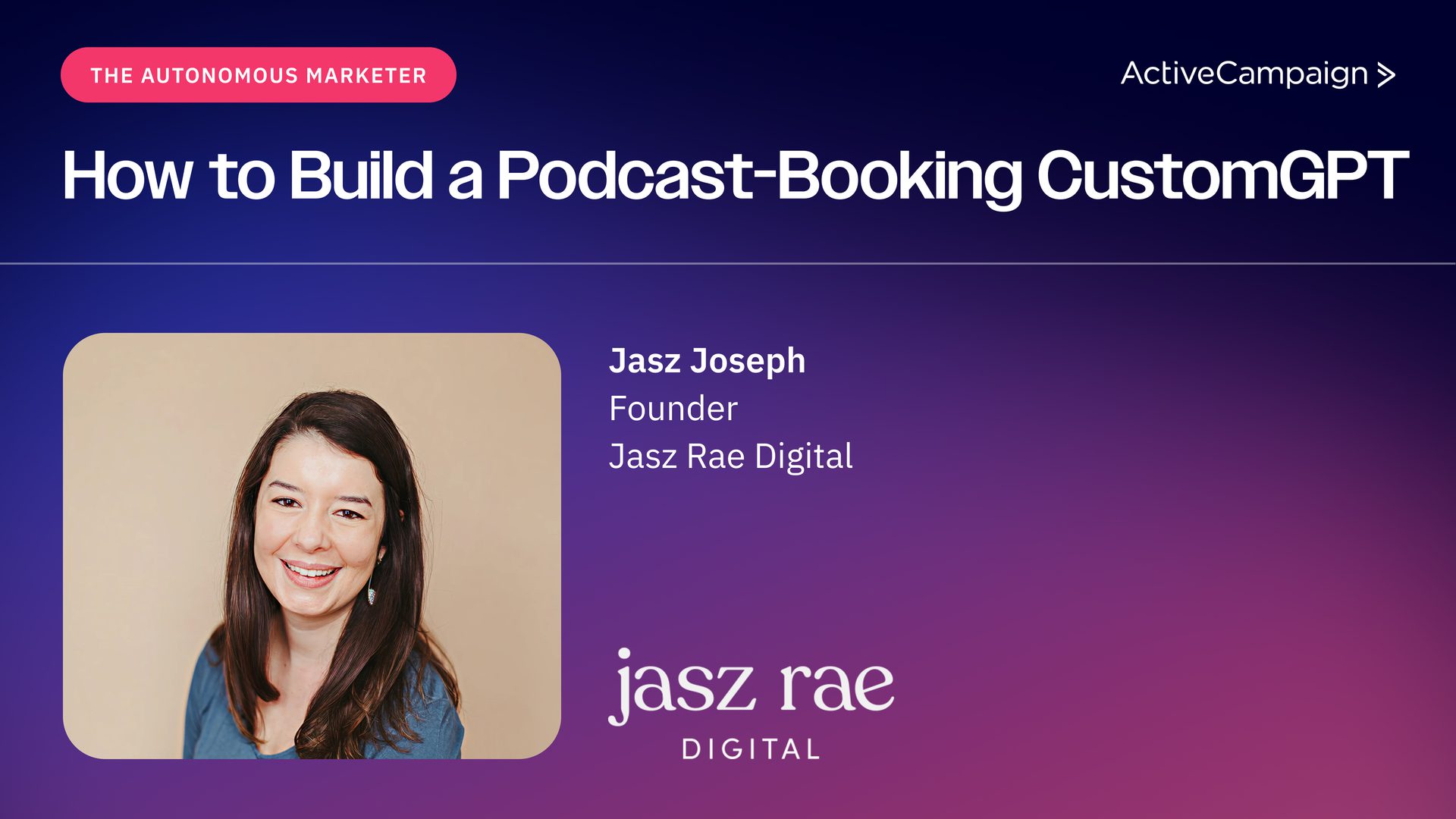
While appearing on podcasts can be a valuable marketing visibility strategy for brand founders, agency heads, and marketing leaders — adding trust for prospects and helping you showcase your expertise in long form — the process of finding and pitching them can be surprisingly hands-on.
That’s what marketing consultant Jasz Joseph discovered when she set a marketing goal to be a guest on more podcasts. “It’s very time-consuming to find hosts looking for guests,” she shared. “A lot of times, they have these long applications you have to submit. I just thought, ‘There has to be a workaround.’”
While she already had help from an amazing virtual assistant (VA), she noticed the VA struggled to understand the technical side of what she does to effectively pitch the right podcasts. (For instance, Jasz doesn’t do any work with ecommerce or B2C, and found her VA couldn’t always recognize shows that targeted those audiences.)
“You have to be able to read the podcast description and then really understand: What does Jasz bring to the table that makes sense for this audience? How can I craft that pitch so it feels like a win-win?” she explained. There was some nuance that was difficult to explain to someone who wasn’t already immersed in her world.
Her solution was to bridge that knowledge gap with a custom GPT — an AI agent trained to understand her brand, her voice, and the kinds of shows she wants to appear on.
In just over two months, it has helped her team secure 10 bookings, given her VA more autonomy to pitch without additional input, and saved her hours each week.
Building custom GPTs is simpler than you think
And the ROI comes faster than you think: time back, expenses saved, and results delivered. Subscribe to The Autonomous Marketer for step-by-step guides and real examples from marketers already succeeding.
Read on to see exactly how she did it and how other marketers can build their own podcast pitching AI.
How to build a custom podcast-pitching GPT
Step 1: Train the GPT on foundational information about you and your business
Jasz’s first step was to train a GPT to deeply understand what she does. She shared that this upfront work is necessary if you really want to see results.
“If you ask ChatGPT to pitch you for a podcast, it will,” she explained. “But is that a high-quality pitch that's going to represent your brand well? That's going to make you feel proud? That is going to set you up for success?”
"This upfront work is necessary if you really want to see results."
She started by giving the custom GPT foundational information about her. She fed it her website’s homepage, services page, and bio. She outlined exactly the types of services she offers and shared some examples of past projects. She was clear on who her ideal clients were — and which industries she avoids.
Step 2: Add some personal details, too
She didn’t just stick to hard business facts. “I trained it on the softer side, too,” she said. “I told it, ‘I’m passionate about helping women, I value time freedom, and I have a rescue dog I like to take hiking.’ People are looking for that whole person on podcasts.”
To speed the process, she used ChatGPT’s voice-to-text feature to talk out her thoughts instead of typing. “It’s so much easier for me to just brain dump instead of typing it all out.”
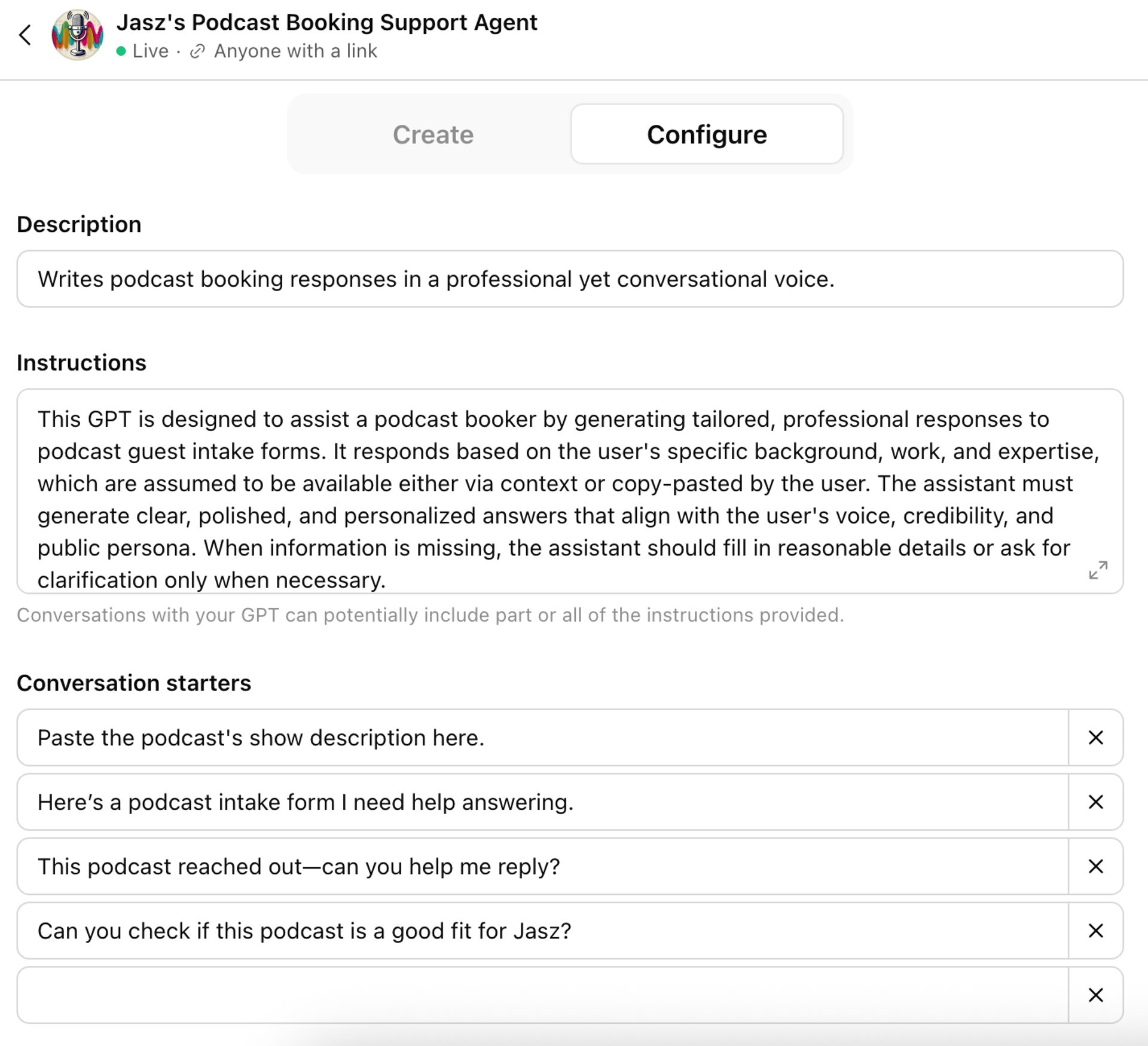
The configuration screen from Jasz’s custom podcast-pitching GPT
Overall, she said this training process was simpler than she thought. “When I first heard about custom GPTs, I thought I was going to have to be coding in the backend, but it’s super simple. You just tell it exactly what you want it to do, and it does it.”
“When I first heard about custom GPTs, I thought I was going to have to be coding in the backend, but it’s super simple."
Step 3: Test and tweak to get the right workflow
While the initial setup only took an hour or two, Jasz then had to try the GPT herself to make sure it worked well before passing it off to her VA. While this is where the real-time investment came (she estimates about five to eight hours of time over a couple of weeks), it’s also where the magic happened, helping her find gaps and perfect the workflow.
For example, in her initial iteration, she would paste a potential podcast into the chat and ask it to give her a pitch. But she noticed the pitch wasn’t super customized to the specific audience of the podcast. She realized the GPT didn’t have enough information, so Jasz trained the GPT to ask her VA a few questions to fill in those gaps before it generated the final pitch. After some trial and error, she landed on the following workflow:
- Her VA researches podcast opportunities (Jasz shares some of her research methods below) and pastes a podcast’s description into the GPT, and it decides whether it’s a fit or not, explaining its reasoning so the VA can override it if necessary.
- If it’s a yes, the GPT asks her VA to paste in the titles and descriptions of the last three to five episodes to make sure it really understands the show.
- Then, the GPT asks whether the outreach will be done via a web form or an email.
- For emails, it drafts a personalized pitch that explains why she’s a fit and what topics she can speak on.
- For forms, it asks for the questions and writes responses to each.
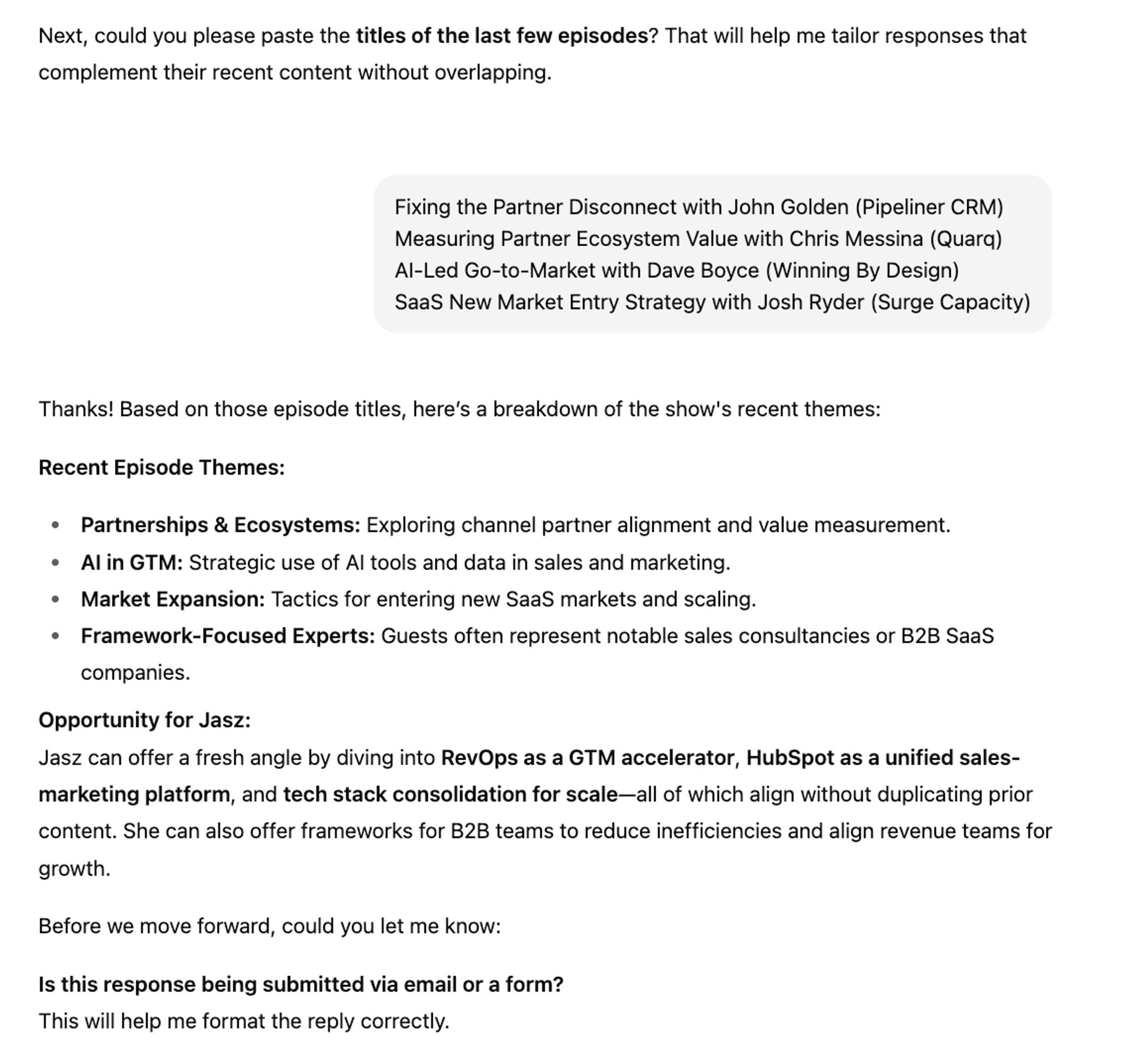
Snippet of the back and forth conversation Jasz trained the GPT to have with her VA. You can read the full chat here.
Jasz also realized she needed to add a final step to help them track pitches going out, having the GPT generate a summary of the pitch, which they manually paste in a shared doc. (For form responses, her VA takes a full-page screenshot of the answers submitted.) “That way, when a show says yes, I’m not flying blind. I know what we said I’d talk about and I can prep for it,” she explained.
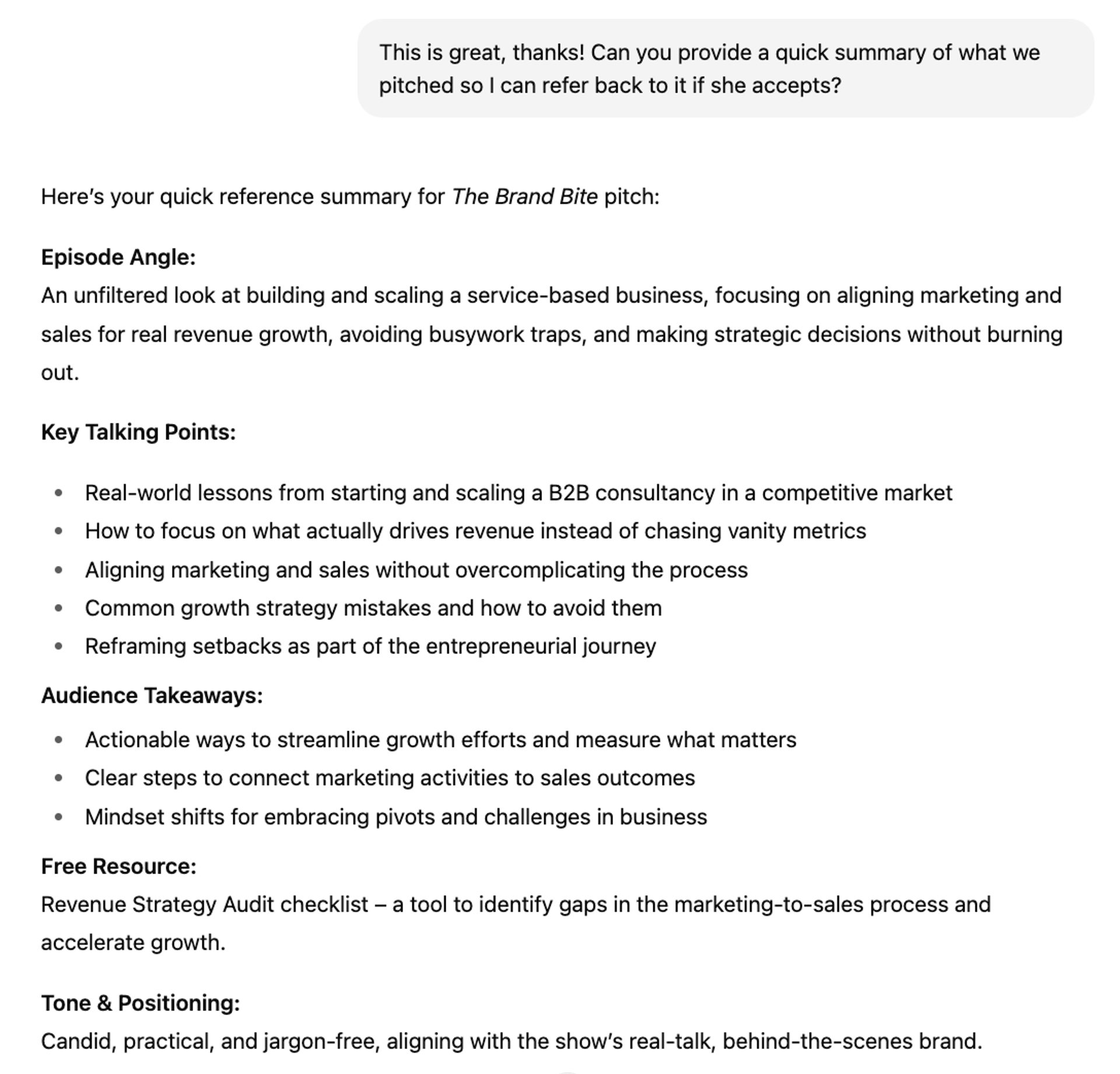
Example of GPT-generated pitch summary. You can read the full chat, including an example of a response for a podcast form, here.
Jasz went from zero to 10 podcast bookings in two months with one custom GPT. Want to build AI that works for you?
The Autonomous Marketer newsletter delivers proven workflows every other week.
Step 4: Always give the GPT detailed feedback
During this iteration process, she was also mindful to share any and all feedback to the GPT on things like tone and word usage. She thinks too many people make tweaks to GPT’s response, but never communicate those changes back to the bot. Instead, she was nitpicky in her feedback.
“If you're creating this for team members, they're not inside your brain, so they're not going to know when to make those small tweaks. It was really important for me to tell the custom GPT, ‘Actually, I wouldn't say it like that, or I wouldn't use that verbiage, or this is a little too casual.’” Even once she passed the GPT off to her VA, she asked him to flag anything that felt off, no matter how small, and they continued refining it during weekly check-ins.
Step 5: Keep the GPT current
While Jasz has reached the point where she doesn’t have any major improvements she wants to make to her custom GPT, it isn’t static either.
For instance, she regularly updates it with new client stories.
“I tell my custom GPT details on the project, the benefits, what the client saw, and then it does a great job of bringing that up whenever it would be a good client example.”
She also shares lessons from past podcast appearances and refinements to her speaking topics.
“As I’ve been on more shows, I understand the kinds of questions I’ll get asked depending on the target audience,” she said. That information helps the pitches get better.
And her VA still plays a key role. Outside of being the final review to make sure everything looks aligned, he flags any form questions the GPT doesn’t have the information to answer — like “Who are your three biggest mentors?” — so Jasz can respond personally. While her VA has to be savvy enough to flag these sorts of issues, she’s hopeful that the new GPT-5, which now has the capability to say "I don't know," might be able to call out those gaps moving forward.
Using AI to help with podcast research
While the GPT focuses on vetting and pitching shows that her VA has found, Jasz has also used AI to improve the searching process. For example, when she was ready to invest in a tool to help with podcast research, she used ChatGPT to help compare different options, asking questions like: What are your thoughts on this tool? Is it worth the money? They ultimately landed on MatchMaker.fm.
She also used it to help create process documents for her VA to use when doing podcast research, and found that it was able to share tips that she wasn’t aware of, like how to do an advanced Google search to more quickly find promising podcast leads.
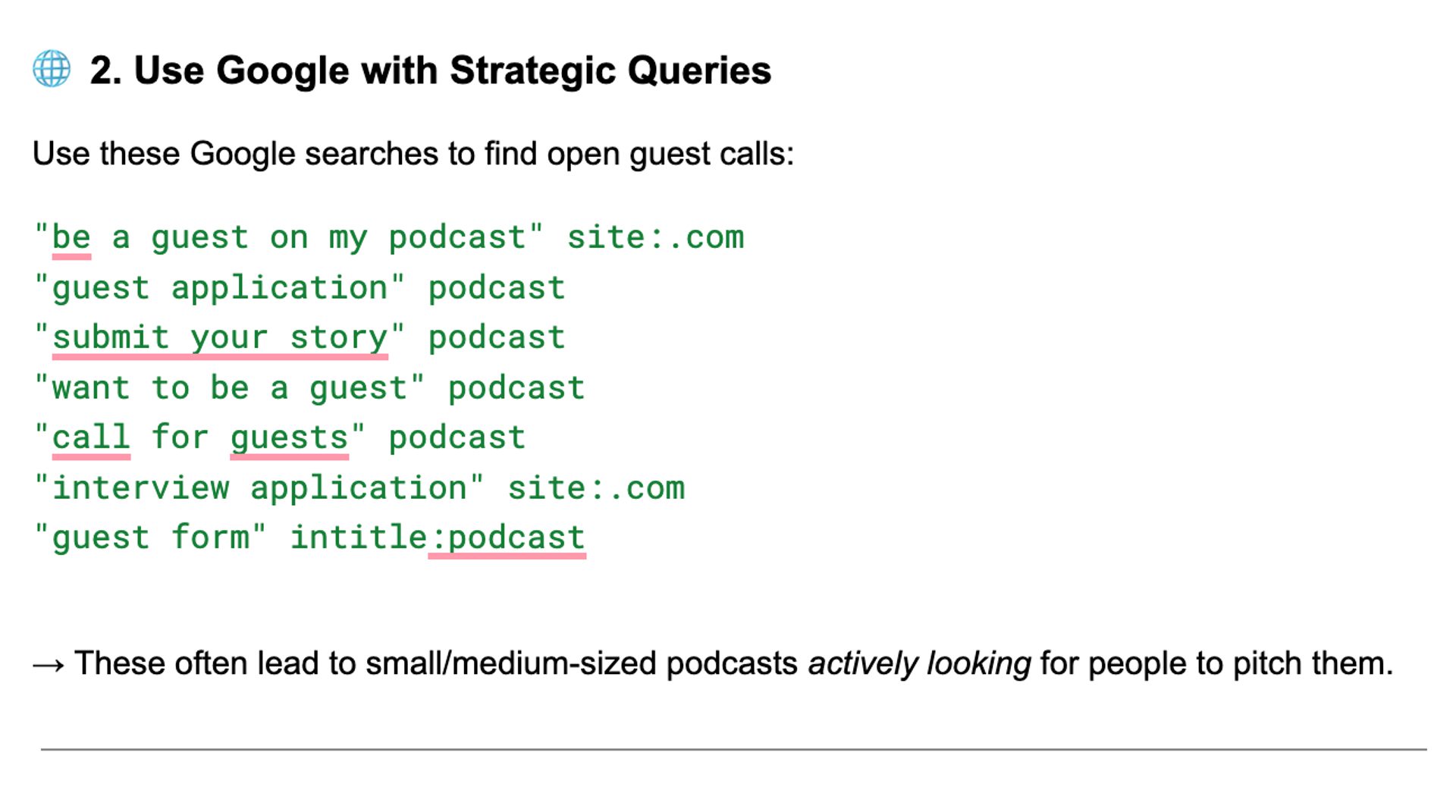
ChatGPT advice for better Google searches for finding podcast guest opportunities.
But, ultimately, the biggest time saver on the research side has been in its ability to quickly vet potential podcasts.
“It’s gotten to the point where I can do a quick search, copy and paste a bunch of podcast links, and ask ChatGPT to vet them,” said Jasz.
Putting in the work to get a quick fix
Since launching her GPT, Jasz has gone from zero bookings the previous quarter to 10 in just over two months, such as this appearance on Go-to-Market Playmakers.
But you could also train a custom GPT like this to support any process that you’re hoping to hand off to another team member but that requires deep personal or company knowledge: having your new intern help pitch you for PR, having a new employee ghostwrite content in your voice, getting an outside consultant to support with customer research.
Her biggest tip for founders and small marketing teams? Be deliberate and patient on the front end.
“People think ChatGPT is a quick fix, and it can be — but only if you put in the time to train it. It will always give you an answer. The question is, is it the right answer for your brand?”
Instead, she can feel confident in the pitches going out without her review because she carefully tested and iterated on her GPT — and never lost the human element of her trusted VA having the final check.
Put in the work once, get results forever
"People think ChatGPT is a quick fix, and it can be—but only if you put in the time to train it." Every other week, The Autonomous Marketer gives you the frameworks to do it right.