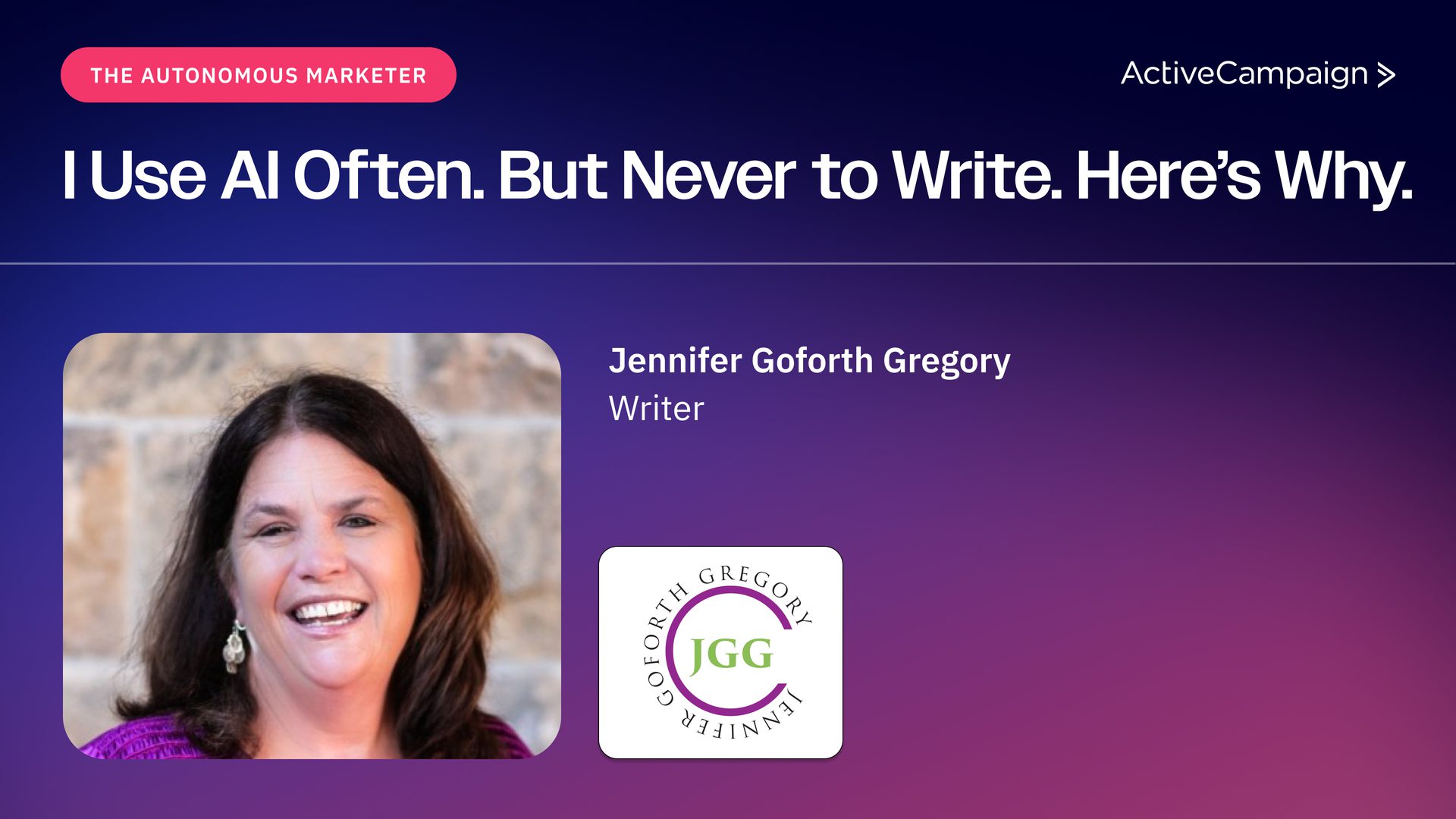
Many industries have been slow to adopt AI, but one in particular has professionals especially questioning the ethical ramifications of using AI for their work: writing.
While some writers are skeptical about AI—or even flat-out refuse to use it—others, like seasoned freelance writer Jennifer Goforth Gregory, are embracing AI, while creating and maintaining their own personal code of ethics around the technology.
“I've always been positive about [AI], and I've always felt that in the end, it's going to make writers more valued than we were before,” Gregory says. “I have never been in the gloom and doom camp with it at all.”
Here are three things Gregory believes to be true about AI:
- AI isn’t new. In fact, Jennifer has been writing about the technology for clients for nearly a decade.
- We’re currently living in the “messy middle” of AI adoption—the very best time to experiment and “tinker.” This is also the perfect time to figure out your personal comfort levels and ethical standards around the technology.
- The writers who hop on board and experiment now are the ones most likely to succeed when this all shakes out and settles.
With more than 30 years of experience as a B2B technology writer, Gregory has worked with top brands, including Lenovo, Google, Dell and Microsoft, among others, covering AI, cybersecurity, IoT, cloud, digital transformation and storage.
Gregory also teaches and mentors freelance writers through books, courses and her nearly 10,000-member strong Facebook group, The Freelance Content Marketing Writer.
Adopting an ‘inventor’s mindset’ around AI
Gregory’s ultimate stance on using AI as a freelance writer: “This is a good thing, and we need to learn how to use it responsibly and ethically.”
Unlike many freelance writers who have approached AI with fear and trepidation—Gregory says a hot topic in her freelancer Facebook group is losing clients to AI—she has always been pro-AI.
The writers that are going to survive this massive shift in our industry will adopt what Gregory calls an inventor’s mindset.
The concept is simple: Try something new in your business, and see what works. If it works, keep doing more of it. If it doesn’t, move forward and don’t look at it as a failure.
“An inventor doesn’t usually start with a fully formed idea, but usually a concept,” Jennifer writes on LinkedIn. “They tinker with this and then tinker with that. Then they get a lightbulb moment then they make six more changes till it’s the way that they want it. And then they come up with something that works. But it usually looks totally different than they thought it would.”
Gregory recently launched a series on LinkedIn called Tinkering Tuesdays where she encourages folks to try something new in their businesses without fear of failure.
“The short version is that the best way to reinvent yourself in the AI era is to give yourself permission to try new things without viewing it as a failure, but part of the process,” she writes.
"It’s time for writers to stop overthinking AI."
The messy middle we’re currently in is the perfect time to adopt that inventor’s mindset and start tinkering.
“This is evolving, and as writers, we need to stay up on what's happening. I feel very strongly that writers will need to understand, use and be aware of the ethics of AI going forward to be successful,” Gregory says. “It's not something we can ignore.”
Embracing AI with open arms—making the case for human writers
Here’s the primary reason Gregory isn’t worried about AI taking the place of human writers:
"A world where everything is written by AI would be really boring and awful."
“The human voice; the human perspective is going to stand out even more,” she shares, noting the stark and noticeable difference between content crafted by humans and content crafted by AI.
Still, Gregory cautions that we’re in the thick of “the ugly” right now, and we’ll eventually get to the point where humans and AI work better together.
“A lot of companies are figuring out how they're going to use [AI], and that, a lot of time, starts by using it for more things than they'll probably end up using it for in the long term,” she explains.
Plus, Gregory advises freelancers to look for types of writing assignments and subjects that AI can’t replace, even in the short term.
“For example, for myself, I have been focusing on recently emerging types of tech that don't exist yet, so I'm interviewing the experts that are creating it,” she says.
Smart thinking: AI can’t help you with what it doesn’t yet know, making Gregory even more valuable as a human collector of information and writer.
Approaching freelance writing and AI with ethics in mind
After covering AI for the last 10 years and utilizing it herself for tasks related to her role as a writer, Gregory has one firm boundary she hasn’t crossed and would never cross without express consent from a client: using it to write.
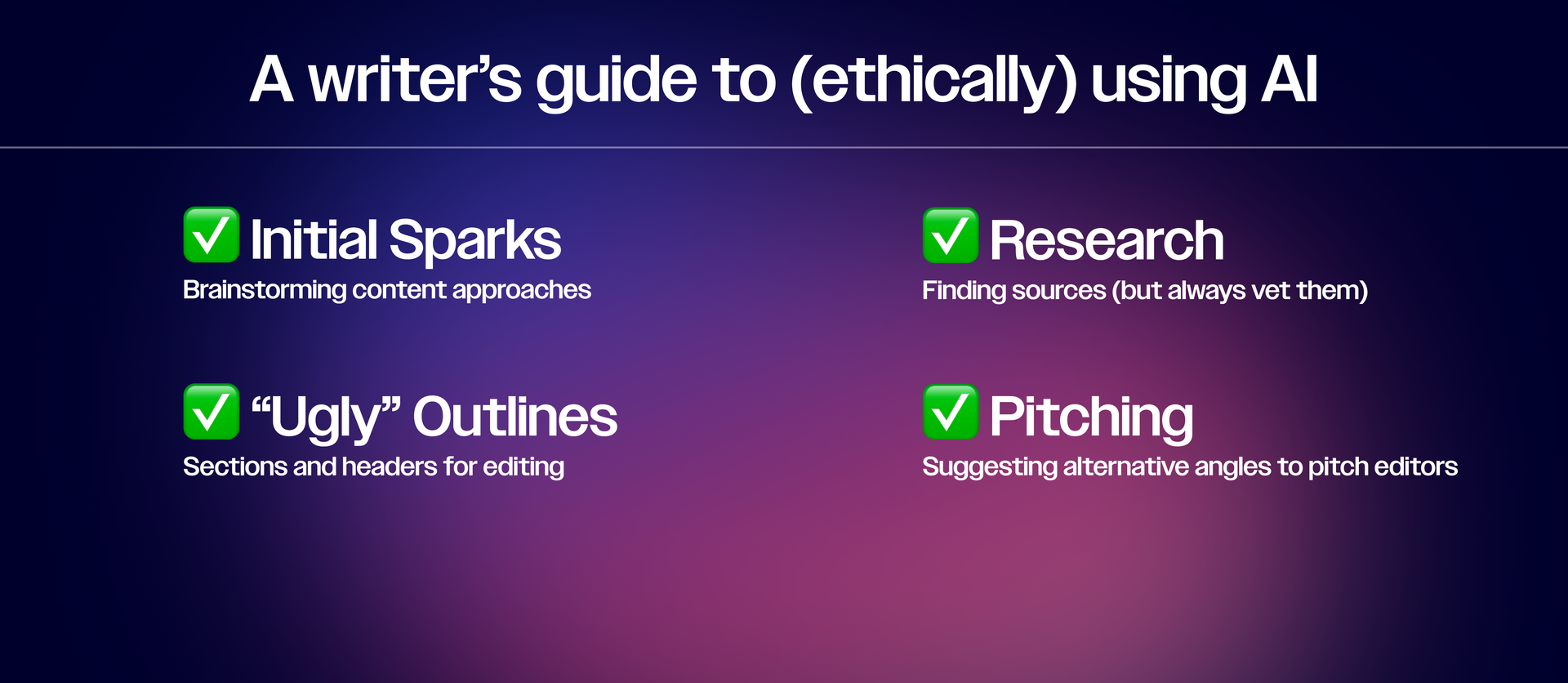
Instead, Gregory uses various AI tools to help her creativity blossom and for research.
For creativity with brainstorming, outlining and headlines
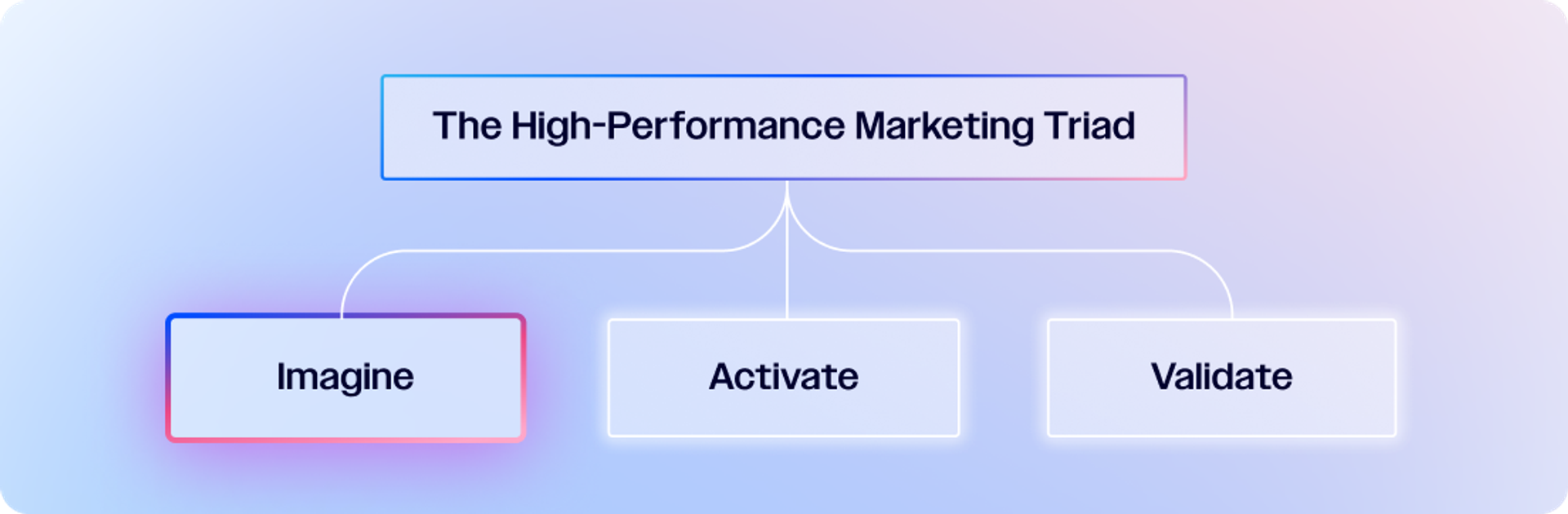
Gregory’s workflow is a textbook Imagine approach. Learn more about the High-Performance Marketing Triad.
Any writer taunted by a blank Google doc knows the hardest part of any writing assignment is getting started, and for Gregory, AI is the perfect starting point for any assignment.
“I use [AI] to help myself be more creative,” she explains. Gregory compares using ChatGPT to the way she used Google for brainstorming and research prior to LLMs’ existence. "I use it a lot like you would use Google. To get ideas. But I never copy and paste from Google into my draft."
"It’s against my personal code of ethics unless the client specifically requested AI generated content."
63% of marketing professionals use it to help them “imagine” new campaigns. See more about AI usage today in our report: 13 Hours Back
Many of the clients Gregory works with deeply care about this; some have had her sign a form saying she won't turn in AI generated content as her own. Gregory explains that she uses AI to help discover story ideas and angles. Just like she’d use Google, she reads more about the topic through her searching.
“What I read sparks me; it sparks my creativity, my curiosity,” she explains. “And a lot of times, that's how I then take my own thoughts to create a unique spin.”
In addition to using AI to help with pitches and ideation, Gregory has experimented with using ChatGPT for outlining a piece.
“One specific client encouraged me to use it for outlining,” she remembers. “I would use it to come up with the outlines, the main headlines, and then the sections and the points to include in the sections. I would write everything from there, and I would go back and change it,” she shares.
Many writers grapple with headlines, and Gregory is no stranger to the struggle. She finds it helpful to brainstorm headlines and subheadings using ChatGPT. While she never takes a headline or subhead suggestion verbatim, she often uses what ChatGPT offers as ideas, and sometimes combines a few different options or the output sparks ideas of her own.
💡Real life application: “If I need to come up with pitches, I'll put in AI: What are some trends in cloud computing? What are the biggest challenges business leaders are having with AI? From there, I don't think I've ever taken anything that it comes out with straight, but I use it to spark my own creativity, just like you would if you're sitting with a co-worker brainstorming ideas.”
For research
Once Gregory determines an angle for her story, she turns to AI—usually Perplexity—to help her conduct research.
One important caveat: Gregory never takes a statistic or piece of research from AI without fact checking the original source.
“I never take anything it says as truth,” she shares. I view it kind of like a Wikipedia page. All writers go there to look for [information] and ideas, but we always go and check the regular sources. Nothing from there is taken as fact.”
Gregory says AI is especially helpful in gathering statistics for a piece, which can be a more time-consuming task otherwise. Once she has the statistics she needs, she always refers back to the original survey or report for fact checking.
💡Real life application: “Recently, I worked on an article where I knew the statements I made were accurate because I've been writing in the industry so long, but I needed some sources to back it up. I needed to link to an article saying the facts of what's happening in the industry, and was able to use [AI] that way as well.”
Flexibility is the name of the game
Ultimately, Gregory always closely follows any guidelines or policies set forth by her clients regarding AI use.
Because the technology is constantly evolving, Gregory says flexibility and trying to stay on the leading edge of developing new skills is key.
“I'm being totally flexible, as it's all shaking out,” she says. “And I'm using every project I work on to form my own opinions and game plans.”
Get started with using AI and autonomous marketing: Get the Intro to Autonomous Marketing, go from 0 to 1, and learn how to extend your creative style using AI tools.