Regardless of your personal feelings toward artificial intelligence, there’s no denying AI’s impact on the marketing world. What started as an experiment a few years ago has now evolved into mission-critical infrastructure that informs how teams imagine, activate, and validate campaigns.
38 AI in marketing stats you need to know
Data only supports the narrative of AI’s staying power. The latest ActiveCampaign research reveals a whopping 97% of marketers say AI has affected their work, and it’s estimated the AI marketing industry will reach $47.32 billion in 2025 (Statista). For marketing teams keen on staying ahead of the curve, keeping an eye on the latest AI marketing tools and statistics needs to become a part of your routine.
Whether you’re just beginning your AI journey or looking to improve your existing operations, these 38 statistics will help you navigate the opportunities and challenges ahead. For each section across adoption, implementation, and usage, you’ll find a list of the top 6 stats about AI and marketing you need to keep top of mind.
Mapping AI’s cross-functional adoption: Marketing leads the way
We’ve reached a critical moment in AI marketing adoption, with people now equally likely to use AI daily for personal or professional use (48%) (ActiveCampaign). This suggests AI has transcended workplace boundaries and is increasingly becoming a part of how people interact with technology at home.
Investments in AI are on the rise. See the top 6 stats on the future outlook of AI in marketing below.
Data from ActiveCampaign shows marketing leads the way with 82% of respondents saying their business uses AI for marketing activities (ActiveCampaign). Marketers are 2.5X more likely to say they use AI for marketing compared to other areas like customer support (31%), operations (28%), or product (25%) (ActiveCampaign).
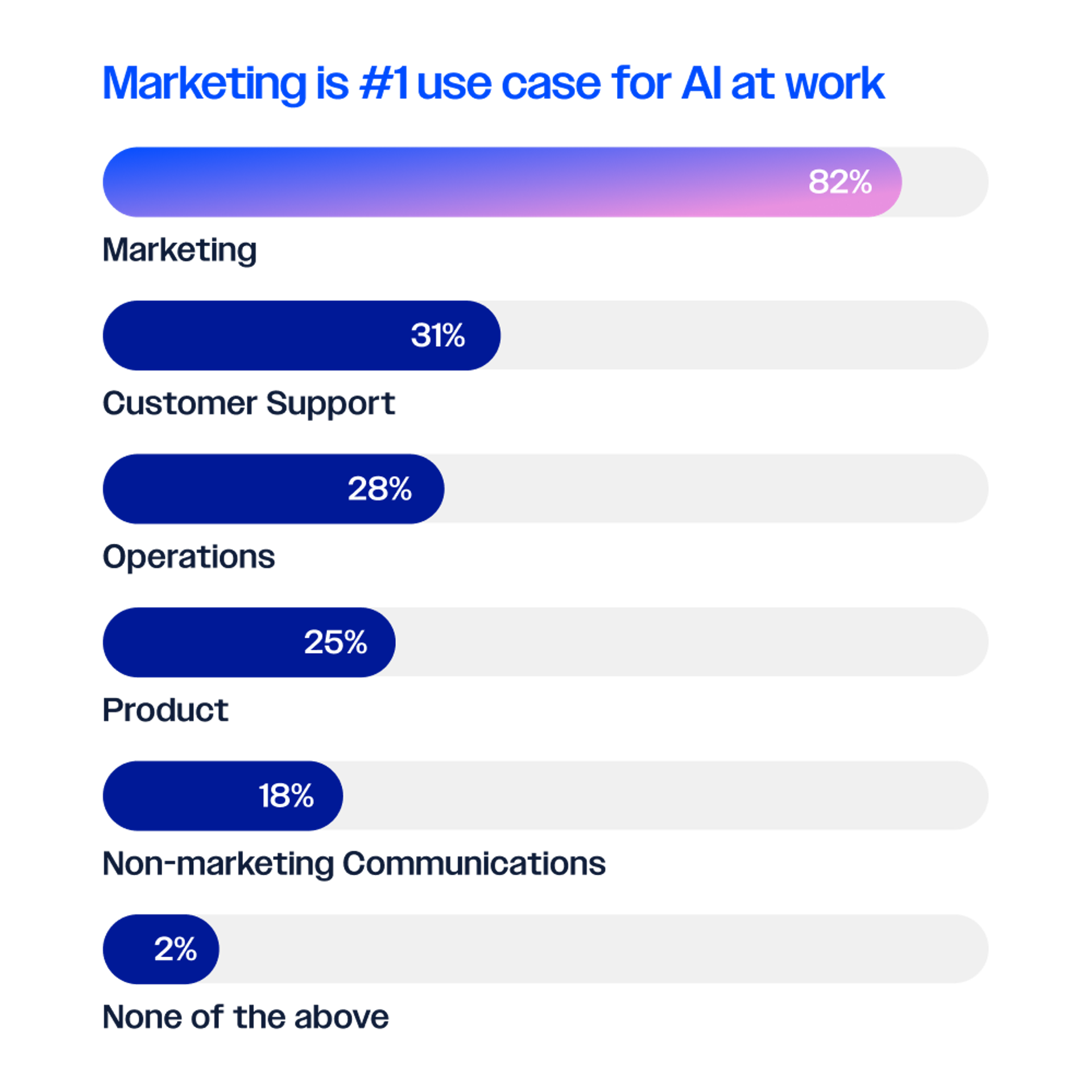
Bar chart comparing AI use cases at work, with marketing taking the number one spot.
Top 6 AI in marketing stats around future outlook and expectations:
- 49% of AI adopters have established a marketing AI council with another 16% planning to implement one by 2025 (Jasper)
- 48% of companies are adding AI-specific roles, like prompt and content engineers (AirOps)
- 92% of companies plan to increase their investments in AI (McKinsey Research)
- 69% of marketing professionals feel excited about AI technology and its impact on their jobs (SurveyMonkey)
- 71% of marketers expect generative AI will help eliminate busy work and allow them to focus on more strategic work (Salesforce)
- Employees are 3x more likely than leaders realize to believe that AI will replace a third of their work in the next year (McKinsey Research)
Measuring AI’s implementation across marketing functions
As the relationship between AI and marketers continues to strengthen, we’re witnessing a fundamental shift in how marketing professionals approach their craft.
Did you know 77% of small business marketers feel confident in the quality of their work the more they use AI? Check out the top 6 stats on marketing AI usage and implementation below.
The most successful marketers are the ones who view AI as more than an automated tool. This strategic partnership manifests in three key activities: imagination (ideation and strategy), activation (execution and creation), and validation (measurement and optimization). While 82% of marketers say they use AI for their work, only 23% are using it across all three pillars, suggesting room for growth in AI sophistication (ActiveCampaign). The confidence boost from using AI is measurable: 77% of marketers say using AI tools increases their confidence in the quality of their work (ActiveCampaign). Additionally, three-quarters believe AI makes their business more competitive against larger, more established organizations.
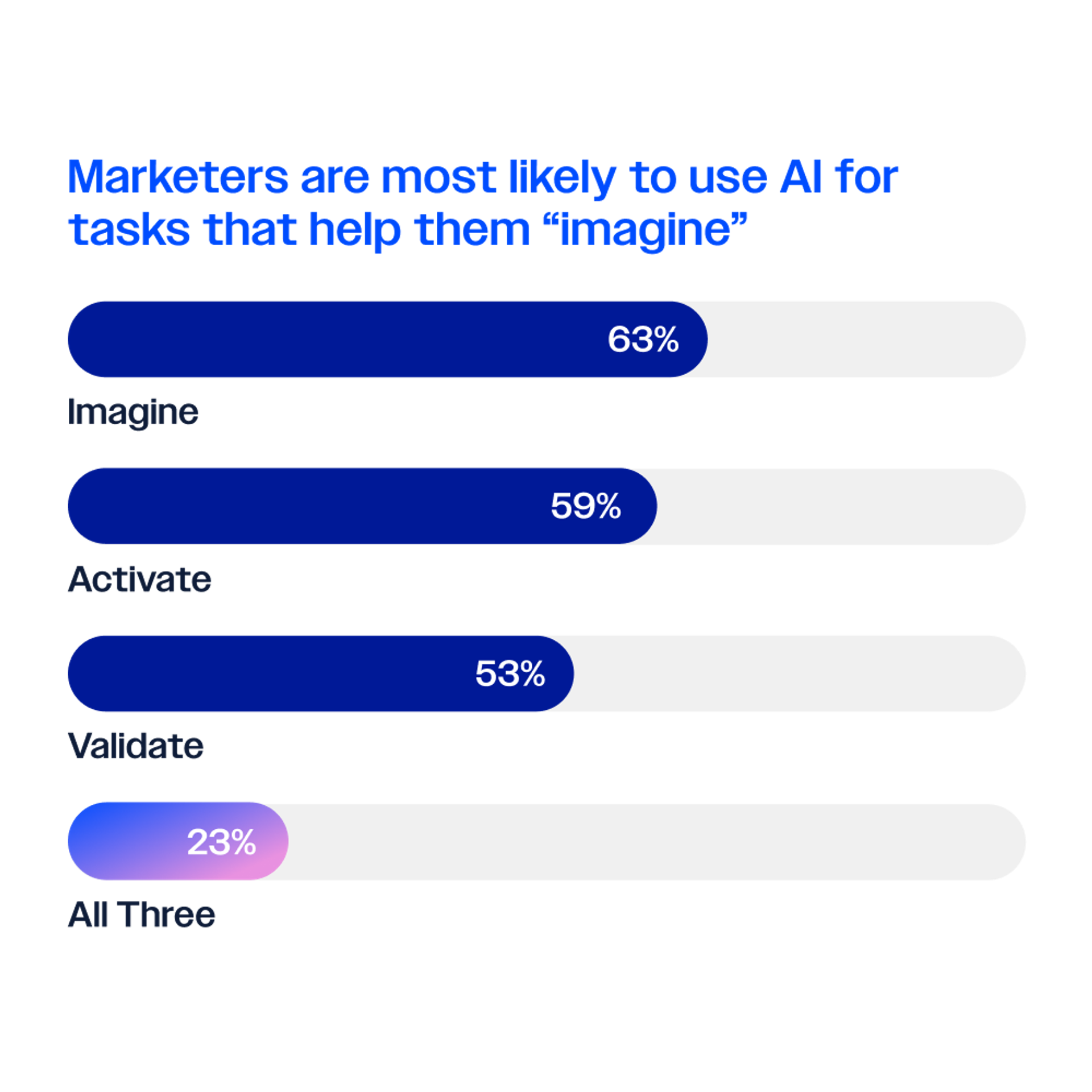
Bar chart showing how marketers use AI for various marketing activities including imagine, activate, and validate.
Top 6 AI in marketing stats around usage and implementation:
- 77% of small business marketers say the more they use AI tools for work, the more confident they feel in the quality of their work (ActiveCampaign)
- 37% of marketers on lean teams feel AI makes them more efficient in completing tasks and allocating resources (ActiveCampaign)
- 51% of marketers use AI to optimize content and 73% use AI to create personalized customer experiences (SurveyMonkey)
- 43% of marketers who have adopted AI say they don’t know how to maximize its value (Salesforce)
- 57% of marketers use generative AI for content creation and 55% use AI for idea generation (G2)
- AI-driven personalization will drive a 50% increase in B2B buyer engagement for militant adopters (G2)
Quantifying AI’s impact on marketing efficiency
Marketers are seeing efficiency gains when using AI in their day-to-day work, with AI saving marketers an average of 13 hours per week. AI also comes with cost savings, saving the average marketer $4,739 a month in operational costs (ActiveCampaign).
For Power Users, or those who use AI on a daily basis, those time and cost savings are even higher. Power Users save 57% more time each week with AI compared to Infrequent Users and 36% more each month in operational costs (ActiveCampaign). This translates to roughly 14.8 hours saved per week and over $5,000 saved each month.
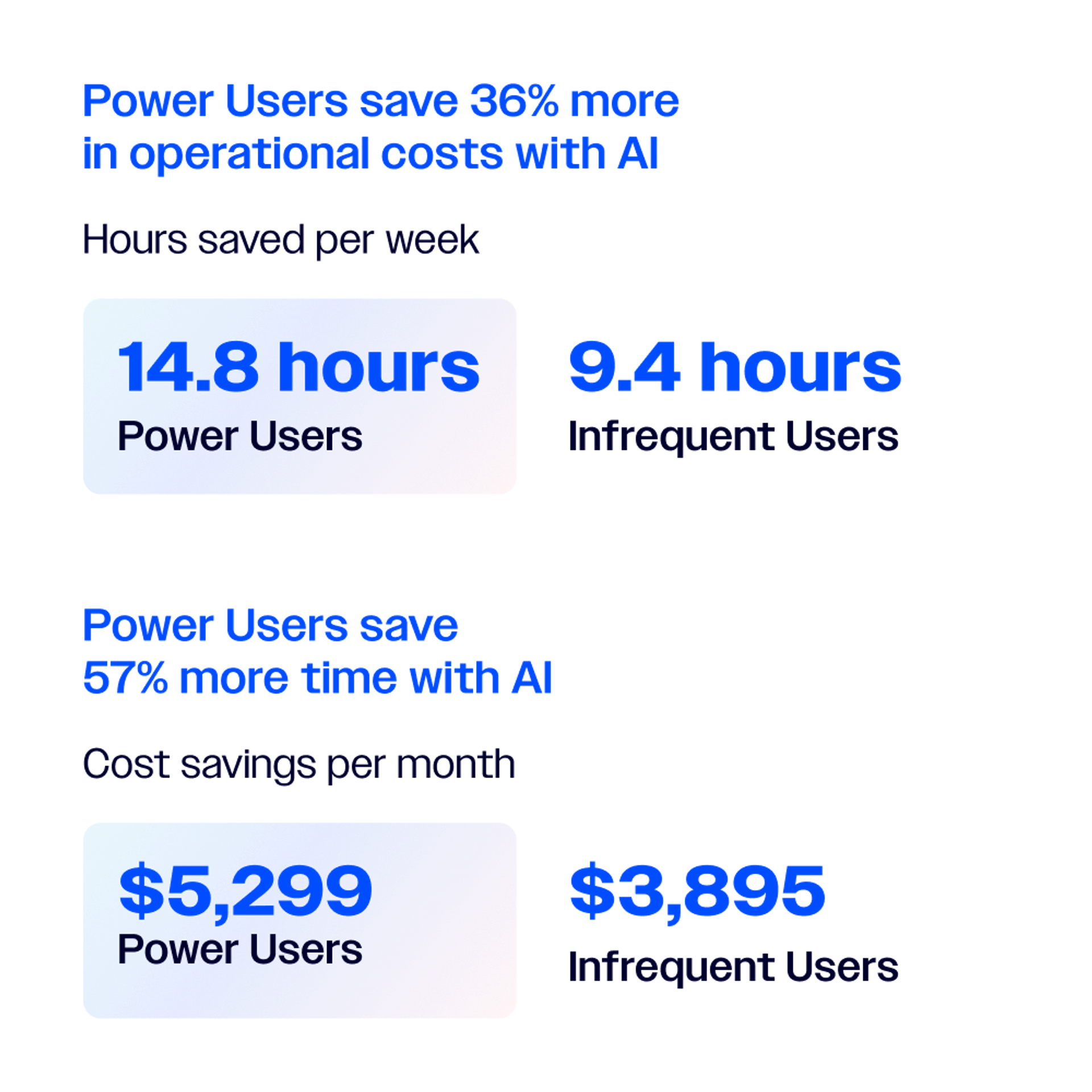
Graphic shows the hours saved per week and cost savings per month Power Users experience when using AI at work.
Top 6 AI in marketing stats around efficiency and cost savings
- 32% of marketers feel they can take on more strategic work since using AI at work (ActiveCampaign)
- 90% of marketers use AI for quicker decision-making (SurveyMonkey)
- Roughly 30% of work hours may be automated using AI by 2030 (McKinsey)
- 42% of businesses cite the need to reduce costs and automate key processes as drivers for adopting AI (IBM)
- 75% of marketers in the US say AI helps save organizational costs (Statista)
- Companies using AI in marketing will pivot 75% of their staff’s operations from production to more strategic tasks (Gartner)
Tracking AI in marketing’s shift from optional to essential
Companies that embrace AI are seeing more than just time and cost savings; they’re also realizing the strategic advantage it brings that propels businesses forward.
Did you know half of businesses are already using AI at work? Discover the 6 stats on AI marketing adoption you need to know below.
For small teams in particular, AI gives them the confidence boost they need to level the playing field with larger, more established enterprises. ActiveCampaign research reveals 77% of small business marketers see improved work quality when they use AI, and 71% say it makes them more competitive.
Top 6 AI in marketing stats around market adoption and scale:
- 81% of small businesses use AI for all types of marketing activities (ActiveCampaign)
- 88% of marketers rely on AI in their current jobs (SurveyMonkey)
- 19% of consumers use platforms like ChatGPT, Perplexity, and Gemini when searching for services and companies (SOCi)
- Global AI marketing revenue is estimated to reach more than 107.5 billion dollars by 2028 (Statista)
- 50% of businesses are already using AI, while 29% have plans to use AI in the future (WebFX)
- 77% of software buyers agree that software companies have genuinely advanced AI technology in their products beyond capitalizing on the AI hype (G2)
Discover your AI Marketing Maturity level
Keeping up with the latest AI marketing statistics is one piece of the adoption puzzle; you also need to understand where your organization stands and your pathway to the next level. The data included in this article shows that AI marketing success is about more than adoption—it’s also about maturity.
Our research shows marketers fall into five distinct maturity levels, each with their own characteristics, capabilities, and unique growth opportunities.
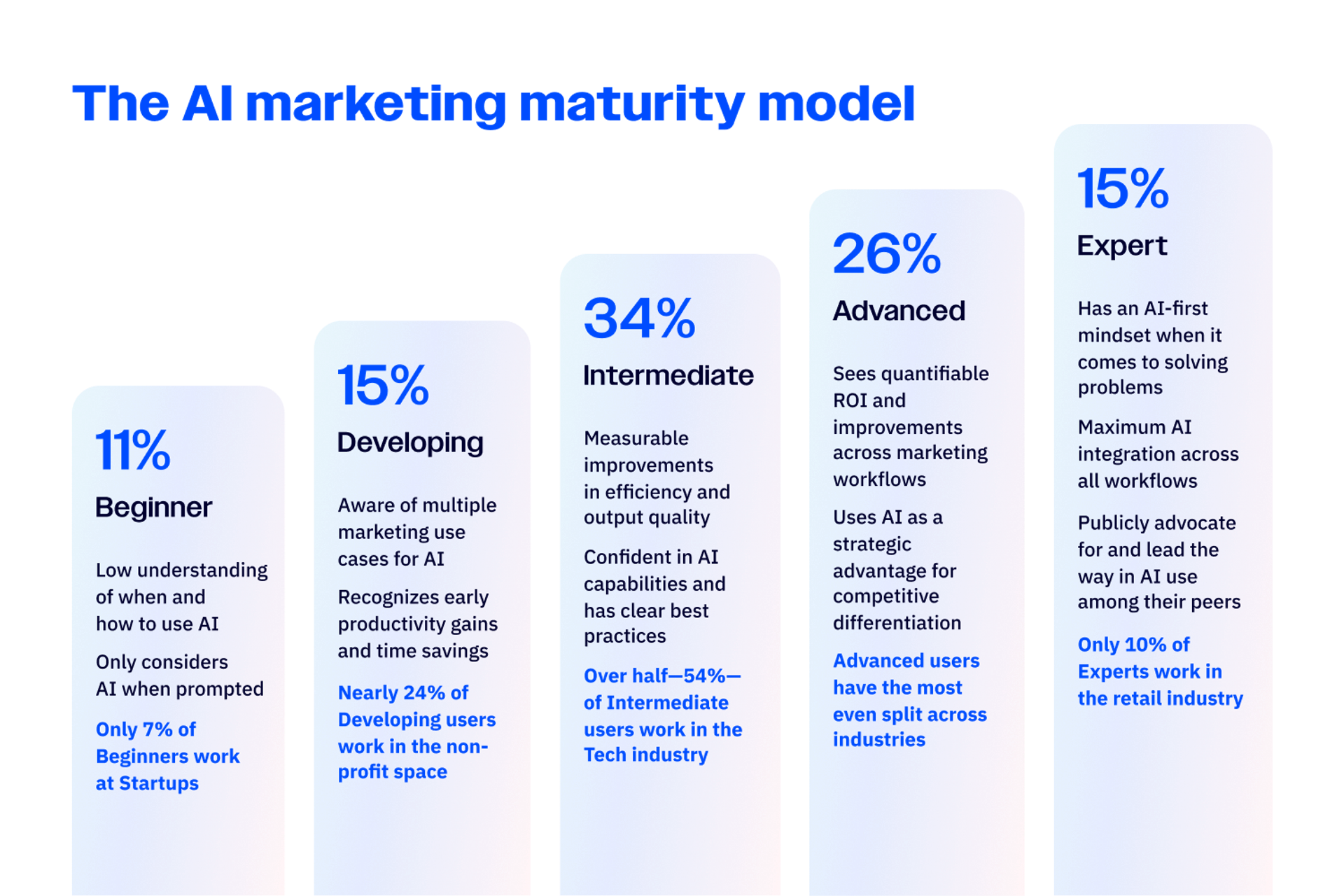
Graphic shows five bars in ascending order with varying levels of AI maturity, starting with beginner all the way up to expert.
The statistics paint a clear picture: AI is now an essential component of marketing and success will depend on how quickly and effectively organizations can implement AI into their workstreams. As we look ahead to 2030 and beyond, the competitive advantages will belong to those who master AI’s strategic application across all three marketing pillars.
Dive deeper into AI marketing maturity and the opportunities AI presents in ActiveCampaign’s comprehensive AI Marketing Maturity Report to accelerate your journey from AI adoption to AI mastery.
Stay ahead of the AI marketing curve
The AI in marketing statistics we’ve examined above represent a snapshot of a rapidly growing field. As more and more marketers embrace AI in their work, we’ll continue to see new use cases, advancements in technology, and competitive pressures intensify.
For marketers, staying on top of AI in marketing statistics remains an imperative. Regular pulse checks on industry benchmarks will help you understand your competitive position, identify untapped opportunities, and recognize areas where your organization can accelerate its AI journey. The organizations that will thrive will be the ones that treat these statistics not as static benchmarks but as dynamic indicators of an ever-changing marketplace.