When Ryan McCready joined Demostack as Principal Content Engineer, he came with a clear mission: to make the most of every asset. Rather than treating content creation as an endless cycle of starting from scratch, Ryan wanted to scale quality output by making it easier to surface the expertise trapped within the company.
Demostack, a product demo software company operating in a niche B2B space, can’t rely solely on generic SEO content to win attention. So, Ryan strategically scaled Demostack’s content engine by designing an automated workflow that turns its library of webinars into thought leadership content.
Ryan’s philosophy: Automation as a force multiplier
Ryan doesn’t see automation as a replacement for human marketers, but rather as a force multiplier.
“I don't think anything should ever be fully AI-driven or else you will be putting out slop to fill a quota,” he explains.
Instead, his approach to AI focuses on repurposing—not replacing—human-created content.
“AI isn’t great at generating original material unless you have a very large knowledge base to pull from,” Ryan says. “What it is great at is making the content we already produce consumable across different channels.”
In other words, Ryan practices a form of autonomous marketing that automates the repetitive parts of the process—transcription, extraction, structuring—while keeping strategy, creativity, and quality control firmly in human hands.
For him, efficiency comes from pairing AI’s scale with human context. The key is that he doesn’t treat content creation as an endless treadmill of new content, but as a transformation engine: turn what you have into what you need.
"The key is that he doesn’t treat content creation as an endless treadmill of new content, but as a transformation engine: turn what you have into what you need."
How Demostack turns webinars into blog posts with Zapier
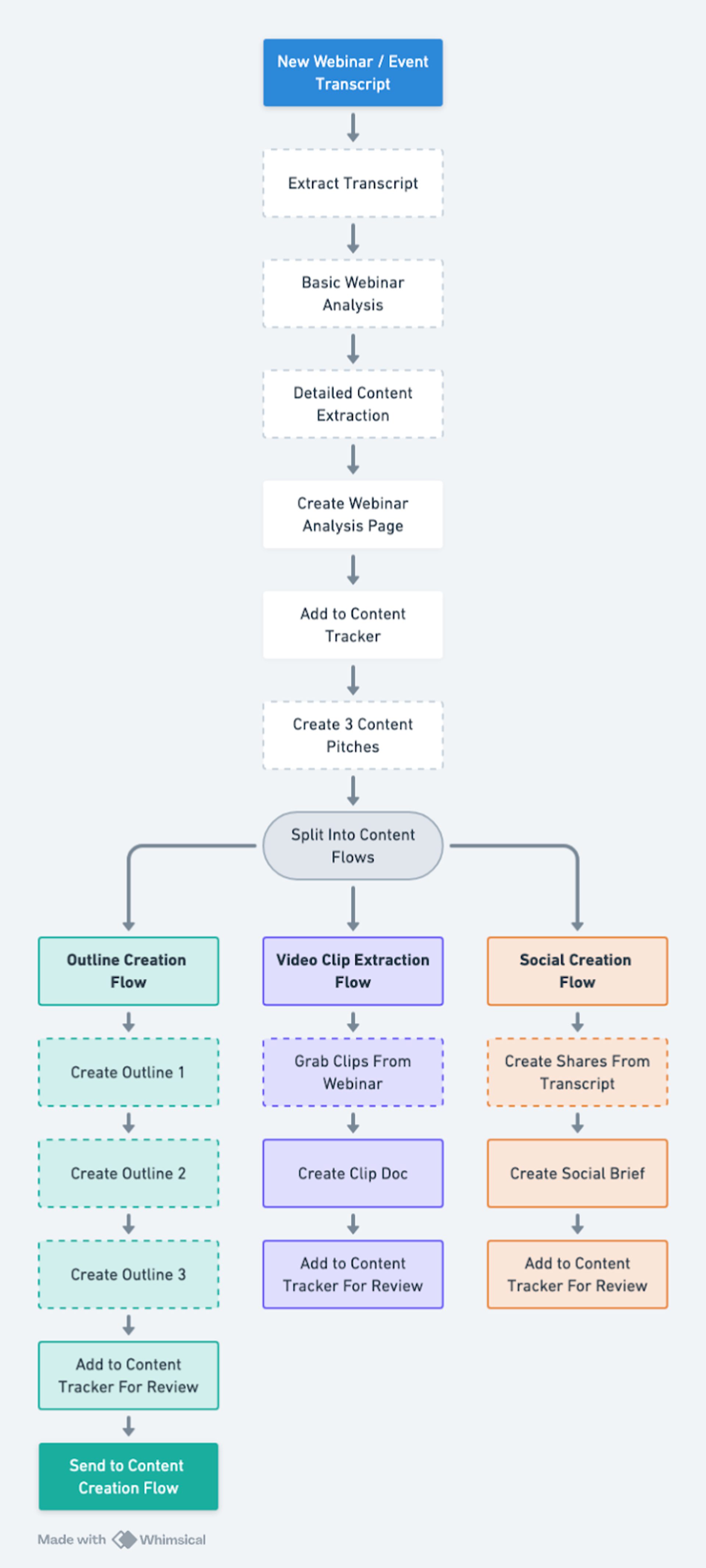
At the core of Ryan’s content-production system is a Zapier pipeline that ingests webinar transcripts and transforms them into written, video, and social content. Here’s how it works:
1. Webinar transcript input: After a webinar is recorded, its transcript is dropped into Notion.
2. Webinar analysis: AI (specifically a combination of OpenAI API and GPT-4.1 nano) analyzes the transcript and flags key quotes, statistics, and more to create a timestamped repurposing guide that includes key themes and insights, customer success signals, soundbites, customer pain points, and repurposing angles.
3. Add analysis to content tracker: Ryan can keep track of everything in Notion, for easy reference.
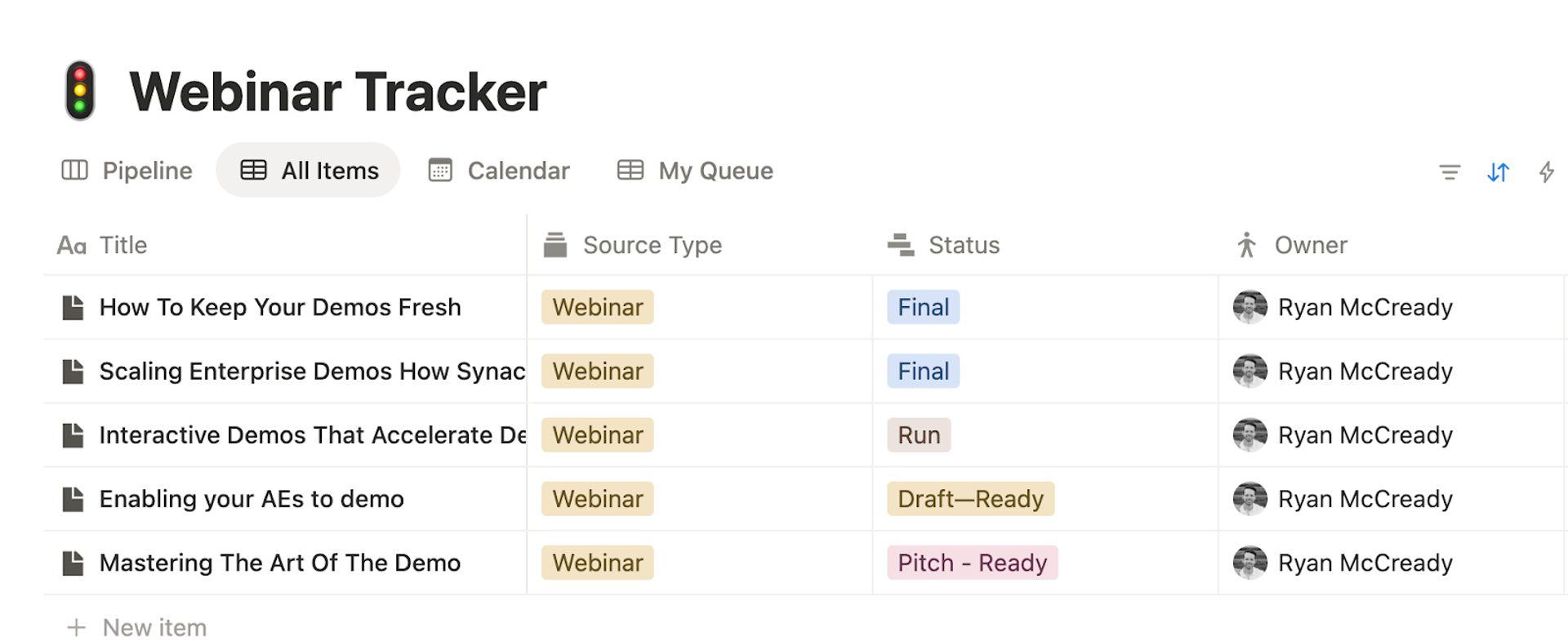
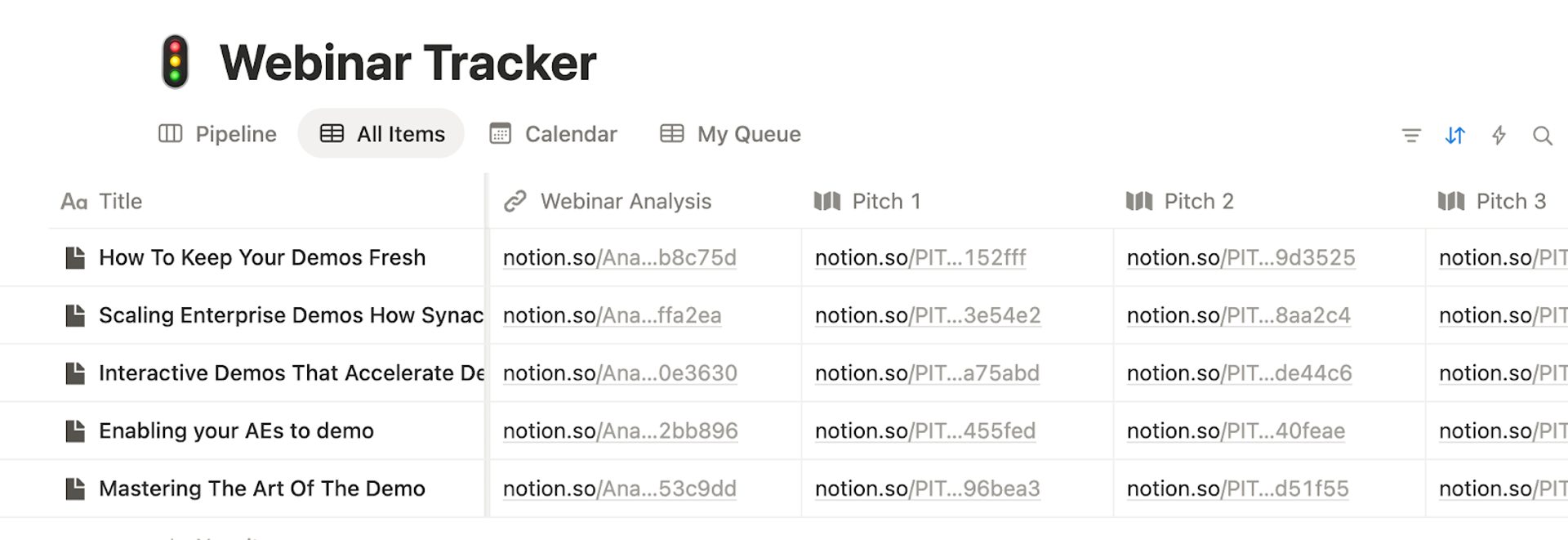
Ryan’s contract tracker in Notion
4. Create pitches: The flow creates three blog pitches for Ryan to choose from.
5. Content flow: Then the pitches are sent through a three-part content creation automation that involves:
- Blog creation flow: The system builds detailed outlines from each pitch, then uses AI to write structured blog drafts and summaries.
- Video clip extraction flow: The workflow generates video clip ideas and adds them to Demostack’s content tracker for review.
- Social creation flow: In tandem, social media post briefs are written and shared with Ryan for review.
This pipeline turns a single webinar into multiple high-quality assets—all with minimal manual effort.
Ryan turned one webinar into multiple high-quality assets with minimal manual effort. Want workflows like this? Subscribe to The Autonomous Marketer for step-by-step automation strategies from marketers already seeing results.
Results: Scaling quality and output
Even after just a few months, Ryan’s workflow has produced remarkable results for Demostack, including:
More mileage from each webinar
“In the past, the company would do webinars that would then disappear,” Ryan says. “Now we're taking those 20-25 webinars from the last couple years and turning them into valuable content, instead of them just existing as YouTube videos.”
Compressed content cycles
What once took a month from idea to blog post now happens in hours.
“This process turns the content creation process from weeks to maybe just 10 hours total [inclusive of the editing process],” Ryan says.
"What once took a month from idea to blog post now happens in hours."
Internal evangelism & AI fluency
An unexpected consequence of this workflow is that Ryan has become the go-to in his company for AI. Ryan says that showing Demostack’s executives what raw ChatGPT output looks like versus what his pipeline produces has been “mind-blowing” to them.
In other words: he has demonstrated that he can successfully upscale content without hiring two or three new marketers.
Rather than handing off to external writers, Ryan’s team retains full control over the editorial process.
Key takeaways for marketers looking to build a similar workflow
Want to scale your content like Ryan did? Here are his key takeaways for marketers exploring AI and automation:
Choose high-value source content
Rather than feeding your workflow content that’s made up of mostly external research, like SEO blog posts, start with assets rich with insights, like webinars, interviews, and podcasts from your library. These will result in higher-quality, more original content.
Give AI the right context
The more context you provide your AI tools, the better you’ll train them to create accurate output. Ryan provides his AI with an outline, pitch, or brief, and webinar analysis docs.
“This approach allows us to write much better long-form content, because we’re building a base for the model. It's got all these things it can reference as it's putting together blog posts, instead of just getting caught up in the 55- or 60-minute webinar transcript, which I've seen other approaches struggle with,” he says.
Break down your AI prompts into small steps
Ryan doesn’t just drop a transcript into ChatGPT and hope for the best. He breaks each task into micro-prompts: several for analysis, one for outlining, and one for writing.
“AI works best when you ask it to do one or two things at a time,” he says.
Ask AI for multiple options
Ryan’s system always produces three pitches and three outlines per webinar.
“If you rely on one result, you’ll get the worst one. But if you ask for three, you’ll almost always get a good one—or at least inspiration for a new angle,” he says.
The three pitches the workflow generates tend to include “a very traditional read through of the webinar, a wildcard pitch, and a framework pitch.” Ryan can choose the pitch that produces the best results for the task.
Combine tools based on strengths
Different LLMs have different strengths, so rather than just inputting data through one tool, experiment with several until you figure out which one is best for each step of your workflow.
Ryan drafts in ChatGPT, then refines in Claude, which he feels is better at writing for expansion, polishing, and voice.
Balance automation with human oversight
Ryan manually reviews every draft for structure, tone, and narrative quality.
"I don't think anything should ever be fully autonomous,” he emphasizes.
Clean and structure your source material
Just like the more specific your prompts, the better the results, the clearer the source data, the better the output. Rather than uploading a raw transcript, trim filler words, segment by theme, and tag key moments first to get sharper, more usable results.
Keep improving your workflow
Ryan treats his automation system as a living project. Don’t just set it and forget it. Rather, refine prompts and model choices often to improve performance.
Evangelize internally
Want to get more buy-in for automation that will make you an invaluable member of your company, like Ryan did? When you use AI to create workflows, show stakeholders why the process improves speed, quality, and ROI.
High-quality content at scale
Ryan McCready’s Zapier-based workflow turns webinars into a steady stream of high-quality thought leadership. This model demonstrates how automation paired with human curation creates a sustainable way of boosting content volume, maintaining quality, reducing costs, and staying nimble in a niche where deep content matters.
For marketers who want to scale content without scaling headcount blindly, Ryan’s approach offers a compelling blueprint. Repurpose what you have, automate wisely, keep humans in charge, and build a content engine that works smart.
Your content library is a gold mine
The Autonomous Marketer shows you how to unlock the value you've already created:
- Repurposing workflows that turn one asset into many
- Automation strategies that compress content cycles
- Real blueprints from marketers already scaling smart