In case you missed it, Merriam-Webster’s word of the year for 2025 was “slop”: “digital content of low quality that is produced usually in quantity by means of artificial intelligence.”
Perhaps unsurprisingly, there are several types of slop you may have encountered already.
First there’s “workslop,” which usually refers to written internal work documents, such as emails or meeting notes. According to Tim Metz, director of marketing and innovation at content marketing agency Animalz, workslop “seems valuable when you first read it, but then if you really try to understand what it says, you realize it has no value or just doesn’t make any sense."
We’ve all, for example, received an email from a colleague that seems eloquent until we realize it’s needlessly verbose and redundant. That’s workslop.
Then there’s “AI slop” or “content slop,” meaning low-quality content generated by AI, usually to grab attention or increase production volume. Think fake news, Italian brainrot, or more innocuous: a poorly written article.
In his role at an AI-forward content marketing agency, Metz has carefully considered when to leverage and when to put the brakes on what AI creates. One of his greatest innovations has been creating an “unslop” command that cuts slop from AI-generated documents and frees writers to focus on high-value editorial work, strategy, and research instead of repetitive tasks.
Here's how Metz thinks about AI at work, how his “unslop” command functions, and how you can embrace AI as a marketer while maintaining high quality content.
How Animalz uses AI deliberately
AI is undeniably changing how marketers do their jobs. Rather than shy away from using AI, Animalz embraces it in both client-facing and internal work. However, the agency doesn’t leverage AI with reckless abandon.
The key to using AI strategically is creating the right infrastructure.
"You really have to build almost a different infrastructure, giving the AI models access to different kinds of data and I think when you start to do that with the latest models, you start to see very interesting and good results that were not possible before," Metz says.
At Animalz, this infrastructure looks different depending on the service:
- High-end thought leadership and custom research reports: AI plays a minimal role. These require deep strategic thinking and original analysis.
- LinkedIn content program: This is where Metz has built extensive AI infrastructure, touching nearly every stage of production while maintaining human oversight.
- AEO (Answer Engine Optimization) audits: The team uses significant AI assistance for analysis and recommendations.
"I don't think all work can ever be done by AI, hopefully, but I do think more and more of it can be done by AI than ever before."
How to build an “unslop” command for AI-generated content
Even with careful systems in place, Metz has learned that slop appears anywhere AI touches content creation.
“Even if you use AI behind the scenes, for example, for creating brand kits, it tends to produce (work)slop,” he says. “So it's not just what comes out of the system, but even if you use AI to create things inside the system (e.g., the brand kit elements that feed into the workflows), those brand kit elements also become sloppy.”
To combat slop, Metz developed a custom Claude prompt he calls an "unslop" command. It's built around three principles: MECE, DRY, and Essential.
Principle 1: MECE (Mutually Exclusive, Collectively Exhaustive)
MECE, a framework from management consulting, ensures content covers everything it needs to without overlap.
"If you follow that rule, you haven't left anything out, but you also haven't made different sections overlap each other," Metz explains.
In practice, MECE means each section should address a distinct topic, and together, all sections should fully address the topic.
Principle 2: DRY (Don’t Repeat Yourself)
This principle is simple: if you've said something once, don't say it again.
Apply this principle by eliminating anything that just rephrases earlier content.
Principle 3: Make things as simple as possible, but not simpler
This principle prevents over-aggressive cutting. The goal is clarity and conciseness, not minimalism that removes necessary context.
Metz notes that each workflow goes through systematic testing after any changes to ensure it doesn’t cut too much.
“Every time you make changes, you need to run standardized tests to see if things are improving or regressing. So if too much has been cut (from a brand kit, for example), you'll see the quality of the posts starts to drop,” he says.
One give away that the command has gone too far is if the text “starts to read like shorthand.” Or if it “starts to cut out examples because it thinks those are unnecessary, but they're actually very important (in this context of content creation).”
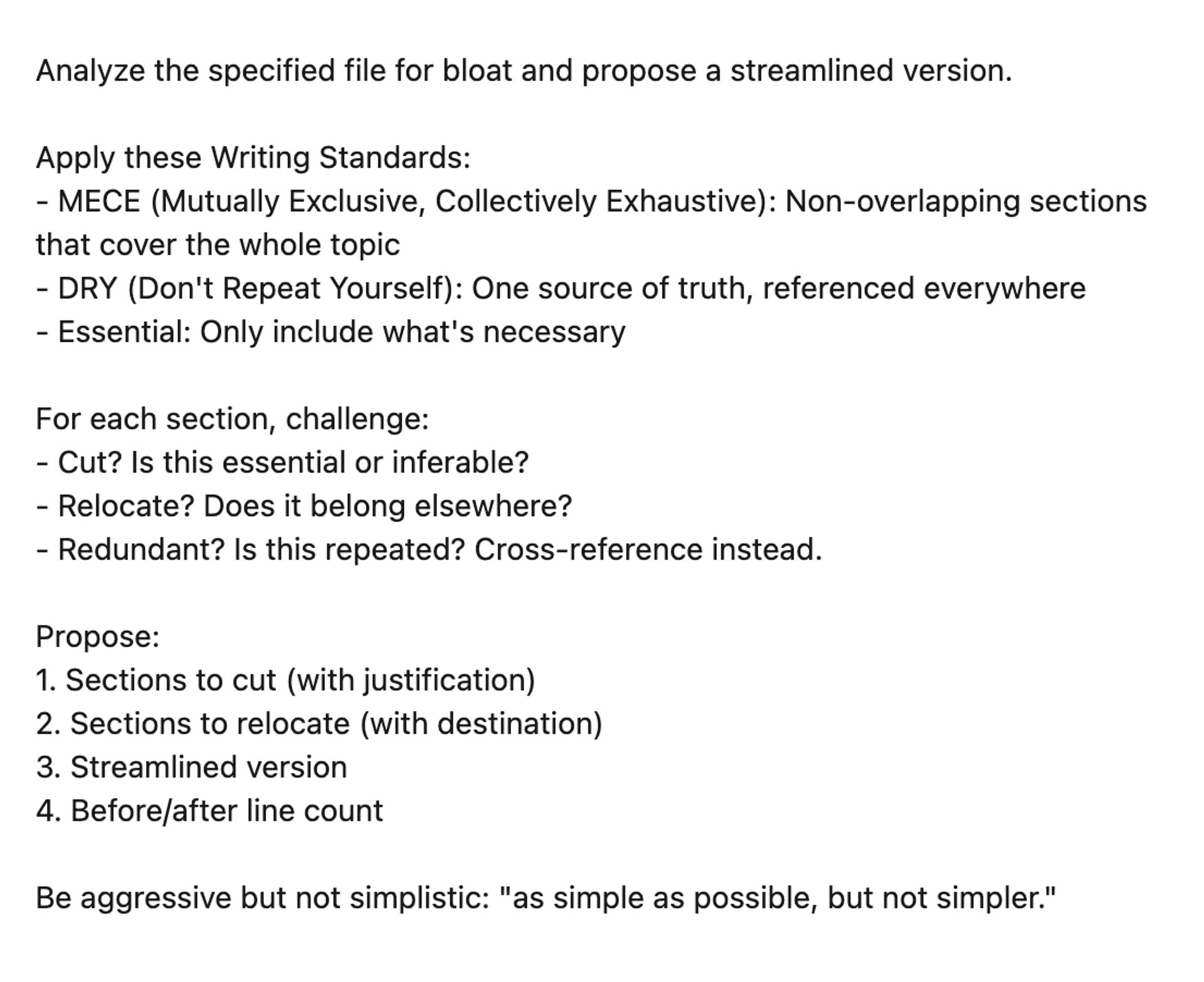
Metz’s “unslop” command
You can learn more about Metz’s unslop command via LinkedIn.
The “Unslop” command in action
Let’s see Metz’s “unslop” command work its magic on a product strategy roadmap document.
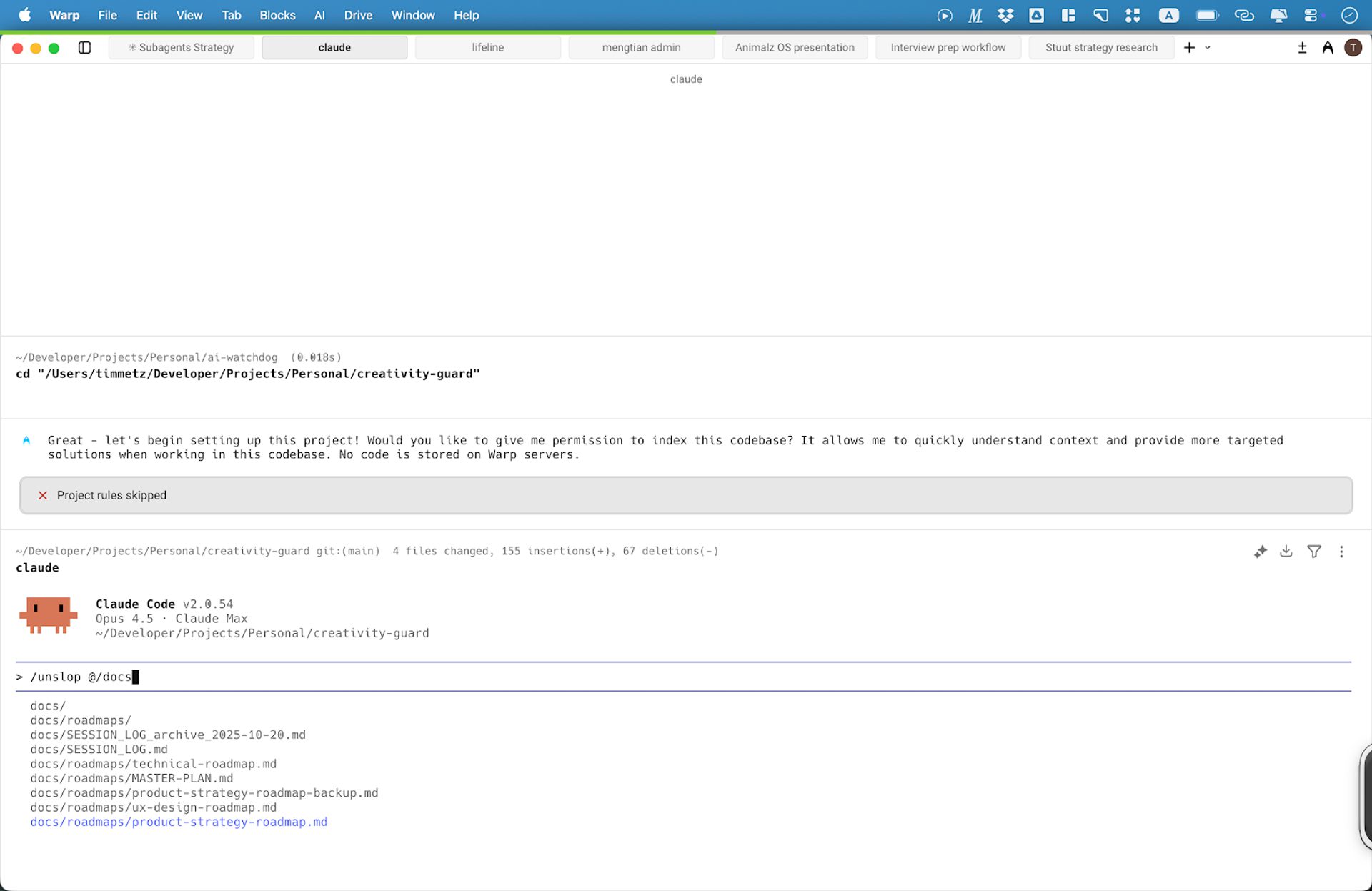
Unslop command initiated via Claude Code
First, it suggests sections to cut and provides justification for doing so. Next, it recommends sections to relocate while providing reasoning.
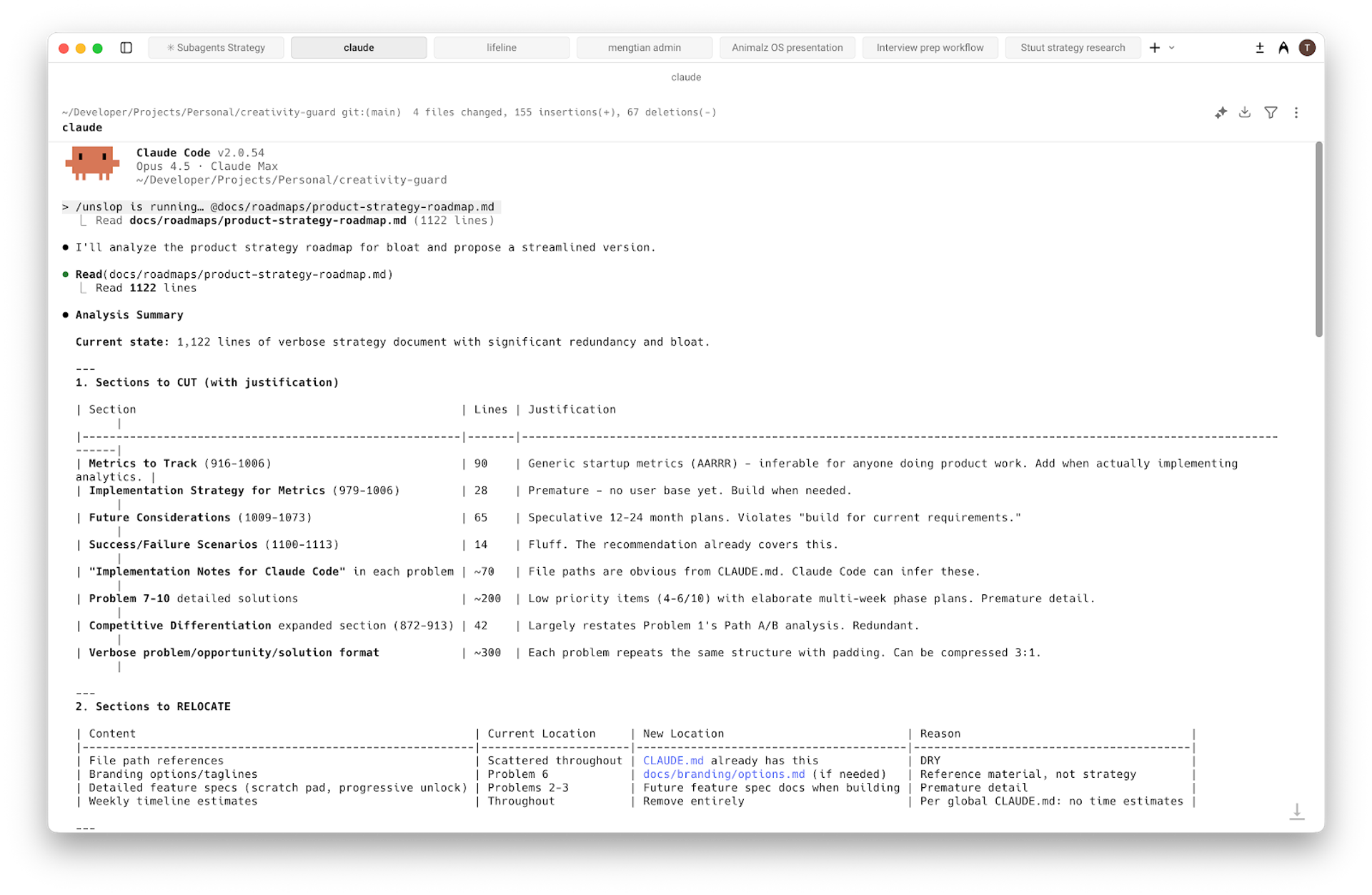
Claude Code highlights sections to cut and relocate
Finally, Claude Code rewrites the document sans slop.
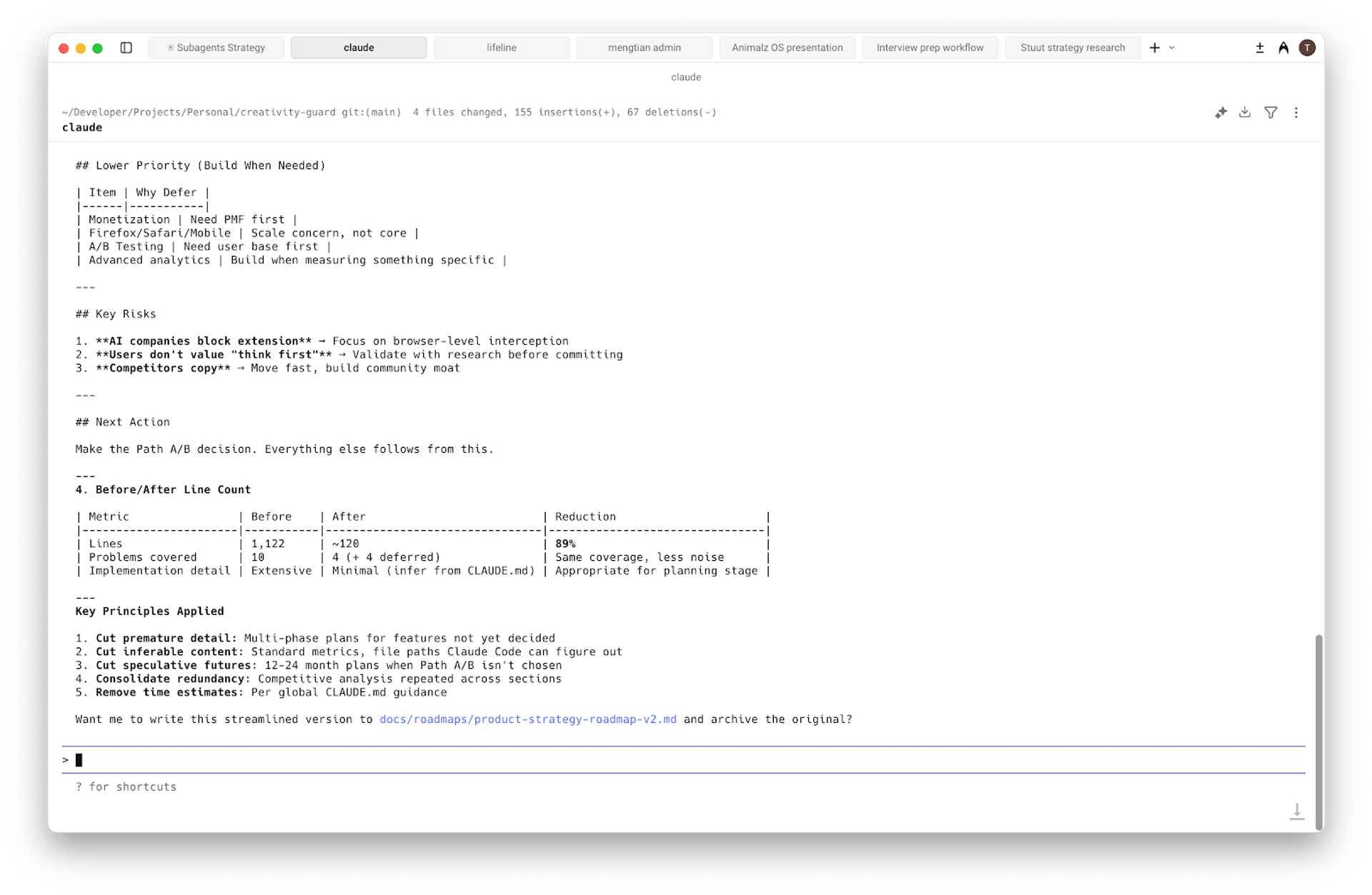
Claude Code rewrites the document, following the unslop command, and analyzes content reduction and key principles applied
Here’s how the product strategy roadmap document looks pre-unslop command (on the left) and post-unslop command (on the right). The unslopped document gets right to the problem and presents two decisions in a very easy-to-understand way.
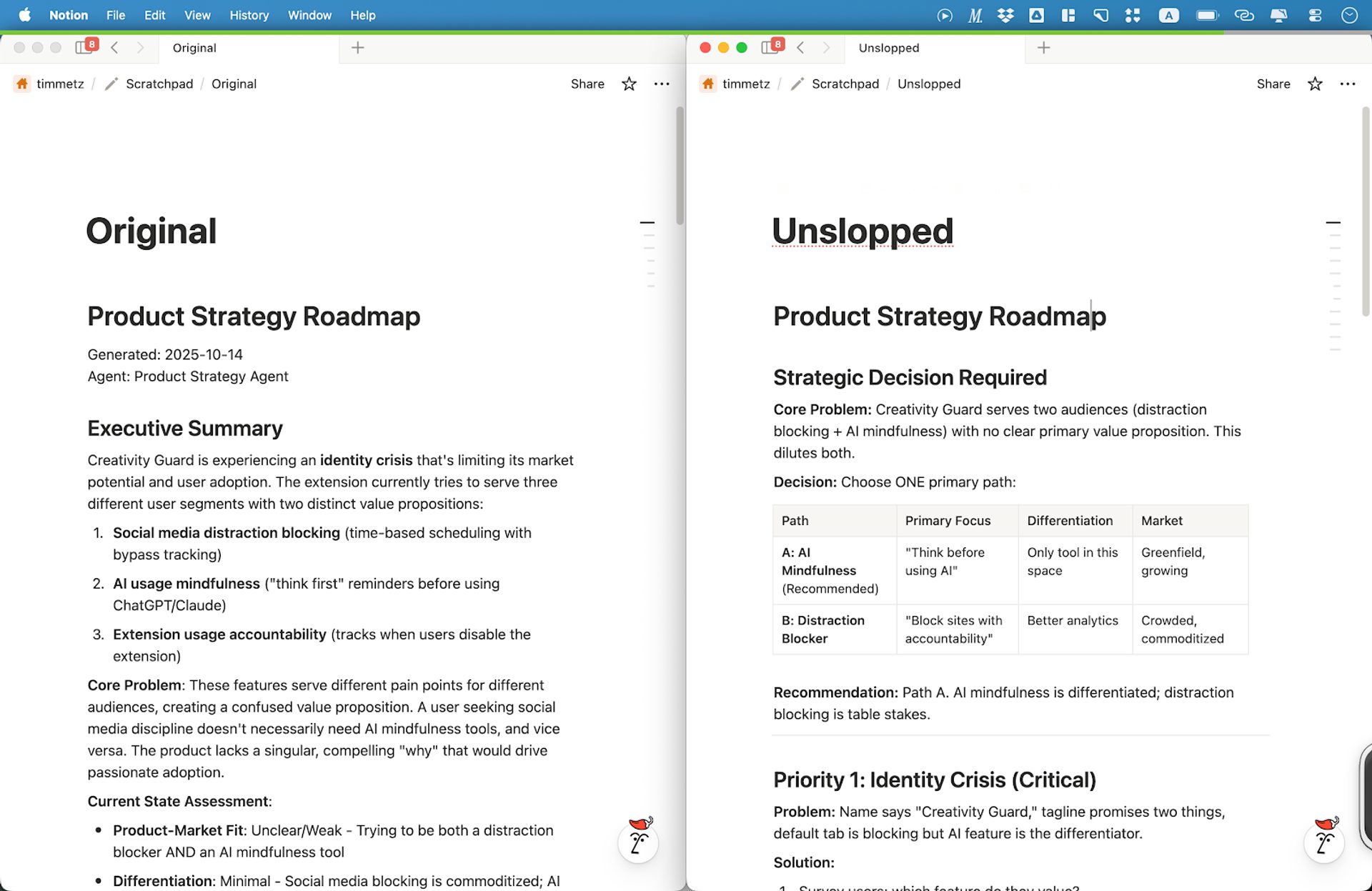
Key takeaways: Embracing AI while maintaining quality
Metz's work on slop offers a blueprint for marketers who want to scale content without sacrificing quality:
- Build infrastructure first. Don't just plug ChatGPT into your workflow. Create databases that give AI context, build brand kits that define voice and strategy, and establish clear handoff points between AI and humans.
- Use feedback loops. Store outputs, analyze what works, and feed that learning back into your prompts and brand kits.
- Keep humans in the loop. With the help of AI, writers and editors can focus on making strategic decisions and polishing content rather than starting from blank pages.
- Apply clear editing principles. Use frameworks like MECE and DRY to cut slop systematically rather than just relying on a gut feeling.
- Watch for slop everywhere. Don't just check external content. Internal documents, briefs, and strategy memos are equally vulnerable to slop. "Most people are not really trying to cheat with AI; they just need a shortcut," Metz notes. AI makes those shortcuts dangerously easy.
- Match AI use to content type. Not all content should involve AI. Animalz uses extensive AI for LinkedIn posts and AEO audits but minimal AI for high-end thought leadership. Know where AI adds value and where it doesn't.
For marketing teams considering their own AI implementations, Metz's experience shows what's possible when you combine thoughtful infrastructure with rigorous quality control. Writers can spend less time on mechanical tasks and more time on the strategic and creative work that AI can't replicate.
If you’re enjoying reading this series and want to learn even more about how to embrace AI at work (and in your personal life), check out Metz’s Substack: We Eat Robots.