

Key stats
- 2 xopen rates
- 58 %less time to create campaigns
- 22 %increase in inbound pipeline from email alone
- 18 %dormant contacts re-engaged quarterly
Gary Spagnoli has a contrarian take on mainstream ideas around AI currently consuming Silicon Valley. While engineers debate which large language model reigns supreme, the CEO of Analytics Mates takes a different approach.
"My hot take on this is: I don't care," he says. "I'm going to use them all."
Spagnoli is leveraging a suite of AI tools in concert, with ActiveCampaign at the center. Here, eight years of customer interaction data become the context that makes everything else work.
Before Active Intelligence, a newsletter took four people and a Friday deadline
Analytics Mates started in 2022, helping marketing agencies migrate clients from Universal Analytics to GA4. The company built expertise in marketing analytics, working with clients from small ecommerce stores to enterprise accounts, like Costco Auto and Gallagher Insurance.
By Q4 2025, the team developed AI agents for internal workflows. In January 2026, they launched The Helm, an AI product that connects to Google Analytics for automated auditing and analysis. Within the first month, customers were signing up without ever talking to sales.
But before integrating Active Intelligence with their automation strategy, Analytics Mates faced constraints. As a company born from Gary's experience running an SEO agency, organic content is Analytics Mates' most powerful discovery pipeline. And sharing that content meant sending a lot of emails. A single email campaign required a copywriter, designer, QA tester, and analyst. Each person contributed one to two hours minimum. A content brief submitted on Friday wouldn't get reviewed until Monday.
"There used to be so much more lag time because you'd have to work with more people," Spagnoli recalls. "I would have to refine the copy and then send this over to a designer."
Manual reporting required an analyst to extract insights before weekly content meetings. Sales proposals demanded custom design work. And the company had no systematic way to reactivate prospects who went cold after 90 days.
Why Gary uses ChatGPT, Claude, and Gemini–and why none of them run the show
Analytics Mates uses multiple AI tools (ChatGPT, Claude, Gemini), but Spagnoli is clear about ActiveCampaign's unique advantage: it owns the customer data.
"The most critical element of any LLM or AI tool that you want to use is the context around your prompt and your request," he argues. Active Intelligence has direct access to eight years of Analytics Mates’ email performance data. Which subject lines worked? Which offers converted? Which messaging failed? Generic LLMs require you to manually upload this context. Active Intelligence already has it, because AnalyticsMates has sent dozens of campaigns with ActiveCampaign, and Active Intelligence has first-party access to all of your campaign data at the touch of a button.
"Even if you had a database you set up Databricks, BigQuery, whatever, and it was all connected, I still think that the context can get too wide," Spagnoli says. "You need guardrails, which is why we're going to see specialization in AI products." One area where this context advantage is most obvious is in content creation.
How Gary goes from zero to newsletter-ready in 2.5 hours
Before Active Intelligence, creating Analytics Mates' newsletter required hours: time spent researching, copywriting, designing, and multiple rounds of reviews. Now it takes 2.5 hours.
Spagnoli follows a three-phase framework. He starts by querying Active Intelligence something like: "What emails have done well in the past month or this time last year, and what emails have not done well?" Active Intelligence analyzes historical performance and surfaces which subject line styles resonate, which content formats drive clicks, and which offers fall flat.
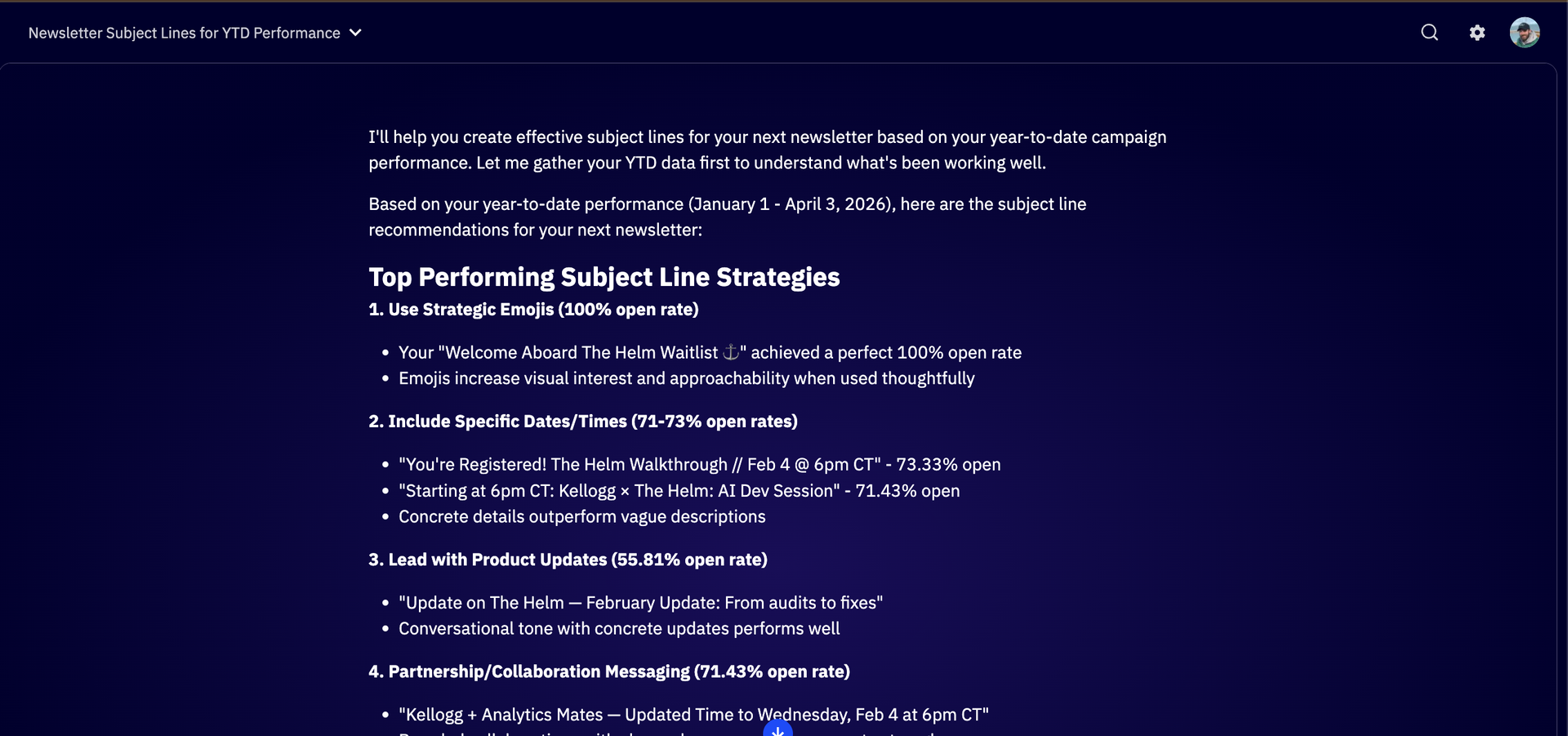
Active Intelligence analyzing Gary’s subject lines
Here's one of his go-to prompts: "Analyze the last 12 email campaigns. Identify patterns in open rate, click rate, and downstream conversion by topic, persona, and send time. Recommend 3 campaign themes most likely to improve conversions next quarter."
What comes back isn't just surface-level metrics. Active Intelligence tells him which topics actually resonated with specific personas, when his audience is most likely to engage based on their history, and which content themes led people to book meetings or sign up for demos.
"The biggest driver was better segmentation and timing, not just subject lines," Spagnoli says. "This fits our Analytics Mates philosophy: better data context leads to better decisions."
Armed with these insights, he feeds Active Intelligence new content (recent blog posts, industry trends, competitor examples) along with the performance context: "Here's the blog. Here are some external sources. Here's what you told me doesn't work. Here is the template. Draft something new for me."
When he's working on subject lines specifically, he'll ask: "Generate 10 subject lines optimized for CFO-level analytics buyers based on past high-performing campaigns. Include tone variations: educational, urgent, curiosity-driven."
"A newsletter at this point, you could one-shot it," Spagnoli says. "There are almost no modifications necessary."
His weekly newsletter follows a consistent structure: one featured blog post, three external industry resources, one call to action, and sailing metaphors woven throughout.
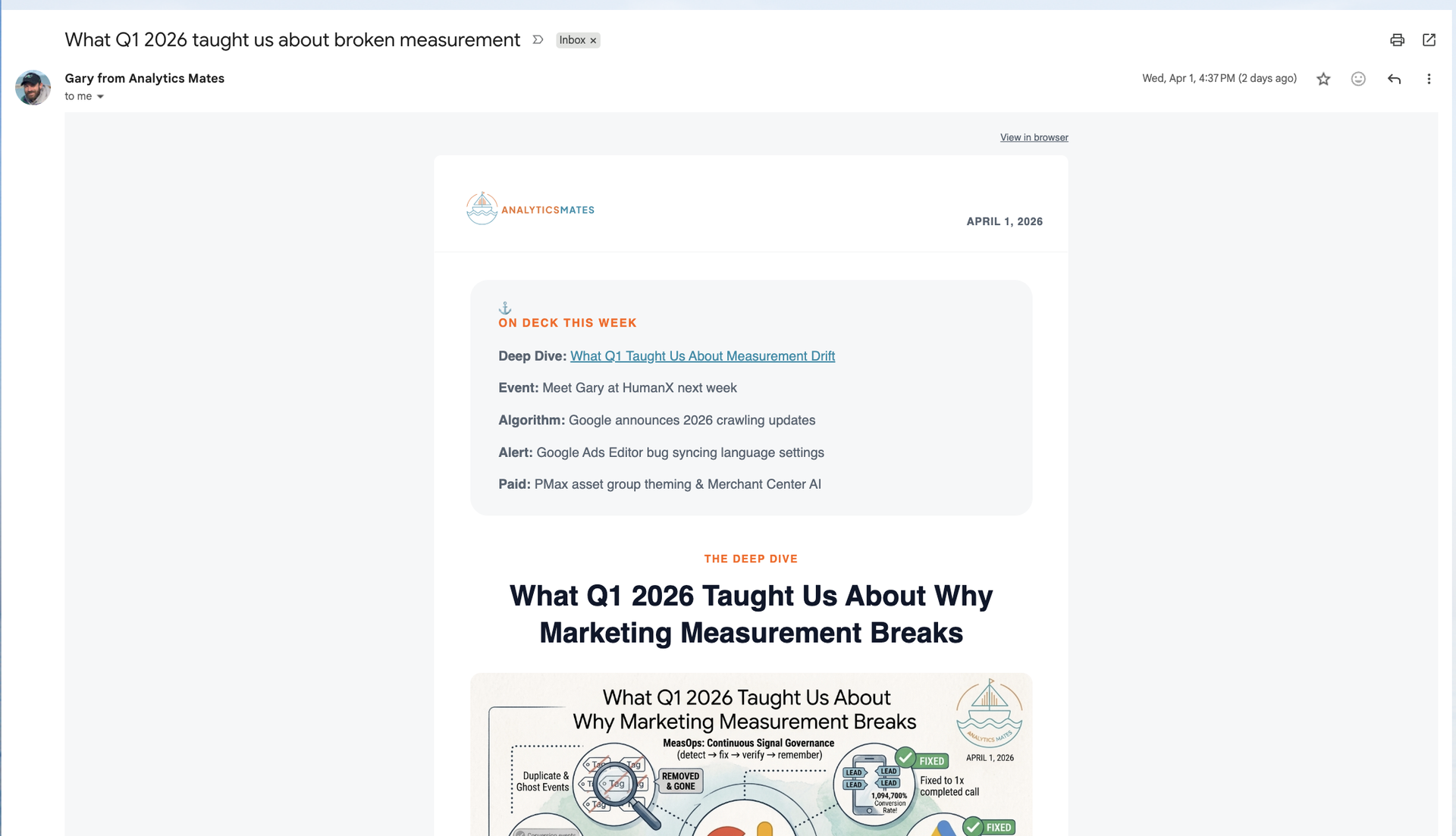
An example of Gary’s newsletter now
The efficiency extends beyond production. Weekly reporting meetings disappeared entirely. "I used to have reporting that we would review on email performance that was manually done," Spagnoli notes. "That's not really necessary any longer because I'm in that tool and I can just ask Active Intelligence." The analyst who previously pulled reports now works on higher-impact client projects instead.
“ActiveCampaign doesn’t just power our email– it feeds the intelligence layer behind The Helm, where we turn engagement data into actionable analytics workflows.”
Active Intelligence analyzes your past campaigns, including open rates, click patterns, and conversion trends. Then, it surfaces what’s actually working. No manual reporting or analyst required.
How to Replicate This Content Strategy
The key is letting Active Intelligence learn from your actual performance data rather than starting from generic best practices.
1. Start with performance analysis
Before asking Active Intelligence to create content, ask it to analyze what already works:
- "Show me my top 10 performing emails from the last 90 days by open rate. What patterns do you see in subject lines and content structure?"
- "Compare emails sent to [segment A] vs [segment B]. What messaging resonates differently with each audience?"
- "Which calls to action have the highest click-through rates?"
2. Create with historical context
Once you understand your patterns, provide Active Intelligence with both the historical insight and new content requirements:
- Reference specific past emails that performed well
- Include your new content (blog posts, offers, announcements)
- Specify what didn't work
- Request output in your proven template format
The more you use Active Intelligence for analysis and creation, the better it understands your brand voice, audience preferences, and what drives results for your specific business. Generic AI tools start from zero every time. Active Intelligence builds on what your customers have already told you through their behavior.
The system that finds your best leads before you do
Analytics Mates drives growth through organic search, ranking in the top three results for terms like "free Google Analytics 4 templates." When prospects download resources, ActiveCampaign tracks every interaction and assigns points based on behavior.
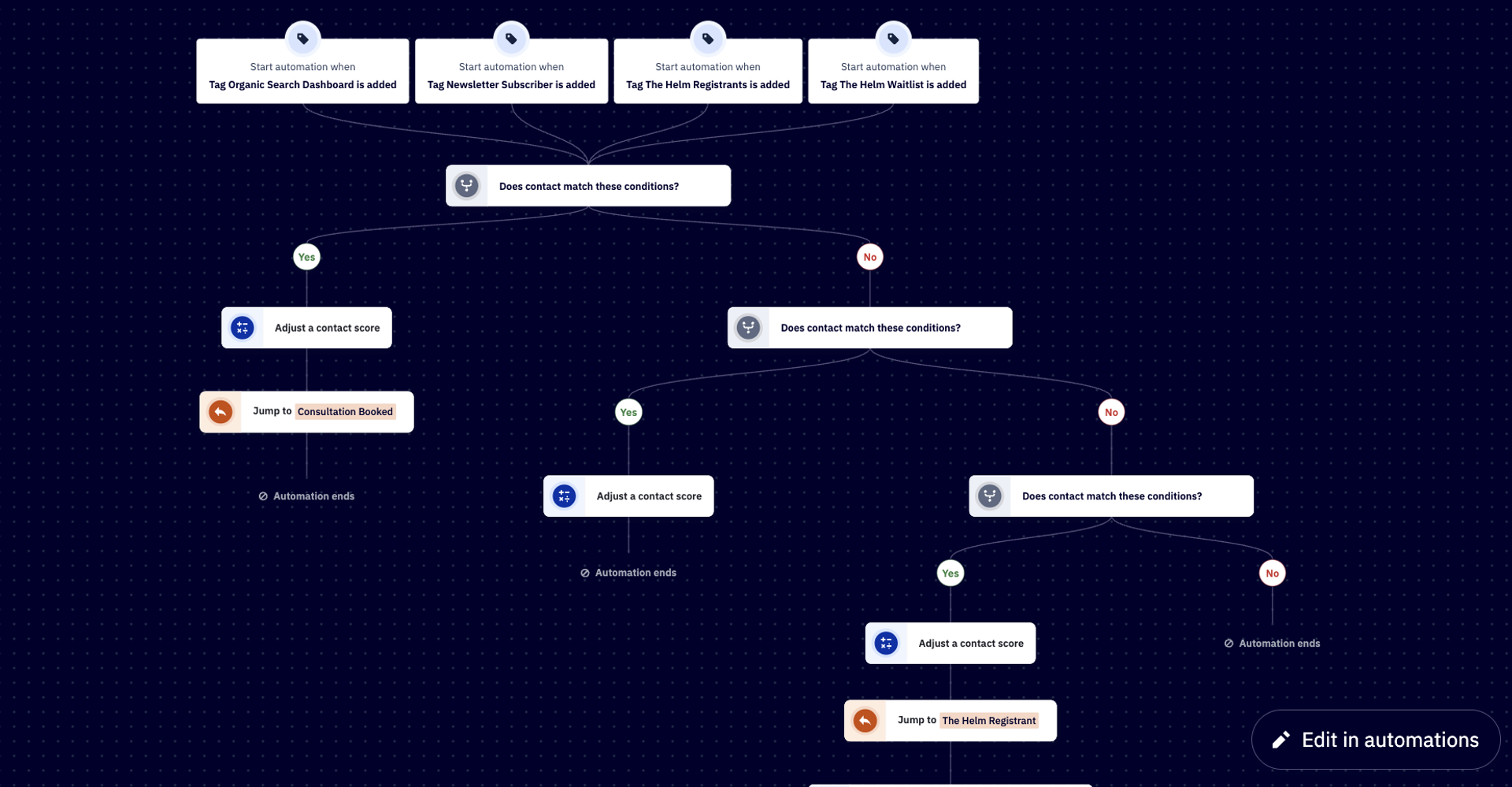
Gary’s lead scoring automation
Their lead scoring automation sends leads that gather 25 or more points into a personalized one-to-one email sequence from Gary's inbox. The gated content workflows trigger different paths based on what the prospect downloaded.
"We don't just mark that they downloaded the gated content," Spagnoli explains. "We tag them for what specific content they downloaded. If it's an SEO dashboard, we now know that it is an SEO contact because we have that tag on them."
This tagging enables conditional content. Someone interested in SEO gets different follow-up resources than someone focused on attribution tracking. The automations nurture based on demonstrated interest rather than generic sequences.
The numbers prove the system works. Leads with 25 points or more convert at rates between 2.5 and 3 times higher than leads with low scores. Their sales cycles move 18% faster, too.
"Lead scoring helps our small team focus attention where judgment matters most," Spagnoli says.
How to Build Behavior-Based Lead Scoring
You don't need eight years of data to start. Here's how to build a system that gets smarter over time:
1. Identify your high-intent signals
What actions indicate someone is close to buying? Some examples Gary uses:
- Visits pricing page multiple times
- Downloads bottom-of-funnel content (case studies, ROI calculators)
- Engages with product-specific emails (not just newsletters)
- Replies to outreach emails
- Spends time on competitor comparison pages
2. Assign point values by intent level
Start with a simple framework:
- Awareness actions (like page views, trackable with the ActiveCampaign pixel): 5 points
- Consideration actions (like downloading lead magnets): 10 points
- Decision actions (like filling out a contact form or booking a discovery call): 15-20 points
Example image that would be helpful to create/add (not branded):
3. Set threshold-based automations
Decide what happens at different score levels:
- 15 points: Move from generic nurture to targeted content sequence
- 25 points: Trigger personalized sales outreach
- 40+ points: Notify sales team for direct contact
- Score drops below 10 after 90 days: Enter reactivation campaign
4. Refine with Active Intelligence
After 30-60 days of data collection, ask:
- "Which scored leads converted to customers? What behaviors did they have in common?"
- "Are there contacts with high scores who aren't converting? What's different about their engagement pattern?"
- "Should I adjust point values based on what's actually predicting conversion?"
Let your actual conversion data inform how you weight different behaviors. Active Intelligence can spot patterns you might miss.
The tactic Gary calls “The Best,” and how it booked $60K in one quarter
At the end of each quarter, Spagnoli reviews contacts who haven't engaged in 90 days, focusing on people who booked consultations but never converted. They're still opening emails occasionally, but their scores aren't climbing.
Every quarter, the team pulls between 2,500 and 4,000 dormant contacts from their CRM and client accounts. The reactivation campaigns consistently get 14 to 18% of those people re-engaging. Of those, somewhere between 3 and 5% end up booking meetings or requesting demos.
Spagnoli leans on Active Intelligence to write the actual sequences. He'll prompt it with something like: "Segment dormant contacts by last engagement type and industry. Draft a 3-email reactivation sequence tailored to each segment, emphasizing value rather than promotion."
ActiveCampaign's segmentation makes this systematic. He identifies the contacts, reviews what they originally engaged with, and sends personalized reactivation messages referencing their initial interest.
One of their clients, an orthopedic practice, booked $60,000 worth of appointments in a single quarter just from reaching back out to patients who'd gone quiet.
The business impact: Same team, 30–40% more clients
The improvements show up across the board:
- Open rates went from 28% to 39%
- Click rates doubled from 3.5% to 7.2%
- Time to build a campaign dropped from 6 hours to 2.5 (a 58% drop)
- The same team can handle 30 to 40% more clients than before
- Their inbound pipeline from email alone grew 22% year over year
- 14 to 18% of dormant contacts re-engage each quarter
"Each person was probably going to be involved for one to two hours on the lowest end," Spagnoli says about the old process. "You're removing working time so they could do work for clients and do fulfillment."
The speed unlocks experimentation velocity. "You could experiment, you could test way faster, and do analysis way faster."
ActiveCampaign isn't just their marketing platform. It's become part of how they actually grow The Helm. They've got over 2,000 people who've downloaded their GA4 templates and another 1,000+ newsletter subscribers. ActiveCampaign is what converts those free users into paying Helm customers.
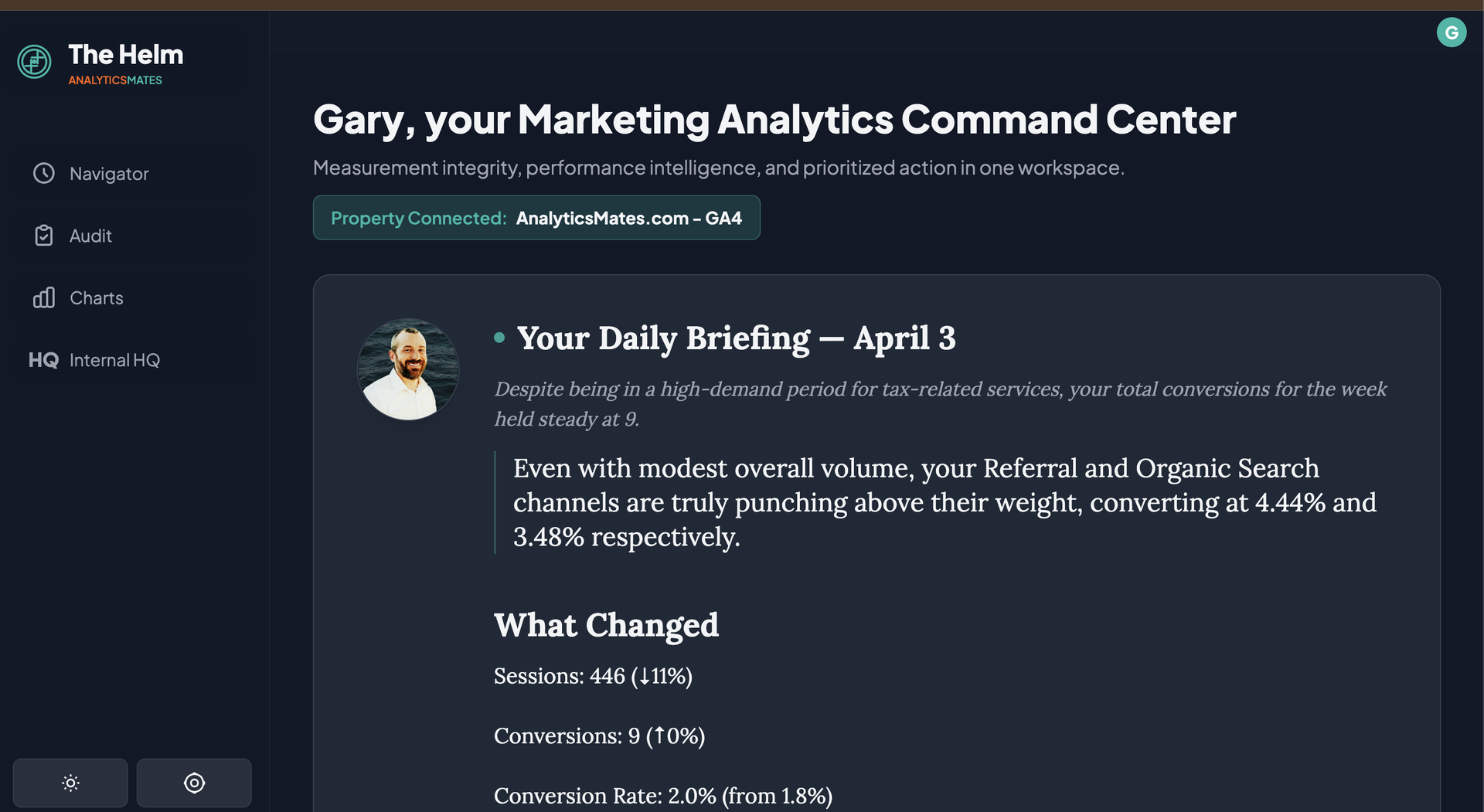
Daily briefing from The Helm, Analytics Mates’ new flagship product
When Analytics Mates launched The Helm in January 2026, customers started signing up without sales intervention. The automated nurture sequences, lead scoring, and reactivation campaigns work without human touch.
The orchestration advantage: Why the best AI stack has a human layer
Spagnoli pays for Claude, ChatGPT Plus, and Gemini Advanced. But ActiveCampaign remains central because it owns the communication data.
"I think of ActiveCampaign as not just being an ESP. I think of it as a marketing automation platform, but it's a critical piece toward helping us improve sales. I need it for infrastructure for my organization at this point."
His advice for business owners: "I would highly recommend ActiveCampaign. I think it's one of the easiest interfaces to start building and interacting with your contacts immediately."
While the tech industry debates which AI will dominate, Spagnoli demonstrates a clear path: build on a foundation that knows your customers, use specialized tools for specific tasks, and let Active Intelligence turn your historical data into a competitive advantage.
"I really do think that you should lean them against each other so they help you become a better operator, a better strategist," he says. "The product, whatever you're ultimately trying to create becomes better because you're having them work alongside one another."
In a landscape overflowing with AI options, the companies that win won't be those with the best individual tools. They'll be the ones who orchestrate them with customer data at the center.
If you'd like to see how ActiveCampaign and Active Intelligence can help you powerfully leverage your customer data to grow your business, start a 14-day free trial and see for yourself.