Most marketing teams have spent the last two years adopting AI tools. The result, for many, is a more complicated stack: collections of copilots, assistants, and generators that each handle one slice of the workflow and leave humans to stitch the rest together manually.
Agentic marketing platforms are a different category. Instead of waiting to be prompted, AI agents autonomously plan campaigns, build audiences, execute across channels, and optimize performance in real time.
But not all platforms that claim the "agentic" label deliver the same depth. Some automate a single channel. Some require significant setup before any autonomous behavior kicks in. And some bolt AI onto a legacy system and call it transformation.
We evaluated five agentic marketing platforms based on a key question: how much of the end-to-end marketing workflow can the platform handle autonomously? The more of that workflow a platform can own without requiring additional tools or manual handoffs, the higher it ranks. By the end of this guide, you’ll have a clear ranking and a practical framework for separating real agentic capability from hype.
What makes a marketing platform truly agentic
Marketing automation exists on a spectrum:
- Traditional automation follows rules a marketer sets: if this, then that.
- AI-assisted tools go a step further, making suggestions that a marketer still has to review and act on.
- Agentic platforms take the next leap: they take autonomous action toward goals a marketer defines.
In practice, "taking action" means autonomously launching campaigns, adjusting send times, switching segments, optimizing content, and reporting outcomes. Not just drafting copy or generating subject lines.
Think of it this way: traditional automation is a recipe card: follow the steps exactly. An AI-assisted tool is a sous chef who preps ingredients when asked. An agentic platform is a head chef who plans the menu, cooks the meal, and adjusts the seasoning based on real-time feedback from every table.
Six capabilities separate truly agentic platforms from everything else:
- Autonomous campaign creation and execution
- Cross-channel orchestration across email, SMS, WhatsApp, ads, and web
- Outcome-based decisioning and optimization
- CRM and customer data unification
- Multi-system integration and orchestration
- Built-in governance, approvals, and auditability
All of these depend on a shared foundation: autonomous marketing software paired with unified customer data and deep integrations. Without clean data and connected tools, AI agents lack the context to make good autonomous decisions. A platform with impressive AI features but shallow integrations still leaves marketers doing the assembly work.
The 5 best agentic marketing platforms
The six capabilities above set a high bar and no two platforms clear it the same way. The platforms below are evaluated across agentic features, real-world limitations, and ideal use cases. But the organizing principle throughout is workflow coverage: how much of the marketing workflow, from strategy and planning through execution, optimization, and reporting, each platform can handle autonomously.
Workflow coverage matters because partial automation still creates manual work. A platform that autonomously executes campaigns but requires human input at the strategy and reporting stages leaves marketers assembling multiple tools. A platform that covers the full cycle reduces that assembly to near zero.
| Platform | Agentic capabilities | Pros | Cons |
| ActiveCampaign | Goal-based campaign creation 1:1 personalization Translation Cross-channel execution AI optimization Native CRM | Broadest end-to-end coverage Accessible pricing for AI | Feature depth might feel overwhelming initially |
| Salesforce Marketing Cloud | Segmentation Content variation Journey optimization | Enterprise scale Deep data layer | Heavy IT dependency Complexity limits out-of-the-box autonomy |
| Braze | Audience identification Content generation Cross-channel delivery Real-time optimization | Sophisticated agentic execution at the engagement layer | No upstream funnel or CRM Requires other tools pre-acquisition |
| Marketo Engage | Lead scoring Nurture automation Account-based marketing (ABM) | Proven B2B depth Strong enterprise integrations | AI is additive rather than native High configuration overhead |
| Klaviyo | Autonomous email and SMS flows E-commerce triggers | Specifically designed for e-commerce automation | Narrow workflow scope Limited beyond owned channels |
Each platform's full breakdown follows below, starting, yes, with our own. We've put ActiveCampaign first because we believe it offers the broadest end-to-end workflow coverage of any platform on this list — but we've done our best to evaluate every platform honestly, so we'll let the breakdown speak for itself.
1. ActiveCampaign: Broadest end-to-end agentic workflows
ActiveCampaign is an autonomous marketing platform rebuilt for the AI era. It covers the full campaign workflow from strategy through reporting in a single system.
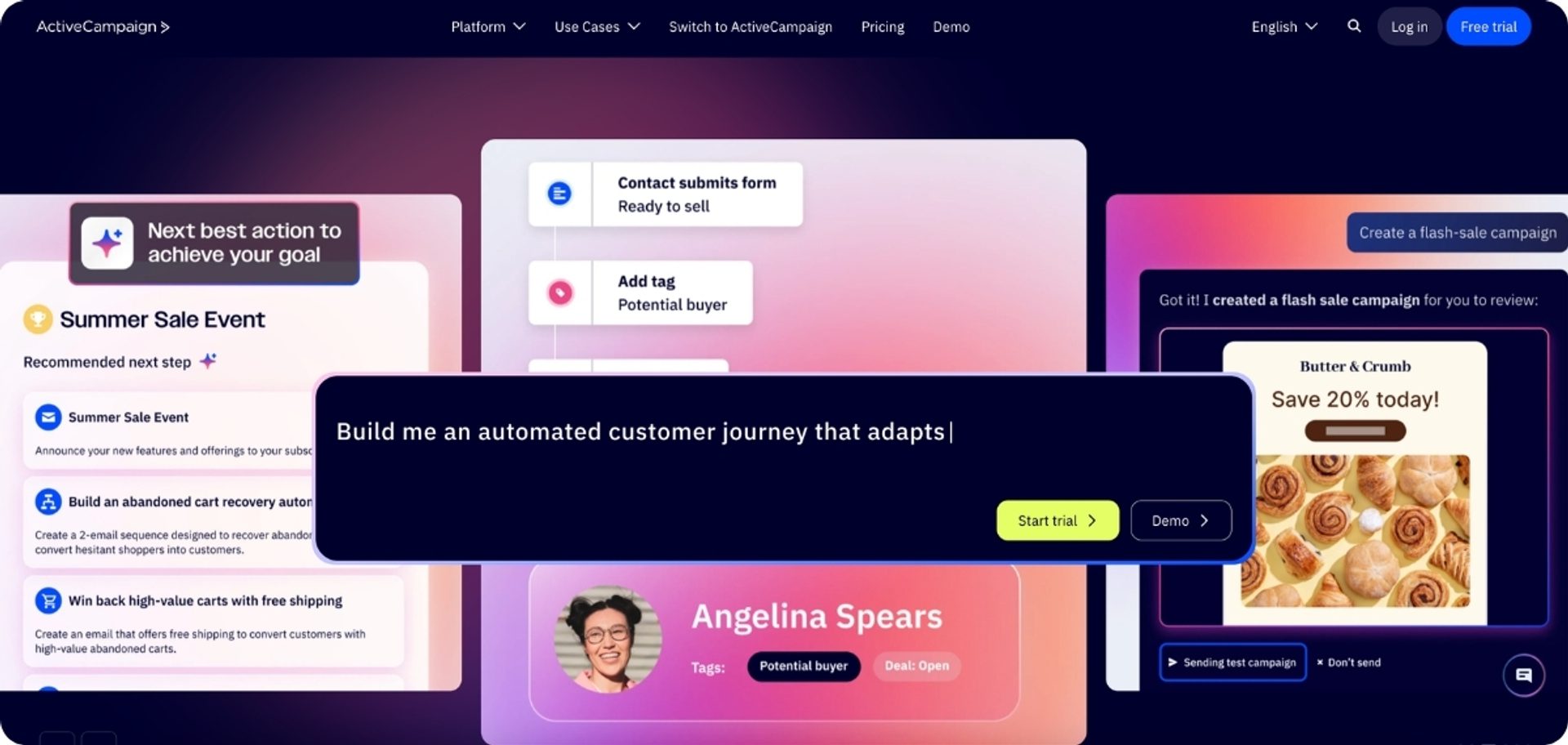
Key agentic capabilities include:
- 25+ AI Agents handle tasks across the full campaign lifecycle, from audience discovery to performance optimization, without requiring manual setup at each step.
- Conversational Workspace lets marketers build campaigns, create automations, and analyze performance through a single chat-based interface that maintains context across tasks.
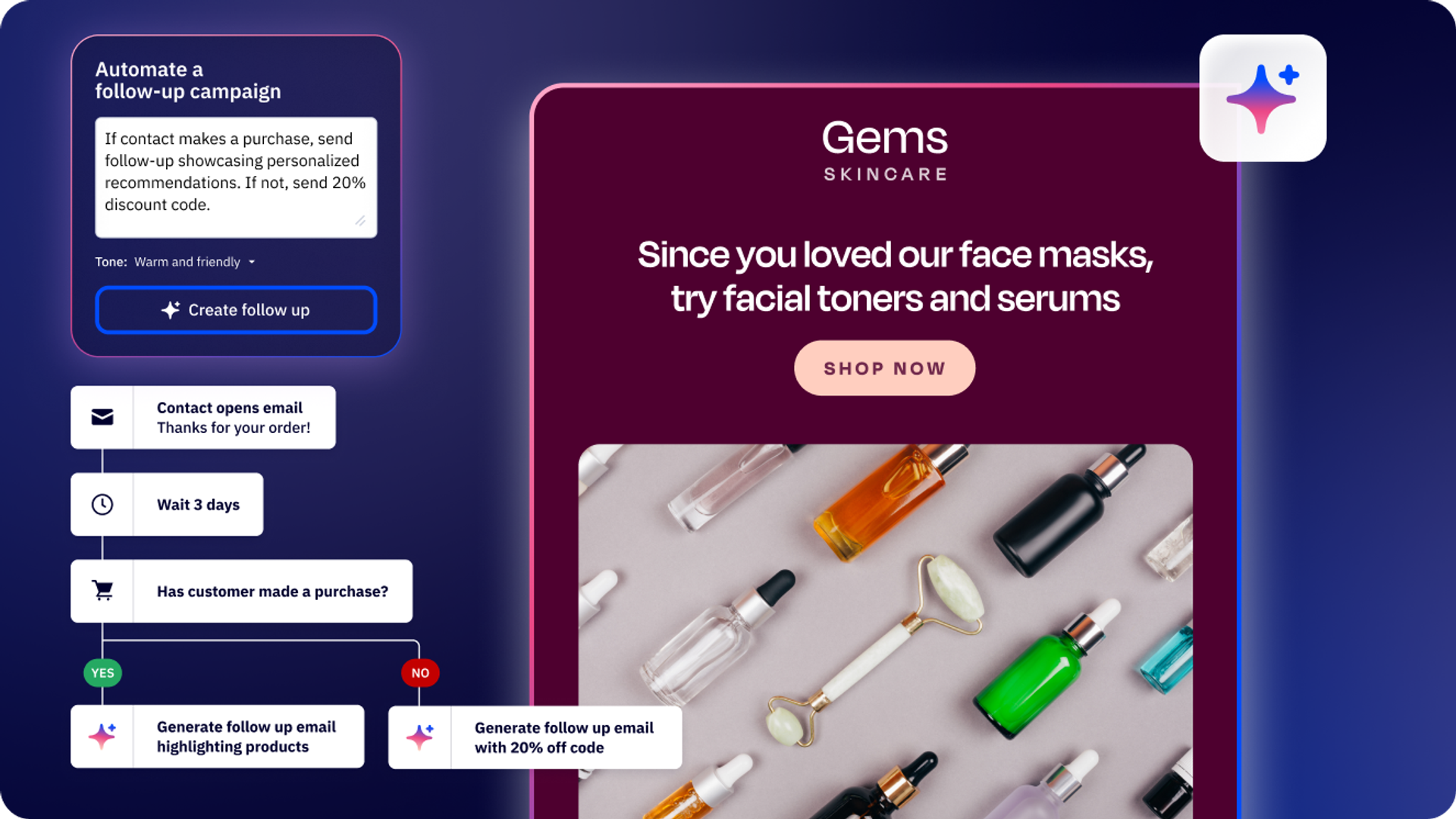
- AI Campaign Builder generates a complete campaign, including subject line, email body, images, and automation flow, from a single natural language prompt.
- Business Goals tracks marketing objectives in real time with automated progress monitoring and clear next-step recommendations tied to each goal.
- AI-Suggested Segments analyze behavior patterns and purchase history to surface high-value audience groups a marketer might not identify manually.
- Predictive Sending uses machine learning to calculate the optimal send time for each individual contact.
- Autonomous Insights proactively monitor campaign performance and surface recommended next steps before a marketer has to ask.
- AI Automation Builder translates plain-language descriptions into multi-step marketing workflows with triggers, conditions, and actions already configured.
- Cross-channel orchestration coordinates campaign delivery across email, SMS, WhatsApp, social, and ads from a single workflow.
- MCP Server connects external AI tools like Claude and ChatGPT directly to ActiveCampaign, giving them secure access to customer data, campaign metrics, and platform actions.
The Active Intelligence engine ties these capabilities together as a continuous intelligence layer. It analyzes billions of data points from customer interactions to provide strategic recommendations, predict what will work best for your audience, and guide your marketing decisions. Think of it as an always-on analyst that surfaces what to do next before a marketer even asks.
The native sales CRM keeps customer and pipeline data unified in one place so agents always have full context. 1,000+ integrations mean that context extends across your existing stack.
Limitations
With this breadth of agentic power, the limitations of ActiveCampaign are hard to find. Some users report that the system can seem intimidating initially, but the intuitive AI tools, simple prompt-based design, and wealth of onboarding resources are designed to help teams get up to speed fast.
Best for: Teams that want a single platform handling the full marketing workflow without stitching together multiple point solutions.
2. Agentforce by Salesforce: Enterprise-grade agentic orchestration
Agentforce is Salesforce's agentic AI layer, designed to automate tasks across Sales Cloud, Service Cloud, Marketing Cloud, and Commerce Cloud.
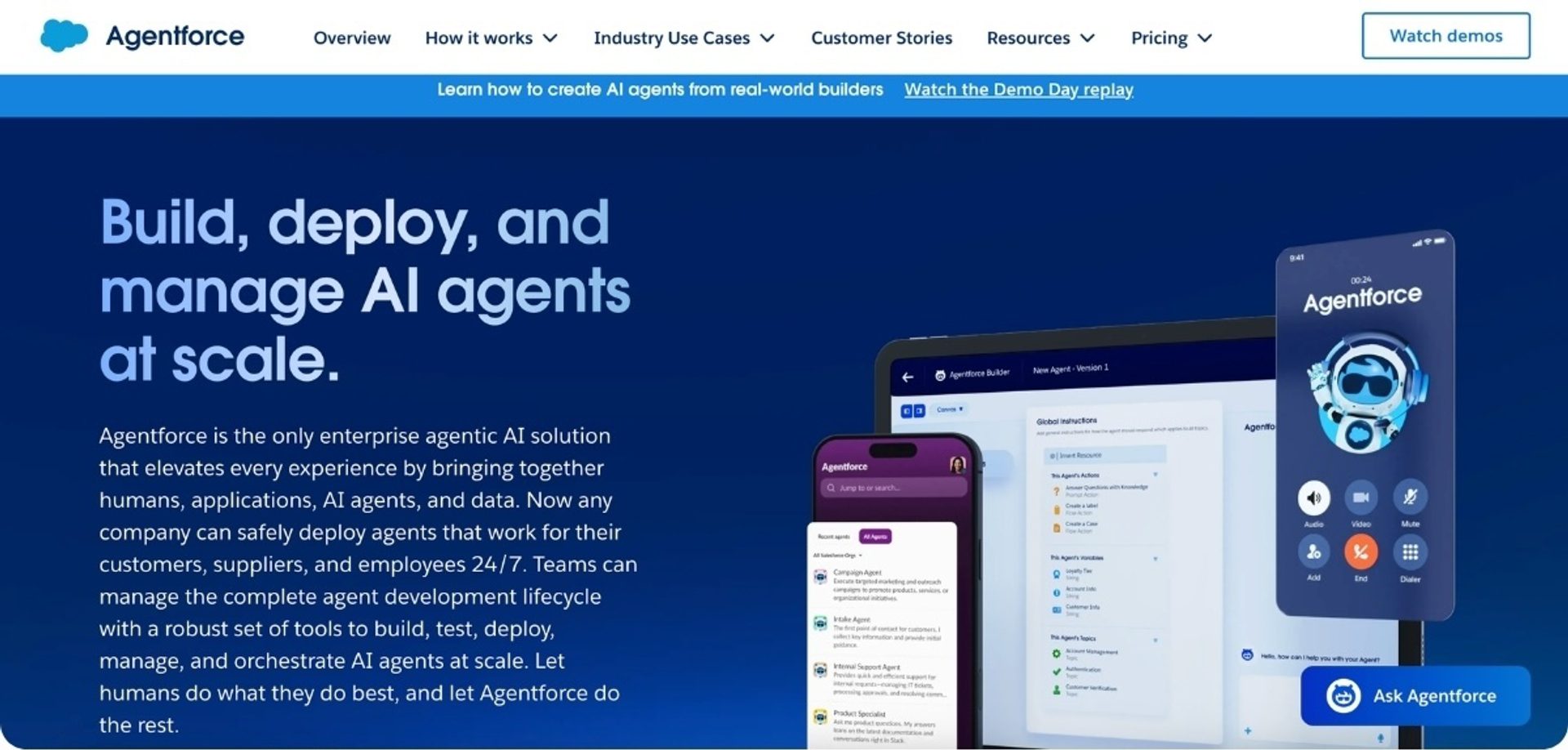
Key agentic capabilities include:
- Custom agent builder using Salesforce Flow, Data Cloud, and prompt templates.
- Einstein AI with predictive scoring, next-best-action recommendations, and opportunity insights.
- Data Cloud unification that aggregates real-time customer profiles from every Salesforce object into a single live master record.
- Multi-cloud orchestration that triggers actions across Sales, Service, Marketing, and Commerce in a single flow.
The infrastructure behind these agents is powerful: a deep data model, enterprise-grade security, and the Salesforce ecosystem's breadth of first-party data.
Limitations
Agentforce's agentic marketing focus is newer in the market. Reliable performance depends on strong data preparation, careful guardrail design, and Salesforce ecosystem expertise. Without that foundation, teams risk misconfigured agents and unreliable outputs.
Best for: Enterprise organizations with dedicated Salesforce administrators and a mature data infrastructure looking to automate complex, multi-cloud workflows.
3. Braze: Real-time agentic engagement
Braze is a customer engagement platform with strong AI capabilities for messaging orchestration, personalization, and real-time triggered campaigns.
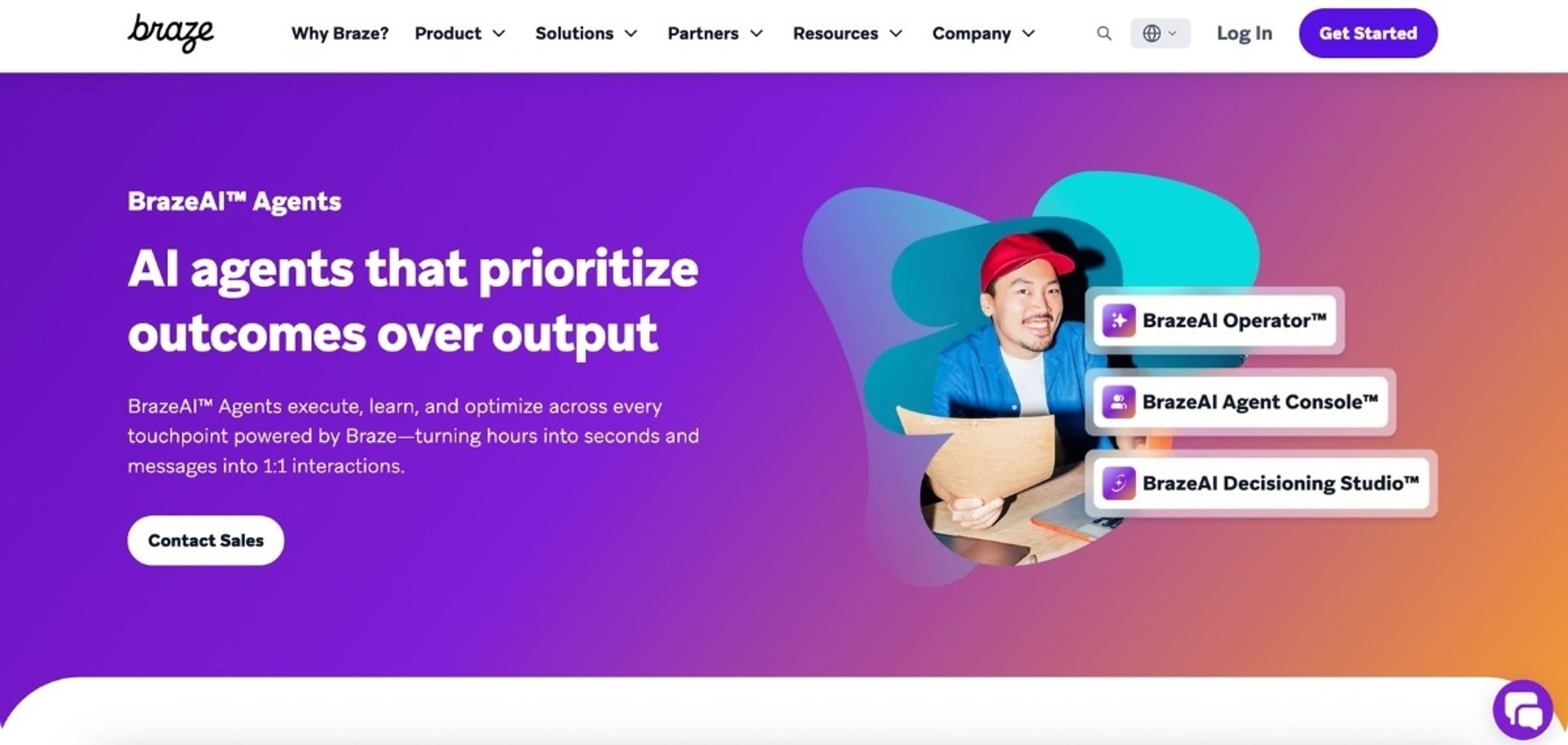
Key agentic capabilities include:
- BrazeAI for automated message generation, send-time optimization, and variant testing.
- Configurable AI Agents that assist with task automation, personalizing campaigns, and improve results across channels.
- Canvas Flow visual journey builder with real-time branching based on behavioral signals.
- Intelligent channel routing that automatically selects the best channel per user, whether email, push, SMS, or in-app.
- Predictive churn and purchase scoring that flags at-risk users and likely buyers.
Braze's data layer supports these features through real-time event streaming, user profile unification, and deep mobile SDK integration for in-app behavioral signals.
Limitations
The gap is upstream. Braze covers activation and engagement deeply, but it lacks a native CRM, lead generation tools, audience acquisition capabilities, and top-of-funnel campaign creation. Teams need to pair Braze with separate tools for those stages of the workflow.
Best for: Product-led or mobile-first companies that already have upstream funnel tools and need deep, real-time engagement orchestration.
4. Marketo Engage: B2B campaign agents
Marketo Engage is Adobe's B2B marketing automation platform, with AI capabilities delivered through Adobe Sensei for lead scoring, account-based marketing, and revenue attribution.
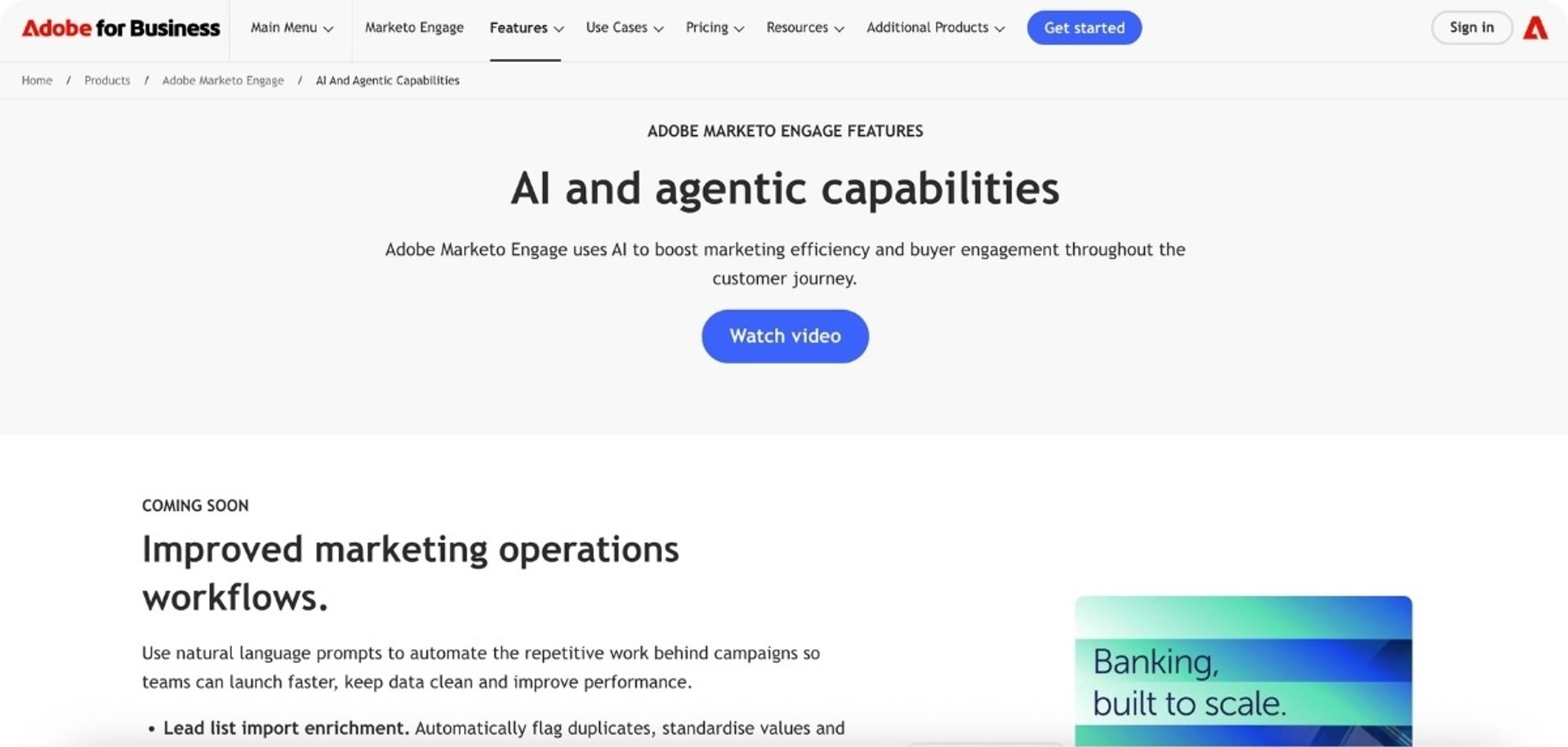
Key agentic capabilities include:
- Lead and account scoring with predictive models that rank leads and accounts by conversion likelihood.
- Smart campaigns with trigger-based automation and nested logic that branch like decision trees based on how each lead responds.
- Account-based marketing orchestration that coordinates campaigns across buying committees.
- Multi-touch attribution for revenue tracking across channels and touchpoints in long sales cycles.
Adobe Sensei, Adobe's AI and machine learning engine, runs across the broader Adobe Experience Cloud and powers Marketo's predictive capabilities. Because Sensei is a shared AI layer across Adobe's product suite rather than intelligence built specifically for marketing execution, its depth within Marketo depends on how much of the broader Adobe ecosystem a team has in place.
Marketo's integration backbone includes a deep Salesforce CRM sync, Adobe Experience Cloud connections, and a library of third-party integrations that feed data into automation flows.
Limitations
Marketo requires more technical resources for setup and maintenance, and implementation timelines run longer than platforms designed for faster onboarding. Total cost of ownership is higher, too, so it can be difficult to justify for lean teams.
Its agentic capabilities are growing but still require more manual orchestration than purpose-built autonomous platforms.
Best for: Enterprise teams with dedicated marketing operations staff and complex, multi-touch sales cycles.
5. Klaviyo: Predictive agents for e-commerce
Klaviyo is an e-commerce-focused marketing platform with AI-driven email and SMS automation, predictive analytics, and deep Shopify integration.
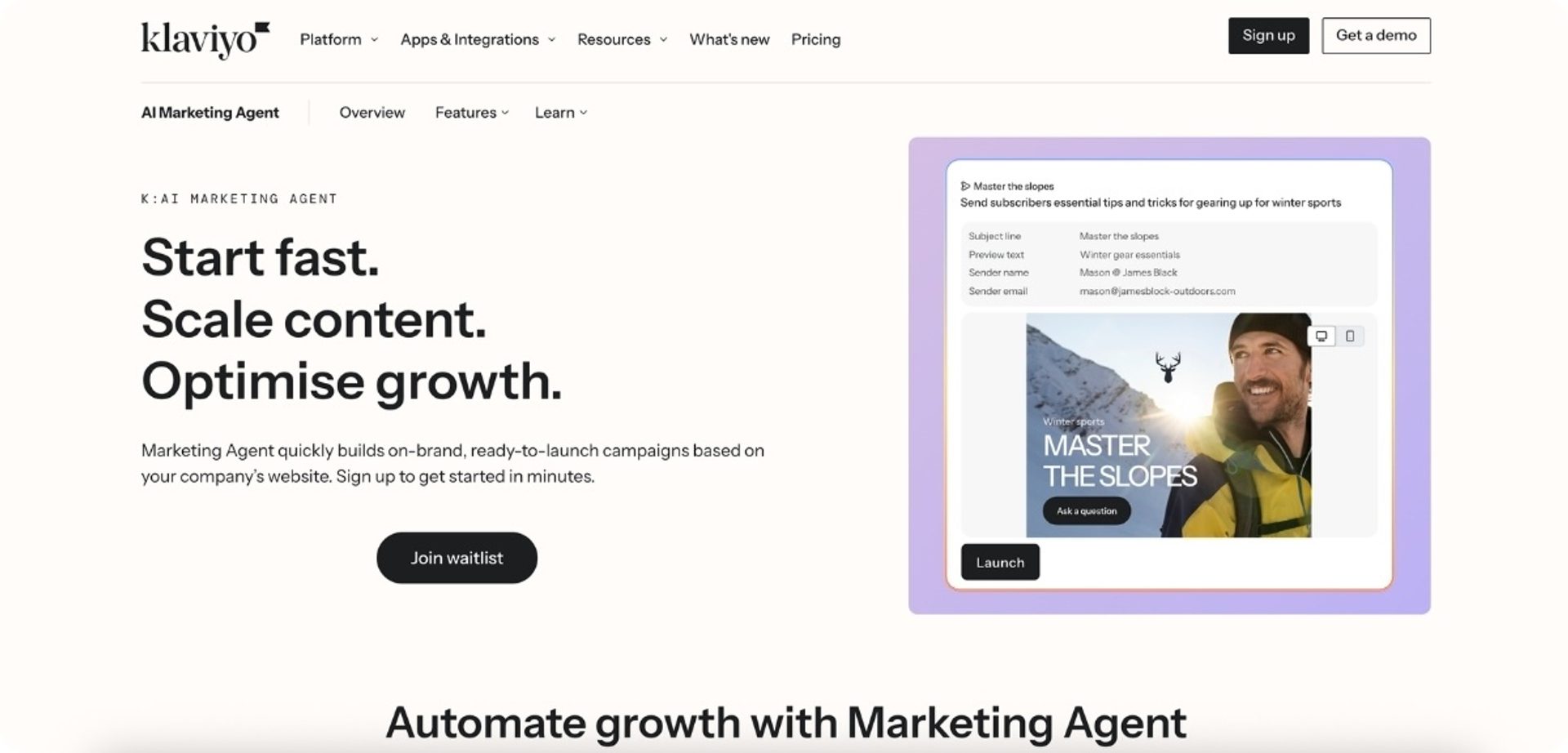
Key agentic capabilities include:
- Predictive analytics for customer lifetime value, churn risk, and next-order-date predictions baked directly into segmentation.
- Pre-built e-commerce flows for abandoned cart, browse abandonment, post-purchase, and win-back sequences.
- AI-generated content and subject lines based on campaign context.
- Smart send time optimization calibrated per contact based on past engagement.
Klaviyo's deep Shopify integration syncs product catalogs, order history, and on-site behavior into a unified customer profile that powers these automations.
Limitations
Klaviyo’s scope is the narrowest on this list. It lacks a native CRM, sales automation, landing page builder, and multi-channel reach beyond email and SMS. Businesses that grow beyond pure e-commerce quickly hit the platform's ceiling.
Within Shopify-based retail, Klaviyo automates effectively. But its workflow branching and channel coverage are more limited than broader platforms on this list.
Best for: Shopify-centric DTC brands focused exclusively on e-commerce email and SMS marketing.
How to spot real agentic capability vs. “agent-washing”
The rise of agentic marketing has also produced exaggerated claims. Many platforms have rebranded existing assistant or chatbot tools as "agentic" when they only offer AI-assisted suggestions or chatbot interfaces that still require a human to act on every recommendation.
Before sticking with a platform, ask these five questions:
- Can it take action without manual handoffs? A truly agentic platform should be able to execute campaigns rather than just recommending next steps.
- Can it optimize based on outcomes by learning from results and adjusting autonomously? Platforms that simply report what happened are lagging behind modern optimization opportunities.
- Does it work across channels and tools? Agentic value multiplies with integration depth, and a platform that only touches email is only partially autonomous.
- Does it support approvals, guardrails, and auditability? Autonomy without governance creates risk, so look for human-in-the-loop controls, audit trails, and configurable permissions.
- How fast can a marketer go from goal to live campaign? The speed from prompt to execution reveals how much of the workflow the platform actually handles.
Apply this checklist to every platform you evaluate. The answers separate platforms that automate marketing from platforms that merely talk about it.
Choose the platform with the most workflow wins
Every platform on this list has genuine AI capability. The difference is architectural.
Most of them added AI to an existing system, layering intelligence on top of workflows that were designed before autonomous execution was possible. That approach produces useful tools. But the best agentic marketing platform is the one that autonomously manages the largest share of the marketing workflow.
Rather than adding AI to a legacy automation engine, ActiveCampaign rebuilt the platform around AI, treating autonomous execution as the foundation, not a feature. It allows AI agents to operate seamlessly within a single system. It covers more workflow stages with less manual intervention than any other platform on this list.
This level of autonomy allows ActiveCampaign to move incredibly fast. The AI Campaign Builder generates full campaigns 3x faster than building manually and ActiveCampaign users save 10 hours per week on manual tasks.
SparkJoy NY tripled booked sales calls and grew revenue 10x after moving to ActiveCampaign's AI-powered approach, with founder Amy Chinitz describing the agentic tools as "my creative partners".
Less assembly. More growth. Start your free trial to see ActiveCampaign’s agentic marketing in action.
FAQs
How much technical expertise is needed to use an agentic marketing platform?
The level of technical expertise required to use an agentic marketing platform varies. ActiveCampaign and Klaviyo are designed for marketers without dedicated technical staff, with campaign builders and pre-built flows that work out of the box. Salesforce Agentforce and Marketo Engage require more technical expertise, including dedicated administrators and longer implementation timelines.
What should marketers look for when evaluating agentic marketing platforms?
When evaluating an agentic marketing platform, focus on workflow coverage first: how many stages of the marketing cycle does the platform handle autonomously? Then evaluate integration depth, data unification, governance controls, and the speed from goal to live campaign. Platforms that score well on all five dimensions are genuinely agentic; those that automate only one or two stages still leave marketers assembling the rest.
Can an agentic marketing platform integrate with an existing CRM and tech stack?
Yes, most platforms on this list offer CRM integrations, but depth varies. ActiveCampaign includes a native CRM and 1,000+ integrations, plus an MCP Server that connects external AI tools directly to the platform. Salesforce also offer strong CRM foundations, but you should always review whether the integration passes enough data context for AI agents to make good autonomous decisions.