Klaviyo is a familiar name in ecommerce marketing, built to notice what a shopper does and respond to it. For a store finding its feet, that can be enough to get going. But the purchase: who bought, when, and what they might buy next is a narrow flow to build a whole platform around, and Klaviyo charges a premium for it.
As a brand grows, its list starts to hold more than shoppers. People at different stages, with different intent, can't always be understood by purchase history alone. Serving them requires more flexible targeting.
Plenty of platforms match Klaviyo’s core email and SMS. Some offer simpler, cheaper takes on what Klaviyo already does. Other platforms extend well beyond Klaviyo’s offering, adding a real CRM, a sales pipeline, and reach across more channels. Below, we’ve broken down the best Klaviyo alternatives so you can match the tool to why your business is looking to switch.
What to look for in a Klaviyo alternative
Before you compare alternatives, it’s helpful to know exactly where Klaviyo’s limitations are, and what "better" actually looks like in each area.
Klaviyo fans appreciate how quickly its automations come together. The tight Shopify connection is another recurring highlight, giving stores an easy path to reaching customers with the right message. The common caveats are the cost and learning curve of Klaviyo, which many smaller brands find climb faster than they'd like.
What I like most about Klaviyo is how easy it makes it to build targeted email campaigns and automate customer communication. One challenge I’ve noticed is that some of the more advanced features can take a while to learn, especially for new users. Also, as my contact lists grow, pricing can become more of a consideration.
While Klaviyo is very powerful, the learning curve can be a bit steep at first, especially when setting up more advanced flows and segmentation. Some features can also feel overwhelming due to the depth of options available.
Here are some key areas to consider when choosing a Klaviyo alternative that won’t hit the same walls:
- Flexible automation. Klaviyo's automation flows always start from a single, ecommerce-based trigger, but the relationship around it is made of many moments: questions before buying, silence after, interest that never quite converts. Look for a platform where the whole relationship can drive automation, not just the moment of purchase.
- A steady learning curve. People often leave Klaviyo because it gets harder to manage as they grow and their needs get more complex. Look for a platform that absorbs the setup work, instead of cutting capabilities.
- A real CRM and sales layer. Klaviyo offers a Customer Data Platform (CDP) that can pull a customer's purchases, support tickets, and email history into one profile. However, accessing it comes at a high cost (a minimum of $500/month that scales rapidly with list size), and it still isn't built to run a sales team. For deal pipelines, lead scoring, or sales automation, you’ll need to pay for another tool on top. Look for a platform that handles marketing and sales in one place.
- Better targeting options. Klaviyo is great at segmenting customers by their shopping habits, but that's as far as it goes. Once you're guiding people through a sales conversation or a longer relationship, you need more to work with. Look for a platform that can also target by how people engage with you and what they do on your site, not just their order history.
- A deep integration library. Your marketing platform should plug into the rest of your tools, and into whatever store platform you actually run. Klaviyo works best with Shopify, and the quality drops off with other platforms. Look for a wide range of connections that stay solid no matter what you're running.
- Value for what you spend. Klaviyo's plans start at a higher cost than many alternatives—around $30 a month for 1,000 contacts—and the number on the pricing page usually isn't the number you end up paying. Compare the whole bill, not the starting price. Klaviyo doesn't include a landing page builder or a true CRM, so you’ll end up paying for extra tools like Unbounce and a standalone CRM on top. Look for a platform that bundles what you'd otherwise buy separately.
Klaviyo defines a customer by their last purchase, but growth changes what you need to know about people. For some brands that means the same shopper now shows up as a lead, a wholesale account, or a deal in progress, or just that there’s a large enough audience that "everyone who bought recently" is too wide a net.
Don’t choose an alternative that simply matches what Klaviyo already does well. Look for a platform that keeps up with where your business is headed. Different teams will have different priorities:
- Scaling ecommerce brands need to build lasting customer relationships, not just chase the next order. A platform that supports retention and lifetime value should be the priority.
- DTC brands moving into wholesale or B2B are taking on a second way of doing business. They need a platform that can run one-off orders and accounts at the same time, so they need a platform that can handle that, not just the quick transactions Klaviyo was built for.
- High-volume B2C teams live or die by relevance at scale. They should prioritize strong segmentation and granular targeting for large audiences.
- Lean teams and solo marketers are protecting their time above all. They should examine how much a platform can manage for them without manual work.
ActiveCampaign: Best Klaviyo alternative for growing brands
ActiveCampaign is an AI-native marketing platform that brings email, SMS, WhatsApp, automation, and a native CRM together in one system. Built on the Active Intelligence AI engine, it's a great Klaviyo alternative for businesses that have outgrown limited flows.
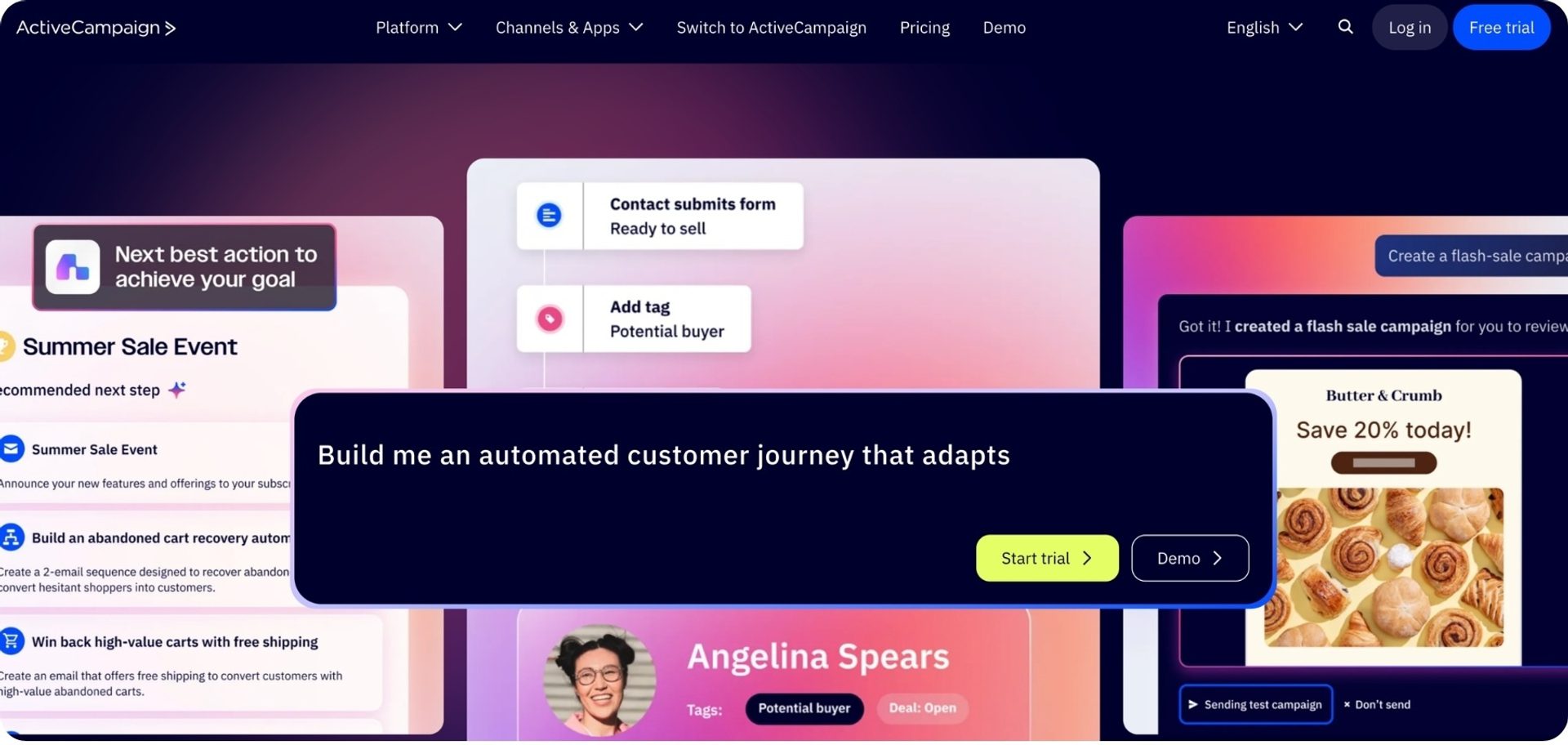
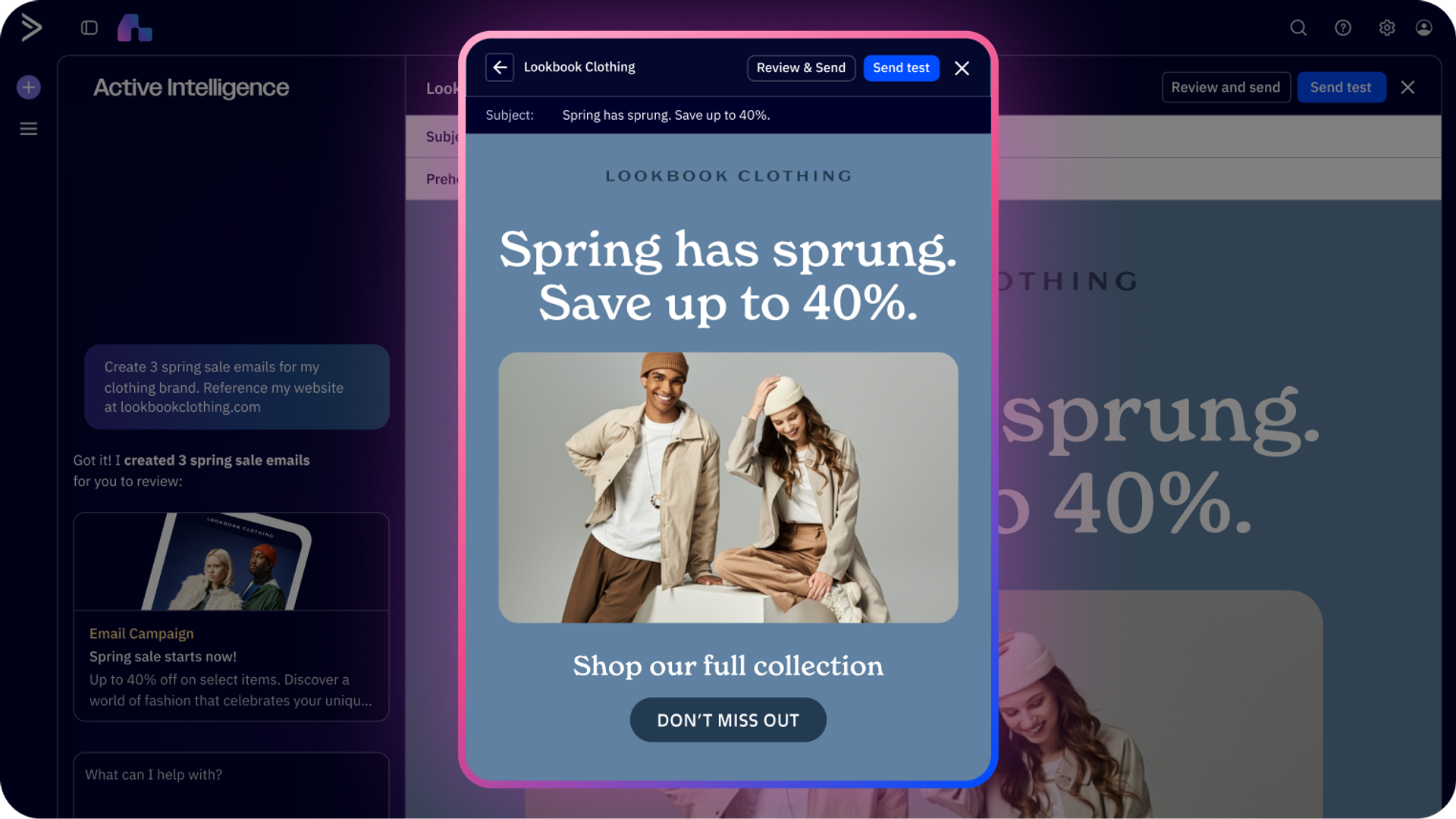
ActiveCampaign’s AI tooling is the best in the category, and its defining strength is how much of the work it takes off your plate. Instead of leaving you to map out a workflow branch by branch, you can simply describe your goals and it will build the segments, campaigns, and automations from scratch. The return per dollar grows as your marketing gets more sophisticated instead of your workload growing with it.
If you need a growth system, ActiveCampaign puts a campaign, a pipeline, and a follow-up in one place, all running off the same customer data instead of three disconnected tools.
- AI across the full workflow: ActiveCampaign builds AI into every stage of marketing through Active Intelligence—generating campaigns, automations, and segments from a conversational workspace, then proactively surfacing reports and suggestions for how to optimize. This end-to-end approach is hard to find elsewhere, where AI usually stops at content generation or basic analytics.
- Automation without a ceiling: The visual builder supports multi-step, cross-channel journeys with branching logic, goals, and split testing, so a campaign adapts as customers move rather than pushing everyone down one path. Automations can start from far more than a store event—a form fill, a booked call, or a new sales lead—and AI lowers the setup work by building goal-aware flows from simple prompts.
- A native Sales CRM: Pipelines, lead scoring, Win Probability, and Sales Routing live in the same platform as the marketing, so leads and deals are easy to see and follow-ups don't slip. Marketing and sales work from shared data, and AI signals help surface high-intent contacts earlier.
- Cross-channel from one platform: Email, SMS, and WhatsApp share the same automations, segments, and customer data, so a single journey can move a customer between channels without stitching tools together.
- 1,000+ integrations: Deep connections across Shopify, WooCommerce, BigCommerce, and the rest of your stack, against Klaviyo's 350+, so the platform fits whatever ecommerce system and tools you already run.
While it offers far more capability than an ecommerce-first tool, ActiveCampaign is built to stay approachable. The added depth might imply a learning curve, but AI now absorbs much of the setup it once demanded. AI-assisted autonomous marketing workflows, visual builders, and libraries of 250+ templates and pre-built 1,000+ automation recipes inspire teams to launch sophisticated campaigns without deep technical skill.
ActiveCampaign users save up to 10 hours per week on manual tasks.
ActiveCampaign is a natural step up for brands hitting the edges of Klaviyo. Where Klaviyo reads the purchase, ActiveCampaign is built for everything around it. When a contact is also a lead, a deal, or an account worth following up on, email alone can't hold what comes next and ActiveCampaign closes that gap without adding to your workload to do it.
Reviewers consistently praise ActiveCampaign’s automation depth, the tight tie between CRM and marketing data, and the savings from folding several tools into one. Ecommerce businesses highlight how automations interact with user behavior, making it possible to build truly effective, data-driven campaigns.
What I like best about ActiveCampaign is its powerful automation capabilities. It makes it easy to create personalized customer journeys, automate follow ups, and manage email campaigns efficiently. The visual automation builder is intuitive and allows complex workflows to be created without much effort.
| ActiveCampaign | Klaviyo | |
| Key difference | Full-lifecycle platform—automation, native Sales CRM, and cross-channel messaging in one system, with AI doing the setup work | Ecommerce-focused email and SMS built around the purchase funnel |
| Which businesses choose this platform? | Growing ecommerce brands, SaaS companies, and B2B lifecycle teams that want a flexible platform they won't outgrow | DTC and online retail brands that want fast, purpose-built email and SMS for driving store revenue |
| Pricing & value | Free trial available Plans start at $15/month for 1,000 contacts Core features included in all plans. Pay for specialist features only when you need them | Limited free plan available Starts at $30/month for 1,000 contacts Modular pricing for CDP, analytics, and more |
| Integrations | 1,000+ | 350+ |
To dive deeper into the differences between Klaviyo and ActiveCampaign, read our full ActiveCampaign vs. Klaviyo comparison.
Omnisend: Best budget ecommerce alternative to Klaviyo
Omnisend is an ecommerce-first marketing platform built for Shopify, WooCommerce, and BigCommerce stores. It covers the same core ground as Klaviyo and is the closest thing to a like-for-like swap for a store that wants to keep doing exactly what it's doing, for less.
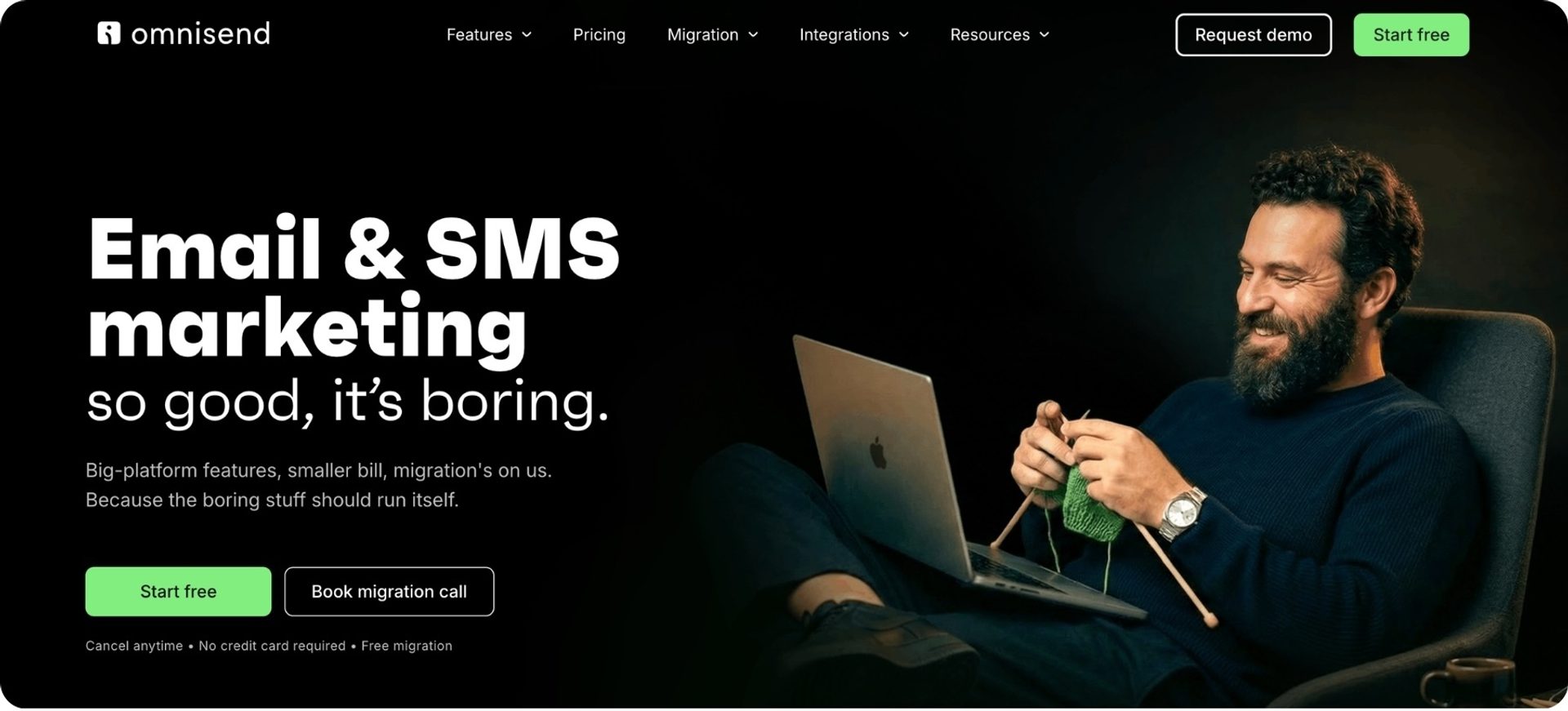
Where Klaviyo's plans start higher and climb, Omnisend starts free and stays affordable well into a growing list, with a free plan generous enough to run real campaigns rather than just kick the tires. For a lean store whose main frustration with Klaviyo is price, it's an easy, affordable switch.
- Ecommerce built in: Product pickers, dynamic recommendations, and pre-built retail workflows come ready out of the box, so a store isn't building common flows from scratch.
- Email, SMS, and web push together: All three channels run from one platform, giving stores a third channel most email-first tools leave out.
- Genuinely easy to run: Consistently rated simple to onboard, which suits small or non-technical teams—the opposite of the complexity that pushes people off Klaviyo.
- 24/7 support on every plan: Round-the-clock help isn't reserved for higher tiers.
- AI store workflows: A content and subject-line writer, AI-driven segmentation, and product recommendations.
However, Omnisend’s own homepage says it best: “so good it’s boring”. Like Klaviyo, it’s purpose-built for ecommerce, and offers little marketing flexibility past the purchase—the same ceiling Klaviyo has. It's the right swap for lower-cost ecommerce email marketing, but not much else.
Reviewers consistently praise Omnisend for its intuitive campaign creation and value, with many noting it costs a fraction of what they paid before. The common criticisms are the limited reporting, and difficulty implementing more complex designs and workflows.
I appreciate Omnisend for offering more options for abandonment flows and segmentation compared to Shopify’s native features, while being less complicated than Klaviyo. I find the limited options for splits in the flows and setting up Shopify coupons to be a constraint
| Omnisend | Klaviyo | |
| Key difference | Ecommerce email, SMS, and web push at a lower price, with a generous free plan | Ecommerce email and SMS with deeper data tooling, at a higher price |
| Which businesses choose this platform? | Cost-conscious Shopify, WooCommerce, and BigCommerce stores that want strong ecommerce marketing without the premium | DTC and online retail brands wanting a more data-rich, purpose-built platform |
| Pricing & value | Free plan (up to 250 contacts, 500 monthly emails) Starts $16/mo for 500 contacts SMS is a Pro-plan add-on | Limited free plan available Starts at $30/month for 1,000 contacts Modular pricing for CDP, analytics, and more |
| Integrations | 100+ | 350+ |
Mailchimp: Best Klaviyo alternative for smaller lists and lighter needs
Mailchimp is one of the most recognized names in email marketing. It's a general-purpose, beginner-friendly platform rather than an ecommerce specialist like Klaviyo.
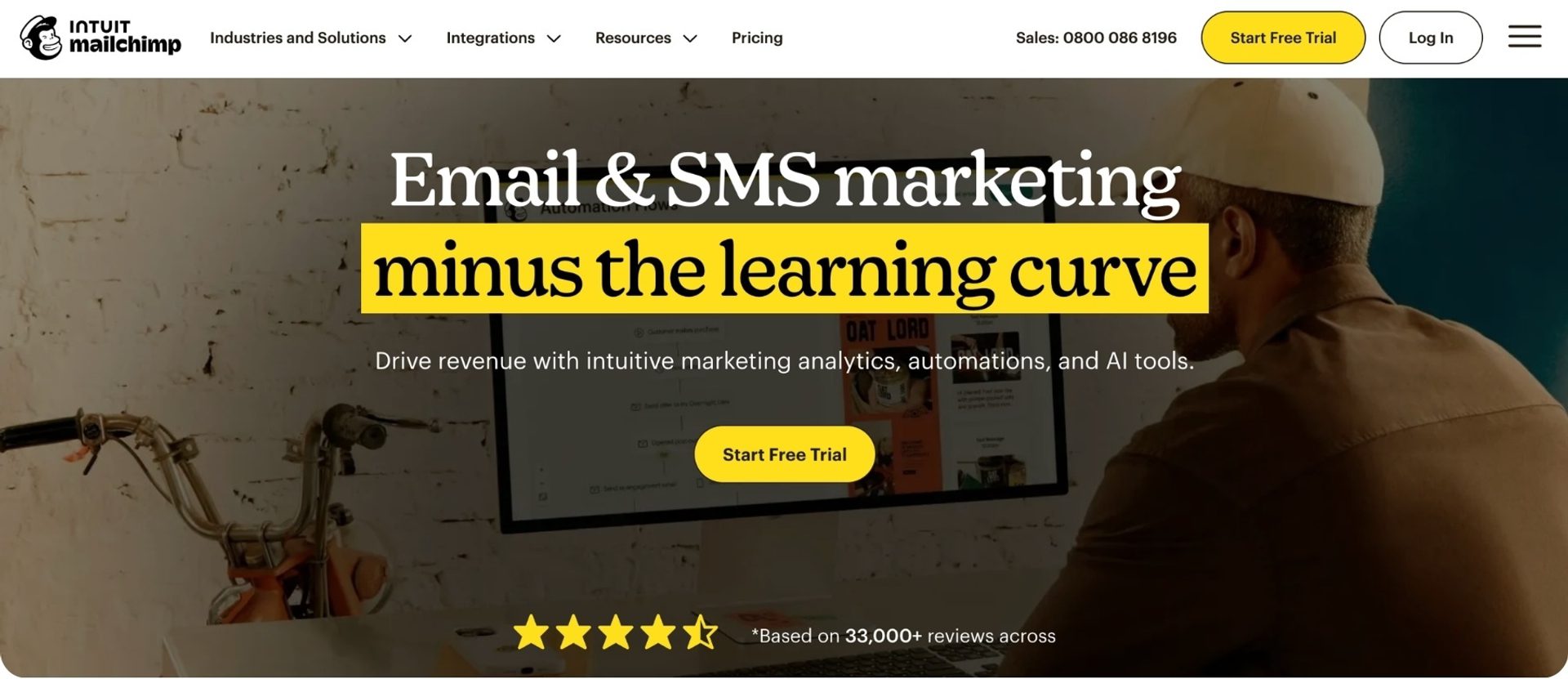
Mailchimp is simpler and easier to start with than Klaviyo, which makes it a strong fit for a small team or a lighter sending schedule. But it isn't built around storing data the way Klaviyo is. It fits smaller lists and general email needs best.
- Easy to learn: The drag-and-drop editor and template library are consistently reviewers' favorite thing about it.
- Broad integrations: A large app ecosystem connects to most of the tools a small business already uses.
- Familiar and low-commitment: A free plan and a low entry price make it simple to start without a big decision.
- Intuit AI: Drafts email copy, suggests subject lines, recommends send times, and surfaces content optimization tips.
Not every brand needs Klaviyo's ecommerce depth, and those that aren’t using Klaviyo’s full feature set may find Mailchimp covers what they actually do—newsletters, updates, and straightforward campaigns—for less effort and less money.
It’s worth knowing before you switch that Mailchimp’s automation and many segmentation features now sit behind higher tiers. The free plan has been pared back over the years, and many users find that cost climbs steeply as your list grows.
Reviewers love Mailchimp for ease of use, its editor, and its template range. Consistent frustrations reflect the cost rising sharply as lists grow and useful features being reserved for pricier tiers.
Mailchimp is a solid email marketing tool with an intuitive interface and a wide range of templates that make it easy to get started quickly. The segmentation and automation features cover the basics well. However, compared to more advanced tools like Klaviyo, it reaches its limits fairly quickly.
| Mailchimp | Klaviyo | |
| Key difference | General-purpose, beginner-friendly email that's simple to start with | Ecommerce-focused email and SMS built around store data |
| Which businesses choose this platform? | Small businesses, solo creators, and lighter senders who want an easy, familiar tool | DTC and online retail brands that want purpose-built ecommerce marketing |
| Pricing & value | Free plan (250 emails/mo, limited features, no automation) Paid plans from $13/mo for 500 contacts Limited access to essentials on lower-tier plans | Limited free plan available Starts at $30/month for 1,000 contacts Modular pricing for CDP, analytics, and more |
| Integrations | 300+ | 350+ |
Curious how Mailchimp compares to ActiveCampaign? Read our Mailchimp vs. ActiveCampaign comparison.
HubSpot: Best integrated marketing and sales platform
HubSpot is an all-in-one platform that unifies marketing, sales, and customer service around a single CRM. It's the broadest tool on this list by a wide margin.
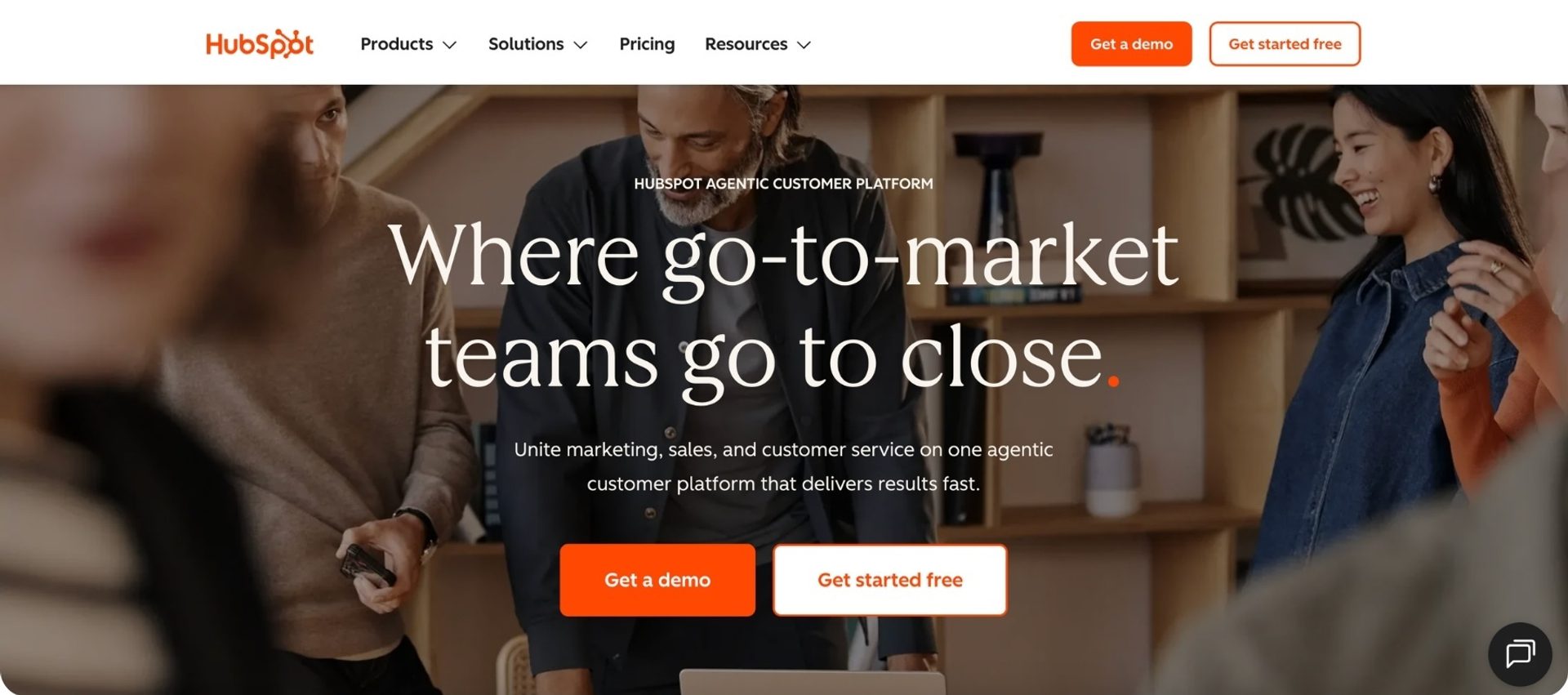
Where Klaviyo is a focused ecommerce email and SMS engine, HubSpot is built to run an entire go-to-market operation from one shared database.
- One shared database: Marketing, sales, and service all read and write to the same customer record, so teams work from one view instead of syncing between tools.
- Genuinely easy to use: Despite its breadth, reviewers rate it highly for an approachable interface and self-service campaign building.
- A useful free plan: Unlike most CRMs, HubSpot's free tier has no expiration and covers real basics—handy for starting small.
- Deep ecosystem: A large app marketplace and mature integrations connect to most of the tools a growing business runs.
- Breeze AI: AI assistant, autonomous agents, and a data-enrichment layer that are strong for CRM-connected and cross-functional tasks.
For a business that has grown past ecommerce into managing leads, sales pipelines, and support tickets—and wants all of it in one place—HubSpot is hard to beat. However it comes at a serious price. You have to adopt multiple hubs across sales, marketing, CRM, etc. to really benefit and the jump from the entry Starter plan to Professional is steep (from around $20 per seat to $800+ per month, plus a mandatory onboarding fee). Much of the advanced automation and AI only unlocks at those higher tiers.
For a store that just needs strong ecommerce marketing, it's a lot of platform (and a lot of cost) to take on. It suits brands consolidating a whole stack, not those looking for a leaner Klaviyo swap.
Reviewers consistently praise HubSpot for consolidation and depth of reporting. The complaints cluster tightly around that price jump to Professional and the features paywalled there.
It’s definitely the “Goldilocks” of marketing tools—easy enough to use but powerful enough to scale—but man, that monthly invoice can really sting once you’ve actually built something successful.
| HubSpot | Klaviyo | |
| Key difference | Full marketing, sales, and service suite built around one CRM | Focused ecommerce email and SMS built around the purchase funnel |
| Which businesses choose this platform? | Growing businesses consolidating marketing, sales, and service into one platform | DTC and online retail brands that want purpose-built ecommerce marketing |
| Pricing & value | Free version available Marketing Hub plans start at $20/month for 1,000 contacts Modular pricing across hubs for CRM, Marketing, Data, Revenue, etc. | Limited free plan available Starts at $30/month for 1,000 contacts Modular pricing for CDP, analytics, and more |
| Integrations | 1,000+ | 350+ |
Curious how HubSpot compares to ActiveCampaign? Read our HubSpot vs. ActiveCampaign comparison.
Kit: Best Klaviyo alternative for content creators
Kit is an email platform built for creators—bloggers, newsletter writers, course sellers, and podcasters—rather than online stores.
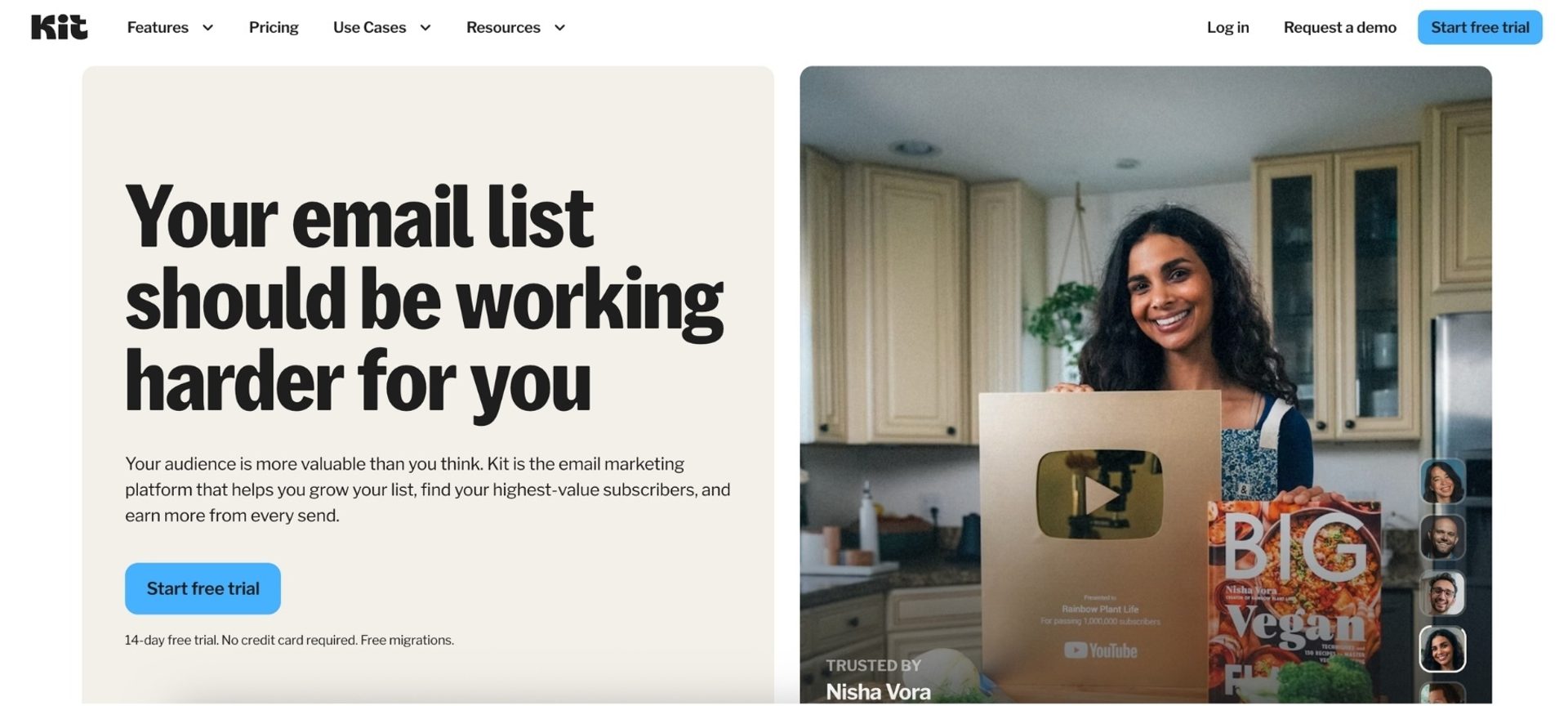
Where Klaviyo is organized around products and purchases, Kit is organized around an audience and how you grow and monetize it.
- Built for monetizing an audience: Sell digital products, paid newsletters, and subscriptions natively, without bolting on a separate commerce tool.
- Simple, tag-based automation: Subscribers are organized by interest and behavior through tags, which keeps setup approachable for non-technical creators.
- An unusually generous free plan: The free tier covers up to 10,000 subscribers with unlimited emails—one of the most generous in the category.
- Creator-friendly by design: Landing pages, opt-in forms, and a clean interface aimed at people who write more than they configure.
- Kit + AI: Helps draft subject lines and email content to get creators publishing faster.
Kit’s whole design assumes your "product" is your content. For a creator-shaped business, that's a better fit than an ecommerce engine. For a brand that lives on cart flows and product data, it's the wrong tool—Kit's ecommerce features are light by design.
It’s also worth knowing that paid plans aren't cheap, and prices rose around 35% in late 2025. Email design and template flexibility are limited, and reporting is on the basic side.
Creators praise Kit for simplicity, its monetization tools, and a free plan generous enough to grow on. The common criticisms are paid pricing that's steep next to competitors, limited email design options, and basic reporting.
What I best like about Kit is how simple and creator focused it is, compared to other enterprise heavy marketing tools. Some useful features, especially the advanced A/B testing capabilities, are restricted only for the Pro plan.
| Kit | Klaviyo | |
| Key difference | Email and monetization built for creators and their audiences | Ecommerce email and SMS built around products and purchases |
| Which businesses choose this platform? | Bloggers, newsletter writers, course sellers, and other creators monetizing an audience | DTC and online retail brands selling physical products |
| Pricing & value | Free plan up to 10,000 subscribers Paid Creator plans from $39/mo for 1,000 subscribers Limited automations and sequences on the lower plans | Limited free plan available Starts at $30/month for 1,000 contacts Modular pricing for CDP, analytics, and more |
| Integrations | 100+ | 350+ |
Curious how Kit compares to ActiveCampaign? Read our Kit vs. ActiveCampaign comparison.
Brevo: Best Klaviyo alternative for cost-effective email marketing
Brevo is an all-in-one platform spanning email, SMS, WhatsApp, automation, transactional email, and a CRM. It's the value pick on this list, but it relies on an unusual pricing model rather than a stripped-down feature set.
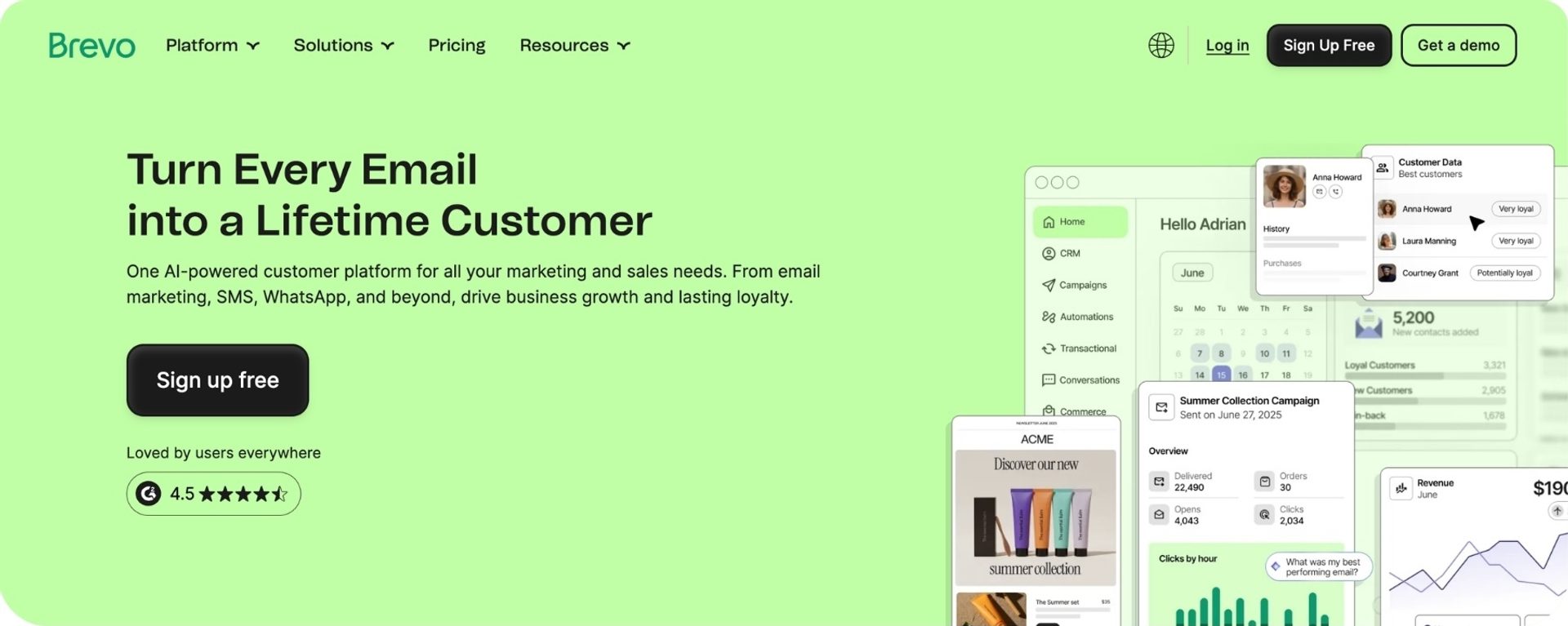
Klaviyo is a specialized ecommerce engine priced by list size, while Brevo is a broader, budget-friendly toolkit priced by send volume. It’s a different shape of platform for a different kind of sender.
- Send-based pricing: Pay for volume, not contacts—distinctive value for large, low-frequency lists.
- A true all-in-one toolkit: Email, SMS, WhatsApp, a CRM, and transactional email under one roof.
- Reliable transactional email: A consistent strength reviewers single out, useful for order confirmations and receipts.
- A genuinely free tier: 300 emails per day, free forever, with a generous contact allowance.
- Aura AI: Offers practical help for writing and scheduling optimized content.
Brevo bills on the number of emails you send, not the size of your list. For a store with a big customer base but a measured sending rhythm (like a monthly newsletter, a seasonal promotion, and the occasional launch) that can work out far cheaper than list-based pricing, since you're not paying to store contacts.
The flip side is that stores leaning on high-frequency, automated flows (like abandoned cart, browse abandonment, post-purchase series, or back-in-stock alerts) tend to send a lot of email per contact, and under a send-based model that volume adds up. Brevo rewards the store that emails a large list occasionally, not the one running constant automated sends to a smaller one.
Reviewers typically praise Brevo on price-to-value and its all-in-one toolkit. The recurring complaints are limited automation and reporting, and a lack of customization. The strict account-approval process also catches some new users off guard.
The interface is easy to navigate, email deliverability has been reliable, and the automation workflows save me a lot of time. I’d like to see more advanced reporting and more template customization options. Some automation features could be easier to configure for new users, and the pricing increases quickly as contact lists grow.
| Brevo | Klaviyo | |
| Key difference | All-in-one email, SMS, and CRM with send-based pricing suited to large, low-frequency lists | Ecommerce email and SMS built around store data and the purchase funnel |
| Which businesses choose this platform? | Budget-conscious businesses with big lists and measured send volume that want multichannel basics | DTC and online retail brands that want purpose-built ecommerce marketing |
| Pricing & value | Free tier (300 emails/day) Paid plans from $9/mo by send volume SMS, WhatsApp, and CRM billed separately | Limited free plan available Starts at $30/month for 1,000 contacts Modular pricing for CDP, analytics, and more |
| Integrations | 150+ | 350+ |
Curious how Brevo compares to ActiveCampaign? Read our Brevo vs. ActiveCampaign comparison.
How to pick the best Klaviyo alternative: Features that matter
Choosing a Klaviyo alternative—especially when you're migrating contacts, automations, and campaign history—should come down to long-term fit, not a short-term feature swap.
A lot of platforms can look fairly similar on a comparison chart; they offer comparable features and starting prices. The big differences show up later, as your marketing grows: how deep the automation really goes, how pricing behaves as your list expands, how much the tool can shoulder for you. Look for a platform that solves not just today's limitation, but the next one you haven't hit yet.
When comparing options, weigh the areas where the choice actually makes a difference:
Feature depth, not feature checklists. Two tools can both list "automation" and deliver very different things underneath. Evaluate the actual capability: how many conditions a workflow allows, what data a segment can draw on.
ActiveCampaign’s AI-powered automations run on dozens of triggers with branching logic, goals, and unlimited actions that respond proactively to integrated apps, and your business’s targets.
Pricing as your list grows. Entry price rarely reflects real cost. What matters is how the bill behaves as you scale, and what's included versus billed separately. A low headline price loses its appeal once you're paying extra for a CRM, landing pages, and integrations on top.
ActiveCampaign offers CRM, landing pages, and AI from early plans, often lowering total cost even when plan prices look similar.
Automation flexibility. Linear sequences are easy. The best platforms build journeys that adapt for you. Look for adaptive, intelligent, cross-channel steps in a single workflow.
ActiveCampaign’s AI will assemble multi-step, cross-channel journeys with branching and split testing from a plain-language goal. It will suggest segments and pathways you might never have imagined.
AI that reduces manual work. Most platforms point AI at content generation. The bigger gain is AI that cuts the effort of building, optimizing, and scaling campaigns—not just writing them.
Active Intelligence runs across the full workflow, covering predictive sending, AI-suggested segments, automation built from natural language, and proactive insights. Plus, it’s included on plans rather than metered.
Scalability. The right platform keeps pace as contacts, channels, and complexity grow—so you're not re-platforming again in a year. Look for room to expand beyond ecommerce into sales and lifecycle marketing.
ActiveCampaign has a native CRM, cross-channel messaging, and 1,000+ integrations to support growth across verticals, not just a storefront.
Migration enablement is easy to underestimate, and it's often the difference between a successful switch and another false start. If you’re switching to Klaviyo, there’s a risk that lists, templates, and automations might not survive the move, so the team could stall before seeing value.
Most Klaviyo alternatives offer some migration and onboarding support to make the switch low-effort:
- ActiveCampaign: Offers free agentic migration and onboarding, including migration of data, contacts, automations, and templates on qualifying plans. Backed by extensive self-serve resources, AI-assisted onboarding, and a large support ecosystem.
- Omnisend: Provides self-serve import tools and migration help, with hands-on assistance more readily available for stores moving from another ecommerce platform, though deeper migrations lean on your own setup.
- Mailchimp: Supports basic import tools, but migration is largely self-serve, and more advanced automations and workflows typically need to be rebuilt manually.
- HubSpot: Provides onboarding support, but it's often tied to higher-cost plans and can require a more involved setup across multiple hubs. Compulsory onboarding also comes at a high cost for plans that enable real marketing features, starting at $3,000.
- Kit: Offers free list migration handled for you on paid Creator and Creator Pro plans, with a clean, simple setup that suits creator-shaped lists rather than complex ecommerce data.
- Brevo: Provides self-serve import tools and documentation, with hands-on migration help generally reserved for higher tiers.
The best Klaviyo alternative matches where your business is headed. If you want a cheaper, like-for-like ecommerce swap, Omnisend could fit. For a simpler, general-purpose tool, Mailchimp might work. For a full marketing-and-sales suite, there's HubSpot; for creators, Kit; for send-based value on a big list, Brevo.
If you want more from your marketing—deeper automation, a real CRM, and cross-channel journeys in one place—ActiveCampaign delivers, whether you're sharpening your ecommerce program today or growing into sales and lifecycle marketing tomorrow.
Teams switching from Klaviyo to ActiveCampaign see 3x faster campaign creation with Active Intelligence.
Switching platforms should be a step forward, not a lateral move. If you've outgrown Klaviyo, the right choice is the one that lets you scale your marketing without hitting the same wall again.
Your Shopify store is just the start. Give your marketing more room to grow by starting your 14-day free ActiveCampaign trial.
Related Alternatives
FAQs
Why do people switch from Klaviyo?
Most brands switch away from Klaviyo when their needs grow past the narrow ecommerce fit it was built for. It’s a strong ecommerce email and SMS tool, but it centers on the purchase—so once a business needs a real sales CRM, automation that starts from more than a store event, or targeting beyond purchase history, it starts to feel limiting. Cost as lists grow and a learning curve for smaller teams are common factors too.
What is the best Klaviyo alternative?
There isn’t a single best Klaviyo alternative—it depends on where your business is headed. Omnisend is the closest like-for-like swap for a store that wants the same job for less, while ActiveCampaign is the strongest step up for brands that need a CRM, deeper automation, and cross-channel journeys alongside their ecommerce marketing. HubSpot, Kit, and Brevo each fit more specific cases, from full sales suites to creators to send-based value.
Can you use ActiveCampaign for ecommerce marketing?
Yes, ActiveCampaign is a powerful choice for ecommerce marketing. It integrates deeply with Shopify, WooCommerce, BigCommerce, and other platforms, and handles the core ecommerce flows like abandoned cart, browse abandonment, and post-purchase sequences across email, SMS, and WhatsApp. What sets it apart is that the same customer data also feeds a native CRM and lifecycle automation, so your ecommerce marketing can grow into sales and retention without switching tools.
How hard is it to switch from Klaviyo to a new marketing platform?
It’s easier than most people expect to switch from Klaviyo to a new marketing platform, especially with a platform that migrates your data for you. ActiveCampaign offers free agentic migration and onboarding on qualifying plans, moving your contacts, templates, and automations so you’re not rebuilding from scratch, with most migrations completing within a few business days. The bigger risk is choosing a tool you’ll outgrow again, so it’s worth picking one that fits where you’re headed, not just where you are now.
Is ActiveCampaign difficult to learn for beginners?
ActiveCampaign is designed to be approachable for beginners, combining a user-friendly interface with powerful AI enablement. New users benefit from free agentic onboarding, live chat support, a comprehensive help center, and guided templates that make setup quick and stress-free. Most users find they can launch campaigns in just a few clicks, and the platform grows with you as your skills and business needs evolve.
How does ActiveCampaign’s pricing compare to Klaviyo and other alternatives?
ActiveCampaign’s pricing is transparent and scales predictably with your contact list, offering more features for the same or lower cost than many competitors. It provides enterprise-grade automation, segmentation, and reporting at every tier, ensuring you get maximum value and flexibility as your business grows. Each plan is designed to deliver long-term ROI by saving you time and driving better results.