The first AI marketing tools were built to be good at one thing. Predictive analytics identify opportunities and writing assistants generate copy, but if they don’t talk to each other, someone else has to carry over the context. So, marketers spend their time copying outputs from one tool, reformatting them for the next, and manually rebuilding the context that got lost between handoffs.
AI agent orchestration coordinates multiple specialized tools and systems to execute complex marketing tasks as a unified workflow. Instead of switching between tools, insights, content, and campaigns are connected into a seamless process.
This guide breaks down what AI agent orchestration looks like in marketing and introduces you to the patterns teams use most.
What is AI agent orchestration?
AI agent orchestration is the practice of coordinating multiple specialized AI agents through a central management layer that routes work, maintains shared context, and handles handoffs between steps.
A single AI agent is scoped to one task. It’s useful, but isolated. It has no awareness of what happened before it or what needs to happen next. Orchestrating multiple agents gives every component in the system awareness.
Think of it like a film production crew. The camera operator, costume designer, and composer each own their domain. Meanwhile, the director provides shared context: the script, the timeline, the through-line that makes every individual contribution add up to the same film. Orchestration works the same way. Each agent executes autonomously within its role. The orchestration layer ensures they're all working with a common goal in mind.
How AI agent orchestration works in marketing
AI agent orchestration is a specific marketing architecture, not a feature, and it is not a synonym for automation.
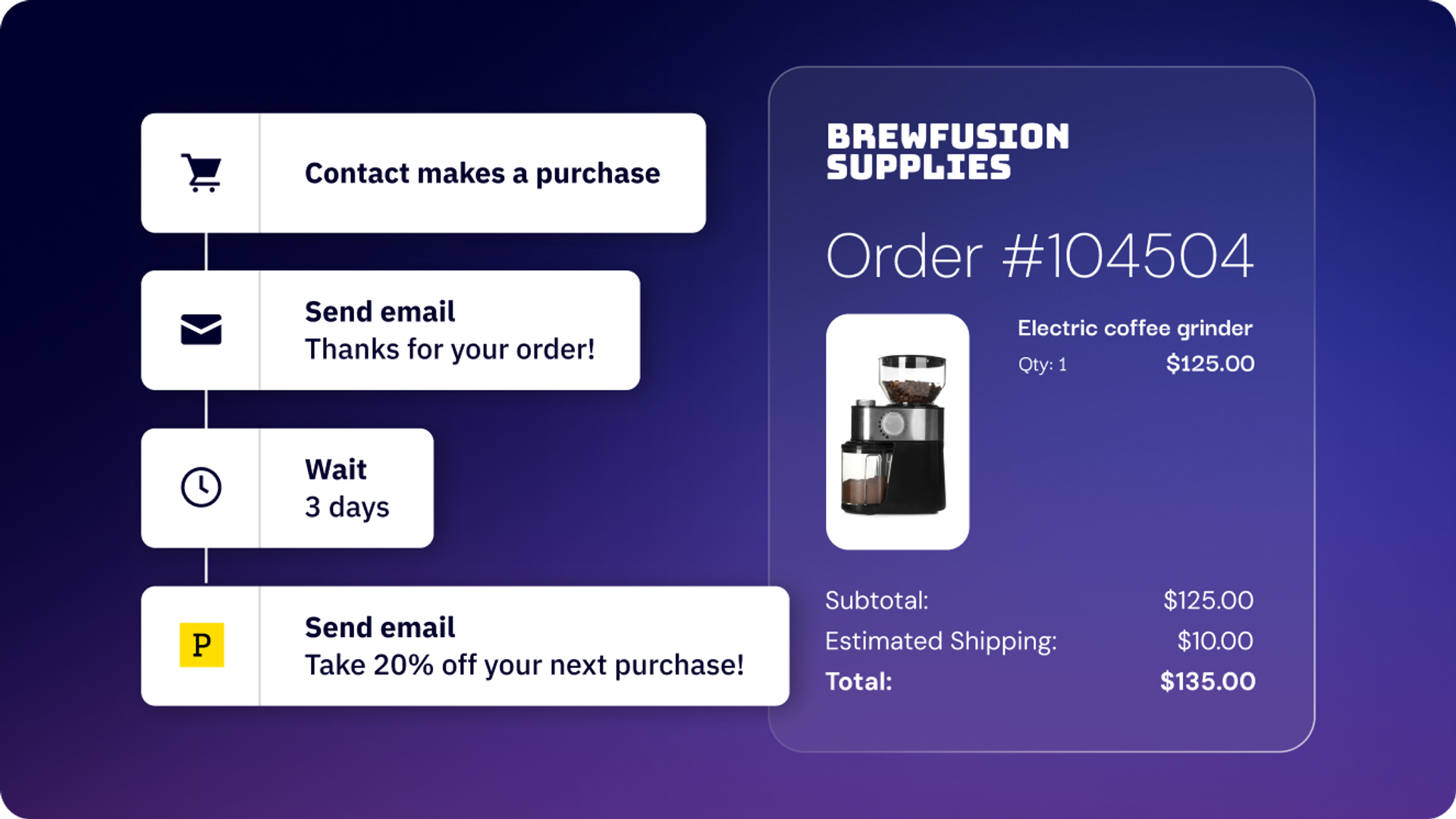
Linear automation, while useful for simple sequences, still follows rigid if/then logic built around signals you anticipated when you designed it.
AI agent orchestration can handle the signals you didn’t anticipate. Agents read and respond to the full customer picture in real time rather than a predefined decision tree, and can change course mid-sequence when the data calls for it.
In marketing workflows, it runs on three components working together.
- Specialized AI agents handle distinct tasks. Each agent is purpose-built for a specific function: one generates content, another identifies audience segments, a third optimizes send timing. Specialization produces higher-quality output because each agent focuses on one domain rather than attempting to do everything.
- A controller routes work and manages handoffs. The orchestration engine decides which agent acts next, passes relevant context between agents, and ensures the workflow adapts to real-time signals. Handoffs happen automatically. The output of one agent becomes the input for the next without a marketer manually moving data or switching tools.
- A unified data layer keeps every agent aligned. Customer behavior, campaign history, CRM records, and engagement signals remain accessible to every agent in the workflow. Without shared context, agents make decisions in silos and produce fragmented customer experiences. This is the most common failure mode when teams stitch together disconnected point tools. With a shared data layer, an agent choosing the next email can factor in whether the contact already responded to an SMS or clicked a social ad.
The foundational architecture works in any industry where multiple AI systems need to collaborate. But marketing has a set of conditions that make orchestration particularly useful. The work is inherently cross-channel, the audience behaves unpredictably, and the pressure to personalize grows faster than the team does.
Customer journeys are nonlinear, and with channels growing constantly, that challenge is multiplying. Email, SMS, WhatsApp, social, ads, on-site messaging: every channel adds another stream of decisions about who receives what message, in what format, at what time. Meanwhile, real buyer behavior crosses channels, skips stages, and reverses. A prospect might click a social ad, browse three product pages, abandon a cart, open an email a week later, and then convert through a text message.
Adapting and personalizing campaigns at the individual level across a growing number of channels requires decisions at a pace and granularity that no team can sustain manually. Even automations require a lot of effort to adapt to this reality.
AI agent orchestration absorbs the workload, intelligently rerouting the journey across AI automations in real time based on complex behavioral signals. Because a controller monitors signals continuously, it redirects the next agent in the sequence based on what really happened rather than what a workflow assumed was possible.
Core productivity outcomes include:
- Faster campaign execution from prompt to launch
- Personalization at the individual level, not just the segment level
- Scalability without adding headcount
- Compounding intelligence where every campaign makes the next one smarter
- Fewer errors and dropped handoffs between tools
The agentic marketing orchestration cycle
Agentic marketing orchestration works as a single continuous cycle. A marketer sets a goal, and agents handle the chain of decisions from audience to content to channel to optimization. Each step feeds the next.
1. From goal to campaign in a plain-language prompt
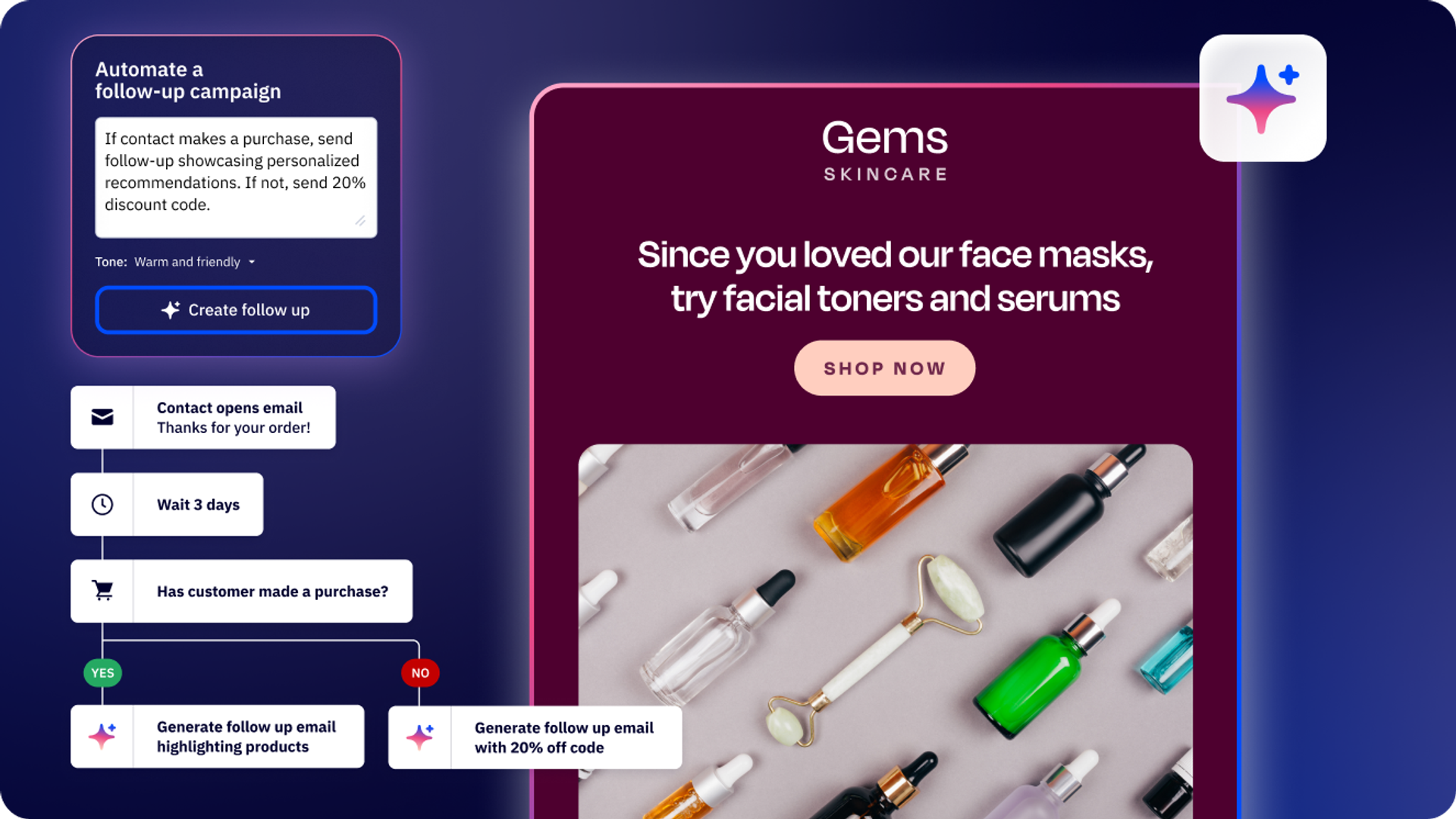
The cycle begins with a prompt. Instead of opening five different tools and configuring each one separately, orchestrated agents take a single input. Agentic marketing platforms typically allow marketers to describe a goal in plain language. The orchestration layer will interpret that intent and assign it to the right agents.
A marketer could say "I want to launch a re-engagement sequence for contacts who haven't opened in 90 days,” and agents will be directed to generate content, select audiences, choose channels, set timing, and assemble the complete campaign as one coordinated sequence.
This compresses what used to be days of manual work into minutes. Each agent's output flows directly into the next agent's input. There is no export, no copy-paste, no switching between tabs.
ActiveCampaign's Conversational Workspace takes a prompt and runs with it. The platform has 25+ AI agents that handle everything autonomously. AI Campaign Builder and AI Automation Builder handle the content and configuration of multi-step, cross-channel workflows.
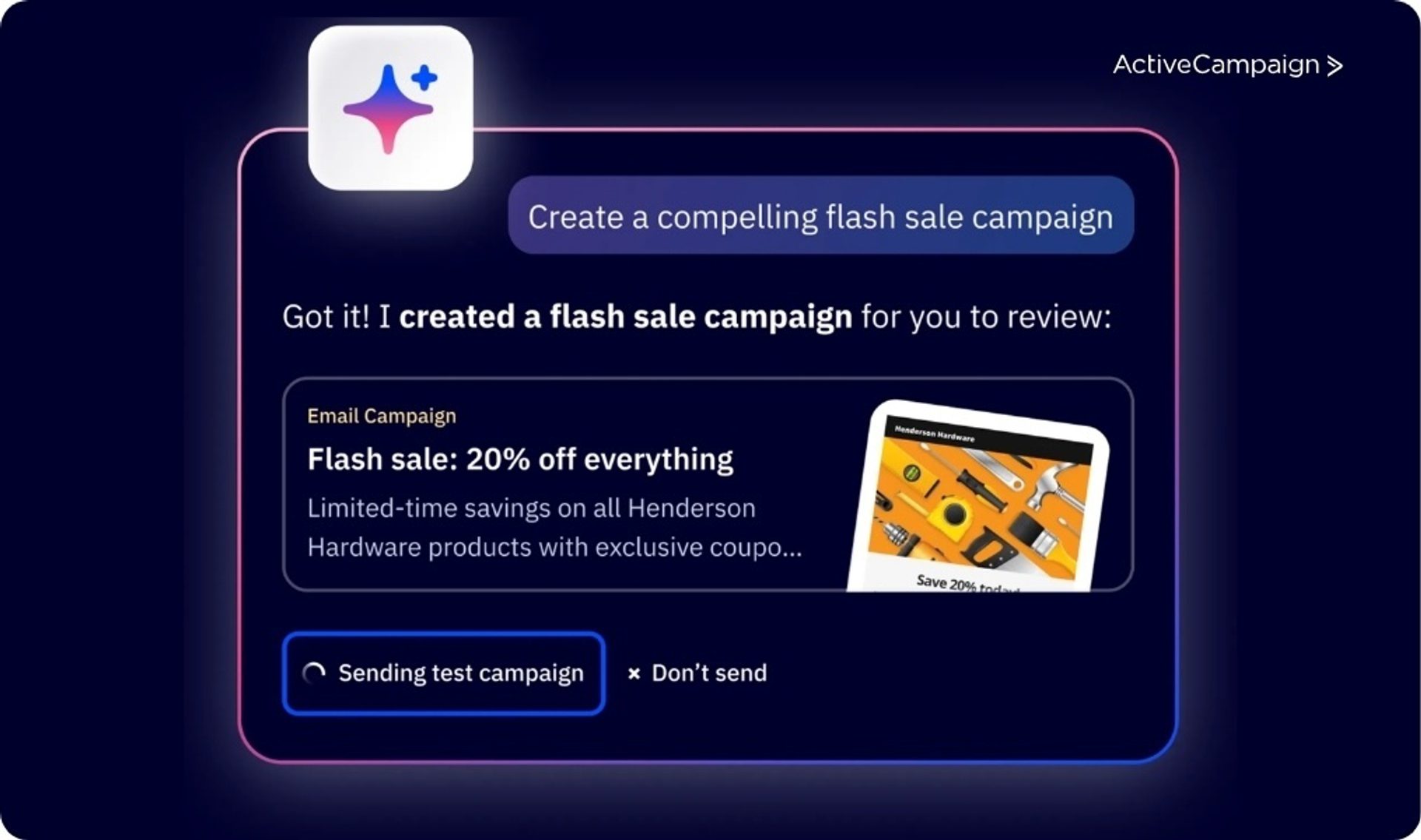
Triggers and actions span everything from email opens and website activity to contact field changes and app events, so the agents have a broad toolkit for adaptive automations. Workflows reflect the full complexity of how contacts actually behave, not just the signals a marketer thought to account for upfront. All of this is assembled in the background while the marketer moves on to something else.
2. Agents surface the right audience and the right timing
While a campaign is being built, AI agent orchestration is also busy making sure it will be distributed to relevant customers. Audience agents continuously analyze behavioral and transactional data to surface the right audience for the campaign.
ActiveCampaign’s AI segmentation reflects what contacts are doing right now, not who they were when they first entered the database. Those segments feed back into the campaign itself, shaping personalized messaging and structure before anything gets sent.
When messages are ready for send, timing agents work through engagement history to identify the best times for distribution. ActiveCampaign’s Predictive Sending optimizes delivery timing per contact, rather than applying a single send window to the entire list. Each customer receives the message at the moment they’re most likely to act.
3. Performance agents optimize live campaigns
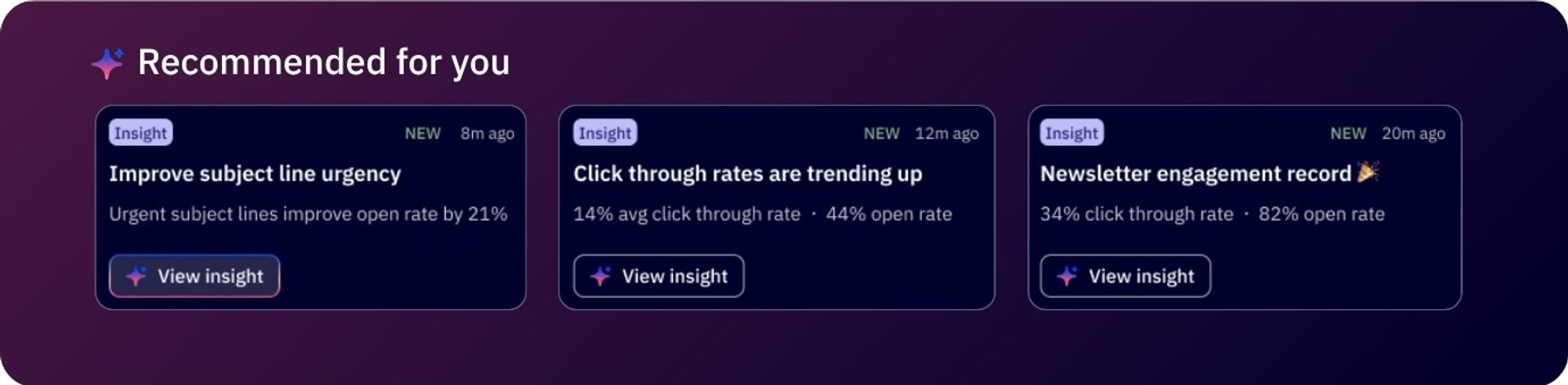
The cycle does not end at send. Once campaigns are live, optimization agents monitor performance, tracking engagement, conversions, and revenue contribution to ensure the system is successful. AI agents can then flag where the campaign is underperforming before the marketer thinks to check. There’s no need to wait for reports to be pulled or dashboards to be interpreted.
Next, agents proactively recommend or execute adjustments. Because they draw from the same shared data as every other agent in the system, their recommendations account for how a contact has behaved across every touchpoint, not just how they responded to a single email.
ActiveCampaign's campaigns are continuously measured against defined Business Goals. They keep marketing objectives aligned with the metrics that you have specifically said matter. Autonomous Insights are tethered to these goals, highlighting which segments are underperforming, which campaigns need adjustment, and where untapped opportunities exist. Optimization recommendations can be actioned in a click.
Foundations of high-performance AI marketing orchestration
For AI agent orchestration platforms to deliver high-quality workflows, two foundations must be in place: unified data that every agent can access and human oversight at the decisions that matter most.
Fragmented data is the most common reason orchestration fails. When one tool tracks email engagement, another tracks SMS, and a third holds CRM fields, agents make conflicting decisions. They see different versions of the same customer.
Every agent should read from and write to the same customer record, so decisions made by one agent are immediately visible to every other agent in the workflow. Unified data does not just improve agent decisions. It creates an audit trail. Marketers get a single view of what every agent has done, decided, and handed off, so reviews and approvals are based on full context rather than partial information.
ActiveCampaign provides a native sales CRM and 1,000+ integrations that ensure agents always operate from the full customer and pipeline context. The MCP Server extends that shared data layer to external AI tools like Claude and ChatGPT, so nothing falls out of sync even when workflows span tools outside the platform.
AI agent orchestration automates execution, not judgment. Marketers should retain control over:
- Brand-sensitive decisions
- Budget thresholds
- High-stakes customer interactions
- Strategic direction
An effective orchestration platform provides review checkpoints so marketers can approve before high-impact actions go live.
ActiveCampaign's agents execute tasks autonomously, but safeguards including AI Brand Kit and Custom Instructions apply account-wide guidelines that align the AI agent orchestration layer with your business, brand, audience, and communication style. That way, humans remain at the center of strategy while agents handle the volume.
ActiveCampaign: purpose-built for AI agent orchestration at scale
AI agent orchestration works best when the agents, channels, and data all operate from the same system. Stitching it together across multiple tools reintroduces exactly the coordination overhead it's designed to eliminate: context gets lost between platforms, handoffs require manual intervention, and the intelligence each agent builds stays trapped in its own environment.
ActiveCampaign is a single platform built for AI agent orchestration and autonomous marketing across all of your channels. It is not a collection of AI features bolted onto a legacy tool. Instead, the Active Intelligence engine runs a coordinated system where specialized agents work together across the full campaign lifecycle.
There is a single interface for the entire system. AI agent orchestration is seamless across strategy, execution, optimization, and analysis. There's no switching between tools, no reformatting outputs, no manually carrying context from one platform to the next.
Every agent works from the full customer picture. Because all agents draw from the same unified data layer, decisions made by any agent are immediately available to every other.
External tools become part of the system. Integrations, third-party apps, external AI tools, and custom workflows plug into the same automation logic and customer record, so the orchestration layer extends to the tools your team already uses.
Intelligence compounds with every campaign. Orchestrated systems learn. Active Intelligence analyzes billions of data points from customer interactions and each campaign adds to the data agents draws from, so targeting gets sharper over time.
The marketer becomes a director, not a builder. Time shifts from campaign assembly to strategy and creative thinking. ActiveCampaign customers report saving an average of 10 hours per week on intensive manual tasks.
I shifted from being an executor to a strategic advisor.” — Luis Fer, Parrish Law “I feel like the AI tools are my creative partners.

Learn more about ActiveCampaign’s AI agents in this interactive tour.
Ready to stop being the middleman? Start your 14-day free trial with ActiveCampaign and watch AI agent orchestration take it from here.
FAQs
How does AI agent orchestration differ from marketing automation?
Marketing automation follows predefined rules: if a contact does X, then do Y. AI agent orchestration adds a coordination layer where specialized agents make dynamic decisions based on real-time signals and shared context. The workflow adapts to what is actually happening rather than following a fixed path.
What should a marketer look for in an AI agent orchestration platform?
The most important factors in an AI agent orchestration platform for marketers are a unified data layer so every agent works from the same customer information, specialized agents that cover the full campaign lifecycle, and built-in human review checkpoints. The most powerful platforms like ActiveCampaign also support cross-channel coordination from a single workflow rather than requiring separate setups per channel.
Can AI agent orchestration work with existing marketing tools?
Yes, AI agent orchestration platforms like ActiveCampaign connect with existing tools through integrations and protocols like the MCP Server. External AI tools, CRMs, e‑commerce platforms, and other marketing apps can feed data into the same orchestration layer, extending the system rather than replacing the entire stack.
What role does shared customer data play in AI agent orchestration?
Shared customer data is the foundation that makes AI agent orchestration possible. When every agent accesses the same behavioral, transactional, and engagement data, decisions stay coordinated across channels and lifecycle stages. Without it, agents make conflicting choices based on incomplete information, producing the fragmented experiences that orchestration is designed to eliminate.